Procurement category management connects the strategic activities required to manage an organization’s external spend by category over time. It spans category taxonomy and portfolio architecture, spend analysis, demand and specification management, supply market intelligence, category strategy development, stakeholder governance, opportunity pipeline management, supplier portfolio management, value tracking, and category performance reporting.
Procurement category management focuses on how enterprises organize spend, understand supply markets and business requirements, define sourcing and supplier strategies, build opportunity pipelines, and govern category value across the strategic lifecycle.
For CPOs and category management leaders, the function sits between procurement data and sourcing execution. Category teams consume classified spend information, combine it with demand, supplier, contract, market, cost, risk, ESG, and stakeholder information, and use that evidence to determine where procurement should focus. Classification standards such as the United Nations Standard Products and Services Code (UNSPSC) [1] provide a common structure for organizing products and services and supporting spend analysis.
The resulting category strategy can influence supplier consolidation, specification rationalization, demand management, indexed pricing, value analysis/value engineering (VAVE), low-cost-country sourcing, payment terms, risk mitigation, sustainability requirements, and the sequencing of future sourcing initiatives. Portfolio approaches such as the Kraljic framework [2] provide a widely used basis for assessing purchasing categories and supply-market exposure when developing these strategies.
Because category management depends on continuously interpreting spend data, supplier information, market signals, risk indicators, and stakeholder requirements, it is increasingly becoming a practical area for AI adoption. AI can help category teams refresh baselines, monitor external market movements, identify opportunity patterns, draft strategy materials, and prepare decision packets for human review.
Deloitte’s 2025 Global Chief Procurement Officer Survey, which captured insights from more than 250 CPOs across 40 countries, found that leading procurement organizations achieved approximately three times greater returns on GenAI investments than their peers.[3] The survey also highlights increasing investment in digital procurement and AI as CPOs respond to supply disruption, regulatory demands, cost pressure, and rising expectations for strategic decision support.
Category management is well suited to AI because much of the work requires bringing together fragmented evidence and repeatedly reevaluating it as business and market conditions change. A category manager may compare spend baselines, supplier risks, market indices, demand, and ESG requirements before updating the category strategy. A procurement analyst may need to separate addressable from non-addressable spend and investigate classification exceptions. A supply market intelligence analyst may need to interpret commodity movements, supplier capacity announcements, financial distress indicators, regulation, and geopolitical developments.
AI can reduce the preparation and analysis burden behind these activities. Classification models can identify taxonomy and spend-classification exceptions. Document intelligence can extract information from category playbooks, contracts, supplier assessments, market reports, and policy documents. Predictive and anomaly analysis can identify unusual demand, price, supplier-risk, and savings patterns. Retrieval-based analysis can bring together approved frameworks, savings methodologies, ESG commitments, and regulatory requirements. Recommendation models can prepare category levers, supplier segmentation proposals, opportunity priorities, and scenario comparisons for professional review.
For CPOs, category directors, and procurement transformation leaders, the opportunity is not to replace category managers or allow AI to determine procurement strategy independently. It is to extend the value of existing spend analytics, ERP, CLM, SRM, supplier-risk, market-intelligence, and benefits-tracking investments by reducing the manual work required to assemble evidence, compare alternatives, maintain category artifacts, identify exceptions, and prepare decisions.
The operating boundary is equally important. AI can analyze data, identify patterns, draft recommendations, and prioritize opportunities, while procurement professionals retain decision authority. Category managers own strategy and commercial direction, finance partners validate savings, and business stakeholders approve demand or specification changes. AI can support supplier segmentation and sourcing opportunity analysis, but it should not independently approve supplier status, commit savings, negotiate, select suppliers, or award business.
The boundaries with adjacent procurement disciplines should remain explicit. Category management uses established spend data as an input; it does not build or maintain the underlying data infrastructure. Detailed spend ingestion, cleansing, classification engineering, and transaction-level compliance belong to spend management. Similarly, category management identifies, sizes, prioritizes, and governs sourcing opportunities, but RFP and RFQ creation, supplier bidding, negotiation, auction execution, supplier selection, and contracting belong to strategic sourcing. Source-to-pay transaction processing and intake workflows are outside the scope of this article.
For this reason, organizations should map AI opportunities across the complete procurement category management operating model. Rather than defining broad use cases such as “AI for category strategy” or “AI for market intelligence,” they should focus on specific sub-processes with clear inputs, source systems, frameworks, outputs, exception conditions, accountable reviewers, and human approval boundaries.
This process-level approach helps procurement leaders distinguish an interesting AI concept from an implementable workflow. It also makes it possible to evaluate data readiness, integration requirements, operational impact, governance requirements, and the point at which AI output must return to a category manager, finance business partner, category director, or CPO for judgment and approval.
- How AI is transforming procurement category management
- Procurement category management operating model and AI opportunity mapping across the category management processes
- High-value AI use cases in procurement category management
- How agentic AI works in procurement category management workflows
- How to prioritize AI use cases in procurement category management
- Governance, risk, and responsible AI in procurement category management
- How ZBrain operationalizes AI use cases in procurement category management
- Future of AI in procurement category management
How AI is transforming procurement category management
AI changes category management work by analyzing category artifacts before a specialist begins review, connecting information distributed across procurement and enterprise systems, and preparing the evidence required for strategic decisions. The opportunity is strongest where work requires repeated analysis of spend, demand, supplier, market, cost, risk, and performance information but still depends on commercial judgment.
-
Classification-heavy work: Category trees, UNSPSC or custom taxonomy mappings, spend cube extracts, and supplier records can be analyzed to identify possible classification errors, fragmented category structures, cross-category dependencies, and records requiring analyst or category manager review.
-
Analysis-heavy work: Addressable-spend baselines, price-volume-mix analyses, unit-cost histories, demand patterns, specification data, supplier concentration, and contract expiries can be evaluated together to identify cost drivers, baseline movements, demand changes, and possible category opportunities.
-
Market-intelligence-heavy work: Commodity indices, input-cost data, freight indices, supplier financial information, capacity changes, M&A activity, geopolitical developments, and regulatory signals can be synthesized into category-specific market intelligence and compared with supplier pricing and category assumptions.
-
Strategy-heavy work: Kraljic assessments, supplier-preferencing analyses, demand records, should-cost models, market intelligence, category playbooks, ESG objectives, and existing roadmaps can be brought together to prepare strategic options and supporting evidence for category manager review.
-
Opportunity-heavy work: Opportunity matrices, contract expiry radars, category roadmaps, and savings pipeline registers can be analyzed to identify, size, prioritize, and sequence potential initiatives before approved opportunities are handed to strategic sourcing for execution.
-
Supplier-portfolio-heavy work: Supplier segmentation records, preferred supplier lists, performance scorecards, risk assessments, ESG data, and innovation objectives can be compared to identify concentration, rationalization opportunities, changing supplier importance, and potential portfolio risks.
-
Governance-heavy work: Category playbooks, category council materials, stakeholder maps, annual plans, decision logs, and scorecards can be monitored for changes, missing decisions, outdated assumptions, and upcoming governance requirements.
-
Value-tracking-heavy work: Savings pipeline records, approved baselines, implementation evidence, budget information, and the finance-signed savings glossary can be compared to identify stage-gate exceptions, unsupported benefit classifications, and savings requiring Finance Business Partner review.
AI therefore does more than generate category strategy documents. It can perform document intelligence, classification, anomaly detection, predictive analysis, entity extraction, market-signal synthesis, framework and policy retrieval, scenario simulation, recommendation generation, natural-language drafting, and workflow coordination.
The value comes from applying these capabilities to a specific category-management artifact and a clearly bounded task.
Build governed AI workflows across category management
Scale governed AI across category management functions and processes while maintaining human accountability for commercial, financial, and sourcing decisions.
Procurement category management operating model and AI opportunity mapping across the category management processes
Procurement category management spans interconnected activities that begin with defining how enterprise spend is organized and continue through category strategy development, opportunity identification, supplier portfolio management, value tracking, and ongoing category governance. Each function depends on upstream information, downstream decisions, and multiple procurement and enterprise systems, making it difficult to identify AI opportunities without understanding the complete operating model.
The following operating model maps procurement category management activities across foundational operations, strategy formulation, execution-adjacent operations, and governance and sustaining operations. Each function is decomposed into its underlying processes and sub-processes to identify where AI can support specific activities using defined artifacts, systems, frameworks, exception categories, and human review boundaries.
For each function, the analysis identifies:
-
The teams responsible for the work
-
Where AI capabilities such as classification, document intelligence, anomaly detection, predictive analysis, retrieval-based analysis, scenario simulation, and natural-language generation can support specific activities
-
Which strategic, commercial, supplier, and financial decisions remain with procurement, finance, and business stakeholders
-
The artifacts, systems, frameworks, regulations, and controls that shape implementation
The goal is not to automate category management end to end. It is to identify practical, governed AI opportunities that improve how category teams analyze information, prepare strategies, identify opportunities, track value, and manage category decisions while maintaining human accountability for commercial and financial outcomes.
A. Foundational operations
Function 1: Category taxonomy and portfolio structuring
Turning enterprise purchasing activity into a governed category structure with consistent classification, clear category ownership, and defined relationships between categories.
Category taxonomy and portfolio structuring establish the structural foundation for category management. The function defines how goods and services are grouped, how enterprise-specific category structures align with standards such as UNSPSC, how category ownership is assigned, and how dependencies between categories are represented.
Teams involved: Category managers, category directors, procurement analysts or spend analysts, procurement excellence or transformation teams, procurement data and analytics teams, and relevant business stakeholders.
What AI helps with: Classification models can compare supplier, purchase, GL, PO, and category descriptions with approved taxonomy definitions to identify possible mappings and inconsistencies. Semantic analysis can detect overlapping or ambiguous category definitions. Clustering and portfolio analysis can identify fragmented category structures, cross-category dependencies, and unusual category-manager spans of control. Change-detection capabilities can compare new taxonomy versions with existing structures and prepare impact assessments.
What humans continue to own: Procurement leaders define the category architecture, approve taxonomy changes, determine category ownership, resolve strategically ambiguous category boundaries, and decide how categories should be grouped for management purposes. AI classifies, compares, detects, and recommends but does not independently restructure the procurement organization or approve a new category taxonomy.
| Process | Sub-process | AI-enabled opportunities |
|---|---|---|
| Category taxonomy design and maintenance | Category tree design and hierarchy review |
|
| UNSPSC or custom taxonomy alignment |
|
|
| Category taxonomy governance | Taxonomy exception identification |
|
| Taxonomy change impact assessment |
|
|
| Category ownership and span-of-control management | Category-to-manager assignment |
|
| Span-of-control review |
|
|
| Cross-category spend and supplier dependency mapping | Cross-category dependency mapping |
|
| Category boundary and ownership exception review |
|
Key artifacts
-
Category taxonomy or category tree
-
UNSPSC/custom taxonomy mapping
-
Category definition and mapping rules
-
Category ownership matrix
-
Category-to-manager assignment records
-
Cross-category dependency map
-
Taxonomy exception log
-
Taxonomy change and approval records
Systems involved
-
Spend analytics platforms
-
Procurement analytics platforms
-
ERP systems
-
Supplier master or master data platforms
-
Procurement data repositories
-
Taxonomy and classification repositories
-
Category management workspaces
Regulatory and framework considerations
-
UNSPSC can provide the external classification reference used to align or validate enterprise category taxonomies.
-
GDPR applies where taxonomy, supplier, or category-management datasets process personal data relating to identifiable individuals; access and processing should therefore follow applicable data-protection controls.
-
Internal data-governance and change-control requirements should define who can alter production taxonomy mappings and how changes are documented.
-
Taxonomy changes that affect spend baselines or downstream performance reporting should retain traceable mapping and approval history.
Accountable roles
-
Category director/head of category management
-
Category manager
-
Procurement analyst / spend analyst
-
Procurement excellence/transformation lead
-
Procurement data or analytics owner
-
Chief procurement officer for material category-architecture changes
Highest-value opportunities
-
Taxonomy mapping and exception detection: High value because inconsistent classification can distort category baselines, supplier concentration, market analysis, opportunity sizing, and performance reporting downstream.
-
Cross-category dependency mapping: Valuable because shared suppliers, materials, specifications, and commodities can create dependencies that are difficult to identify from a hierarchical taxonomy alone.
-
Category portfolio balancing: Valuable because category complexity varies substantially; AI-supported portfolio analysis can reveal ownership structures where spend, supplier count, risk, or workload is concentrated disproportionately.
-
Taxonomy change impact analysis: High leverage because category-tree changes can affect historical baselines, dashboards, opportunity pipelines, category plans, and manager ownership simultaneously.
Example agentic workflow: Category taxonomy maintenance and portfolio review
- The workflow begins with the current category taxonomy, taxonomy mapping table, category ownership matrix, and classification exception log.
- The agent analyzes the latest classified spend cube and identifies recurring low-confidence mappings, overlapping category definitions, new supplier or item clusters, and cross-category relationships.
- It retrieves the approved internal classification rules and relevant UNSPSC hierarchy information.
- The agent prepares a proposed taxonomy-change packet showing affected categories, spend, suppliers, historical mappings, downstream reports, and alternative ownership options.
- The procurement analyst validates classification evidence, the relevant category managers resolve ambiguous boundaries, and the category director approves material taxonomy or ownership changes.
- After approval, the updated taxonomy and mapping rules are published through the governed category-management process, while the change rationale, affected records, approvals, and previous mappings are retained for traceability.
Function 2: Spend analysis and baseline construction
Turning classified procurement spend into a category-level analytical baseline that defines addressable spend, cost structure, supplier exposure, and the starting point for category strategy and value assessment.
Spend analysis provides the quantitative foundation for category strategy. Category management consumes the refreshed spend cube produced by the upstream spend-management and data environment and evaluates it from a category perspective. The function reviews classification quality, determines which spend is realistically addressable, establishes unit-cost and volume baselines, and separates price, volume, and mix effects so category managers can understand what is driving category economics.
This function does not build the spend cube. Data ingestion, cleansing, normalization, supplier-master harmonization, and the underlying classification pipeline belong to spend management. Category management consumes that output and turns it into an approved strategic baseline.
Teams involved: Category managers, procurement analysts or spend analysts, category directors, finance business partners, procurement excellence teams, procurement analytics teams, and relevant budget owners or functional stakeholders.
What AI helps with: Classification and anomaly-detection can identify questionable category assignments and unusual spend records within the supplied spend cube. Rules-based and retrieval-grounded analysis can distinguish potentially addressable from non-addressable spend using approved business definitions. Calculation and analytical models can normalize quantities and units, construct cost baselines, perform price-volume-mix decomposition, and identify unexplained changes requiring investigation.
What humans continue to own: Procurement analysts validate data and classification exceptions. Category managers determine whether spend is strategically addressable and approve category assumptions. Business stakeholders validate demand and operational constraints. Finance business partners validate financial baselines which they will subsequently support for savings or benefits reporting. AI analyzes and prepares the baseline but does not independently certify spend as addressable or approve a savings baseline.
| Process | Sub-process | AI-enabled opportunities |
|---|---|---|
| Spend cube consumption and quality review | Refreshed spend cube intake |
|
| Classification confidence review |
|
|
| Classification exception investigation |
|
|
| Addressable spend determination | Addressable versus non-addressable spend classification |
|
| Exclusion and constraint analysis |
|
|
| Baseline construction | Quantity and unit normalization |
|
| Unit-cost baseline development |
|
|
| Cost-driver analysis | Price-volume-mix decomposition |
|
| Cost-driver analysis | Baseline variance investigation |
|
Key artifacts
-
Spend cube extract
-
Spend classification confidence report
-
Classification exception log
-
Addressable spend baseline workbook
-
Addressable/non-addressable spend rules
-
Unit-cost baseline
-
Price-volume-mix analysis
-
Baseline assumptions and exclusions
-
Category spend summary
Systems involved
-
Spend analytics platform
-
ERP systems
-
Procurement analytics platform
-
Data warehouse or procurement data lake
-
Supplier master data
-
Contract repository or CLM for committed-spend context
-
Finance planning and reporting systems where baseline validation is required
Regulatory and framework considerations
-
UNSPSC or approved custom taxonomy provides the classification structure against which category-level spend can be reviewed.
-
SOX-related financial controls become relevant where category baselines and subsequent savings calculations feed financial reporting, management attestations, or controlled benefits reporting. The Sarbanes-Oxley framework [4] places emphasis on financial reporting controls and accountability within covered organizations.
-
GDPR applies where underlying supplier or transaction datasets contain personal data and those data are processed within analytics workflows.
-
Baseline calculations should retain source-data lineage, assumptions, exclusions, methodology versions, and reviewer approvals where they later support savings claims.
Accountable roles
-
Procurement analyst/spend analyst
-
Category manager
-
Category director/head of category management
-
Finance business partner
-
Budget owner/functional stakeholder
-
Procurement excellence/transformation lead
Highest-value opportunities
-
Classification confidence and exception review: High value because category strategies built on incorrectly classified spend can distort supplier concentration, addressable spend, opportunity sizing, and reported category performance.
-
Addressable spend determination: High leverage because it establishes the realistic economic scope of the category and prevents opportunity estimates from being calculated against spend that procurement cannot influence.
-
Price-volume-mix decomposition: Valuable because changes in total spend alone do not show whether cost movement resulted from supplier pricing, business demand, or changes in purchased specifications and mix.
-
Unit-cost baseline preparation: High value because a reliable baseline is required for should-cost analysis, market comparisons, opportunity sizing, and later benefits validation.
-
Baseline exception detection: Valuable because unusual transactions, one-time purchases, unit-of-measure issues, and structural changes can materially distort the reference point used in category decisions.
Example agentic workflow: Category spend baseline and addressability review
- The workflow begins when a refreshed, classified spend cube is made available to the category team together with the existing taxonomy, previous baseline, and classification confidence report.
- The agent profiles category spend by supplier, business unit, geography, period, item or service family, and other relevant dimensions and identifies unusual movements or low-confidence classifications.
- It retrieves the approved taxonomy rules, addressable-spend definitions, baseline methodology, known exclusions, and relevant contract commitments.
- The agent prepares a draft addressable-spend baseline, normalizes comparable units where appropriate, performs price-volume-mix decomposition, and separates unresolved classification, exclusion, and baseline issues into an exception queue.
- The procurement analyst validates data and classification issues; the category manager confirms addressability and category assumptions; business stakeholders validate material demand constraints; and the finance business partner reviews the baseline where it will support governed savings measurement.
- The approved baseline, assumptions, exclusions, exception resolutions, and data lineage are retained as category artifacts and become inputs to demand analysis, supply market intelligence, category strategy development, opportunity sizing, and later value tracking.
B.Strategy formulation operations
Function 3: Demand and specification management
Turning business demand, consumption patterns, specifications, and purchasing policies into category-level opportunities for demand reduction, standardization, and specification optimization.
Demand and specification management examines why the organization buys what it buys, not only what it pays. The function connects category spend with business demand, consumption drivers, SKU or service specifications, operating requirements, and procurement policies to identify opportunities that may not be visible through price analysis alone.
Teams involved: Category managers, procurement analysts, budget owners and functional stakeholders, operations leaders, engineering or product teams for direct categories, finance business partners, sustainability or ESG teams, and procurement excellence.
What AI helps with: Pattern analysis can identify unusual consumption, demand fragmentation, SKU proliferation, and differences between business units or sites. Similarity analysis can identify materially comparable specifications or SKUs. Retrieval-based analysis can compare purchasing behavior with approved policies. Scenario analysis can estimate the potential operational and financial effect of specification, demand, or policy changes.
What humans continue to own: Business stakeholders determine legitimate operating requirements. Engineering, operations, IT, marketing, or other functional owners approve specification changes. Category managers determine which demand levers belong in the category strategy. AI identifies patterns and prepares alternatives but does not independently restrict demand, change specifications, or impose purchasing policies.
| Process | Sub-process | AI-enabled opportunities |
|---|---|---|
| Demand analysis | Demand pattern analysis |
|
| Consumption driver mapping |
|
|
| Demand variance investigation |
|
|
| Specification management | Specification comparison |
|
| SKU or service rationalization |
|
|
| Over-specification identification |
|
|
| Policy management | Policy compliance pattern analysis |
|
| Policy lever opportunity assessment |
|
Key artifacts
-
Demand analysis workbook
-
Consumption driver map
-
Specification and SKU inventory
-
Specification comparison matrix
-
SKU rationalization assessment
-
Category policy documents
-
Demand-management opportunity register
-
Addressable spend baseline
-
Category playbook
Systems involved
-
Spend analytics platform
-
ERP systems
-
Procurement analytics platforms
-
Product lifecycle management systems for applicable direct categories
-
Catalog systems
-
Inventory or asset-management systems
-
Travel, print, IT, facilities, or other category-specific operational systems
-
Business planning and forecasting platforms
Regulatory and framework considerations
-
ISO 20400 sustainability considerations can be incorporated into specification and demand decisions where reduced consumption, product substitution, lifecycle impact, or responsible purchasing requirements are relevant.
-
GDPR emphasizes that personal data should be minimized when employee-level purchasing or usage information is analyzed.
-
Functional, safety, engineering, quality, regulatory, and operational specifications remain authoritative constraints for relevant direct and regulated categories.
-
AI-generated rationalization opportunities should not override approved technical requirements.
Accountable roles
-
Category manager
-
Budget owner/functional stakeholder
-
Procurement analyst / spend analyst
-
Engineering or operations representative where applicable
-
Finance business partner
-
Sustainability / ESG manager
-
Category director
Highest-value opportunities
-
Consumption driver analysis: High value because it separates legitimate business-driven demand growth from potentially controllable consumption.
-
SKU and specification rationalization: High leverage where fragmentation reduces buying power, creates supplier complexity, or increases inventory and operational cost.
-
Over-specification analysis: Valuable because category savings may come from changing what is bought rather than negotiating a lower price for the same requirement.
-
Policy-lever analysis: Valuable in indirect categories where travel, print, IT, facilities, catalog, and service policies materially influence demand.
Example agentic workflow: Specification and demand rationalization
- The workflow begins with the approved category spend baseline, quantity history, specification or SKU records, and applicable purchasing policies.
- The agent analyzes consumption by business unit, site, SKU, supplier, and relevant operational driver.
- It groups similar specifications, identifies low-volume variants and potential over-specification, and retrieves applicable policy constraints.
- The agent prepares a rationalization packet showing candidate changes, current spend, demand volumes, affected stakeholders, and indicative value ranges.
- The category manager reviews the commercial opportunity, while the appropriate functional, engineering, or operational owner determines whether specification or policy changes are acceptable.
- Approved opportunities are incorporated into the category strategy and opportunity pipeline with the business decision and supporting evidence retained.
Function 4: Supply market intelligence
Turning external commodity, supplier, economic, regulatory, and geopolitical information into category-specific market insight and cost-driver evidence.
Supply market intelligence helps category teams understand the external forces influencing supplier economics, capacity, competition, risk, and category cost. It combines market-data feeds, supplier information, public disclosures, commodity indices, regulatory developments, and internal category information to provide a structured view of market conditions.
Teams involved: Supply market intelligence analysts, category managers, procurement analysts, supplier risk teams, sustainability / ESG managers, category directors, strategic sourcing managers, and relevant finance or operations stakeholders.
What AI helps with: Retrieval and signal-detection capabilities can monitor commodity indices, supplier announcements, public filings, capacity changes, M&A activity, financial-risk signals, freight movements, regulatory updates, and geopolitical developments. Time-series analysis can compare external indices with paid prices. Document intelligence can convert large volumes of market information into category-specific briefs. Scenario analysis can estimate potential cost or supply implications.
What humans continue to own: Category managers determine whether external market signals are commercially relevant. Supply market intelligence analysts validate sources and interpretation. Legal and compliance teams determine regulatory implications. AI gathers, compares, detects, and summarizes but does not independently establish a supplier negotiation position or make sourcing decisions.
| Process | Sub-process | AI-enabled opportunities |
|---|---|---|
| Commodity and input-cost intelligence | Commodity index monitoring |
|
| Freight and logistics index monitoring |
|
|
| Price intelligence | Index-versus-paid-price analysis |
|
| Indexation-clause analysis |
|
|
| Supplier landscape intelligence | M&A and ownership monitoring |
|
| Capacity and entry/exit monitoring |
|
|
| Financial distress monitoring |
|
|
| Regulatory intelligence | Regulatory horizon scanning |
|
| Geopolitical intelligence | Geographic exposure analysis |
|
| Should-cost intelligence | Cost-driver model maintenance |
|
Key artifacts
-
Commodity index tracker
-
PPI and category-specific market series
-
Supplier landscape brief
-
Market intelligence report
-
Regulatory horizon-scanning report
-
Supplier risk assessment
-
Geopolitical exposure map
-
Index-versus-paid-price analysis
-
Should-cost model library
-
Category risk register
Systems involved
-
Market intelligence platforms
-
Commodity-data services
-
Supplier risk platforms
-
SRM platforms
-
CLM or contract repositories
-
ERP and spend analytics systems
-
Trade and regulatory information sources
-
News and public-disclosure sources
Regulatory and framework considerations
-
Antitrust and competition rules require market intelligence gathering to use appropriate sources and controls. Current or competitively sensitive information exchanged among competitors can raise antitrust concerns, so category teams should distinguish legitimate market research from prohibited information sharing.
-
UFLPA categories with relevant US import exposure may require supplier, product-origin, and traceability information as part of risk assessment.
-
Affected carbon-intensive imports under CBAM can introduce embedded emissions and sourcing considerations into category strategy.[5]
-
CSRD/ESRS for organizations within applicable scope, sustainability reporting requirements can create upstream supplier-data and value-chain information needs.[6]
-
ISO 20400 provides guidance for integrating sustainability considerations into procurement.[7]
Accountable roles
-
Supply market intelligence analyst
-
Category manager
-
Supplier risk lead
-
Sustainability / ESG manager
-
Category director
-
Legal / compliance where required
-
Chief procurement officer for material category-risk escalations
Highest-value opportunities
-
Index-versus-paid-price variance analysis: High value because it provides evidence for determining whether supplier pricing is moving consistently with relevant external cost drivers.
-
Supplier distress and capacity monitoring: High leverage for categories where supply continuity depends on a limited number of suppliers or production locations.
-
Regulatory horizon scanning: Important for categories exposed to trade, forced-labor, sustainability, carbon, or import requirements.
-
Should-cost model maintenance: Valuable because external cost-driver changes can be incorporated into structured category economics rather than reviewed manually and intermittently.
Example agentic workflow: Category market-intelligence refresh
- The workflow begins with the commodity index tracker, current category baseline, supplier list, contracts, and previous market intelligence brief.
- The agent retrieves approved market series, supplier disclosures, capacity developments, financial-risk signals, and relevant regulatory updates.
- It compares market indices with paid-price history and updates approved should-cost assumptions.
- Supplier concentration, financial deterioration, capacity changes, regulatory exposure, and significant price-index divergences are assembled into a category intelligence packet.
- The supply market intelligence analyst validates sources and interpretation, while the category manager determines which developments should affect category assumptions or strategy.
- Approved findings are incorporated into the category playbook, opportunity analysis, or category risk record.
Accelerate AI Solutions Development
Build fully functional solutions from your high-value use cases, based on specific operational needs and enterprise context.
Function 5: Category strategy development
Turning category baselines, demand analysis, supplier positioning, market intelligence, cost models, risk information, and stakeholder priorities into a governed category strategy and multi-year roadmap.
Category strategy development brings together the analytical work performed across the category-management lifecycle. The category manager assesses supply-market conditions, business needs, supplier positioning, cost drivers, risks, sustainability requirements, and value opportunities before selecting the levers that define the future direction of the category.
The Kraljic portfolio approach [8] is commonly used to consider purchasing importance and supply risk when shaping sourcing and supplier strategies.
Teams involved: Category managers, category directors, procurement analysts, supply market intelligence analysts, budget owners and functional stakeholders, strategic sourcing managers, finance business partners, sustainability / ESG managers, procurement excellence, and the CPO for material strategies.
What AI helps with: Multi-source analysis can combine category artifacts and identify changes since the previous strategy. Classification and recommendation models can prepare draft Kraljic or supplier-preferencing assessments. Scenario analysis can compare strategic levers. Natural-language generation can prepare category playbooks, executive summaries, and roadmaps from approved evidence.
What humans continue to own: Category managers determine the category strategy and select commercial levers. Functional stakeholders validate operational implications. Category directors and CPOs approve material strategic commitments. Finance validates savings assumptions. AI analyzes, simulates, and drafts but does not finalize sourcing direction or commit the organization to a supplier strategy.
| Process | Sub-process | AI-enabled opportunities |
|---|---|---|
| Portfolio positioning | Kraljic assessment |
|
| Supplier-preferencing analysis |
|
|
| Strategic diagnosis | Category issue and opportunity synthesis |
|
| Lever selection | Supplier consolidation assessment |
|
| LCC sourcing assessment |
|
|
| VAVE opportunity development |
|
|
| Demand-management lever selection |
|
|
| Commercial lever assessment |
|
|
| Strategy authoring | Category playbook drafting |
|
| Multi-year roadmap preparation |
|
Key artifacts
-
Kraljic matrix
-
Supplier-preferencing analysis report
-
Category strategy document / category playbook
-
Annual category plan
-
Multi-year roadmap
-
Demand and specification analysis report
-
Addressable spend baseline
-
Commodity index tracker
-
Should-cost models
-
Supplier risk assessments
-
ESG objectives
-
Opportunity assessment
Systems involved
-
Category management workspace
-
Spend analytics platform
-
SRM and supplier-risk platforms
-
Contract lifecycle management (CLM)
-
Market intelligence platforms
-
Benefits-tracking tools
-
ESG data systems
-
Collaboration and document-management systems
Regulatory and framework considerations
-
Kraljic framework supports structured portfolio analysis while final category positioning remains a management judgment.
-
ISO 20400 supports the incorporation of sustainability considerations into category objectives, specifications, supplier strategies, and lever selection.
-
UFLPA and CBAM may constrain sourcing options or change the risk and economic assessment for affected categories.
-
Applicable CSRD/ESRS sustainability and value-chain reporting requirements can influence supplier-data and category-governance requirements.
-
Strategic options involving market intelligence must remain consistent with applicable antitrust requirements.
Accountable roles
-
Category manager
-
Category director / head of category management
-
Chief procurement officer
-
Budget owner / functional stakeholder
-
Finance business partner
-
Supply market intelligence analyst
-
Sustainability / ESG manager
-
Strategic sourcing manager
Highest-value opportunities
-
Automated strategic diagnosis: High value because category evidence often resides across multiple systems and documents that must otherwise be manually reconciled.
-
Kraljic and supplier-preferencing preparation: Valuable because AI can structure evidence while preserving the professional judgment required for final positioning.
-
Lever scenario analysis: High leverage because different combinations of consolidation, VAVE, demand management, geographic sourcing, and commercial changes can produce materially different risk and value profiles.
-
Category playbook drafting: Valuable because AI can reduce document-preparation effort while linking major recommendations to source evidence.
-
Roadmap sequencing: High value where contract timing, business dependencies, resource constraints, and implementation readiness affect when opportunities can realistically be pursued.
Example agentic workflow: Annual category strategy refresh
- The annual category-plan cycle opens for the packaging category and creates a strategy-refresh task with the previous category playbook attached.
- The agent consumes the refreshed spend cube and baseline, retrieves contract-expiry information from the CLM, supplier scorecards and risk ratings from the SRM environment, and the approved resin and containerboard market-index history.
- It retrieves the finance-signed savings glossary, category strategy template, previous decisions, and corporate sustainability commitments such as recycled-content targets.
- The agent prepares a refreshed strategic decision packet containing updated Kraljic positioning, supplier and market developments, index-versus-paid-price analysis, proposed strategic levers, sized opportunities, and a draft multi-year sourcing-wave calendar.
- The category manager edits and approves the proposed strategy. The category director reviews pipeline commitments and escalates disputed benefit assumptions to finance. Functional stakeholders validate operational changes, and the CPO or designated category council approves material strategic direction.
- Following approval, the category playbook and roadmap are published to the governed workspace. Approved sourcing opportunities move to the sourcing pipeline, while assumptions, source evidence, approvals, and baseline lineage are retained for later governance and benefits review.
C. Governance and sustaining operations
Function 6: Stakeholder alignment and governance
Turning category strategy into an agreed business direction through stakeholder engagement, category councils, defined decision rights, formal approvals, and periodic strategy review.
Category strategies often affect budgets, specifications, supplier relationships, operating models, and business policies outside procurement. Stakeholder governance therefore provides the mechanism through which category assumptions, trade-offs, opportunities, risks, and commitments are reviewed and approved.
Teams involved: Category managers, category directors, CPO, budget owners and functional stakeholders, finance business partners, strategic sourcing managers, sustainability / ESG representatives, procurement excellence, and relevant operations or engineering leaders.
What AI helps with: Entity and relationship analysis can maintain stakeholder maps. Retrieval can identify previous category decisions, unresolved actions, and approval requirements. Natural-language generation can prepare council decks, decision summaries, meeting briefs, and engagement plans. Workflow monitoring can track actions, approvals, and refresh deadlines.
What humans continue to own: Stakeholders make business decisions and approve changes affecting their functions. Category directors and CPOs approve procurement commitments within delegated authority. Finance validates financial assumptions. AI prepares governance information but does not provide organizational approval.
| Process | Sub-process | AI-enabled opportunities |
|---|---|---|
| Stakeholder management | Stakeholder identification and mapping |
|
| Engagement-plan preparation |
|
|
| Category governance | Category council preparation |
|
| Decision logging |
|
|
| Strategy approval | Strategy sign-off coordination |
|
| Strategy maintenance | Annual refresh-cycle management |
|
Key artifacts
-
Stakeholder map
-
RACI or engagement plan
-
Category council deck
-
Category decision log
-
Category strategy / playbook
-
Annual category plan
-
Approval records
-
Category governance calendar
Systems involved
-
Category management workspace
-
Collaboration platforms
-
Project or portfolio-management systems
-
Document repositories
-
Benefits-tracking tools
-
SRM and risk systems
-
Finance planning systems
Regulatory and framework considerations
-
SOX-related controls are relevant where category governance includes approval of savings commitments or figures used in controlled financial reporting.
-
GDPR requires stakeholder records containing personal data to follow applicable access, retention, and data-protection requirements.
-
Governance workflows should preserve segregation of duties where financial benefits, supplier decisions, or material commitments require different approvers.
Accountable roles
-
Category manager
-
Category director
-
Chief procurement officer
-
Finance business partner
-
Budget owner / functional stakeholder
-
Procurement excellence / transformation lead
Highest-value opportunities
-
Category council packet preparation: Reduces manual consolidation of strategy, market, supplier, pipeline, and performance information.
-
Decision and action tracking: Helps prevent material category decisions from being lost across meetings, presentations, and email.
-
Strategy-change summarization: Valuable in annual refreshes because reviewers can focus on what materially changed rather than rereading the entire playbook.
-
Stakeholder dependency mapping: Helps category managers identify where a lever requires finance, technical, operational, or executive approval.
Example agentic workflow: Category council decision preparation
- The category council calendar triggers preparation for the quarterly review.
- The agent retrieves the approved playbook, current opportunity pipeline, category scorecard, supplier-risk changes, market-index movements, contract-expiry radar, and open decisions.
- It identifies material changes and prepares a decision-focused council deck.
- Open actions, disputed assumptions, required approvals, and supporting evidence are linked to each agenda item.
- The category manager validates the packet; finance reviews financial issues; business stakeholders address operating decisions; and the category director or CPO approves decisions within delegated authority.
- Approved decisions, action owners, due dates, and supporting evidence are recorded in the decision log.
D. Execution-adjacent operations
Function 7: Opportunity pipeline and sourcing wave handoff
Turning category-strategy opportunities into sized, prioritized, governed pipeline entries and handing approved initiatives to strategic sourcing for execution.
This function is the boundary between category strategy and sourcing execution. Category management identifies and sizes opportunities, determines relative priority, connects them with category timing and dependencies, and creates the sourcing pipeline. It does not execute the RFx, supplier bidding, negotiation, auction, award, or contracting activities that follow.
Teams involved: Category managers, strategic sourcing managers, procurement analysts, category directors, finance business partners, budget owners, procurement excellence teams, and sourcing PMO or transformation teams.
What AI helps with: Opportunity models can combine potential value, effort, readiness, risk, contract timing, stakeholder complexity, and data quality. CLM and contract information can support expiry radars. AI can prepare sourcing-wave proposals and project handoff packets from approved opportunities.
What humans continue to own: Category managers approve pipeline inclusion. Finance team reviews benefit assumptions where required. Category directors determine portfolio priorities. Strategic sourcing managers accept approved projects for execution. AI prepares the handoff but does not launch a competitive event or select suppliers.
| Process | Sub-process | AI-enabled opportunities |
|---|---|---|
| Opportunity identification | Opportunity consolidation |
|
| Opportunity sizing | Indicative value estimation |
|
| Opportunity prioritization | Value-versus-effort assessment |
|
| Contract timing | Contract renewal and expiry monitoring |
|
| Pipeline management | Pipeline entry preparation |
|
| Wave planning | Sourcing-wave sequencing |
|
| Sourcing handoff | Project charter preparation |
|
| Strategic sourcing acceptance |
|
Key artifacts
-
Opportunity assessment one-pager
-
Value-versus-effort prioritization matrix
-
Opportunity pipeline
-
Contract expiry radar
-
Sourcing-wave calendar
-
Category roadmap
-
Savings pipeline entry
-
Sourcing project charter / handoff packet
Systems involved
-
Category management workspace
-
CLM
-
Strategic sourcing platform
-
Benefits tracker
-
Procurement analytics platform
-
Project / portfolio-management tools
Regulatory and framework considerations
-
SOX-related controls require benefit assumptions carried into governed savings tracking to maintain approved baselines and documented review.
-
Opportunity prioritization should not bypass approved sourcing, competition, delegation-of-authority, or supplier-selection procedures.
-
Detailed sourcing execution belongs to the strategic sourcing process and remains outside this category-management operating model.
Accountable roles
-
Category manager
-
Category director
-
Strategic sourcing manager
-
Procurement analyst
-
Finance business partner
-
Budget owner
-
Procurement excellence / transformation lead
Highest-value opportunities
-
Contract expiry radar: High value because it connects category strategy with the time windows when sourcing actions can practically occur.
-
Opportunity sizing: Valuable because it creates a consistent evidence base before sourcing resources are committed.
-
Portfolio prioritization: Helps procurement allocate limited sourcing capacity to opportunities with the strongest combination of value and readiness.
-
Automated handoff packet preparation: Reduces information loss between category strategy and sourcing execution.
Example agentic workflow: Contract expiry to sourcing-wave handoff
- The workflow begins with the current contract-expiry radar and approved category roadmap.
- The agent identifies contracts entering the defined planning window and retrieves category baseline, market intelligence, supplier information, and applicable opportunity records.
- It calculates indicative opportunity ranges and prepares a value-versus-effort assessment.
- A proposed sourcing-wave calendar and project-charter package are generated.
- The category manager approves the opportunity, Finance validates the benefits assumption where required, and the category director confirms prioritization.
- The approved charter is handed to the Strategic Sourcing Manager for event execution. From this point, RFx, negotiation, supplier award, and contracting follow the strategic sourcing operating model.
E. Governance and sustaining operations
Function 8: Supplier portfolio management within the category
Turning category strategy and supplier information into a governed supplier portfolio with segmentation tiers, preferred-supplier decisions, rationalization objectives, and defined innovation and risk postures.
Supplier portfolio management applies the category strategy to the set of suppliers serving the category. It considers supplier importance, performance, risk, capabilities, concentration, sustainability, innovation potential, and future category requirements.
Teams involved: Category managers, category directors, supplier relationship management teams, procurement analysts, supply market intelligence analysts, supplier risk teams, sustainability / ESG managers, operations or engineering stakeholders, and strategic sourcing counterparts.
What AI helps with: Classification can prepare supplier segmentation recommendations. Portfolio analysis can identify supplier fragmentation, concentration, performance patterns, and rationalization candidates. Retrieval can assemble supplier evidence. AI can also monitor whether preferred supplier lists remain consistent with current performance, risk, ESG, and category strategy.
What humans continue to own: Category managers approve segmentation and portfolio objectives. Business and technical owners validate supplier capabilities. Supplier risk and ESG functions validate specialist assessments. Authorized procurement leaders approve preferred-supplier changes and rationalization targets.
| Process | Sub-process | AI-enabled opportunities |
|---|---|---|
| Supplier segmentation | Category-level supplier segmentation |
|
| Segmentation-change monitoring |
|
|
| Portfolio rationalization | Supplier-fragmentation analysis |
|
| Rationalization target setting |
|
|
| Preferred supplier management | AVL / preferred supplier list review |
|
| Supplier eligibility evidence preparation |
|
|
| Supplier posture management | Innovation-objective setting |
|
| Risk-posture setting |
|
Key artifacts
-
Preferred supplier list / AVL
-
Supplier segmentation matrix
-
Supplier rationalization assessment
-
Supplier scorecards
-
Supplier risk assessments
-
Sustainability / ESG scorecards
-
Supplier innovation objectives
-
Category risk register
-
Category playbook
Systems involved
-
SRM
-
Supplier risk platform
-
ESG / sustainability platforms
-
Spend analytics
-
CLM
-
Supplier master data system
-
Category management workspace
Regulatory and framework considerations
-
ISO 20400 provides guidance for integrating sustainability considerations into procurement and supplier decisions.
-
UFLPA may affect supplier eligibility and sourcing-risk assessments for exposed supply chains.
-
CBAM may affect portfolio decisions involving relevant imported materials and suppliers.
-
Applicable CSRD/ESRS value-chain reporting requirements can increase the importance of reliable supplier sustainability data.
-
GDPR requires supplier contact and personnel information to be processed under applicable data-protection controls.
Accountable roles
-
Category manager
-
Category director
-
Supplier risk lead
-
Sustainability / ESG manager
-
Functional / technical stakeholder
-
Procurement analyst
-
CPO for material supplier-strategy changes
Highest-value opportunities
-
Supplier segmentation preparation: Reduces manual evidence collection while keeping strategic positioning with Category Managers.
-
Portfolio rationalization analysis: High value in fragmented categories where supplier proliferation increases management cost and weakens leverage.
-
Preferred supplier list integrity: Helps identify cases where approved status no longer aligns with risk, performance, capability, or category direction.
-
Supplier posture monitoring: Valuable because supplier importance and risk can change between formal category reviews.
Example agentic workflow: Supplier portfolio refresh
- The workflow starts with the current supplier segmentation, preferred supplier list, category playbook, supplier scorecards, and risk data.
- The agent combines spend, performance, risk, ESG, contract, capability, and market information for each category supplier.
- It identifies segmentation changes, concentration concerns, long-tail rationalization candidates, outdated preferred-supplier status, and missing evidence.
- A supplier portfolio review packet is prepared with proposed changes and supporting evidence.
- The category manager determines segmentation and rationalization recommendations; Risk, ESG, and technical stakeholders validate specialist factors; the category director approves material portfolio changes.
- Approved changes are recorded in the preferred supplier list, category playbook, and supplier-governance records.
Function 9: Value realization and savings governance
Turning approved category opportunities into a governed savings pipeline with consistent stage gates, finance-aligned benefit classifications, and validated budget impact.
Value tracking provides the governance link between category strategy and reported procurement outcomes. It distinguishes an identified opportunity from a negotiated result, an implemented change, and a financially realized benefit.
Category management owns the strategic savings pipeline and stage-gate governance. Transaction-level purchasing compliance and detailed spend-realization measurement remain part of the adjacent spend-management environment.
Teams involved: Category managers, finance business partners, category directors, procurement analysts, strategic sourcing managers, budget owners, procurement excellence / transformation teams, and CPO leadership.
What AI helps with: Workflow monitoring can track stage-gate evidence. Retrieval-based analysis can compare savings entries with the finance-approved savings glossary. Calculation models can reconcile baselines, negotiated values, implementation timing, and budget information. Anomaly detection can identify duplicate, unsupported, stale, or inconsistent benefit claims.
What humans continue to own: Finance determines accepted benefits treatment. Category and sourcing managers confirm commercial evidence and implementation. Budget owners validate business impact. Authorized leaders approve reported benefits. AI prepares calculations and exceptions but does not certify savings.
| Process | Sub-process | AI-enabled opportunities |
|---|---|---|
| Savings lifecycle validation and governance | Identified-stage entry validation |
|
| Negotiated-stage validation |
|
|
| Implemented-stage validation |
|
|
| Realized-stage validation |
|
|
| Benefits classification | Hard-savings classification |
|
| Cost-avoidance classification |
|
|
| Benefits controls | Duplicate-benefit detection |
|
| Budget validation | Budget flow-through assessment |
|
| Pipeline monitoring | Stage aging and slippage |
|
Key artifacts
-
Savings pipeline register
-
Stage-gate status
-
Finance-signed savings glossary
-
Approved spend baseline
-
Opportunity assessment
-
Negotiation outcome or sourcing result
-
Implementation evidence
-
Budget-validation record
-
Benefits approval record
Systems involved
-
Benefits-tracking platform
-
Spend analytics environment
-
Strategic sourcing platform
-
CLM
-
ERP
-
Finance planning and budgeting systems
-
Category management workspace
Regulatory and framework considerations
-
SOX-related controls require savings reporting that feeds controlled financial reporting or management assertions to use reliable baselines, documented methodologies, segregation of duties, and traceable approvals.
-
The finance-signed savings glossary is the governing internal methodology for hard savings, cost avoidance, and other benefit categories.
-
GDPR applies where benefit evidence includes personal data.
-
AI should not move savings through governed stage gates without required human review.
Accountable roles
-
Category manager
-
Finance business partner
-
Category director
-
Strategic sourcing manager
-
Budget owner
-
Procurement excellence / transformation lead
-
Chief procurement officer
Highest-value opportunities
-
Stage-gate evidence validation: High value because it strengthens the credibility of the procurement savings pipeline.
-
Savings classification support: Valuable because hard savings and cost avoidance often require consistent application of finance-approved definitions.
-
Duplicate-benefit detection: High leverage in large procurement programs where several initiatives may touch the same supplier or spend pool.
-
Budget flow-through review: Important for connecting procurement claims with the financial outcomes recognized by the business.
-
Pipeline-aging analysis: Helps leadership distinguish active opportunities from stale or unlikely benefits.
Example agentic workflow: Savings stage-gate validation
- A category opportunity requests movement from ‘implemented’ to ‘realized.’
- The agent retrieves the approved baseline, opportunity record, sourcing outcome, implementation evidence, finance-signed savings glossary, and relevant budget information.
- It calculates the candidate benefit, checks classification rules, searches for overlapping savings entries, and verifies required stage-gate evidence.
- Exceptions such as missing implementation evidence, conflicting baselines, duplicate scope, or unclear cost-avoidance treatment are highlighted.
- The category manager confirms commercial and implementation evidence; the budget owner validates business impact where required; and the finance business partner determines the accepted financial treatment.
- The approved status, amount, classification, evidence, and reviewers are recorded in the benefits tracker with a complete audit trail.
Function 10: Category performance reporting
Turning savings, market, supplier, risk, compliance, ESG, innovation, and roadmap information into a category scorecard that supports ongoing performance review and annual strategy reset.
Category performance reporting closes the category-management cycle. It shows whether the approved category strategy is producing the expected financial, supplier, risk, sustainability, innovation, and business outcomes and identifies where the strategy requires adjustment.
Transaction-level compliance measurement remains part of spend management. Category management consumes relevant compliance indicators as one component of the broader category scorecard.
Teams involved: Category managers, category directors, CPO, procurement analysts, finance business partners, supplier risk teams, sustainability / ESG managers, supply market intelligence analysts, budget owners, and procurement excellence.
What AI helps with: Multi-source aggregation can maintain scorecard measures. Anomaly and trend analysis can identify performance deterioration. AI can compare price movements against category baselines and market indices, summarize supplier and ESG changes, identify roadmap slippage, and prepare annual category-review material.
What humans continue to own: Category leadership determines performance interpretation and corrective strategy. Finance validates financial metrics. Risk and ESG functions validate their measures. Business stakeholders determine whether category outcomes support operational objectives. AI prepares evidence but does not determine strategic success independently.
| Process | Sub-process | AI-enabled opportunities |
|---|---|---|
| Category scorecarding | Savings KPI reporting |
|
| Compliance KPI integration |
|
|
| Supplier risk KPI reporting |
|
|
| ESG and sustainability KPI reporting |
|
|
| Innovation KPI reporting |
|
|
| Cost and benchmark performance analysis | Price-versus-market-index reporting |
|
| Baseline variance analysis |
|
|
| Roadmap governance | Category initiative tracking |
|
| Annual review | Category plan performance assessment |
|
| Strategy reset preparation |
|
Key artifacts
-
Category scorecard / performance dashboard
-
Category playbook
-
Annual category plan
-
Multi-year roadmap
-
Savings pipeline register
-
Supplier scorecards
-
Risk assessments
-
ESG / sustainability scorecards
-
Commodity index tracker
-
Price-versus-market-index report
-
Category council deck and decision log
Systems involved
-
Category management platform
-
Procurement analytics platform
-
Benefits tracker
-
Spend analytics platform
-
SRM
-
Supplier-risk system
-
ESG / sustainability platforms
-
Market intelligence platforms
-
CLM
-
Finance reporting tools
Regulatory and framework considerations
-
SOX-related controls apply where savings and other category financial measures support controlled financial reporting.
-
ISO 20400 can inform sustainable procurement performance objectives and governance.
-
Applicable CSRD/ESRS sustainability-reporting requirements may create category-level supplier and value-chain data needs.
-
CBAM and UFLPA exposure can become category-level risk or compliance indicators for affected supply chains.
-
Compliance KPIs should preserve the stated boundary: category management consumes the metric, while transaction-level compliance measurement remains in spend management.
Accountable roles
-
Category manager
-
Category director / head of category management
-
Chief procurement officer
-
Procurement analyst
-
Finance business partner
-
Supply market intelligence analyst
-
Sustainability / ESG manager
-
Procurement excellence / transformation lead
-
Budget owner / functional stakeholder
Highest-value opportunities
-
Integrated category scorecard: High value because category performance is otherwise fragmented across savings, supplier, market, risk, ESG, and sourcing systems.
-
Price-versus-index reporting: Valuable because it connects external market conditions with actual category price performance.
-
Roadmap slippage detection: Helps leaders identify initiatives that are delayed before expected category value is materially affected.
-
Annual review preparation: High leverage because AI can assemble the evidence required to reset the category plan without rebuilding the analytical package manually.
-
Performance-to-strategy feedback: Valuable because it connects category outcomes directly with the next strategic planning cycle.
Example agentic workflow: Annual category performance review and reset
- The annual category review opens with the current scorecard, approved playbook, annual plan, roadmap, savings pipeline, supplier scorecards, market-index tracker, risk data, and ESG measures.
- The agent compares current results with approved targets and the previous category baseline.
- It identifies savings gaps, roadmap delays, supplier-risk changes, price-versus-index divergences, sustainability issues, and material changes in demand or market conditions.
- The agent prepares an annual category-review deck and creates a list of assumptions and strategic areas that require reconsideration.
- The category manager validates the analysis, finance confirms financial measures, risk and ESG owners validate specialist metrics, and the category director and business stakeholders determine whether the category strategy requires reset.
- Approved changes become inputs to the next annual category strategy refresh, completing the category-management lifecycle.
Accelerate AI Solutions Development
Build fully functional solutions from your high-value use cases, based on specific operational needs and enterprise context.
High-value AI use cases in procurement category management
Procurement category management contains many opportunities for AI support, but the highest-value use cases are not defined by the function name alone. A broad area such as “AI for category strategy,” “AI for market intelligence,” or “AI for savings” can contain multiple workflows with different data requirements, implementation complexity, governance needs, and human review boundaries.
The strongest opportunities typically occur where category teams repeatedly combine structured data with documents, market information, supplier evidence, internal policies, and analytical models to prepare a decision. These workflows allow AI to reduce evidence-gathering and analytical effort, identify exceptions earlier, maintain category artifacts more consistently, and help category managers focus on commercial judgment and stakeholder decisions.
The following use cases represent high-value opportunities identified across the procurement category management operating model.
| AI use case | Operational scope | Why it is high value |
|---|---|---|
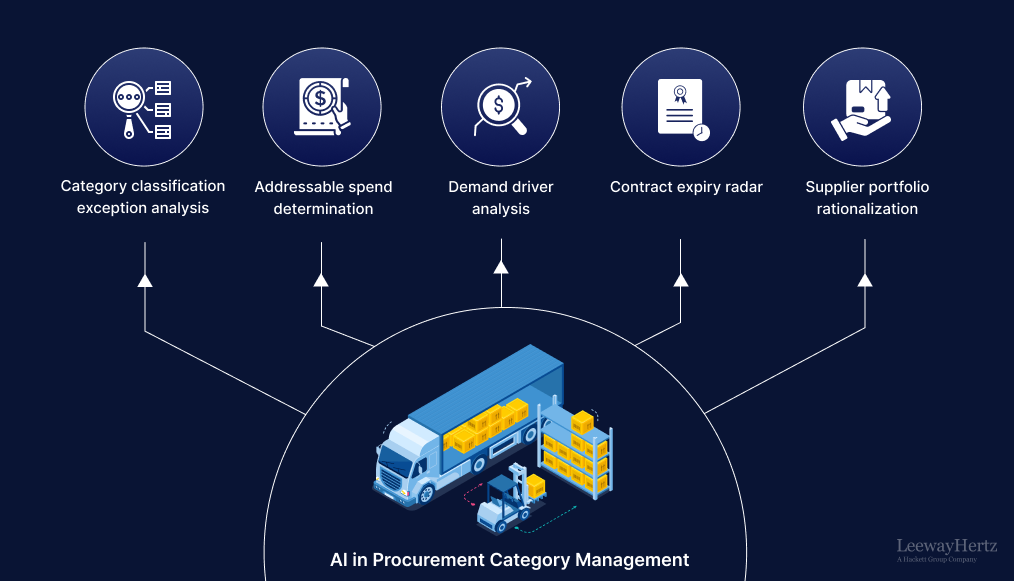
| Category classification exception analysis | Uses classification and semantic matching across the spend cube extract, category taxonomy, supplier descriptions, GL information, and UNSPSC or custom mappings to identify potentially incorrect category assignments. | Improves the analytical foundation used for category baselines, supplier concentration, opportunity sizing, and performance reporting without requiring category management to rebuild the spend cube. |
| Addressable spend determination | Applies approved category and finance rules to distinguish potentially influenceable spend from taxes, mandated spend, statutory payments, committed arrangements, pass-through costs, and other exclusions. | Establishes a realistic category opportunity base and reduces the risk of overstating the spend pool against which procurement value is estimated. |
| Price-volume-mix decomposition | Separates changes in category spend into price, demand/volume, and mix effects using the approved category baseline. | Helps category managers distinguish supplier-price movement from changes caused by business demand or specifications. |
| Demand and consumption-driver analysis | Connects purchasing volumes with operational drivers such as headcount, production, site count, asset base, project demand, or other business measures. | Identifies whether category growth is commercially addressable or driven by legitimate business activity. |
| Specification and SKU rationalization | Uses similarity analysis to identify duplicate, near-equivalent, highly customized, or low-volume specifications and SKUs. | Can reveal value opportunities that price negotiation alone cannot address while preserving functional or engineering approval for specification changes. |
| Commodity and input-cost monitoring | Tracks approved category-relevant PPI series, commodity benchmarks, metals, resins, freight indices, energy, or other input-cost indicators. | Reduces manual market monitoring and gives category managers a more current view of external cost drivers. |
| Index-versus-paid-price variance analysis | Compares supplier price histories with relevant market indices, contractual indexation provisions, and lag structures. | Identifies situations where paid-price movement appears inconsistent with external cost movements and may warrant category review. |
| Supplier landscape and distress monitoring | Monitors approved information sources for supplier M&A, ownership change, capacity expansion or closure, market entry or exit, financial deterioration, and other relevant developments. | Helps category teams identify changes in competition, capacity, supplier concentration, and continuity risk before periodic category reviews. |
| Regulatory and geopolitical horizon scanning | Retrieves and classifies developments affecting categories exposed to trade, forced-labor, carbon, sustainability, sourcing geography, or supply-chain requirements, including UFLPA and CBAM where relevant. | Helps incorporate emerging external constraints into category strategy rather than treating regulation as a separate compliance exercise. |
| Should-cost model refresh | Updates approved category should-cost models using relevant material, labor, freight, energy, yield, conversion, and other cost inputs. | Keeps category cost models aligned with changing external economics and supports evidence-based commercial analysis. |
| Kraljic and supplier-positioning preparation | Combines supply risk, category importance, supplier concentration, switching difficulty, market complexity, and other approved criteria to prepare a draft portfolio assessment. | Reduces evidence-assembly effort while preserving category manager judgment over final positioning and strategy. |
| Category strategy refresh preparation | Combines the category playbook, spend baseline, demand analysis, market intelligence, supplier risk, contract expiry, ESG requirements, should-cost information, and previous decisions into a refreshed decision packet. | High leverage because annual category refreshes require repeated reconciliation of information spread across many procurement and enterprise systems. |
| Opportunity sizing and prioritization | Uses approved baselines to prepare indicative value ranges and compares opportunities across value, effort, risk, timing, readiness, stakeholder complexity, and dependency. | Helps procurement allocate category and sourcing capacity toward opportunities that are both economically attractive and implementable. |
| Contract expiry radar | Extracts contract expiry dates, renewal windows, notice periods, and relevant commercial milestones from CLM records. | Connects long-term category strategy with the practical windows when sourcing initiatives can be launched. |
| Supplier portfolio rationalization | Analyzes supplier fragmentation, long-tail suppliers, concentration, capabilities, risk, performance, ESG, and switching constraints. | Helps identify whether the category supplier portfolio is more fragmented or concentrated than the strategy requires. |
| Preferred supplier list integrity review | Compares AVL or preferred-supplier status with current performance, risk, contracts, capabilities, sustainability evidence, and category strategy. | Prevents preferred-supplier status from becoming static when supplier conditions or strategic requirements change. |
| Savings stage-gate validation | Checks savings pipeline entries across identified, negotiated, implemented, and realized stages against required evidence and the finance-signed benefits methodology. | Strengthens the credibility of procurement value reporting and keeps stage advancement linked to evidence rather than pipeline optimism. |
| Hard savings versus cost-avoidance classification | Uses retrieval-based analysis to compare an opportunity with the finance-approved savings glossary and supporting baseline or counterfactual. | Reduces inconsistent benefits classification while preserving final Finance Business Partner validation. |
| Duplicate savings detection | Uses entity and similarity analysis to identify overlapping initiatives, suppliers, contracts, spend pools, periods, or benefit scopes. | Reduces the risk of double counting across category, sourcing, transformation, and supplier initiatives. |
| Integrated category scorecard preparation | Aggregates approved savings, supplier risk, compliance, ESG, innovation, market, and roadmap measures into the category performance view. | Reduces fragmented reporting and gives category leadership a consistent basis for periodic strategy review. |
| Annual category-plan reset preparation | Compares current performance, market conditions, supplier developments, savings realization, demand changes, contract timing, and risk against the previous annual plan. | Closes the category-management loop by turning performance evidence into inputs for the next strategy cycle. |
The strongest initial projects are generally artifact-rich, repeatable, evidence-intensive sub-processes with a clearly named reviewer and limited decision risk. Category classification review, index-versus-paid-price analysis, market-intelligence synthesis, contract-expiry monitoring, strategy-refresh preparation, savings-stage validation, and category-scorecard preparation fit this profile because AI can prepare evidence and recommendations without independently making commercial, supplier, or financial commitments.
Organizations should also avoid assuming that the highest-value use case is necessarily the most autonomous. In category management, substantial value can come from reducing the time required to gather evidence, maintain analytical artifacts, identify exceptions, and prepare decisions while preserving category manager, finance, stakeholder, and executive accountability.
How agentic AI works in procurement category management workflows
Agentic AI can coordinate multiple activities around a category-management objective. An agent can retrieve approved artifacts, query procurement systems, analyze market and supplier information, evaluate category policies or frameworks, prepare analytical models, monitor deadlines, and route exceptions.
The workflow should still stop before a material category strategy is approved, a supplier position is changed, savings are certified, or a sourcing commitment is made. Similarly, when a category opportunity moves into RFx, negotiation, supplier award, or contracting, execution passes into the strategic sourcing operating model.
Example 1: Annual category strategy refresh
-
Agent role: Prepare the annual category strategy decision packet.
-
Starting artifacts: Existing category playbook, refreshed spend cube extract, addressable-spend baseline, supplier segmentation, contract-expiry radar, supplier scorecards, risk assessments, market-index tracker, and annual category plan.
-
Workflow: Recalculate category baseline views, analyze price-volume-mix movements, update relevant market and input-cost trends, identify supplier and risk changes, refresh draft Kraljic positioning, retrieve contract expiries, and summarize performance against the prior strategy.
-
Policy and framework retrieval: Retrieve the finance-approved savings glossary, category strategy template, applicable sustainability commitments, ISO 20400-related procurement guidance, and relevant trade or regulatory constraints.
-
Opportunity preparation: Identify candidate levers such as supplier consolidation, specification rationalization, demand management, VAVE, indexed pricing, payment-term changes, or alternative sourcing geography. Prepare indicative value ranges and a proposed sourcing-wave sequence.
-
Exception handling: Separate contested baselines, unsupported savings assumptions, missing supplier evidence, unresolved stakeholder requirements, and regulatory constraints into review items.
-
Human checkpoint: The category manager determines the strategy and edits the playbook. Functional stakeholders approve demand or specification implications. The finance team validates contested benefits assumptions. The category director reviews roadmap commitments, and the CPO or category council approves material strategic direction.
-
Output: An approved category playbook, multi-year roadmap, opportunity pipeline entries at the appropriate stage, and a complete record of the source evidence and approvals.
Example 2: Market-index and supplier-price variance analysis
-
Agent role: Prepare evidence for a category price-performance review.
-
Starting artifacts: Commodity index tracker, approved supplier price history, category unit-cost baseline, contracts containing indexation clauses, purchasing volumes, and should-cost models.
-
Workflow: Retrieve relevant PPI, commodity, resin, metal, freight, or other approved index histories; normalize periods; extract indexation formulas, reset dates, caps, floors, and lag provisions from contracts; and compare external movements with paid-price changes.
-
Analysis: Identify sustained divergences between relevant external cost drivers and supplier pricing, estimate the spend affected, and distinguish potential commercial variance from differences explained by contract lag or category-specific cost structure.
-
Exception handling: Flag supplier-specific cost structures, non-comparable indices, unusual mix shifts, missing volume data, or ambiguous index clauses.
-
Human checkpoint: The supply market intelligence analyst validates the selected benchmarks and interpretation. The category manager decides whether the evidence represents a commercial opportunity or requires further supplier analysis.
-
Output: An index-versus-paid-price variance report, updated market-intelligence brief, should-cost assumptions where applicable, and a possible category opportunity entry. The workflow does not contact the supplier or initiate negotiation.
Example 3: Contract-expiry and sourcing-wave preparation
-
Agent role: Identify category opportunities approaching actionable sourcing windows.
-
Starting artifacts: CLM contract records, category roadmap, supplier segmentation, current category baseline, opportunity pipeline, and strategic sourcing capacity information.
-
Workflow: Extract expiry dates, renewal terms, notice requirements, and termination windows; identify contracts entering the defined planning horizon; and connect each contract with category spend, supplier position, market conditions, and existing category opportunities.
-
Opportunity assessment: Prepare indicative value, readiness, risk, stakeholder dependencies, and strategic rationale for each potential sourcing initiative.
-
Wave planning: Sequence candidate opportunities by contract timing, value, implementation complexity, sourcing capacity, category dependency, and business readiness.
-
Exception handling: Flag auto-renewal issues, missing contracts, disputed scope, operational constraints, or cases where the existing category strategy does not support a sourcing event.
-
Human checkpoint: The category manager approves pipeline inclusion. Finance department validates relevant savings assumptions. The category director determines portfolio priority, and the strategic sourcing manager accepts the approved project for execution.
-
Output: An approved opportunity one-pager, sourcing-wave calendar, and sourcing project charter. RFx creation, negotiation, supplier selection, and contracting occur outside category management.
Example 4: Savings pipeline and realization governance
-
Agent role: Prepare category savings entries for stage-gate review.
-
Starting artifacts: Savings pipeline register, finance-signed savings glossary, approved baseline, sourcing outcome, implementation evidence, budget information, and prior approval records.
-
Workflow: Compare each pipeline entry with the required evidence for its current and requested stage, recalculate the candidate value using the approved baseline, and compare the claimed benefit type with the finance methodology.
-
Control checks: Search for duplicate supplier, contract, initiative, period, or spend scope; identify missing implementation evidence; compare effective dates with claimed realization; and detect inconsistencies between the opportunity, sourcing result, and realized value.
-
Exception handling: Route disputed baselines, ambiguous hard-savings versus cost-avoidance treatment, duplicate benefit candidates, and missing budget evidence separately.
-
Human checkpoint: The category manager confirms category and implementation evidence. The strategic sourcing manager confirms relevant commercial outcomes. The budget owner confirms applicable operating impact, and the finance business partner determines the accepted savings treatment.
-
Output: A governed stage-gate decision and updated savings pipeline record with amount, classification, evidence, reviewer, and approval history. AI does not certify the financial benefit independently.
These workflows illustrate an important distinction between agentic coordination and autonomous procurement decision-making. An agent may move across spend, CLM, SRM, market-data, risk, ESG, finance, and category-management systems to assemble evidence and prepare a decision packet. The accountable professional still determines whether the recommendation should change category strategy, supplier treatment, sourcing priority, or reported financial value.
How to prioritize AI use cases in procurement category management
Organizations should prioritize AI investments in category management based on strategic impact, implementation readiness, artifact and data quality, integration requirements, and governance, rather than according to how advanced the AI model appears.
For CPOs and heads of category management, the objective is not to implement the largest possible number of AI use cases. It is to identify specific sub-processes where AI can improve the quality or speed of category decisions, strengthen market and supplier intelligence, increase visibility into value opportunities, reduce manual analytical work, and improve governance without creating uncontrolled commercial or financial risk.
A strong AI investment case connects three perspectives: the category outcome the organization wants to improve, the operational sub-process where that improvement can occur, and the governance boundary required to deploy the workflow responsibly.
For example, an AI-supported category strategy refresh should not be evaluated only on the quality of the generated playbook. Procurement leaders should also consider whether the spend baseline is reliable, supplier and market information is available, the necessary systems can be connected, the Category Manager can validate the recommendations, Finance can review savings implications, and the workflow can retain the source evidence behind each recommendation.
| Criterion | What to ask |
|---|---|
| Strategic importance | Does the sub-process influence material category spend, supplier exposure, cost structure, business continuity, or strategic objectives? |
| Frequency and repeatability | Does the activity recur often enough across categories, annual refreshes, monthly monitoring, or governance cycles for AI support to create meaningful leverage? |
| Manual analytical effort | Do category managers or analysts spend substantial time collecting, reconciling, comparing, or summarizing information before making the actual decision? |
| Artifact availability | Are the required category taxonomies, spend cube extracts, baselines, contracts, market reports, supplier scorecards, risk assessments, savings records, or category playbooks available in usable form? |
| Data quality and lineage | Can the organization identify where baseline figures, supplier information, market data, and savings assumptions originated and whether they are current enough for the decision? |
| Framework clarity | Are the applicable taxonomy rules, savings methodology, Kraljic criteria, sustainability guidance, approval rules, or category-specific policies sufficiently defined for AI to apply them consistently? |
| System integration readiness | Can the workflow retrieve the necessary information from spend analytics, ERP, CLM, SRM, market intelligence, risk, benefits-tracking, or finance systems without relying on uncontrolled manual transfers? |
| Exception structure | Can the organization define the circumstances in which the AI output is uncertain, contradictory, incomplete, or requires specialist review? |
| Human review boundary | Is there a clearly named category manager, procurement analyst, finance business partner, category director, stakeholder, risk specialist, or other accountable reviewer who can validate the output before action? |
| Decision blast radius | If the AI output is wrong, does it remain a recommendation, draft analysis, exception flag, or proposed pipeline entry rather than directly becoming a supplier commitment or financial record? |
| Business impact | Can the organization connect the use case with measurable outcomes such as analyst effort, category-cycle time, opportunity coverage, supplier-risk visibility, savings credibility, market responsiveness, or category-plan performance? |
| Governance and control requirements | Does the workflow affect financial reporting, supplier treatment, sustainability commitments, regulatory exposure, or material commercial decisions requiring additional controls? |
| Scalability across categories | Can the same underlying workflow be adapted across multiple categories by changing the category artifacts, market feeds, business rules, and accountable reviewers? |
A practical prioritization process starts by selecting one sub-process, not an entire function. The organization should identify its starting and output artifacts, current volume or frequency, manual effort, exception rate, accountable reviewer, required systems, and measurable outcome.
Procurement leaders can then evaluate potential use cases across three broad dimensions:
- Business and strategic impact
The use case should influence an outcome that matters to category management. Examples include improving addressable-spend accuracy, increasing opportunity coverage, detecting market-price divergence earlier, reducing the time required for category strategy refreshes, improving supplier-risk visibility, strengthening savings validation, or improving category roadmap execution.
- Implementation readiness
High-value ideas are not necessarily high-readiness ideas. A workflow may require reliable category mappings, consistent supplier identifiers, current contracts, trustworthy market feeds, or an approved savings methodology before AI can add value. An organization with weak baseline data should address that dependency rather than expecting AI to infer an authoritative baseline.
- Governance and decision risk
Use cases differ materially in their impact if the output is wrong. Misclassifying an internal market-news item may require analyst correction. Incorrectly advancing a savings claim to realized status can affect financial reporting. A recommendation to change supplier segmentation may influence strategic relationships. Higher-impact workflows require stronger evidence, role-based review, traceability, and approval controls.
Four failure patterns should be avoided.
- Function-wide scope: Treating “AI for category management” or even “AI for category strategy” as one implementation rather than identifying a bounded sub-process.
- Weak artifact foundations: Attempting sophisticated analysis where taxonomies, spend baselines, supplier identifiers, contract records, market data, or savings definitions are unreliable.
- Missing decision ownership: Allowing AI to produce strategic or financial recommendations without identifying who must validate and approve the result.
- Boundary expansion: Allowing a category-management workflow to drift into autonomous supplier negotiation, supplier award, transaction processing, or other activities belonging to strategic sourcing or source-to-pay.
The strongest first investments are therefore usually workflows where the artifacts already exist, the analysis repeats, the evidence burden is high, the reviewer is clear, and an incorrect AI output remains a reviewable recommendation rather than an irreversible commercial action.
Examples include classification exception review, addressable-spend preparation, market-index analysis, supplier landscape monitoring, contract-expiry radar, category-strategy refresh preparation, category council packet generation, savings-stage validation, and category performance reporting.
Once these workflows demonstrate reliable performance, procurement organizations can connect them into broader agentic category-management journeys. A market signal can trigger a category review; the category review can identify an opportunity; the opportunity can enter the governed sourcing pipeline; the approved sourcing outcome can enter benefits tracking; and category performance can feed the next annual strategy cycle. The value comes from connecting those activities while maintaining the human decision boundaries defined at each stage.
Accelerate AI Solutions Development
Build fully functional solutions from your high-value use cases, based on specific operational needs and enterprise context.
Governance, risk, and responsible AI in procurement category management
AI in procurement category management operates across spend data, supplier information, contracts, market intelligence, savings records, category strategies, risk assessments, sustainability information, and business plans. Some outputs can influence sourcing direction, supplier relationships, reported savings, budgets, and business requirements. Governance should therefore be designed into each workflow rather than added after the AI solution is deployed.
Organizations can use the NIST AI Risk Management Framework [9] as a voluntary structure for identifying, assessing, managing, and monitoring AI risks, then map those controls to procurement-specific financial, privacy, competition, sustainability, trade, and internal governance requirements. NIST describes the AI RMF as a voluntary, use-case-agnostic framework intended to help organizations manage AI risk and support trustworthy and responsible AI use.
Human-in-the-loop accountability: Every category management use case should state what AI may extract, classify, compare, predict, simulate, draft, or recommend and which professional must validate the result. A procurement analyst reviews classification exceptions. A category manager approves category assumptions, supplier positioning, strategic levers, and pipeline recommendations. Functional stakeholders approve demand and specification changes. A finance business partner validates savings treatment. Category directors and CPOs approve material strategic commitments.
This boundary becomes especially important in agentic workflows. An agent may identify a supplier-consolidation opportunity, quantify indicative value, prepare a sourcing-wave recommendation, and create a draft project charter. It should not independently initiate supplier engagement, negotiate commercial terms, select a supplier, approve an award, or commit the organization financially.
Source and evidence governance: Category management outputs should be grounded in approved artifacts and traceable sources. A price-versus-index recommendation should show the selected market benchmark, time period, supplier price history, contract indexation provisions, baseline assumptions, and any lag adjustment used. A savings recommendation should identify the approved baseline, applicable finance methodology, implementation evidence, and calculation logic.
Source hierarchy should also be explicit. An executed contract is more authoritative for a supplier-specific pricing clause than a market-intelligence summary. The finance-signed savings glossary governs internal benefits classification. Approved technical specifications govern whether a SKU can be rationalized. AI should surface conflicts between authoritative sources rather than silently resolving them.
Financial integrity and savings controls: AI-supported value tracking should preserve the controls surrounding identified, negotiated, implemented, and realized benefits. Baseline versions, calculation assumptions, savings classifications, evidence packages, reviewer decisions, and stage changes should remain traceable. Where procurement benefits feed controlled financial reporting or management assertions, appropriate SOX-related financial controls and segregation of duties should be maintained.
AI can prepare a candidate hard-savings or cost-avoidance classification, identify missing evidence, detect possible double counting, and calculate a proposed benefit. The finance business partner or other authorized financial reviewer continues to determine the accepted treatment.
Market intelligence and antitrust controls: Supply market intelligence can involve supplier announcements, pricing benchmarks, commodity data, capacity changes, industry analysis, and other external information. Organizations should define which sources can be used and how competitively sensitive information is handled. AI should not be used to facilitate inappropriate exchange or coordination of current competitively sensitive pricing, capacity, customer, or strategic information among market participants.
For example, an agent may analyze publicly available commodity indices and licensed market data to prepare a category-cost outlook. It should not obtain or combine improperly shared competitor pricing information to create a sourcing recommendation.
Privacy and access governance: Category systems may contain supplier-contact information, employee purchasing information, stakeholder records, or other personal data. Workflows processing personal data should apply relevant GDPR requirements where applicable, including appropriate purpose, access, retention, and security controls.
Access should also follow least-privilege principles. A category strategy agent may require read access to a spend cube, approved market data, CLM records, supplier scorecards, and the category playbook, but it does not automatically require permission to change contract records, modify supplier status, advance a savings stage, or initiate external communications.
Sustainability, trade, and supply-chain compliance: AI-supported category strategies should incorporate relevant sustainability and trade requirements at the point where they affect a category decision. ISO 20400 can inform sustainable procurement practices. UFLPA may affect supplier and origin-risk assessment for relevant US imports, while CBAM can change carbon-data, cost, and sourcing considerations for covered EU imports. Applicable CSRD and ESRS requirements can also increase demand for reliable value-chain sustainability information.
AI can retrieve applicable requirements, map potentially affected suppliers or materials, identify missing evidence, and prepare the issue for review. Legal, compliance, sustainability, and procurement professionals retain responsibility for interpreting obligations and determining the organizational response.
Use-case risk classification: Not every category-management workflow requires the same level of control. A low-risk category council summarization workflow should not necessarily be governed identically to a supplier-positioning recommendation or savings-realization workflow.
Organizations can classify use cases according to factors such as:
-
Whether the output affects a financial figure
-
Whether it could influence supplier treatment or sourcing direction
-
Whether regulated or sensitive data are involved
-
Whether an external communication or system update can occur
-
Whether the workflow relies on predictive scoring
-
Whether the decision is easily reversible
-
Whether a named professional reviews the output before action
Higher-risk workflows should require stronger validation, confidence thresholds, approval gates, monitoring, exception handling, and audit evidence.
Model and workflow validation: Procurement teams should evaluate more than the quality of generated text. Testing should determine whether the workflow retrieves the correct category artifacts, uses the intended versions, applies calculation rules correctly, distinguishes missing evidence from negative evidence, handles conflicting data, identifies exceptions, and remains within its permitted authority.
Validation cases should include normal scenarios as well as edge cases. For example, an index-versus-paid-price workflow should be tested when the selected index is unavailable, when a contract uses a lagged formula, when supplier pricing includes multiple cost drivers, and when category mix changes make historical comparisons unreliable.
Traceability and auditability: Governed workflows should retain enough evidence to reconstruct consequential recommendations. Depending on the use case, this can include input artifacts, data versions, retrieved policies or frameworks, market sources, workflow version, model output, calculations, exceptions, reviewer disposition, approvals, and resulting system actions.
This is particularly important for category strategy changes, supplier segmentation decisions, sourcing pipeline commitments, and savings validation because those decisions may be reviewed months after the original analysis was performed.
Ongoing monitoring: Category conditions change continuously. Models and workflows should therefore be monitored for stale data, changes in taxonomy definitions, expired contracts, outdated market benchmarks, changed savings methodologies, supplier-risk deterioration, and declining output quality.
Governance should not prevent category teams from using AI. It should make the boundary clear: AI prepares evidence and recommendations; accountable procurement, finance, business, risk, sustainability, and executive roles continue to make the decisions that commit the organization.
How ZBrain operationalizes AI use cases in procurement category management
Identifying an AI opportunity in procurement category management is only the first step. Organizations need a controlled way to analyze the current workflow, define requirements, design integrations and review boundaries, build and validate the solution, deploy it, and govern it in operation.
ZBrain supports this lifecycle through four connected stages: ZBrain Analyzer, ZBrain Design, ZBrain Solution Builder, and ZBrain Governance. The platform provides a governed path from use-case analysis to deployed agentic workflows while maintaining policies, permissions, approval points, monitoring, and runtime evidence.
ZBrain Analyzer
ZBrain Analyzer helps teams examine selected procurement category management processes, identify AI opportunities, and document the business context, systems, data, roles, controls, and review requirements needed to evaluate each use case.
ZBrain Design
ZBrain Design creates a build-ready technical design for the selected use case. It generates the BRD, functional requirements, user journeys, architecture, workflow logic, data details, integration context and governance considerations needed before development begins.
ZBrain Solution Builder
ZBrain Solution Builder enables teams to create, configure, and validate governed AI workflows for procurement category management on the technical design provided by the ZBrain Design module. It supports testing across normal, exception, and control scenarios before deployment.
ZBrain Governance
ZBrain Governance applies policies, access controls, human approval requirements, monitoring, and traceability throughout workflow execution. It provides guardrails, approval gates, escalation controls, kill switches, and audit trails to help organizations maintain oversight of AI outputs, user actions, exceptions, and authorized system updates.
Future of AI in procurement category management
The next stage of AI in procurement category management is likely to move beyond disconnected assistants and individual analytical tasks toward connected, governed workflows that maintain category context across the strategic lifecycle. Current enterprise agentic platforms are already moving toward shared orchestration, enterprise integrations, runtime governance, human approvals, and persistent audit evidence, providing the technical foundation for this direction. This is an inference based on the current evolution of governed agentic platforms rather than a claim that procurement organizations have already reached this operating model.
One change will be the shift from periodic category intelligence to event-driven category intelligence. Today, a category manager may refresh the strategy annually and review some indicators monthly or quarterly. A future category-management workflow could continuously monitor approved market indices, supplier-risk changes, contract expiries, demand deviations, regulatory developments, and category performance.
A material event would not automatically change the strategy. Instead, it could create a review task, retrieve the affected category artifacts, quantify the potential impact, and show the category manager what assumptions may need reconsideration.
For example, a major resin-price decline could trigger an update to the packaging market-intelligence brief. The workflow could identify suppliers with relevant index-linked or fixed-price arrangements, compare current paid prices with the market movement, quantify the spend exposed, retrieve upcoming contract windows, and prepare a category-review packet. The category manager would decide whether the development warrants an opportunity or strategy change.
A second shift will be from static category documents to living category evidence. The category playbook, Kraljic assessment, opportunity pipeline, supplier segmentation, market assumptions, savings commitments, and category scorecard can become connected rather than independently maintained artifacts.
When an approved underlying assumption changes, AI can identify which category outputs may be affected. A supplier-risk downgrade might prompt review of segmentation and preferred-supplier status. A major demand reduction might change the addressable baseline and sourcing-wave priorities. A regulatory change might affect geographic sourcing options and supplier-data requirements.
A third development will be longer-horizon agentic coordination across category functions. Rather than having separate automations for spend analysis, market intelligence, strategy drafting, and savings reporting, an agentic workflow may maintain the objective of keeping the category strategy current.
Such a workflow could:
- Monitor approved category triggers.
- Identify a material market, supplier, demand, contract, or regulatory change.
- Retrieve the affected category artifacts.
- Recalculate relevant baseline or scenario analyses.
- Identify which strategy assumptions may no longer hold.
- Prepare a proposed category-plan update.
- Route the update to the appropriate category manager, finance, business, risk, or ESG reviewer.
- Update governed artifacts only after the necessary approvals.
The workflow can retain context across these activities, but human accountability remains essential. Category managers continue to determine commercial strategy. Business and technical stakeholders determine whether demand or specification changes are acceptable. Finance owns accepted benefits treatment. Procurement leadership approves material commitments.
A fourth shift will be toward a stronger connection between category intelligence and sourcing readiness. Category management will increasingly be able to maintain a continuously prioritized pipeline informed by contract timing, current market conditions, supplier position, expected value, risk, and business readiness.
This does not remove the boundary with strategic sourcing. Instead, it can make the handoff more complete. When an opportunity is approved, the sourcing team can receive the category rationale, baseline, market evidence, supplier context, stakeholder map, risk factors, value assumptions, and relevant constraints as a governed project package rather than recreating that context.
A fifth development will be more explicit governance of AI-generated procurement recommendations. As workflows become capable of retrieving data, using tools, coordinating multiple agents, and preparing system updates, governance will need to move beyond conventional model evaluation. NIST’s AI RMF already frames AI risk management as an organizational activity spanning design, development, deployment, and use.
For category management, this means organizations will increasingly need to know:
-
Which AI workflow produced a recommendation
-
Which category artifacts and external evidence it used
-
Which rules and methodology versions were applied
-
Which systems and tools the workflow accessed
-
Which actions it was authorized to perform
-
Which exceptions occurred
-
Which person reviewed the recommendation
-
What was ultimately approved or rejected
The competitive advantage is therefore unlikely to come only from selecting a more capable model. It will come from building the category-management operating model around reliable artifacts, connected enterprise context, well-defined sub-processes, trusted market and supplier evidence, enforceable permissions, measurable workflows, and accountable human decisions.
AI can make category management more continuous, evidence-driven, and responsive. The strategic responsibility remains with procurement professionals who understand the category, the supply market, the business requirements, and the trade-offs behind the decision.
Endnote
Procurement category management is not a single strategic planning exercise. It is a connected operating model spanning category taxonomy, spend baseline analysis, demand and specification management, supply market intelligence, category strategy development, stakeholder governance, opportunity pipeline management, supplier portfolio management, value tracking, and category performance reporting.
AI can support this operating model where work requires repeated evidence gathering, classification, market-data analysis, supplier monitoring, scenario comparison, policy retrieval, exception detection, analytical preparation, and strategy drafting. These capabilities can reduce the manual effort required to maintain category intelligence and help category managers focus more of their time on commercial judgment, stakeholder alignment, supplier strategy, and business decisions.
The implementation challenge is precision. Broad ambitions such as “use AI for category management,” “automate category strategy,” or “apply AI to procurement savings” do not define the artifacts, source systems, category frameworks, calculation rules, exception conditions, approval requirements, or accountable reviewers needed for implementation.
A stronger approach starts with a bounded sub-process. An organization might begin with classification exception review, index-versus-paid-price analysis, contract-expiry monitoring, category-strategy refresh preparation, supplier portfolio analysis, or savings-stage validation. It can then define the required inputs, measurable baseline, expected output, exception paths, and the professional who must review the result.
The operating boundary should remain clear as AI capabilities expand. Category management consumes the spend cube; it does not build the underlying spend-data infrastructure. Category management identifies, sizes, prioritizes, and governs sourcing opportunities, but RFx execution, supplier bidding, negotiation, award, and contracting remain within strategic sourcing. Transaction-level purchasing compliance and source-to-pay processing also sit outside the category strategy layer.
The strongest operating model keeps responsibility with the roles that already own the decisions. Category managers own category strategy and supplier portfolio direction. Functional stakeholders own business demand and specification decisions. Finance business partners validate savings treatment. Category directors and CPOs approve material commitments. Strategic Sourcing Managers own sourcing-event execution after an approved opportunity is handed off.
Organizations should therefore begin with artifact-rich, repeatable category-management sub-processes, validate AI outputs against real scenarios and exceptions, measure their effect on reviewer effort and decision quality, and expand only after data quality, accuracy, governance, access controls, and human accountability have been demonstrated.
Explore how ZBrain can support governed AI workflows across procurement category management, from use-case analysis and solution design to deployment and ongoing governance. Connect with the ZBrain team to learn more.
Author’s Bio


Akash's ability to build enterprise-grade technology solutions has garnered the trust of over 30 Fortune 500 companies, including Siemens, 3M, P&G, and Hershey's. Akash is an early adopter of new technology, a passionate technology enthusiast, and an investor in AI and IoT startups.

Transform Enterprise Processes with AI
Whether you have a defined use case or a process you want to improve, we design and build AI solutions that address operational gaps, enhance existing capabilities, and integrate with your enterprise data, systems, and workflows.
Start a conversation by filling the form
Once you let us know your requirement, our technical expert will schedule a call and discuss your idea in detail post sign of an NDA.
All information will be kept confidential.
FAQs
What is AI in procurement category management?
AI in procurement category management is the application of capabilities such as classification, document intelligence, anomaly detection, predictive analysis, retrieval-based analysis, scenario simulation, natural-language generation, and agentic workflow coordination to strategic category-management activities.
AI can analyze category taxonomies, spend cube extracts, demand records, supplier information, commodity indices, contracts, market intelligence, Kraljic assessments, category playbooks, opportunity pipelines, savings registers, and category scorecards. It can identify exceptions, prepare analysis, draft recommendations, and assemble decision evidence.
Category managers and other accountable professionals continue to approve category strategies, supplier positioning, sourcing direction, specification changes, and financial benefits.
Which AI use cases are most valuable in procurement category management?
High-value opportunities span the full category lifecycle:
-
Category foundation: Taxonomy mapping, classification exception detection, addressable-spend determination, unit-cost baseline preparation, and price-volume-mix analysis.
-
Demand and specification: Consumption-driver analysis, demand anomaly detection, SKU rationalization, specification comparison, and policy-lever assessment.
-
Market intelligence: Commodity tracking, supplier landscape monitoring, index-versus-paid-price analysis, regulatory horizon scanning, and should-cost model updates.
-
Category strategy: Kraljic assessment preparation, supplier-preferencing analysis, strategic lever comparison, category playbook drafting, and multi-year roadmap preparation.
-
Opportunity management: Opportunity sizing, value-versus-effort prioritization, contract-expiry radar, sourcing-wave planning, and sourcing handoff preparation.
-
Supplier portfolio: Supplier segmentation, rationalization analysis, preferred supplier list review, risk-posture assessment, and innovation-objective preparation.
-
Value and performance: Savings stage-gate validation, hard-savings versus cost-avoidance classification, duplicate-benefit detection, category scorecard preparation, and annual category-plan reset.
The highest-value starting point depends on the organization’s category maturity, artifact quality, analytical workload, systems, category spend, exception volume, and ability to define a reliable human review boundary.
How is agentic AI different from conventional procurement automation?
Conventional procurement automation generally follows predefined rules, workflows, calculations, or field mappings. It is effective when the inputs, decisions, and next steps are predictable.
Agentic AI can coordinate a broader sequence of activities. It can retrieve information from multiple approved systems, interpret structured and unstructured artifacts, compare market and supplier evidence, apply category frameworks, maintain workflow context, call approved tools, prepare decision packets, monitor changes, and route exceptions to different reviewers.
For example, an annual category strategy agent could retrieve the spend baseline, contract expiries, supplier scorecards, market indices, savings methodology, and sustainability commitments; update the analytical package; identify material changes; and draft a revised category playbook.
That does not make the agent the category manager. The category manager still determines the category strategy, and the relevant finance, business, procurement, risk, or executive reviewers approve consequential decisions.
Can AI autonomously create and approve a category strategy?
AI can support category strategy development by assembling evidence, identifying changes, preparing Kraljic or supplier-preferencing assessments, comparing strategic levers, modeling scenarios, and drafting the category playbook and roadmap.
It should not independently approve the final category strategy, commit the organization to a sourcing direction, change a supplier’s strategic status, approve a financial commitment, or determine that a reported benefit qualifies as realized savings.
Those decisions should remain with the authorized category manager, category director, CPO, finance business partner, functional stakeholder, or other accountable professional.
What data and systems are needed for AI-powered category management?
Requirements depend on the selected sub-process, but common inputs include:
-
Category taxonomy and UNSPSC or custom classification mappings
-
Spend cube extracts and classification confidence records
-
AP, PO, p-card, and GL-derived spend information
-
Addressable-spend and unit-cost baselines
-
Demand, quantity, SKU, specification, and operational-driver records
-
ERP and procurement analytics systems
-
CLM and contract repositories
-
SRM, supplier scorecards, and supplier-risk platforms
-
Market and commodity intelligence feeds
-
Should-cost models
-
ESG and sustainability information
-
Opportunity and sourcing pipeline records
-
Benefits-tracking systems
-
Finance budgets and planning information
-
Category playbooks, annual plans, scorecards, and governance records
The workflow should only receive access to the information and tools required for its approved purpose. Source-system ownership and data lineage should remain visible, particularly when an output affects strategic or financial decisions.
How should organizations prioritize AI use cases in category management?
Organizations should start with a clearly defined sub-process, rather than attempting to implement “AI for category management” as one large initiative.
Strong initial use cases typically have five characteristics: the source artifacts already exist, the activity occurs repeatedly, substantial manual analytical work is involved, a measurable outcome can be established, and a clearly named professional can validate the output before action occurs.
Examples include classification exception analysis, addressable-spend preparation, commodity-index monitoring, contract-expiry radar, strategy-refresh preparation, category council packet generation, and savings-stage validation.
Organizations should also consider the blast radius of an incorrect result. A draft market summary is easier to correct than an incorrectly approved savings figure or supplier-strategy change. Higher-impact workflows need stronger validation, permissions, approvals, monitoring, and auditability.
How can AI support sustainable and responsible category management?
AI can help category teams incorporate sustainability and responsible sourcing information into category analysis by retrieving approved requirements, mapping affected suppliers or materials, identifying missing information, and comparing strategic alternatives.
ISO 20400 provides guidance for integrating sustainability into procurement. Depending on the category and jurisdiction, category teams may also need to consider frameworks or requirements such as UFLPA for relevant US imports, CBAM for covered EU imports and applicable sustainability reporting requirements such as CSRD and ESRS.
AI can prepare the evidence and identify possible exposure, but procurement, sustainability, legal, compliance, and business professionals remain responsible for interpreting requirements and approving category actions.
How can AI improve savings credibility in category management?
AI can strengthen benefits governance by connecting each savings entry with its approved baseline, opportunity scope, sourcing or implementation evidence, finance-signed savings glossary, stage-gate requirements, and budget information.
It can identify missing evidence, detect possible duplicate benefits, recalculate candidate savings using approved assumptions, distinguish apparent hard-savings and cost-avoidance cases according to internal methodology, and identify entries that have remained at one stage for an unusually long time.
AI should not independently certify a benefit as realized. The Finance Business Partner or other authorized financial reviewer should retain final responsibility for accepted savings treatment. Where benefits feed controlled financial reporting, appropriate financial controls and traceability remain important.
Can AI negotiate with suppliers or select suppliers autonomously?
AI may identify a commercial opportunity, prepare market and should-cost evidence, recommend that an opportunity enter the sourcing pipeline, and create a sourcing handoff package. It should not autonomously negotiate supplier terms, communicate an approved commercial position without authorization, select a winning supplier, make an award, or commit organizational spend.
Once an approved category opportunity enters detailed sourcing execution, it should follow the organization’s strategic sourcing workflow, approval structure, competition requirements, and delegated authority.
What controls are important for AI in procurement category management?
Important controls include:
-
Human approval for strategic, supplier, and financial decisions
-
Role-based and least-privilege system access
-
Clear read-versus-write permissions
-
Approved source and data hierarchies
-
Version control for category baselines and methodologies
-
Traceability from recommendations back to supporting evidence
-
Validation using normal, exception, missing-data, and conflicting-data scenarios
-
Confidence thresholds and escalation rules
-
Protection of personal and commercially sensitive information
-
Antitrust controls for market-intelligence activities
-
Savings and financial-reporting controls where relevant
-
Runtime monitoring and audit trails for agentic workflows
-
Explicit restrictions on autonomous negotiation, supplier award, and financial commitments
The control level should match the risk of the use case rather than applying one identical governance model to every AI workflow.
Where should a procurement organization begin?
Begin with a category-management sub-process where the artifacts are already reasonably stable, the current manual workflow is understood, a baseline can be measured, and a specific reviewer owns the decision.
Good starting points can include:
-
Taxonomy or classification exception review
-
Addressable-spend analysis
-
Market-index monitoring
-
Index-versus-paid-price variance analysis
-
Contract-expiry radar
-
Supplier-risk change summarization
-
Category strategy refresh preparation
-
Category council packet preparation
-
Savings stage-gate evidence validation
The organization should test the workflow against expected cases, unusual cases, missing information, contradictory information, and attempts to act outside its permitted scope. It should then measure accuracy, reviewer effort, operational impact, and exception behavior before expanding the workflow.
How does ZBrain enable the end-to-end AI lifecycle for procurement category management?
ZBrain supports the AI lifecycle through four connected stages: ZBrain Analyzer, ZBrain Design, ZBrain Solution Builder, and ZBrain Governance.
-
ZBrain Analyzer helps teams examine procurement category management processes, identify AI opportunities, and document the relevant business context, systems, data, roles, controls, and review requirements.
-
ZBrain Design converts the analyzed use case into build-ready blueprints, defining architecture, integrations, data flows, workflow logic, approval points, permissions, exception paths, validation criteria, and monitoring needs.
-
ZBrain Solution Builder enables teams to create, configure, and validate governed AI workflows based on the approved technical design, including testing across normal, exception, and control scenarios.
-
ZBrain Governance applies policies, access controls, human approvals, monitoring, escalation controls, kill switches, and audit trails during workflow execution.
For procurement category management, this lifecycle can support use cases such as market-intelligence preparation, category-strategy refresh, supplier portfolio review, opportunity prioritization, and savings validation while maintaining defined human review and approval boundaries.
Insights

AI in portfolio management: Use cases, applications, benefits and development
AI is reshaping portfolio management by offering powerful tools that enhance investment strategies and decision-making.

AI in market research: Use cases, applications, benefits and solution
AI in market research involves integrating Machine Learning (ML) algorithms into traditional methods, such as interviews, discussions, and surveys, to enhance the research process.
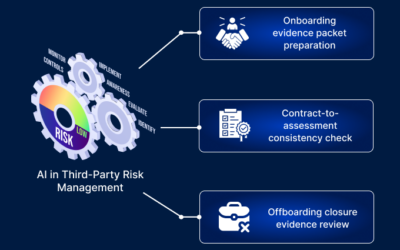
AI in Third-Party Risk Management: Processes and Use Cases Across the Operating Model
AI is changing TPRM by helping teams convert scattered vendor records, questionnaires, evidence reports, monitoring feeds, contract clauses, and remediation updates into structured risk work products.