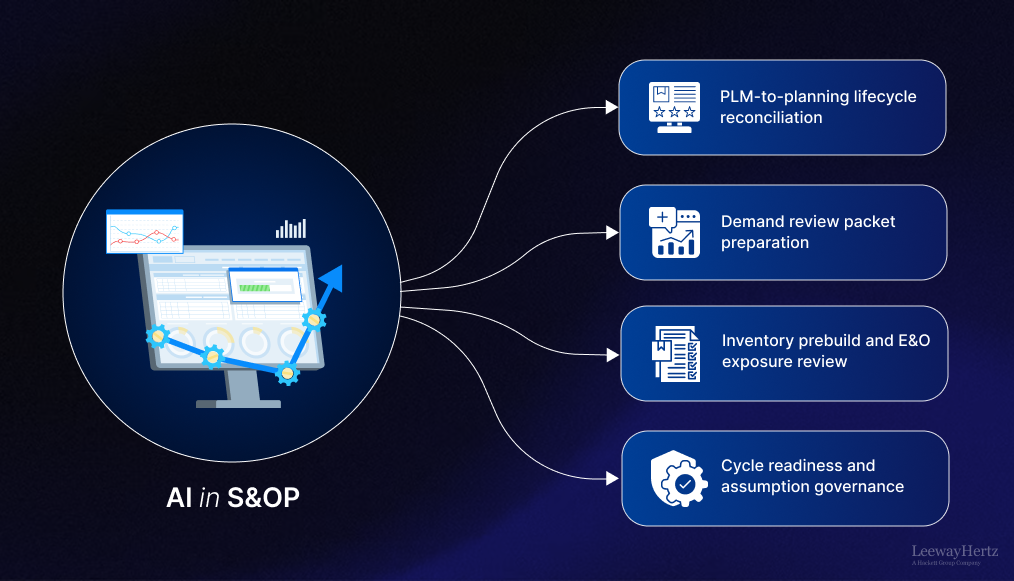
Sales and operational planning (S&OP) sits where product choices, demand signals, supply constraints, inventory exposure, and financial commitments meet. The plan is not only a forecast. It is a managed chain of artifacts: lifecycle status, baseline forecast, consensus demand plan, RCCP, constrained supply plan, inventory projection, AOP bridge, executive deck, assumption log, and decision log.
Many S&OP cycles still depend on fragmented inputs, late assumptions, spreadsheet-based reconciliation, unclear override rationale, and meeting decks assembled after real planning conflicts have already emerged. Demand changes, supply constraints, inventory risks, and financial gaps often move faster than the monthly review cadence. AI matters at this layer because it can aggregate planning artifacts, detect inconsistencies, classify exceptions, compare scenarios, surface unsupported assumptions, and prepare review-ready packets before planners and executives decide.
The market for S&OP, IBP, and supply chain planning software shows why this work is moving from manual meeting preparation to governed AI workflow design. One market estimate valued the global S&OP software market at USD 3.8 billion in 2025 and projected it to reach USD 8.2 billion by 2033 [1].
In this context, AI should function as a governed planning capability, not as a generic chatbot beside the planning system. A demand planning manager needs unsupported sales overlays identified before the demand review. A supply planner needs capacity and material constraints linked to the affected demand families. An FP&A manager needs a volume-to-value bridge that separates volume, mix, price, and cost gaps before pre-S&OP.
This is why S&OP AI use cases must be mapped through the operating model rather than described at the platform or function level. The operating model defines how S&OP work is organized across functions such as portfolio review, demand review, supply review, inventory planning, reconciliation, pre-S&OP, executive S&OP, S&OE, and governance. Within each function, processes break the work into repeatable review activities, and sub-processes identify the specific planning task where AI can be designed, tested, governed, and measured. A single planning platform may support the full cycle, but each sub-process relies on different artifacts, review gates, accountable owners, and risk boundaries.
This article uses the S&OP operating model to break work into functions, processes, sub-processes, artifacts, systems, standards and control considerations, accountable roles, AI-enabled opportunities and governed agentic workflows.
- How AI is transforming S&OP operations
- Why S&OP AI use cases must be mapped at the sub-process level
- S&OP operating model and AI opportunity mapping across S&OP processes
- High-value AI use cases in S&OP
- How agentic AI works in S&OP workflows
- How to prioritize AI use cases in S&OP
- Governance, risk, and responsible AI in S&OP
- How ZBrain operationalizes AI use cases in S&OP
- Future of AI in S&OP
How AI is transforming S&OP operations
AI is changing S&OP by helping teams turn fragmented demand, supply, inventory, product, and financial inputs into evidence-rich review packets for each planning gate. The highest-value applications do not replace enterprise planning, financial, product lifecycle, customer, manufacturing, or execution systems. They sit across those systems, retrieve the right artifacts, compare them with rules, prepare evidence, and route exceptions to named reviewers.
For example, in a demand review, the statistical baseline forecast may show one view of demand while sales overlays, promotion plans, channel inventory, and backlog point to a different number. AI can pull these inputs together, rank baseline-versus-consensus variances, show whether overrides improved or weakened forecast accuracy, and draft concise review notes. The demand planning manager still reviews the evidence and approves the consensus demand plan before it moves to supply review.
S&OP work is suitable for governed AI because the planning cycle depends on artifacts, recurring review gates, and accountable decisions. AI can support this work by preparing the evidence, checking the inputs, and surfacing exceptions before planners and executives make decisions:
-
Document-heavy work: Forecast files, RCCP outputs, supply plans, AOP bridges, and inventory projections can be checked for missing context and inconsistencies before a reviewer opens them.
-
Narrative-heavy work: Executive S&OP decks, gap-closure narratives, MAPE/bias root-cause summaries, and assumption rationale can be drafted from approved source material while showing where evidence is thin.
-
Exception-heavy work: Unjustified forecast overrides, capacity constraints, S&OE escalations, and plan-adherence misses can be classified and prioritized so planners take the highest-impact ones first.
-
Knowledge-heavy work: Consensus process rules, override authority levels, FVA thresholds, and product family review hierarchies can be retrieved at the point of review, along with prior decisions and potential conflicts.
-
Workflow-heavy work: The cadence from demand review to supply review, reconciliation, pre-S&OP, and executive S&OP can be supported by forecasting the next bottleneck and assembling the next review packet.
The practical design rule is simple: AI should prepare, compare, score, retrieve, simulate, and draft inside the planning cadence, while designated teams retain control over consensus demand, supply commitments, financial bridges, executive decisions, and external guidance implications.
Why S&OP AI use cases must be mapped at the sub-process level
A use case becomes vague when it is described only as AI for S&OP. The phrase does not say which artifact starts the work, which system holds the truth, which review gate applies, which role confirms the result, or what output is retained.
A better approach is to map AI use cases to the S&OP operating model:
-
Function: A governed planning domain with its own accountability, such as demand review or integrated reconciliation.
-
Process: A workflow area within a function, such as sales overlay validation, RCCP review, or AOP bridge preparation.
-
Sub-process: The atomic work activity where AI can be designed and tested, such as overlay justification screening or volume-to-value gap decomposition.
-
AI-enabled opportunity: A specific AI capability applied to an S&OP artifact to change how the sub-process is prepared, checked, routed, monitored, or evidenced.
This level of mapping makes implementation more precise and accountable. A reconciliation workflow needs the consensus demand plan, constrained supply plan, AOP, latest financial forecast, price and cost assumptions, owner identity, approval threshold, and decision log boundary. Without those details, a team cannot validate accuracy or assign accountability.
For example, “AI for demand planning” is too broad to guide implementation. In a demand review, variance detection can compare the baseline forecast with the consensus plan and rank the largest deltas. FVA analysis can show whether contributor overrides improved or weakened forecast accuracy. Retrieval-grounded answering can check override rules and confirm whether the contributor had authority to make the change. The demand planning manager still approves the final consensus number.
Scope discipline also matters because S&OP sits between several adjacent functions. Forecasting methods, financial planning, and downstream execution each have their own operating depth. The S&OP layer should focus on how product, demand, supply, inventory, and financial inputs are reviewed, reconciled, escalated, and translated into accountable decisions across the planning cycle.
Build governed AI workflows for S&OP
Connect demand, supply, product, inventory, finance, S&OE, and executive decision workflows while preserving human accountability for plan commitments.
S&OP operating model and AI opportunity mapping across S&OP processes
The mapping below covers the 10 core S&OP functions from portfolio review through process governance. Each section identifies teams, AI support, human ownership, sub-process opportunities, artifacts, systems, standards and controls, accountable roles, highest-value opportunities, and an example agentic workflow.
Function 1: Portfolio and product review
Turning product lifecycle inputs into planning-ready portfolio decisions.
This function opens the S&OP cycle. It reconciles product lifecycle status, NPI timing, phase-in and phase-out plans, and assortment decisions before demand and supply teams plan against the portfolio. Its outputs feed demand review, supply review, inventory planning, and executive trade-off discussions.
Teams involved: Product managers, demand planners, demand planning managers, sales operations leads, supply planners, and the S&OP process owner run this review.
What AI helps with: Entity matching links product, SKU, family, and lifecycle records across PLM, ERP, and planning systems. Classification applies to product status, launch readiness, and discontinuation signals to separate active, launch, sunset, rationalization, and exception items. Retrieval-grounded answering applies to the assumption log and product family hierarchy, surfacing the rule or prior decision that governs each portfolio change.
What humans continue to own: The product manager owns lifecycle status and launch assumptions. The demand planning manager approves how portfolio changes enter the demand plan. The S&OP process owner confirms that portfolio decisions are logged before downstream review. AI scores, drafts, or prepares but does not decide, approve, or attest.
| Process | Sub-process | AI-enabled opportunities |
| Product lifecycle synchronization | PLM-to-planning status reconciliation |
|
| NPI readiness packet preparation |
|
|
| Phase-in and phase-out planning | Phase-in demand handoff |
|
| Phase-out exposure screening |
|
|
| Assortment and rationalization | Portfolio rationalization evidence assembly |
|
Key artifacts: New product forecast, assumption log, decision log, inventory projection, consensus demand plan.
Systems involved: PLM, ERP, demand and supply planning platforms, CRM, and enterprise data warehouse or BI systems.
Standards and control considerations: Oliver Wight IBP supports portfolio, demand, supply, and financial alignment through a monthly process. ASCM SCOR terminology helps keep plan work separate from downstream source, make, deliver, and return activities.
Accountable roles: Product manager, demand planning manager, sales operations lead, supply planner, S&OP process owner/IBP director.
Highest-value opportunities
- PLM-to-planning status reconciliation: Lifecycle defects can distort every later plan.
- NPI readiness packet preparation: Launch assumptions shape demand, supply, inventory, and executive trade-offs.
- Phase-out exposure screening: Late decisions can create obsolete stock and service risk.
Example agentic workflow: Portfolio lifecycle reconciliation
- Trigger artifact and gate: The monthly portfolio review opens and PLM lifecycle records refresh.
- Workflow: Aggregate PLM status, item master data, launch calendars, discontinuation lists, prior decisions, and inventory projections.
- Review packet: Prepare mismatched lifecycle statuses, launch assumption gaps, phase-out exposure, and decisions needed for demand review.
- Human checkpoint: The product manager confirms lifecycle status and the demand planning manager confirms planning treatment.
- Handoff: Approved portfolio assumptions are written to the assumption log and feed the demand review packet.
Function 2: Demand review
Turning baseline demand signals into a governed consensus demand plan.
Demand review converts baseline forecasts, sales overlays, promotion assumptions, backlog, POS signals, and new product inputs into a consensus demand plan. It sits after portfolio review and before supply review. The function tests whether overrides add value and whether assumptions are clear enough to defend downstream.
Teams involved: Demand planners, demand planning managers, sales operations leads, product managers, and the S&OP process owner run the demand review.
What AI helps with: Anomaly detection applies to statistical baseline forecasts, outliers, and promotion spikes before reviewing overlays. Variance detection compares baseline, sales overlay, marketing overlay, and consensus demand by product family. Forecast value-add analysis applies to contributor overrides, showing whether a touchpoint improved or damaged forecast accuracy.
What humans continue to own: The demand planning manager owns consensus demand. Sales and marketing contributors own their assumptions. The S&OP process owner confirms unresolved demand conflicts before escalation. AI scores, drafts, or prepares but does not decide, approve, or attest.
| Process | Sub-process | AI-enabled opportunities |
| Baseline forecast preparation | Baseline forecast refresh review |
|
| Promotion and event adjustment screening |
|
|
| Consensus demand planning | Sales and marketing overlay validation |
|
| Baseline-versus-consensus variance review |
|
|
| Forecast value-add analysis | Contributor FVA measurement |
|
| New product and cannibalization | New product attach-rate forecast review |
|
Key artifacts: Statistical baseline forecast, consensus demand plan, FVA report, new product forecast, assumption log, MAPE/bias report.
Systems involved: Demand planning platforms, customer relationship management systems, promotion calendar tools, POS and channel inventory feeds, and enterprise data warehouse or BI systems.
Standards and control considerations: IBF defines FVA as a way to evaluate which forecast process steps and participants add value. Oliver Wight IBP frames demand review as part of an integrated monthly management process.
Accountable roles: Demand planner, demand planning manager, sales operations lead, product manager, S&OP process owner/IBP director.
Highest-value opportunities
- Overlay validation: High value, as unsupported overrides can weaken the consensus plan.
- Contributor FVA measurement: It shifts the review from opinion-led discussion to evidence-based evaluation.
- New product forecast review: Launch assumptions affect demand, supply, and inventory at the same time.
Example agentic workflow: Demand review packet preparation
- Trigger artifact and gate: The monthly demand review window opens after the statistical baseline refresh completes.
- Workflow: Aggregate baseline forecast, POS and channel inventory data, backlog, CRM overlays, promotion calendars, and the last cycle assumption log.
- Review packet: Prepare baseline-versus-consensus variances, missing overlay assumptions, FVA results, new product forecast logic, and decisions needed at review.
- Human checkpoint: The demand planning manager runs the review and contributors defend or withdraw overlays.
- Handoff: Approved consensus demand publishes to supply review, with the owner logging assumptions and decisions.
Function 3: Supply review
Turning consensus demand into feasible supply commitments and constraint evidence.
Supply review tests whether the consensus demand plan can be supported by capacity, materials, suppliers, and sourcing options. It produces constrained and unconstrained supply views. The output feeds inventory planning, integrated reconciliation, and pre-S&OP decisions.
Teams involved: Supply planners, capacity planners, materials managers, plant schedulers, and the S&OP process owner run the supply review.
What AI helps with: Optimization applies to capacity, material, and sourcing constraints to propose feasible supply response options. Constraint detection applies to RCCP, supplier confirmations, and material availability to rank bottlenecks. Scenario simulation applies to make-versus-buy and alternate sourcing options before escalation.
What humans continue to own: The supply planner owns the supply plan. The capacity planner confirms capacity assumptions. The materials manager confirms critical material assumptions. The S&OP process owner controls escalation to reconciliation or pre-S&OP. AI scores, drafts, or prepares but does not decide, approve, or attest.
| Process | Sub-process | AI-enabled opportunities |
| Rough-cut capacity planning | RCCP load-versus-capacity review |
|
| Bottleneck impact ranking |
|
|
| Material and supplier confirmation | Critical material availability check |
|
| Supplier capacity confirmation review |
|
|
| Supply response options | Make-versus-buy scenario review |
|
| Alternate sourcing scenario review |
|
Key artifacts: RCCP, supply plan, consensus demand plan, demand-supply gap analysis, scenario model workbook, decision log.
Systems involved: Supply planning platforms, enterprise resource planning systems, manufacturing execution systems, advanced planning and scheduling systems, supplier portals, and enterprise data warehouse or BI systems.
Standards and control considerations: ASCM SCOR and CPIM terminology help separate planning, sourcing, making, and delivery work. ISO 9001 planning controls may apply where production and service provision must be controlled in regulated environments.
Accountable roles: Supply planner, capacity planner, materials manager, plant scheduler, S&OP process owner/IBP Director.
Highest-value opportunities
- RCCP load-versus-capacity review: Capacity gaps define the constrained plan.
- Critical material availability check: Material gaps can invalidate supply commitments.
- Make-versus-buy scenario review: The decision affects cost, service, and executive trade-offs.
Example agentic workflow: Supply review constraint packet preparation
- Trigger artifact and gate: The consensus demand plan publishes and the supply review window opens.
- Workflow: Aggregate consensus demand, RCCP output, supplier capacity confirmations, material constraints, and prior open constraints.
- Review packet: Rank capacity and material bottlenecks by demand impact, with make-versus-buy and alternate sourcing options.
- Human checkpoint: The supply planner and capacity planner confirm the constrained supply plan and unresolved gaps.
- Handoff: The constrained supply plan and constraint decisions are published to integrated reconciliation.
Function 4: Inventory and prebuild planning
Turning supply and demand gaps into inventory, prebuild, and exposure decisions.
This function reviews safety stock, seasonal prebuild, launch stock, buffer strategy, and excess-or-obsolete exposure. It sits between supply review and reconciliation because inventory choices affect both feasibility and financial outcomes. The output feeds the AOP bridge, scenario review, and executive decision agenda.
Teams involved: Materials managers, supply planners, demand planners, FP&A managers, and the S&OP process owner run inventory and prebuild review.
What AI helps with: Optimization applies to safety stock parameters and service targets, preparing inventory settings for review. Scenario simulation applies to prebuild and seasonal strategies, showing service and working capital exposure. Anomaly detection applies to inventory projection and lifecycle records, flagging excess, obsolete, and shortage risks.
What humans continue to own: The materials manager owns inventory parameter recommendations. The supply planner owns prebuild feasibility. The FP&A manager owns financial exposure review. AI scores, drafts, or prepares but does not decide, approve, or attest.
| Process | Sub-process | AI-enabled opportunities |
| Inventory parameter review | Safety stock parameter review |
|
| Buffer exception screening |
|
|
| Prebuild planning | Seasonal prebuild strategy review |
|
| Launch prebuild readiness check |
|
|
| Exposure management | Excess and obsolete exposure projection |
|
Key artifacts: Inventory projection, new product forecast, supply plan, consensus demand plan, AOP bridge, decision log.
Systems involved: Supply planning platforms, enterprise resource planning systems, warehouse management systems, product lifecycle management systems, enterprise data warehouse or BI systems, and financial planning systems.
Standards and control considerations: Oliver Wight IBP links portfolio, demand, supply, inventory, and financial choices. SOX adjacency matters when inventory exposure affects financial forecasts or external guidance.
Accountable roles: Materials manager, supply planner, demand planner, FP&A manager, S&OP process owner/IBP director.
Highest-value opportunities
- Safety stock parameter review: Parameter drift can affect service levels and working capital.
- Seasonal prebuild strategy review: Timing decisions shape capacity use and inventory exposure.
- Excess and obsolete projection: Early visibility helps finance assess potential write-down or working-capital risk.
Example agentic workflow: Inventory prebuild and exposure review
- Trigger artifact and gate: The supply review completes and the inventory review opens.
- Workflow: Aggregate constrained supply, consensus demand, inventory projection, lifecycle status, and financial exposure inputs.
- Review packet: Prepare safety stock exceptions, prebuild options, and excess or obsolete exposure by family.
- Human checkpoint: The materials manager confirms inventory recommendations and FP&A confirms financial exposure treatment.
- Handoff: Approved inventory assumptions feed integrated reconciliation and scenario planning.
Accelerate AI Solutions Development
Build fully functional solutions from your high-value use cases, based on specific operational needs and enterprise context.
Function 5: Financial reconciliation (integrated reconciliation)
Turning volume plans into value bridges and finance-ready gaps.
Integrated reconciliation converts the demand and supply plans into financial views. It compares the plan with the annual operating plan and latest financial forecast. The function prepares the bridge that pre-S&OP and executive S&OP use to decide trade-offs.
Teams involved: FP&A managers, S&OP process owners, demand planning managers, supply planners, and sales operations leads run integrated reconciliation.
What AI helps with: Volume-to-value conversion applies approved price, cost, mix, and margin assumptions to demand and supply plans. Variance detection applies to AOP, latest forecast, and reconciled plan values, separating gaps by driver. Natural-language generation applies to bridge commentary, drafting pre-S&OP explanations from approved assumptions.
What humans continue to own: The FP&A manager owns the financial bridge. The S&OP process owner confirms planning assumptions and unresolved gaps. Executives own any decision that changes targets, capacity, pricing, or customer commitments. AI scores, drafts, or prepares but does not decide, approve, or attest.
| Process | Sub-process | AI-enabled opportunities |
| Volume-to-value conversion | Demand plan value conversion |
|
| Supply plan value conversion |
|
|
| AOP and latest forecast variance analysis | AOP and latest forecast gap analysis |
|
| Unresolved gap escalation preparation |
|
|
| AOP bridge preparation | Pre-S&OP bridge commentary |
|
Key artifacts: AOP bridge, demand-supply gap analysis, consensus demand plan, supply plan, assumption log, decision log.
Systems involved: Financial planning systems, enterprise resource planning systems, demand and supply planning platforms, and enterprise data warehouse or BI systems.
Standards and control considerations: S&OP reconciliation is framework-led, but SOX adjacency matters when the plan feeds financial reporting, guidance, or management control evidence.
Accountable roles: FP&A manager, S&OP process owner/IBP director, demand planning manager, supply planner, sales operations lead.
Highest-value opportunities
- AOP and latest forecast gap analysis: It turns planning disagreement into named financial drivers.
- Pre-S&OP bridge commentary: Executives need concise evidence for trade-off decisions.
- Unresolved gap escalation preparation: It keeps lower-priority issues from crowding the executive agenda.
Example agentic workflow: Integrated reconciliation bridge preparation
- Trigger artifact and gate: The constrained supply plan publishes and the reconciliation window opens.
- Workflow: Convert demand and supply plans from volume to value and compare them with the AOP and latest financial forecast.
- Review packet: Prepare gap drivers by volume, mix, price, and cost, with assumption owners and decision needs.
- Human checkpoint: The FP&A manager and S&OP process owner confirm the bridge and unresolved gaps.
- Handoff: The reconciled bridge and gap analysis is published into the pre-S&OP decision agenda.
Function 6: Pre-S&OP and executive S&OP
Turning unresolved gaps into executive decisions and accountable commitments.
Pre-S&OP prepares the decision agenda and removes issues that can be resolved below the executive level. Executive S&OP makes the cross-functional trade-offs that require senior authority. The function produces approved decisions, assumptions, and action ownership.
Teams involved: The S&OP process owner, FP&A manager, demand planning manager, supply planner, sales operations lead, product manager, and COO run pre-S&OP and executive S&OP.
What AI helps with: Multi-source aggregation applies to demand, supply, inventory, financial, and scenario artifacts to assemble the executive deck. Classification applies to gaps and trade-offs, separating information items from executive decision items. Natural-language generation applies to the executive S&OP deck and decision log, drafting concise options and owner-ready actions.
What humans continue to own: The S&OP process owner owns agenda quality. The COO chairs executive S&OP and owns final trade-off decisions. The FP&A manager confirms financial framing. AI scores, drafts, or prepares but does not decide, approve, or attest.
| Process | Sub-process | Exact AI-enabled opportunities |
| Decision agenda management | Pre-S&OP decision agenda assembly |
|
| Decision readiness check |
|
|
| Executive packet preparation | Executive S&OP deck preparation |
|
| Decision and assumption control | Decision log capture |
|
| Assumption log update |
|
Key artifacts: Executive S&OP deck, demand-supply gap analysis, scenario model workbook, AOP bridge, assumption log, decision log.
Systems involved: Demand and supply planning platforms, financial planning systems, enterprise resource planning systems, enterprise data warehouse or BI systems, and collaboration tools.
Standards and control considerations: Oliver Wight IBP frames executive ownership of one operating plan. NIST AI RMF can structure AI risk controls around map, measure, manage, and govern activities.
Accountable roles: COO, S&OP process owner/IBP director, FP&A manager, demand planning manager, supply planner, product manager.
Highest-value opportunities
- Decision agenda assembly: Weak agenda design can waste executive time.
- Executive deck preparation: It condenses multiple planning artifacts into decision-ready evidence.
- Decision log capture: It preserves accountability after the meeting.
Example agentic workflow: Executive S&OP decision agenda preparation
- Trigger artifact and gate: Reconciliation closes and the pre-S&OP agenda window opens.
- Workflow: Aggregate gap analysis, scenario workbook, AOP bridge, assumption log, and unresolved demand-supply conflicts.
- Review packet: Classify decision items, prepare options, draft executive deck commentary, and flag missing owners.
- Human checkpoint: The S&OP process owner approves the agenda and the COO confirms executive decisions.
- Handoff: Approved decisions and assumptions are written to the logs and the next cycle plan version is updated.
Function 7: Scenario planning and gap closure
Turning gaps and trigger events into modeled options and tracked closure actions.
Scenario planning tests demand-shaping, supply-response, pricing, expedite, capacity, and sourcing options. Gap closure turns those options into owned initiatives. The function supports pre-S&OP, executive S&OP, and S&OE escalation when conditions change.
Teams involved: S&OP process owners, demand planning managers, supply planners, FP&A managers, sales operations leads, and capacity planners run scenario and gap closure review.
What AI helps with: Simulation applies to demand, supply, inventory, and finance variables to compare scenario outcomes. Optimization applies to gap closure options, ranking feasible choices against service, cost, and capacity limits. Deadline monitoring applies to gap closure initiatives, identifying actions that are late or unsupported.
What humans continue to own: The S&OP process owner owns scenario framing. The FP&A manager confirms financial assumptions. Functional owners approve pricing, capacity, expedite, and sourcing actions. AI scores, drafts, or prepares but does not decide, approve, or attest.
| Process | Sub-process | AI-enabled opportunities |
| Scenario modeling | Demand-shaping scenario modeling |
|
| Supply-response scenario modeling |
|
|
| Trigger-event analysis | What-if simulation on trigger events |
|
| Gap closure tracking | Gap closure initiative tracking |
|
| Action impact verification |
|
Key artifacts: Scenario model workbook, demand-supply gap analysis, AOP bridge, assumption log, decision log, S&OE exception report.
Systems involved: Demand and supply planning platforms, financial planning systems, enterprise resource planning systems, customer relationship management systems, and enterprise data warehouse or BI systems.
Standards and control considerations: Scenario work should preserve decision traceability because it can shape executive commitments, financial forecasts, and operating priorities.
Accountable roles: S&OP process owner/IBP director, FP&A manager, demand planning manager, supply planner, capacity planner, sales operations lead.
Highest-value opportunities
- What-if simulation on trigger events: It shortens response time when assumptions change.
- Gap closure initiative tracking: Approved gap-closure actions lose value without clear owner follow-through.
- Action impact verification: It tests whether the chosen action actually closed the gap.
Example agentic workflow: Scenario gap closure tracking
- Trigger artifact and gate: A pre-S&OP gap or trigger event is approved for scenario review.
- Workflow: Aggregate the scenario workbook, gap analysis, current plan version, assumptions, and open actions.
- Review packet: Prepare ranked scenarios, sensitivity drivers, action owners, due dates, and expected gap closure impact.
- Human checkpoint: The S&OP process owner and FP&A manager confirm scenario framing before escalation.
- Handoff: Approved options feed executive S&OP and action tracking updates the decision log.
Function 8: S&OE and weekly execution alignment
Turning short-term execution exceptions into controlled monthly-cycle escalations.
S&OE manages weekly demand-supply balancing inside the execution fence. It does not replace monthly S&OP. It identifies exceptions that need short-term action or escalation into the next monthly review cycle.
Teams involved: Plant schedulers, demand planners, supply planners, materials managers, and demand planning managers run S&OE alignment.
What AI helps with: Event classification applies to weekly exception records, separating schedule, material, demand, expedite, and service cases. Predictive analytics applies to short-term demand and supply signals, estimating which exceptions may breach tolerance. Multi-source aggregation applies to S&OE exceptions and prior decision logs, preparing escalation evidence.
What humans continue to own: The plant scheduler owns execution-fence schedule decisions. The demand planning manager confirms escalations to the monthly demand cycle. The supply planner confirms supply-side escalations. AI scores, drafts, or prepares but does not decide, approve, or attest.
| Process | Sub-process | AI-enabled opportunities |
| Weekly demand-supply balancing | Execution-fence demand-supply balancing |
|
| Schedule attainment review |
|
|
| Exception escalation | S&OE-to-S&OP escalation screening |
|
| S&OE exception report preparation |
|
Key artifacts: S&OE exception report, decision log, assumption log, supply plan, consensus demand plan, MAPE/bias report.
Systems involved: Advanced planning and scheduling systems, manufacturing execution systems, enterprise resource planning systems, demand and supply planning platforms, warehouse management systems, and enterprise data warehouse or BI systems.
Standards and control considerations: The cadence boundary matters. S&OE handles near-term execution exceptions, while S&OP owns the medium-term plan and executive trade-offs.
Accountable roles: Plant scheduler, supply planner, demand planner, demand planning manager, materials manager.
Highest-value opportunities
- S&OE-to-S&OP escalation screening: It prevents execution noise from overwhelming monthly planning.
- Schedule attainment review: It measures whether production and supply execution aligned with the approved plan.
- S&OE exception report preparation: Recurring issues need clean handoff evidence.
Example agentic workflow: S&OE to S&OP escalation workflow
- Trigger artifact and gate: A weekly S&OE exception breaches the execution-fence tolerance.
- Workflow: Aggregate exception detail, affected plan version, schedule attainment, and related assumption or decision log entries.
- Review packet: Rank exceptions by downstream impact and identify which items need monthly-cycle escalation.
- Human checkpoint: The plant scheduler and demand planning manager confirm the escalation decision.
- Handoff: Attach escalated exceptions to the next demand or supply review packet.
Function 9: Forecast accuracy and plan governance
Turning actuals and adherence results into learning, accountability, and better plan quality.
This function measures forecast accuracy, bias, FVA, plan adherence, and root causes of misses. It closes the learning loop after execution and before the next planning cycle. The output influences demand review rules, assumption quality, and maturity improvement.
Teams involved: Demand planners, demand planning managers, sales operations leads, supply planners, plant schedulers, and the S&OP process owner run plan governance review.
What AI helps with: Statistical analysis applies to MAPE, bias, and FVA reports by family and contributor. Root-cause classification applies to large misses and plan adherence gaps, preparing evidence for review. Anomaly detection applies to forecast and actuals data, flagging suspicious or unstable accuracy results.
What humans continue to own: The demand planning manager owns forecast performance review. The sales operations lead owns sales overlay behavior. The S&OP process owner owns process changes. AI scores, drafts, or prepares but does not decide, approve, or attest.
| Process | Sub-process | Exact AI-enabled opportunities |
| Accuracy measurement | MAPE and bias reporting |
|
| Contributor-level FVA review |
|
|
| Plan adherence review | Schedule attainment versus plan measurement |
|
| Large-miss root-cause review | Large-miss root-cause packet preparation |
|
| Governance feedback | Forecast rule update candidate review |
|
Key artifacts: MAPE/bias report, FVA report, consensus demand plan, supply plan, assumption log, decision log.
Systems involved: Demand planning tools, demand and supply planning platforms, enterprise resource planning systems, advanced planning and scheduling systems, manufacturing execution systems, and enterprise data warehouse or BI systems.
Standards and control considerations: IBF FVA concepts support contributor-level review. ASCM and SCOR terminology support plan performance measurement across supply chain planning domains.
Accountable roles: Demand planning manager, demand planner, sales operations lead, supply planner, plant scheduler, S&OP process owner/IBP director.
Highest-value opportunities
- Contributor-level FVA review: It shows where human overlays improve or weaken forecast accuracy.
- Large-miss root-cause packet preparation: It turns forecast misses into process learning.
- Forecast rule update candidate review: It feeds improvements into the next planning cycle.
Example agentic workflow: Forecast miss root-cause review
- Trigger artifact and gate: Actuals post and the monthly accuracy review opens.
- Workflow: Aggregate forecast, actuals, FVA, MAPE, bias, assumptions, decisions, and schedule attainment data.
- Review packet: Prepare large misses, contributor FVA results, root-cause candidates, and rule update candidates.
- Human checkpoint: The demand planning manager confirms root causes and process changes.
- Handoff: Approved changes update the assumption library, process rules, and next demand review packet.
Function 10: Process governance and maturity
Turning S&OP cadence, data readiness, and assumptions into a controlled planning system.
Process governance keeps the S&OP cycle disciplined. It administers the calendar, checks data readiness, maintains the assumption library, and assesses maturity against IBP models. It is cross-cutting because every review gate depends on it.
Teams involved: The S&OP process owner/IBP director, FP&A manager, demand planning manager, supply planner, product manager, and COO participate in process governance.
What AI helps with: Readiness scoring applies to cycle calendars, artifact status, and data quality checks before each review. Retrieval-grounded answering applies to S&OP process rules, maturity criteria, and prior decision logs. Anomaly detection applies to assumption library and plan versions, flagging stale, duplicate, or conflicting records.
What humans continue to own: The S&OP process owner owns cadence, standards, and maturity roadmap. Functional leaders own their review readiness. The COO owns executive accountability. AI scores, drafts, or prepares but does not decide, approve, or attest.
| Process | Sub-process | AI-enabled opportunities |
| S&OP planning cycle administration | Cycle calendar administration |
|
| Data readiness assessment | Pre-review data readiness check |
|
| Assumption governance | Assumption library maintenance |
|
| Decision log audit check |
|
|
| S&OP maturity assessment | IBP maturity assessment |
|
Key artifacts: Assumption log, decision log, executive S&OP deck, S&OE exception report, MAPE/bias report, AOP bridge.
Systems involved: Demand and supply planning platforms, enterprise resource planning systems, product lifecycle management systems, customer relationship management systems, financial planning systems, enterprise data warehouse or BI systems, and collaboration tools.
Standards and control considerations: Oliver Wight IBP and NIST AI RMF both emphasize governance, accountability, and evidence. ISO 9001 planning controls may apply where planning discipline supports controlled production.
Accountable roles: S&OP process owner/IBP director, COO, FP&A manager, demand planning manager, supply planner, product manager.
Highest-value opportunities
- Pre-review data readiness check: Poor inputs can weaken the quality of every review meeting.
- Assumption library maintenance: Stale assumptions can distort multiple planning cycles.
- Decision log audit check: Decisions must be reflected in the plans they change.
Example agentic workflow: S&OP cycle readiness assessment
- Trigger artifact and gate: The monthly cycle calendar opens the next review window.
- Workflow: Check required artifacts, owners, plan versions, assumption status, and data readiness across planning systems.
- Review packet: Prepare missing inputs, stale assumptions, late submissions, and plan-version conflicts.
- Human checkpoint: The S&OP process owner confirms readiness and routes gaps to functional owners.
- Handoff: Ready packets move to the next review gate and unresolved items remain in the governance tracker.
High-value AI use cases in S&OP
High-value AI use cases in S&OP are the ones that improve the quality of planning decisions without weakening accountability. They usually sit in recurring review activities where source artifacts are available, exceptions are visible, and a named role can confirm the output before it affects a demand number, supply commitment, financial bridge, or executive decision.
| Use case | Function | How AI creates high-value impact |
| PLM-to-planning lifecycle reconciliation | Portfolio and product review | Entity matching and anomaly detection apply to PLM and ERP lifecycle artifacts, preventing portfolio defects from flowing into demand and supply review. |
| Demand review packet preparation | Demand review | Variance detection, FVA analysis, and natural-language generation apply to baseline, overlay, and assumption artifacts, giving reviewers a focused consensus packet. |
| RCCP constraint impact ranking | Supply review | Constraint detection and optimization apply to RCCP, demand, and capacity artifacts, ranking bottlenecks by service and volume impact. |
| Inventory prebuild and E&O exposure review | Inventory and prebuild planning | Scenario simulation and predictive analytics apply to inventory projection and lifecycle artifacts, showing service and working-capital exposure. |
| AOP bridge and gap decomposition | Financial reconciliation | Volume-to-value conversion and variance detection apply to demand, supply, AOP, and forecast artifacts, separating gaps by driver. |
| Executive S&OP decision agenda assembly | Pre-S&OP and executive S&OP | Classification and multi-source aggregation apply to gap, scenario, bridge, and decision artifacts, separating executive decisions from information items. |
| Trigger-event what-if simulation | Scenario planning and gap closure | Event classification and scenario simulation apply to trigger events and plan versions, preparing fast impact views for review. |
| S&OE-to-S&OP escalation screening | S&OE and weekly execution alignment | Risk scoring and retrieval-grounded answering apply to S&OE exceptions and decision logs, identifying issues that belong in the monthly cycle. |
| Contributor FVA and large-miss review | Forecast accuracy and plan governance | FVA analysis, statistical analysis, and root-cause classification apply to forecast, actuals, and override artifacts. |
| Cycle readiness and assumption governance | Process governance and maturity | Data quality scoring, completeness validation, and anomaly detection apply to review packets and assumption logs before each gate. |
A use case earns high-value status when it changes a bounded sub-process, preserves a defined review gate, and creates evidence that downstream teams can use in supply review, reconciliation, executive S&OP, or the next planning cycle.
Accelerate AI Solutions Development
Build fully functional solutions from your high-value use cases, based on specific operational needs and enterprise context.
How agentic AI works in S&OP workflows
Agentic AI can coordinate multi-step S&OP work across artifacts, systems, review gates, and decision owners. It can retrieve planning records, compare thresholds, prepare review packets, monitor cycle dates, draft commentary, and route exceptions. Each workflow must pause before a consensus number, supply commitment, financial bridge, executive decision, or system-of-record update proceeds.
Here are some examples:
Example 1: Governed S&OP workflow coordination
-
Agent role: Prepare the monthly demand review packet after the statistical baseline refresh completes.
-
Starting artifacts: Statistical baseline forecast, POS and channel inventory data, open orders, backlog, CRM overlays, promotion calendars, and last cycle assumption log.
-
Workflow: Aggregate records, retrieve override authority rules and FVA thresholds, compare baseline and consensus variances, score contributor FVA, and draft decisions needed at review.
-
Exception handling: Route missing overlay assumptions to sales operations, new product forecast gaps to the product manager, and large family-level variance to the demand planning manager.
-
Human checkpoint: The demand planning manager runs the review and confirms which overlays enter the consensus demand plan.
-
Output: Approved consensus demand plan, updated assumption log, decision log entries, and override tags for next cycle FVA measurement.
Example 2: Supply review constraint packet preparation
-
Agent role: Prepare the supply constraint packet when the consensus demand plan publishes.
-
Starting artifacts: Consensus demand plan, RCCP, supplier capacity confirmations, material constraints, open orders, and prior constraint decisions.
-
Workflow: Identify capacity overloads, match material exposure to demand families, rank bottlenecks, retrieve make-versus-buy rules, and prepare alternate supply options.
-
Exception handling: Route capacity gaps to the capacity planner, material gaps to the materials manager, and unresolved supply commitments to the S&OP process owner.
-
Human checkpoint: The supply planner and capacity planner confirm the constrained supply plan before reconciliation.
-
Output: Constrained supply plan, demand-supply gap analysis, constraint decisions, and owners for unresolved issues.
Example 3: Integrated reconciliation bridge preparation
-
Agent role: Prepare the reconciliation bridge after the constrained supply plan is published.
-
Starting artifacts: Consensus demand plan, constrained supply plan, AOP, latest financial forecast, price assumptions, cost assumptions, and assumption log.
-
Workflow: Convert volume to value, compare the plan against AOP and latest forecast, decompose gaps by volume, mix, price, and cost, and draft bridge commentary.
-
Exception handling: Route pricing gaps to sales operations, cost gaps to FP&A, capacity-related gaps to supply planning, and unresolved trade-offs to pre-S&OP.
-
Human checkpoint: The FP&A manager and S&OP process owner confirm the bridge and decision list.
-
Output: AOP bridge, pre-S&OP gap analysis, assumption updates, and decision agenda inputs.
Example 4: S&OE escalation packet preparation
-
Agent role: Prepare an escalation packet when a weekly execution exception breaches tolerance.
-
Starting artifacts: S&OE exception report, schedule attainment record, current plan version, decision log, assumption log, open orders, and supply status.
-
Workflow: Classify exception type, compare it with execution-fence tolerance, retrieve related prior decisions, and rank downstream demand or supply impact.
-
Exception handling: Route schedule issues to the plant scheduler, demand changes to the demand planning manager, and supply gaps to the Supply Planner.
-
Human checkpoint: The plant scheduler and demand planning manager confirm whether the exception escalates to the monthly cycle.
-
Output: Escalated exception packet, updated S&OE report, and attachment to the next demand or supply review packet.
The review gate is the safety property. The workflow can carry context across systems and meetings, but a designated person still confirms every consensus number, supply commitment, financial bridge, executive decision, and plan update.
How to prioritize AI use cases in S&OP
AI use case prioritization in S&OP should start with the planning activity that needs support, not the platform where the data resides. The strongest candidates are sub-processes that recur in the monthly or weekly cadence, depend on stable planning artifacts, have a clearly accountable reviewer, and can improve planning quality without bypassing demand, supply, reconciliation, or executive review gates.
| Criterion | What to ask |
| Recurring cycle volume | Does this sub-process recur on the monthly or weekly cadence often enough for AI support to reduce manual packet-prep effort at scale? |
| Artifact availability | Are the needed planning artifacts available in usable systems with sufficient quality for AI analysis? |
| Clear reviewer | Can a named role confirm the AI output before it affects a consensus, commitment, or reconciled number? |
| Limited blast radius | If the output is wrong, is the impact limited to a draft packet or exception queue rather than a live plan commitment? |
| Measurable planning impact | Can the function tie the use case to improved forecast accuracy, faster gap closure, or reduced reconciliation cycle time without bypassing a review gate? |
Avoid four classic failure patterns: misaligned scope against demand forecasting or FP&A, missing or stale planning data, bypassed review gates, and premature quantified savings. Strong starting points include the demand review packet, RCCP constraint packet, reconciliation bridge, S&OE escalation packet, and assumption library readiness check.
Accelerate AI Solutions Development
Build fully functional solutions from your high-value use cases, based on specific operational needs and enterprise context.
Governance, risk, and responsible AI in S&OP
S&OP AI touches forecasts, capacity assumptions, supplier constraints, inventory exposure, financial bridges, executive decisions, and plan governance. Design governance into each review gate.
Human-in-the-loop oversight: Each use case must state what AI may extract, score, draft, or recommend, and which named role confirms the result. Demand planning managers confirm consensus demand. Supply planners confirm supply commitments. FP&A managers confirm the reconciliation bridge between the S&OP plan and financial targets. The COO confirms executive trade-offs.
Regulatory and standards alignment: Organizations can use the NIST AI Risk Management Framework [2] to structure AI controls, then map those controls to Oliver Wight IBP, ASCM/APICS CPIM and SCOR terminology, IBF forecasting standards, SOX adjacency, and ISO 9001 planning controls.
Bias mitigation and evidence retention: Forecast overrides and scenario rankings can bias attention toward louder contributors, larger customers, recent events, or clean data sources. Teams should retain baseline forecasts, overrides, assumptions, decisions, and actuals so each recommendation remains inspectable.
Key governance requirements: Maintain a use-case inventory that separates low-risk summarization from higher-risk scoring or recommendation. Define risk tiers, approval gates, escalation paths, override reviews, and evidence retention rules.
Design principles: Ground outputs in approved planning sources, use least-privilege access, and scope tool permissions so a workflow can retrieve, compare, draft, and route but cannot publish a consensus number or commit a plan without confirmation.
Traceability and data security: Retain an audit trail of prompts, sources, model version, reviewer disposition, approvals, and system updates across assumption and decision logs. Protect commercially sensitive forecast, cost, margin, supplier, customer, and financial data.
How ZBrain operationalizes AI use cases in S&OP
Identifying use cases is only the first step. S&OP teams need a controlled way to design, build, validate, deploy, govern, and scale AI workflows across portfolio review, demand review, supply review, reconciliation, executive S&OP, S&OE, and plan governance.
This is where ZBrain helps.
ZBrain is an end-to-end AI enablement platform that supports this lifecycle through four connected stages: ZBrain Analyzer, ZBrain Design, ZBrain Solution Builder, and ZBrain Governance. The platform provides a governed path from use-case analysis to deployed agentic workflows while maintaining policies, permissions, approval points, monitoring, and runtime evidence.
ZBrain Analyzer
ZBrain Analyzer helps teams examine selected S&OP processes, identify AI opportunities, and document the business context, systems, data, roles, controls, and review requirements needed to evaluate each use case.
ZBrain Design
ZBrain Design creates a build-ready technical design for the selected use case. It generates the BRD, functional requirements, user journeys, architecture, workflow logic, data details, integration context and governance considerations needed before development begins.
ZBrain Solution Builder
ZBrain Solution Builder enables teams to create, configure, and validate governed AI workflows for S&OP processes based on the technical design provided by the ZBrain Design module. It supports testing across normal, exception, and control scenarios before deployment.
ZBrain Governance
ZBrain Governance applies policies, access controls, human approval requirements, monitoring, and traceability throughout workflow execution. It provides guardrails, approval gates, escalation controls, kill switches, and audit trails to help organizations maintain oversight of AI outputs, user actions, exceptions, and authorized system updates.
Future of AI in S&OP
The future of AI in S&OP will not be defined by a single model, but by the planning platform. Federated planning workflows will connect demand and supply planning, ERP, product lifecycle, customer, manufacturing, scheduling, BI, and financial planning systems under shared orchestration, governance, and observability.
Long-horizon agentic workflows will hold multi-cycle planning goals while preserving human checkpoints. A workflow may track a persistent demand-supply gap, monitor action owners, refresh scenarios, update assumption evidence, and prepare the next executive packet. The value comes from carrying context across review gates while still pausing before commitments.
The advantage will shift from choosing one frontier model to designing the workflow around the review gate. Planning teams will need clean artifacts, reliable system access, reviewer identity, tolerance rules, role-based permissions, and audit trails. Better models will help, but weak workflow design will still produce weak governance.
The future of AI in S&OP depends on workflow design, not only better models.
Endnote
S&OP is an operating discipline of cadence and accountability. A portfolio decision feeds demand review. Demand review feeds supply review. Supply review feeds reconciliation. Reconciliation feeds pre-S&OP. Executive S&OP turns unresolved trade-offs into decisions.
AI can support this discipline when it is placed inside the planning process. It can detect forecast outliers, score overrides, rank RCCP constraints, prepare inventory exposure, draft AOP bridge commentary, assemble executive decks, and maintain assumption evidence.
The governance boundary is equally important. AI should not approve a consensus forecast, commit supply, publish a financial bridge, decide a pricing action, or change the operating plan. Those actions stay with specific planning, finance, product, supply, and executive roles.
The best starting points are the sub-processes where artifacts are stable, review rules are clear, and mistakes create visible rework. Demand review packet preparation, RCCP constraint ranking, integrated reconciliation bridges, S&OE escalation screening, and assumption library checks meet that test for many organizations.
For S&OP leaders, the goal is not AI adoption in the abstract. The goal is better planning evidence, cleaner review gates, faster gap closure, and stronger accountability across the monthly cycle.
To explore how ZBrain can help design, build, validate, and govern AI workflows for S&OP, contact the ZBrain team today.
Author’s Bio


Akash's ability to build enterprise-grade technology solutions has garnered the trust of over 30 Fortune 500 companies, including Siemens, 3M, P&G, and Hershey's. Akash is an early adopter of new technology, a passionate technology enthusiast, and an investor in AI and IoT startups.

Transform Enterprise Processes with AI
Whether you have a defined use case or a process you want to improve, we design and build AI solutions that address operational gaps, enhance existing capabilities, and integrate with your enterprise data, systems, and workflows.
Start a conversation by filling the form
Once you let us know your requirement, our technical expert will schedule a call and discuss your idea in detail post sign of an NDA.
All information will be kept confidential.
FAQs
What is AI in S&OP?
AI in S&OP refers to the use of AI capabilities to support the planning cycle across demand review, supply review, reconciliation, executive decision-making, S&OE, and governance. It can detect variances, identify anomalies, analyze forecast value-add, compare scenarios, optimize planning options, retrieve relevant assumptions or rules, and draft review-ready summaries. These capabilities help teams prepare demand packets, supply constraint evidence, reconciliation bridges, executive decks, escalation notes, and governance records while keeping accountable planners, finance leaders, and executives in control of decisions.
Which AI use cases are most vital in S&OP?
The most vital use cases are the ones where AI can prepare evidence for a recurring, artifact-rich, and clearly reviewed planning sub-process. Some of them are as follows:
-
Portfolio and demand: lifecycle reconciliation, NPI readiness packets, overlay justification screening, FVA measurement, and new product forecast review.
-
Supply and inventory: RCCP constraint ranking, supplier capacity confirmation review, make-versus-buy scenario review, safety stock parameter review, and E&O exposure projection.
-
Reconciliation and executive review: AOP bridge preparation, gap decomposition, executive decision agenda assembly, deck consistency checking, and decision log capture.
-
S&OE and governance: S&OE escalation screening, schedule attainment review, large-miss root-cause packets, assumption library maintenance, and cycle readiness checks.
How is agentic AI different from conventional S&OP planning automation?
Conventional planning automation usually follows predefined rules inside one system. Agentic AI can coordinate a governed sequence across systems, retrieve records, compare thresholds, prepare evidence, draft commentary, monitor cycle dates, and route exceptions. It still pauses before any consensus number, supply commitment, financial bridge, executive decision, or plan update.
Can AI autonomously approve the S&OP plan?
No. AI can recommend, prepare, score, compare, simulate, and draft, but consensus demand approval, constrained supply commitment, financial reconciliation, executive trade-off decisions, and plan publication should remain with named human roles.
What data and systems are needed for S&OP AI?
Requirements depend on the sub-process. Common inputs include baseline forecasts, consensus demand plans, RCCP, constrained and unconstrained supply plans, inventory projections, AOP bridges, scenario workbooks, assumption logs, decision logs, MAPE/bias reports, PLM records, CRM overlays, POS feeds, ERP data, and FP&A planning data.
Where should an organization begin with AI in S&OP?
An organization should begin with a bounded S&OP sub-process where the planning impact is clear and the review boundary is well defined. Strong candidates recur in the monthly or weekly cadence, rely on stable artifacts, have a named reviewer, and limit the impact of errors to a draft packet, exception queue, or review note. Practical starting points include demand review packet preparation, overlay justification screening, RCCP constraint ranking, AOP bridge preparation, S&OE escalation screening, and assumption library readiness checks.
How does ZBrain support AI in S&OP?
ZBrain supports AI in S&OP through four connected modules:
-
ZBrain Analyzer helps teams examine S&OP processes across portfolio review, demand review, supply review, reconciliation, executive S&OP, S&OE, and plan governance. It identifies AI opportunities and captures the business context, systems, data, roles, controls, and review requirements needed to evaluate each use case.
-
ZBrain Design turns a selected use case into a build-ready technical design. It defines the BRD, functional requirements, user journeys, workflow logic, architecture, data requirements, integration context, and governance considerations needed before development begins.
-
ZBrain Solution Builder enables teams to create, configure, and validate governed AI workflows for S&OP processes. It supports testing across normal, exception, and control scenarios before deployment.
-
ZBrain Governance applies policies, access controls, approval gates, monitoring, escalation controls, kill switches, and audit trails throughout workflow execution. It helps teams maintain oversight of AI outputs, user actions, exceptions, and authorized system updates while preserving human accountability for planning decisions.
Insights
AI in Customer Success Management: Processes and Use Cases Across the Customer Lifecycle
AI in customer success management is the governed use of predictive analytics, classification, anomaly detection, natural-language generation, document intelligence, sentiment analysis, optimization, and retrieval-grounded answering across the post-sale lifecycle.
AI in Quality Management: Use Cases Across QMS Processes, Agentic Workflows and Governance
AI is changing quality management by reducing the effort required to find, compare, and connect the evidence behind quality decisions.
AI Use Cases in Investment Across the Operating Model
Investment is particularly well-suited to AI because core workflows already run on structured data, documents, and repeatable decision cycles.