Quality management centers on a simple objective: keeping products, processes, records, and decisions aligned with defined quality requirements. In practice, that depends on a connected operating model spanning document control, nonconformance, CAPA, complaints and post-market surveillance, audits, quality-system change control, risk management, training and competency, release review, and management review.
These areas may appear as separate quality management system modules, but the work moves continuously between them. A recurring nonconformance can trigger containment and MRB review, escalate into CAPA, require changes to a PFMEA or control plan, drive an SOP revision, create new training requirements, and eventually appear in management review. A complaint can move through the same system while adding product-risk and regulatory-reportability considerations. A QMS change can affect procedures, qualifications, validation evidence, and training across several functions at once.
The difficulty for quality teams is therefore not simply creating records. It is maintaining the connections between them. Before acting on a quality issue, teams may need to bring together NCRs, inspection results, prior dispositions, CAPAs, complaints, risk files, controlled documents, training records, and operational data. Much of the effort lies in locating the right evidence, confirming that it is current, identifying what has changed, and understanding how one quality event affects downstream processes.
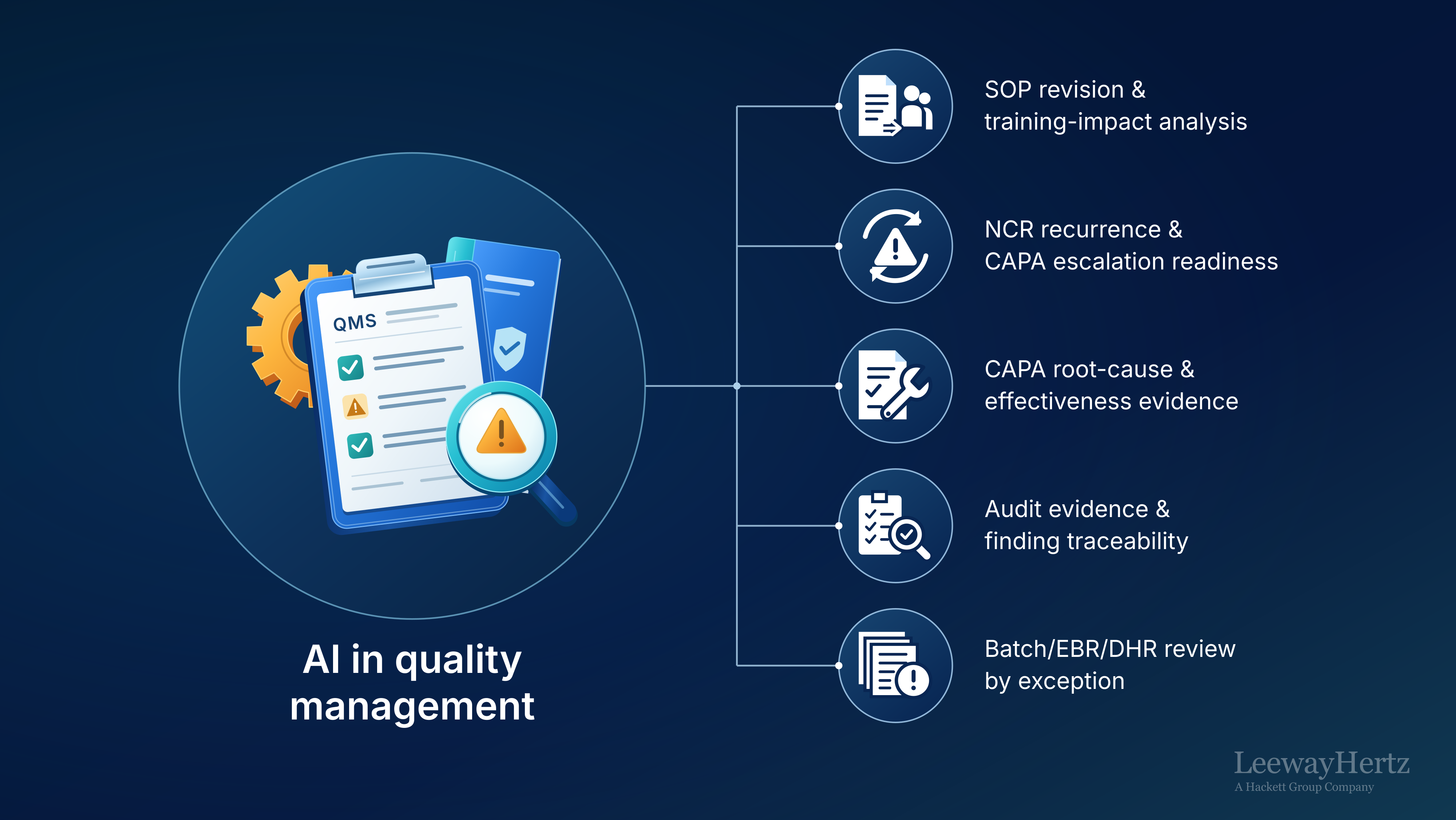
This makes quality management a strong environment for AI enablement. AI can retrieve and compare controlled records, identify recurring patterns, classify exceptions, connect related events, trace downstream impacts, and prepare evidence for review. For example, it can compare an SOP revision with affected training requirements, connect recurring NCRs with prior dispositions and CAPAs, assemble complaint evidence for regulatory affairs review, identify repeat audit findings, or surface exceptions from electronic batch records (EBR) and device history records (DHR) for QA review.
But AI opportunities should not be identified independently of how the QMS actually operates. A broad label such as “AI for CAPA” or “AI for document control” hides the underlying processes, records, system dependencies, controls, and approval points that determine whether a use case is practical. The same QMS domain can contain low-risk activities such as evidence retrieval and much higher-risk activities such as disposition, approval, reportability, or release.
For this reason, AI enablement should follow the quality management operating model itself: from function, to process, to sub-process. At the sub-process level, it becomes possible to define what artifact AI will analyze, which systems provide the evidence, what exception it should identify, what output it should prepare, and where the workflow must stop for human judgment. This operating-model approach also preserves accountability. AI may prepare evidence for containment, CAPA, complaint assessment, risk review, or release, but authorized quality and regulatory professionals remain responsible for the resulting decisions. AI can analyze, organize, recommend, and coordinate; it does not become the quality authority.
The article therefore maps quality management across its core functions, processes, and sub-processes and identifies AI opportunities within that structure. The objective is to move from broad AI ambition to use cases that are specific enough to build, govern, validate, and measure, while keeping quality-critical decisions with the people accountable for them.
- How AI is transforming quality management operations
- Why AI use cases in quality management must be mapped at the sub-process level
- Quality management operating model and AI opportunity mapping across processes
- High-value AI use cases in quality management
- How agentic AI works in quality management operations
- How to prioritize AI use cases in quality management
- Governance, risk, and responsible AI in quality management
- How ZBrain operationalizes AI use cases in quality management
- Future of AI in quality management
How AI is transforming quality management operations
AI is transforming quality management by helping teams interpret, validate, and act on quality data and evidence more effectively, enabling faster investigations, stronger compliance, and more consistent decision-making. Instead of reviewing records in isolation, quality teams can use AI to bring together related information across eQMS platforms, operational systems, document repositories, training systems, and quality records, then surface the exceptions, dependencies, and context that require attention.
The opportunity is strongest in work that is repetitive and evidence-intensive but still depends on professional judgment. AI can accelerate preparation, investigation, and coordination, while authorized quality and regulatory roles retain approval, disposition, release, reportability, and other quality-critical decisions.
The transformation is visible across five types of quality management work:
Document-heavy work
- Artifacts: SOPs, work instructions, NCRs, CAPA records, complaint files, audit reports, change-control records, FMEA, EBR/DHR records, CoAs, and training evidence.
- AI’s role: Document intelligence can extract controlled fields, compare revisions, identify missing or inconsistent evidence, check record completeness.
Narrative-heavy work
- Artifacts: CAPA investigation summaries, 8D reports, complaint investigations, audit findings and responses, change-impact assessments, management-review commentary, and customer response letters.
- AI’s role: Generative AI can prepare source-grounded drafts, distinguish established facts from hypotheses, identify unsupported statements, and highlight gaps that should be resolved before formal review or approval.
Exception-heavy work
- Artifacts: Recurring NCRs, overdue CAPAs, open audit findings, complaint trends, incomplete training, record-review exceptions, and delayed or incomplete change tasks.
- AI’s role: Classification groups related exceptions into consistent categories. Anomaly detection identifies unusual conditions, recurring issues, and emerging quality trends that warrant attention. Pattern analysis prioritizes issues based on factors such as risk, age, product impact, due dates, and potential downstream consequences.
Knowledge-heavy work
- Artifacts: Quality manuals, SOPs, work instructions, regulatory procedures, risk criteria, reportability decision trees, validation standards, prior investigations, and approved policy interpretations.
- AI’s role: Retrieval-grounded AI can locate the applicable approved requirement, bring forward relevant precedent, and compare it with the record under review. It can identify conflicts or missing context, while the authorized quality or regulatory role determines the appropriate conclusion.
Workflow-heavy work
- Artifacts: CAPA tasks, change implementation plans, training assignments, audit responses, release checklists, escalation records, and management records.
- AI’s role: Agentic workflows can monitor dependencies, retrieve the next required evidence, prepare review packets, route exceptions to the appropriate role, pause at defined human approval points, and record only authorized actions in the system of record.
The broader shift is from record-by-record review to evidence-connected quality work. AI can help quality teams move from manually searching across systems and reconstructing context to reviewing a prepared view of the relevant records, exceptions, history, and downstream impact.
That does not change who owns the decision. Quality engineers still decide on containment and technical disposition. CAPA owners and quality managers remain accountable for investigation conclusions and corrective-action approval. Complaint and regulatory teams keep authority over reportability decisions. QA reviewers remain responsible for release decisions. Quality leadership continues to approve management-review conclusions and quality-system actions.
The value of AI therefore depends less on how much of the QMS can be automated and more on how precisely it is applied. The strongest use cases connect a specific AI capability to a defined quality sub-process, a named quality artifact, and a clear human review boundary. That is where AI can reduce review effort, surface risk earlier, and improve the quality of the evidence available for accountable decisions.
Build governed AI workflows for quality management
Map quality management processes, identify high-value AI opportunities, and build governed workflows that connect controlled records, quality evidence, existing systems of record, and accountable human review.
Why AI use cases in quality management must be mapped at the sub-process level
Quality management is not a single workflow but a connected operating model in which distinct processes create, review, investigate, approve, disposition, release, and retain controlled quality records. Broad labels such as “AI for CAPA,” “AI for audits,” or “AI for document control” help identify an area of interest but do not specify an implementable AI solution.
A practical use case must answer more precise questions: What record will AI analyze? Which system holds the authoritative data? What condition or exception should it identify? What output should it prepare? Which procedure or regulatory requirement constrains the action? And who is accountable for reviewing the result?
Without those answers, the same use-case label can describe very different activities. “AI for CAPA,” for example, could mean identifying events that may warrant CAPA, assembling investigation evidence, generating root-cause hypotheses, monitoring corrective actions, supporting effectiveness checks, or assessing closure readiness. Each activity uses different records, carries different quality risks, and requires a different human review boundary.
A useful way to structure the QMS is therefore to decompose the work into four levels:
- Function: A major area of quality accountability, such as nonconformance management, CAPA, complaint handling, or document control.
- Process: A recurring workflow within that function, such as CAPA investigation, MRB disposition, complaint assessment, or periodic document review.
- Sub-process: A specific quality activity with defined inputs, outputs, records, exception conditions, system context, and accountable reviewer.
- AI-enabled opportunity: A specific AI capability applied to a named quality artifact to improve how that sub-process is prepared, analyzed, reviewed, or coordinated without transferring final quality authority to the model.
Consider the broad idea “AI for CAPA.” A more buildable use case would be recurring NCR evidence aggregation for CAPA initiation triage. AI could retrieve related NCRs, inspection results, prior MRB dispositions, supplier deviations, risk records, and existing CAPAs; identify recurrence patterns; and prepare an evidence packet against approved CAPA initiation criteria. The quality manager would still decide whether to open a CAPA.
That level of definition also reveals the data and integration requirements that broad use-case labels hide. Recurring-defect analysis may depend on NCRs from the eQMS, inspection or SPC data, lot genealogy from ERP or MES, supplier deviations, PFMEA entries, control-plan characteristics, and open CAPAs. Mapping those dependencies before design helps determine whether the required records are accessible, current, attributable, consistently structured, and connected well enough for reliable AI analysis.
Sub-process mapping is essential for governance. Drafting a management-review summary differs from recommending an MRB disposition; classifying a complaint differs from determining MDR or vigilance reportability; and identifying missing signatures in an EBR differs from releasing a batch. Defining actions at the sub-process level clarifies what AI may do, where it must stop, and which quality or regulatory role remains accountable for the decision.
It also makes value measurable. Instead of claiming that AI has “automated CAPA” or “improved quality management,” organizations can evaluate specific outcomes such as investigation preparation time, exception aging, recurrence detection, evidence completeness, reviewer rework, or decision turnaround for a defined activity. For this reason, the operating model below maps quality management from function to process to sub-process, then identifies AI opportunities only where the required artifacts, system context, expected output, and human review boundary are clearly defined. This translates broad AI vision into use cases that can be designed, validated, governed, and measured.
Quality management operating model and AI opportunity mapping across processes
Quality management comprises a connected set of activities that begin with controlled requirements and continue through nonconformance, investigation, CAPA, complaints, audits, changes, risk management, training, record review, release, and management oversight. Each function depends on upstream evidence and can create downstream obligations, so identifying practical AI opportunities requires understanding the full operating model.
The operating model covers ten core QMS functions:
1. Document control and SOP lifecycle
2. Nonconformance management
3. CAPA management
4. Complaint handling and post-market surveillance
5. Internal and supplier audit management
6. Quality-system change control
7. Risk management
8. Training and competency management
9. Batch record and release review
10. Management review and quality analytics
For each function, the analysis specifies the responsible teams, AI support for specific sub-processes, decisions reserved for authorized professionals, involved artifacts and systems, applicable regulatory considerations, the highest-value opportunities, and one illustrative agentic workflow.
Function 1: Document control and SOP lifecycle
Convert quality policies, procedures, work instructions, forms, and records into controlled content that is current, approved, traceable, and linked to the people responsible for each revision.
Document control constitutes the foundational element of a quality management system. A single revision can impact process instructions, forms, training requirements, validation assumptions, inspection criteria, and downstream quality records. The scope extends beyond textual edits to include controlled creation, review and approval workflows, effective-date management, distribution, periodic review, supersession, assessment of training implications, and evidence that the approved version is in active use.
Teams involved: Document control specialists, quality managers, process owners, quality engineers, training coordinators, regulatory affairs counterparts, site QA teams, and system administrators.
What AI helps with: Document intelligence can compare revisions, prepare redlines, and extract controlled metadata from document structure and entities. It can also help identify referenced forms and procedures when paired with entity linking, and flag missing approvals when combined with rules and validation logic. Retrieval AI and multi-source aggregation can locate related change records, current approved procedures, and obsolete versions.
What humans continue to own: Document owners determine technical content. Quality and designated approvers decide whether a controlled document is acceptable, when it becomes effective, whether training is required, and when to retire a superseded version. AI prepares evidence and proposed impacts, but it does not approve controlled content or activate an unapproved revision.
| Process | Sub-process | AI-enabled opportunities |
|---|---|---|
| Controlled document creation, review, and approval | Draft preparation and template compliance review |
|
| Review package assembly |
|
|
| Approval routing and authorization readiness assesment |
|
|
| Revision, training impact, and controlled distribution | Revision comparison and redline preparation |
|
| Training-impact assessment |
|
|
| Effective-date and controlled distribution readiness assessment |
|
|
| Periodic review and obsolescence | Periodic review scheduling and prioritization |
|
| Content relevance and obsolescence assessment |
|
|
| Supersession and archival control |
|
Key artifacts
- SOPs and work instructions
- Quality manuals and policies
- Document change requests
- Approval and review records
- Revision histories and redlines
- Controlled forms and templates
- Training-impact assessments
- Effective-date records
- Obsolescence and archival records
Systems involved
- eQMS and document-control platforms
- Document repositories
- Learning management systems
- ERP and MES where procedures reference operational data
- PLM at approved handoff points
- Identity and access-management systems
- Workflow and electronic signature systems
Regulatory considerations
- For medical-device manufacturers, controlled QMS documentation sits within the ISO 13485 framework incorporated into FDA QMSR, with FDA-specific requirements layered on top where applicable.
- When required records or signatures are maintained electronically under FDA predicate rules, assess Part 11 applicability and record-integrity controls.
- Pharmaceutical quality systems use controlled procedures and records under applicable GMP and ICH quality-system practices.
- AI-generated redlines, summaries, or training-impact recommendations remain draft evidence until an authorized document owner and quality approver accept them.
Accountable roles
- Document control specialist
- Quality manager
- Process owner
- Training coordinator
- Quality engineer
- Regulatory affairs specialist
- QMS system administrator
Highest-value opportunities
- Revision comparison and redline preparation: A single SOP revision can alter requirements, forms, linked work instructions, validation references, and training obligations. Evidence-backed comparison reduces manual line-by-line reconstruction while preserving document-owner approval.
- Training-impact identification: Revision-driven training populations are easy to under-scope when roles, sites, qualifications, and linked procedures are maintained in different records. AI can assemble the affected population before Quality confirms the assignment.
- Approval-package completeness validation: Incomplete attachments, unresolved comments, missing signatures, and inconsistent metadata create avoidable review loops. Pre-review validation gives approvers a cleaner controlled package without changing approval authority.
- Periodic-review prioritization: Large controlled-document libraries create review backlogs even though not every document has the same change exposure. Risk and change signals can help Document Control focus attention where content is most likely to be stale.
- Supersession and obsolete-copy detection: Obsolete references can persist in linked forms, training material, or local repositories after a revision becomes effective. Relationship analysis can surface those dependencies before they create execution inconsistency.
Example agentic workflow: revision comparison and redline preparation
- A document change request is approved for an SOP revision.
- AI retrieves the current SOP, the prior approved version, related forms, the open change-control record, the role matrix, and training requirements.
- Document comparison identifies changed requirements, referenced documents, and potentially affected forms or work instructions; it prepares a redline and impact summary.
- Training-impact analysis maps changed steps to roles and qualifications and prepares proposed assignments.
- Human checkpoint: The process owner validates technical content, document control verifies control metadata, and quality approves the revision and training impact.
- After approval, the eQMS activates the authorized version, routes training tasks, archives the superseded copy, and retains the review and approval trail.
Function 2: Nonconformance management
Capture and manage product, process, incoming inspection, and service nonconformances through containment, investigation, disposition, corrective action, and trend analysis.
Nonconformance management begins with a specific deviation from an approved requirement, but its consequences can cross production, inventory, supplier quality, risk management, CAPA, and field-action assessment. The quality record must identify what happened, what is affected, how exposure is contained, how disposition is decided, and whether the event is isolated or part of a recurring pattern.
Teams involved: Quality engineers, quality managers, production supervisors, inspectors, manufacturing teams, MRB members, supplier-quality counterparts, CAPA coordinators, and QA directors.
What AI helps with: Document intelligence can extract and structure NCR intake from forms, inspection reports, service records, and images. Multi-source aggregation can consolidate lot or serial genealogy, inspection results, SPC records, prior NCRs, PFMEA and control plan entries, and supplier nonconformance records into a unified review context. Pattern detection can identify recurring issues, emerging quality trends, and predefined escalation criteria to support CAPA review. Generative AI can prepare an evidence-backed MRB review packet without determining the final disposition.
What humans continue to own: Quality and MRB-authorized roles determine containment adequacy, disposition, concession or deviation acceptance, and whether a recurring problem warrants CAPA. Production executives approve containment and rework. AI can identify affected scope and propose options, but it does not release nonconforming material or decide use-as-is, rework, scrap, or return-to-vendor disposition.
| Process | Sub-process | AI-enabled opportunities |
|---|---|---|
| NCR intake, classification, and containment | NCR intake and structured capture |
|
| Initial severity and risk triage |
|
|
| Containment initiation |
|
|
| Investigation and MRB disposition | Affected-scope and genealogy review |
|
| Defect evidence and recurrence analysis |
|
|
| MRB disposition packet preparation |
|
|
| Disposition execution, trending, and CAPA escalation | Disposition execution verification |
|
| Recurring-NCR trend monitoring |
|
|
| CAPA escalation assessment |
|
Key artifacts
- Nonconformance reports (NCRs)
- Inspection reports
- SPC charts and process data
- Lot and serial genealogy
- Containment records
- MRB disposition records
- Rework instructions
- Supplier deviations
- PFMEA and control-plan references
- Scrap and return-to-vendor records
Systems involved
- eQMS
- MES and production systems
- ERP and inventory systems
- Inspection and SPC systems
- PLM for reference data and approved handoffs
- Supplier-quality systems
- Document repositories
- Data warehouse and analytics platforms
Regulatory considerations
- Medical-device nonconformance records operate within the manufacturer’s QMSR or ISO 13485 quality system, while authorized personnel retain release and disposition authority.
- FDA’s current computer software assurance guidance includes a worked nonconformance management-system example and recommends assurance commensurate with process risk and intended use.
- Automotive and aerospace organizations may apply sector methods such as MRB, PFMEA, control plans, IATF 16949, and AS9100 within their own applicable quality systems.
- A nonconformance that signals broader product or patient risk may be handed off to CAPA, complaint, risk management, or field-action assessment rather than closed as an isolated defect.
Accountable roles
- Quality engineer
- Quality manager
- Production supervisor
- MRB member
- Inspector
- Supplier quality engineer
- CAPA coordinator
- QA director
Highest-value opportunities
- Affected-lot and genealogy analysis: Determining the true scope of a nonconformance often requires lot genealogy, inspection evidence, WIP status, and shipped exposure from several systems. AI can assemble that scope faster for containment and MRB review.
- MRB evidence-packet preparation: MRB decisions require a coherent view of defect evidence, affected units, specifications, history, and disposition criteria. A structured packet reduces evidence hunting and leaves disposition to authorized MRB personnel.
- Repeat-NCR pattern detection: Recurring defects can be hidden by inconsistent descriptions, codes, sites, or lots. Pattern detection can connect similar events early enough for Quality to evaluate whether the issue is systemic.
- Containment scope recommendation: Containment is time-sensitive and depends on correctly identifying potentially affected inventory and operations. AI can propose an evidence-based scope while the quality engineer validates and authorizes the action.
- CAPA escalation assessment: CAPA thresholds are often applied across recurrence, severity, risk, and prior history rather than one NCR alone. Aggregating those signals gives the quality manager a stronger basis for the initiation decision.
Example agentic workflow: affected-lot and genealogy analysis
- A production NCR records the third similar dimensional defect.
- AI retrieves related NCRs, inspection results, SPC trends, lot genealogy, shipped exposure, PFMEA and control-plan rows, and relevant supplier deviations.
- Pattern detection identifies recurring nonconformances and emerging quality trends. Validation compares the available evidence with approved CAPA initiation criteria.
- The workflow prepares a containment recommendation, affected-lot list, MRB evidence packet, and CAPA escalation recommendation.
- Human checkpoint: The quality engineer validates scope and containment; authorized MRB personnel decide disposition; the quality manager decides whether to initiate CAPA.
- Approved tasks are routed to production, the NCR and CAPA records are linked, and the decision trail is retained for later audit and effectiveness review.
Function 3: CAPA management
Converting systemic quality signals into structured investigation, root-cause analysis, corrective and preventive actions, effectiveness verification, and documented closure.
CAPA is not a single investigation form. It is a governed lifecycle that begins with evidence that a problem is systemic or significant enough to require formal action. The work spans triage, problem definition, investigation planning, root-cause analysis, action design, implementation, risk and document updates, effectiveness verification, and closure. Weakness at any stage can produce recurring quality events or actions that treat symptoms rather than causes.
Teams involved: Quality managers, CAPA owners, quality engineers, process owners, production and engineering counterparts, regulatory affairs team where required, QA directors, and site quality heads.
What AI helps with: Multi-source aggregation can assemble evidence from NCRs, complaints, audits, deviations, risk files, process data, and prior CAPAs. Retrieval-grounded AI can retrieve and apply approved CAPA initiation criteria, investigation procedures, and related quality policies during case review. Pattern analysis can support 5-Why, fishbone, 8D, and similar root-cause methods by identifying recurring conditions, correlations, and contradictory evidence across investigations. Generative AI can prepare investigation summaries, corrective and preventive action plan drafts, and effectiveness review packets for human approval.
What humans continue to own: Quality managers authorize CAPA initiation and closure. CAPA owners and process experts determine root cause, action adequacy, and implementation commitments. Authorized quality personnel decide whether effectiveness criteria are met. AI can organize evidence, challenge gaps, and propose hypotheses, but it does not declare root cause, approve actions, or close a CAPA.
| Process | Sub-process | AI-enabled opportunities |
|---|---|---|
| CAPA initiation and triage | Initiation evidence assembly |
|
| CAPA criteria and priority assessment |
|
|
| Investigation and root-cause analysis | Investigation-plan preparation |
|
| 5-Why, fishbone, and 8D evidence facilitation |
|
|
| Corrective and preventive action planning and implementation | Action-plan design |
|
| Cross-record impact coordination |
|
|
| Effectiveness verification and closure | Effectiveness-criteria definition |
|
| Effectiveness evidence review and closure readiness assessment |
|
Key artifacts
- CAPA records
- Problem statements and triage records
- 5-Why analyses
- Fishbone/Ishikawa diagrams
- 8D reports
- Investigation plans
- Corrective and preventive action plans
- Effectiveness criteria and evidence
- Linked NCR, complaint, and audit records
- Risk-file and control-plan updates
Systems involved
- eQMS/CAPA platform
- Document management system
- MES/ERP and process-data systems
- Complaint management system
- Audit management system
- Risk-management repositories
- Training/LMS system
- Analytics and reporting platforms
Regulatory considerations
- Medical-device CAPA operates within the QMSR/ISO 13485 quality system; current FDA inspection practice can examine the evidence supporting how the quality system identifies and corrects systemic issues.
- Pharmaceutical quality systems use CAPA as a core improvement mechanism within ICH Q10 and applicable GMP quality processes.
- Root-cause methods such as 5-Why, fishbone, 8D, and FMEA are methodologies, not regulatory substitutes. Use them where they fit the problem and the evidence.
- Effectiveness verification must remain evidence-based and independent enough to determine whether the action actually reduced recurrence or controlled the identified cause.
Accountable roles
- Quality manager
- CAPA owner
- Quality engineer
- Process owner
- Production supervisor
- Regulatory affairs specialist
- QA director
- Site quality head
Highest-value opportunities
- CAPA initiation evidence assembly: A strong CAPA starts with a defensible problem statement and linked evidence, not a narrative assembled from memory. AI can collect the triggering records and separate known facts from open questions.
- Root-cause evidence synthesis: 5-Why, fishbone, and 8D work can fail when teams converge on a plausible story before reviewing contradictory evidence. AI can organize supporting and disconfirming records, so subject-matter experts test hypotheses more rigorously.
- Action-impact coordination: Corrective actions frequently change procedures, training, controls, suppliers, or risk records. Dependency analysis helps CAPA owners identify downstream obligations before approving and implementing actions.
- Effectiveness-verification readiness assessment: Effectiveness checks are credible only when post-action evidence can be compared with a defined baseline and acceptance criteria. AI can assemble that evidence without declaring the CAPA effective.
- Recurring-CAPA and overdue-action analysis: Aging actions and repeated CAPAs can reveal weak ownership, ineffective remediation, or systemic issues across sites. Trend analysis gives quality leadership a portfolio view beyond individual records.
Example agentic workflow: CAPA initiation evidence assembly
- A recurring NCR pattern meets the organization’s approved CAPA initiation threshold.
- AI creates a CAPA evidence package linking the initiating NCRs, inspection/SPC trends, PFMEA/control-plan controls, prior similar events, and relevant procedures.
- The workflow proposes an investigation plan and root-cause hypotheses, showing which evidence supports or contradicts each hypothesis.
- After human confirmation of the root cause, AI prepares action-impact analysis across procedures, training, controls, validation, suppliers, and risk files.
- Human checkpoint: The CAPA owner confirms root cause and action design; the quality manager approves the CAPA plan and later evaluates effectiveness evidence.
- After effectiveness is accepted, the system records closure, retains linked evidence, and updates trend views so it can detect recurrence after closure.
Function 4: Complaint handling and post-market surveillance
Converting customer and service feedback into quality investigations, reportability assessments, responses, post-market trends, and feedback into CAPA and risk management.
Complaint handling sits at the boundary between customer experience, product quality, regulatory reporting, field action, CAPA, and risk management. The same complaint may contain product-performance evidence, potential safety information, lot or serial references, service history, and incomplete facts that need follow-up. Quality teams need a traceable way to distinguish routine quality complaints from events that require regulatory affairs review or broader post-market action.
Teams involved: Complaint analysts, quality engineers, quality managers, regulatory affairs specialists, service teams, product experts, medical or safety functions where applicable, CAPA coordinators, and QA directors.
What AI helps with: Document intelligence can extract device, product, event, lot, serial, reporter, and symptom information from complaint intake. Retrieval-grounded AI can retrieve prior complaints, service history, risk management file entries, IFU and labeling information, and approved reportability decision trees. Classification can categorize complaints by product, failure mode, severity, and reportability attributes. Pattern detection can identify recurring issues and emerging complaint trends. Generative AI can prepare investigation summaries and draft response letters while clearly distinguishing source facts from recommendations.
What humans continue to own: Complaint and quality personnel validate the investigation. Regulatory affairs personnel or designated authorities make final MDR, vigilance, or other reportability decisions and determine submission actions. Quality and QA leadership decide CAPA or field-action escalation. AI may prepare a reportability recommendation, but it does not make the final regulatory determination or submit on its own authority.
| Process | Sub-process | AI-enabled opportunities |
|---|---|---|
| Complaint intake and quality classification | Complaint intake and structured extraction |
|
| Related-record retrieval |
|
|
| Reportability triage and investigation | US MDR evidence preparation |
|
| Complaint investigation and response drafting |
|
|
| PMS evidence consolidation for medical devices | Post-market trending and quality-system feedback |
|
Key artifacts
- Complaint files
- Intake forms and call transcripts
- Service reports
- Device or product history
- Investigation records
- MDR assessment records
- Customer response letters
- Trend reports
- CAPA links
- Risk-management file updates
Systems involved
- Complaint management/eQMS
- CRM and service systems
- ERP and lot/serial traceability
- Device history or batch repositories
- Regulatory reporting systems
- Risk-management repository
- Document management system
- Analytics platform
Regulatory considerations
- In the United States, the FDA MDR regulation requires manufacturers to evaluate certain device complaints for reportability, and reportable complaint/MDR records must remain clearly traceable.
- Medical-device complaint trends can feed ISO 14971 production and post-production risk management where the new evidence changes known hazards, risk estimates, or control effectiveness.
- Pharmaceutical complaints follow applicable GMP and product-quality complaint processes; do not apply medical device MDR terminology to pharma.
Accountable roles
- Complaint analyst
- Quality engineer
- Quality manager
- Regulatory affairs specialist
- Service representative
- CAPA coordinator
- QA director
- Risk management owner
Highest-value opportunities
- Complaint intake and completeness validation: Missing product identifiers, event dates, reporter details, or service history can delay investigation and reportability review. Early completeness checks reduce back-and-forth while preserving qualified review.
- Reportability evidence preparation: Reportability decisions are time-sensitive and jurisdiction-specific. AI can retrieve the event facts and applicable criteria into one packet so qualified quality or regulatory personnel can make the final determination.
- Complaint trend and recurrence detection: Similar field events may be recorded with different free-text descriptions, symptoms, or failure codes. Pattern analysis can surface emerging recurrence before it is obvious in basic counts.
- Investigation-summary drafting: Complaint investigations combine service records, product history, prior events, tests, and risk evidence. Source-grounded drafting can reduce narrative preparation while keeping conclusions with the investigator.
- Complaint-to-CAPA and risk-file escalation: Complaint signals have value only when systemic issues reach CAPA and risk management. Relationship mapping helps prevent field evidence from remaining isolated inside the complaint module.
Example agentic workflow: complaint intake and completeness validation
- A complaint reports a device malfunction and provides a serial number, service narrative, and partial event description.
- AI extracts the event details and retrieves prior complaints for the same model, service history, device history, labeling, risk-file entries, and approved reportability criteria.
- The QMS intelligence layer identifies missing evidence and prepares a targeted follow-up request; it also groups comparable events to show recurrence and severity patterns.
- The workflow prepares an investigation summary and an MDR or vigilance recommendation, linking the evidence and unresolved questions.
- Human checkpoint: The complaint analyst validates facts, quality reviews the investigation, and qualified regulatory affairs personnel make the final reportability and submission decision.
- The complaint disposition, regulatory decision, CAPA/risk escalation, customer response, and retained evidence are recorded in the controlled systems.
Accelerate AI Solutions Development
Build fully functional solutions from your high-value use cases, based on specific operational needs and enterprise context.
Function 5: Internal and supplier audit management
Converting audit programs, standards, procedures, prior findings, and evidence into risk-based audit plans, supported findings, corrective actions, and closure records.
Audit management is an evidence discipline. Auditors must prepare against the right criteria, sample the relevant records, trace observations to objective evidence, classify findings consistently, and follow up on responses until closure. Supplier audits add coordination with supplier-quality processes but remain part of the QMS hub when the audit supports qualification, monitoring, or a quality-system investigation.
Teams involved: Lead auditors, internal auditors, quality managers, process owners, supplier quality counterparts, document control, regulatory affairs where relevant, CAPA owners, and QA directors.
What AI helps with: Retrieval-grounded AI can assemble current procedures, prior findings, CAPAs, changes, training records, and applicable standards into an audit-preparation packet. Document intelligence can extract, classify, and index audit evidence from documents. Validation can map evidence to audit checklist criteria and identify missing or incomplete support. Classification can normalize audit findings and response status. Generative AI can draft finding narratives and evidence summaries, but the auditor must decide whether the evidence supports the finding.
What humans continue to own: Lead auditors determine sampling, evidence sufficiency, finding classification, and audit conclusions. Process owners own responses. Quality decides acceptance and closure under the audit program. AI cannot declare conformity, close a finding, or substitute generated language for objective evidence.
| Process | Sub-process | AI-enabled opportunities |
|---|---|---|
| Audit program planning and preparation | Risk-based audit scheduling |
|
| Checklist and criteria preparation |
|
|
| Evidence collection, findings, and response tracking | Audit evidence collection and indexing |
|
| Finding classification and report drafting |
|
|
| Response and closure evidence tracking |
|
|
| Supplier audit coordination at the QMS boundary | Supplier audit scope handoff |
|
Key artifacts
- Audit program and schedule
- Audit plans and checklists
- Objective evidence index
- Interview notes
- Finding reports
- Corrective-action responses
- CAPA links
- Supplier audit records
- Closure evidence
- Management review inputs
Systems involved
- Audit management platform
- eQMS
- Document management system
- LMS/training system
- CAPA system
- Supplier-quality systems
- ERP/MES for sampled records
- Analytics and reporting systems
Regulatory considerations
- Under the current FDA QMSR, FDA states that it may inspect management review, quality audit, and supplier audit reports that were previously subject to an inspection-record exception under the former QS regulation.
- Internal audits should therefore be evidence-based and controlled, while remaining a management tool for identifying weaknesses before external inspection.
- Pharmaceutical and other regulated sectors should apply their own applicable GMP or sector audit requirements rather than importing medical-device rules.
Accountable roles
- Lead auditor
- Quality manager
- Internal auditor
- Process owner
- Supplier quality counterpart
- CAPA owner
- QA director
- Site quality head
Highest-value opportunities
- Risk-based audit planning: Audit resources are limited, while risk changes with repeat findings, overdue CAPAs, process changes, complaints, and prior performance. AI can assemble a defensible risk view for the lead auditor to set scope and priorities.
- Audit-evidence packet assembly: Auditors often spend significant time locating approved procedures, records, prior findings, and corrective actions before testing begins. Indexed evidence preparation increases review readiness without substituting for sampling or judgment.
- Finding consistency and traceability review: Finding language can drift across auditors and sites. Comparing observations with criteria and prior classifications can improve consistency while the lead auditor still determines the final finding.
- Response and closure evidence tracking: Corrective responses frequently stall because owners, due dates, evidence, and related CAPAs are split across systems. Cross-record tracking helps auditors see whether commitments are actually complete.
- Repeat-finding and systemic-theme detection: Repeated findings may use different wording even when the underlying control weakness is the same. Semantic and trend analysis can identify systemic themes for management review or CAPA consideration.
Example agentic workflow: risk-based audit planning
- A scheduled internal audit targets CAPA and nonconformance controls after repeat deviations increase.
- AI retrieves current procedures, prior audit findings, CAPA records, representative NCRs, training records, relevant changes, and approved checklist criteria.
- The audit-preparation packet groups evidence by criterion and highlights prior findings, overdue actions, and recurrence patterns for auditor planning.
- During evidence collection, records are indexed to the checklist and possible gaps are flagged as questions, not findings.
- Human checkpoint: The lead auditor determines the sampling approach, evaluates objective evidence, classifies findings, and approves the report.
- The system tracks responses and closure evidence, and surfaces repeat themes for management review and possible CAPA escalation.
Function 6: Quality-system change control
Converting proposed changes to the quality system into classified, impact-assessed, approved, implemented, trained, verified, and traceable changes.
Quality-system change control governs changes to controlled procedures, QMS applications, workflows, records, responsibilities, and regulated quality processes. It is distinct from engineering change management, which owns PLM/ECO/BOM/CAD changes. The two processes may exchange impact information, but they should not be collapsed into one workflow.
Teams involved: Change control coordinators, quality managers, quality engineers, document control, system owners, validation or quality-IT teams, regulatory affairs counterparts, training coordinators, process owners, and review-board members.
What AI helps with: AI can classify a change request, retrieve affected SOPs and records, compare current and proposed states, identify training and validation impacts, and assemble a change-review-board packet. Multi-source analysis can trace dependencies across eQMS, LMS, ERP, MES, LIMS, and approved PLM handoffs. Generative AI can draft impact summaries and implementation checklists for review.
What humans continue to own: The change owner and subject-matter experts determine the proposed change. Authorized quality, validation, regulatory affairs, and change-board roles decide impact, approval, implementation conditions, and closure. AI can propose impacted records and controls, but it does not approve a quality-system change or determine regulatory strategy.
| Process | Sub-process | AI-enabled opportunities |
|---|---|---|
| Change request intake and classification | Change classification and routing |
|
| Impact assessment and review-board preparation | Document, process, and training impact assessment |
|
| Validation and regulatory impact assessment |
|
|
| Change review board packet preparation |
|
|
| Implementation and verification | Approved implementation orchestration |
|
| Implementation verification and closure |
|
Key artifacts
- Quality-system change requests
- Impact assessments
- Validation/qualification assessments
- Regulatory-impact assessments
- Document redlines
- Training-impact records
- Review-board packages
- Implementation plans
- Verification records
- Closure approvals
Systems involved
- eQMS/change-control platform
- Document management system
- LMS
- Validation or CSA repositories
- ERP/MES/LIMS
- Identity and access management
- PLM at engineering-change handoffs
- Workflow and ticketing systems
Regulatory considerations
- Medical-device quality-system software changes should be assessed under applicable QMSR/ISO 13485 obligations and current FDA computer software assurance guidance for production and QMS software.
- If an affected required record or signature is electronic, consider Part 11 applicability and record-integrity controls.
- Pharmaceutical change management should align with applicable GMP and ICH Q10 quality-system expectations, with product and process impact assessed in the relevant quality context.
- Engineering design/BOM/CAD change execution remains in PLM/ECO processes, and only hands approved quality impacts into this workflow.
Accountable roles
- Change control coordinator
- Quality manager
- Quality engineer
- Document control specialist
- Validation/CSA lead
- Regulatory affairs specialist
- Training coordinator
- Process owner
Highest-value opportunities
- Cross-document and process impact analysis: A QMS change can affect procedures, roles, forms, training, validation, integrations, and downstream quality records. Dependency analysis reduces the chance of missing a required update during review.
- Validation/CSA impact assessment: Software-related QMS changes need assurance proportionate to intended use and risk, not a generic testing checklist. AI can organize affected requirements and prior evidence for validation or CSA reviewers.
- Training-impact determination: Change implementation can fail when new process behavior is effective before the right people are trained. Mapping changed requirements to roles helps the change board see the training population before approval.
- Change review board packet assembly: Review boards need one coherent view of rationale, impacted records, validation, regulatory considerations, training, and implementation dependencies. Packet assembly reduces coordination work without weakening approval gates.
- Implementation-verification readiness assessment: Approved changes are not complete until configured changes, documents, training, validation evidence, and linked actions align. AI can assemble closure evidence and flag missing verification before quality signs off.
Example agentic workflow: cross-document and process impact analysis
- A site proposes a change to the electronic nonconformance workflow and its approval logic.
- AI retrieves the change request, current process map, QMS configuration, affected SOPs, training matrix, validation/assurance records, and related integrations.
- Impact analysis identifies changed roles, records, electronic signatures, downstream CAPA handoffs, reporting logic, and procedures that may require revision.
- The workflow prepares a validation/CSA impact summary, training-impact proposal, implementation checklist, and change-board packet.
- Human checkpoint: The system owner and process owner confirm intended use; quality and validation roles determine assurance; authorized change-board members approve or reject the change.
- Changes are implemented only after approval, then verified, training is completed where required, and the change is closed with a complete, traceable history.
Function 7: Risk management
Converting hazards, failure modes, controls, complaints, nonconformances, CAPAs, changes, and post-market evidence into maintained risk analyses and control decisions.
Risk management connects quality signals with the organization’s understanding of what can go wrong, how likely and severe the consequences may be, which controls are in place, and whether new evidence changes the residual-risk picture. In medical devices, this includes the formal risk-management file. In automotive and manufacturing, it often connects to PFMEA, DFMEA, and control plans. In pharma, it intersects with quality risk management under ICH Q9.
Teams involved: Risk management owners, quality engineers, design and manufacturing engineers at defined handoffs, quality managers, complaint analysts, CAPA owners, regulatory affairs specialists, process owners, and QA leadership.
What AI helps with: Multi-source aggregation can connect complaints, NCRs, CAPAs, audit findings, service data, and changes to existing FMEA or risk-file entries. Semantic matching can identify records that refer to the same failure mode using different wording. Pattern detection can surface changed occurrence signals or control weaknesses. AI can prepare proposed risk-file or control-plan updates for expert review.
What humans continue to own: Qualified risk owners and multidisciplinary teams identify hazards and failure modes, determine severity and probability approaches, accept or reject risk-control proposals, and approve residual-risk conclusions. AI can surface evidence and inconsistencies, but it does not accept residual risk or decide that a control is adequate.
| Process | Sub-process | AI-enabled opportunities |
|---|---|---|
| Risk analysis and FMEA maintenance | Risk-record evidence assembly |
|
| FMEA update assessment |
|
|
| Risk-control and control-plan lifecycle | Control-plan linkage and change impact analysis |
|
| Residual-risk and risk-control evidence review |
|
|
| Post-market and periodic risk review | Quality-signal to risk-file update |
|
| Periodic risk-file review |
|
Key artifacts
- Risk-management files
- Hazard analyses
- PFMEA and DFMEA
- Control plans
- Risk acceptability criteria
- Complaint and post-market data
- NCR and CAPA records
- Risk-control verification evidence
- Change-control impact records
- Periodic risk-review records
Systems involved
- Risk-management tools
- eQMS
- PLM at design-risk handoffs
- Complaint and post-market systems
- CAPA/NCR systems
- MES/inspection data repositories
- Document management system
- Analytics platforms
Regulatory considerations
- ISO 14971 defines the medical-device risk-management process and is the appropriate device-specific reference for product risk.
- Pharmaceutical quality risk management should use ICH Q9 and the pharmaceutical quality-system context of ICH Q10 rather than device-specific risk terminology.
- PFMEA, DFMEA, and control plans are relevant in manufacturing, automotive, and device contexts where those methods are actually used, but they are not universal regulatory requirements.
- AI-generated risk suggestions must preserve source evidence, version context, and the human authority responsible for risk acceptance and control decisions.
Accountable roles
- Risk management owner
- Quality engineer
- Quality manager
- Design/manufacturing engineer
- Complaint analyst
- CAPA owner
- Regulatory affairs specialist
- QA director
Highest-value opportunities
- Quality-signal to risk-file linkage: Complaints, NCRs, CAPAs, and audit findings can change the evidence behind an existing hazard or failure mode. Linking those signals keeps risk review connected to current quality experience.
- FMEA refresh candidate identification: FMEAs can become stale when recurrence, controls, or process conditions change. Pattern detection can identify rows whose assumptions no longer match observed quality evidence for team review.
- Control-plan impact analysis: CAPA or risk-control changes often require corresponding inspection or process-control updates. Cross-record comparison can reveal when the approved control plan no longer matches the intended risk control.
- Post-market risk trend detection: Field and complaint evidence may change the frequency or severity picture for known risks. Trend analysis can surface those shifts for the authorized risk team before the next periodic review.
- Residual-risk evidence packet preparation: Residual-risk decisions require traceable evidence that controls were implemented and their effects are understood. AI can assemble the relevant records while risk acceptance remains a human authority point.
Example agentic workflow: quality signal to risk file linkage
- A cluster of complaints and NCRs references a failure mode already present in the medical-device risk-management file.
- AI links the new records to the existing hazard sequence, controls, complaint-trend history, CAPAs, and verification evidence.
- Pattern analysis shows whether occurrence or detectability assumptions appear inconsistent with the new evidence and identifies controls associated with repeat failures.
- The workflow prepares a proposed ISO 14971 risk-file update and, where applicable, PFMEA/control-plan redline suggestions with source links.
- Human checkpoint: The multidisciplinary risk team evaluates severity, probability, control adequacy, and residual risk; regulatory affairs reviews any regulatory implications.
- Approved changes are recorded in the controlled risk file and linked to CAPA, change control, and management review as required.
Function 8: Training and competency management
Converting role requirements, controlled-document changes, qualifications, and effectiveness evidence into current training and competency records.
Training management is often treated as assignment administration, but the harder problem is determining who actually needs training, what level of competency is required, whether the training reflects the effective procedure, and whether a critical operation requires demonstration of qualification rather than simple completion. Revisions, role changes, site transfers, CAPAs, and audit findings can all change the training population.
Teams involved: Training coordinators, document control, quality managers, process owners, production supervisors, HR/LMS administrators, quality engineers, and qualification assessors for critical operations.
What AI helps with: AI can map job roles to approved procedures, compare revision changes with existing training requirements, identify affected learners, detect missing or expired qualifications, and prepare training-on-revision packages. Retrieval-grounded answering can help learners find the current approved procedure while preserving the distinction between training support and qualification evidence.
What humans continue to own: Process owners and quality teams determine whether a revision requires training and what competency standard applies. Supervisors and qualified assessors confirm practical qualification. AI may propose assignments and flag gaps, but it does not certify competency or waive required training.
| Process | Sub-process | AI-enabled opportunities |
|---|---|---|
| Role-based training matrix administration | Role-to-requirement mapping |
|
| Training-gap and assignment review |
|
|
| Training on revision | Revision impact and learner identification |
|
| Training content and assignment package preparation |
|
|
| Effectiveness assessment and qualification review | Training effectiveness review |
|
| Critical-operation qualification readiness assessment |
|
Key artifacts
- Role-based training matrices
- SOP and work-instruction revisions
- Training assignments
- Completion records
- OJT evidence
- Trainer/assessor records
- Training-effectiveness review report
Systems involved
- LMS and training platforms
- eQMS/document control
- HR identity and role systems
- MES/production qualification systems
- Skills matrices
- Workflow and notification tools
- Audit and CAPA systems
Regulatory considerations
- Medical-device QMS competence and training records should remain aligned with the organization’s QMSR/ISO 13485 obligations and the roles performing regulated quality work.
- Pharmaceutical manufacturing and quality operations require training and qualification appropriate to assigned GMP responsibilities.
- Electronic training records and signatures may trigger Part 11 considerations when FDA-required records are maintained electronically.
- Completion alone should not serve as a proxy for competency when a critical operation requires demonstrated qualification or evidence of effectiveness.
Accountable roles
- Training coordinator
- Document control specialist
- Quality manager
- Process owner
- Production supervisor
- Qualified assessor
- HR/LMS administrator
- Quality engineer
Highest-value opportunities
- Training-on-revision population identification: A single controlled revision can affect different roles, sites, shifts, and qualification states. Automated mapping reduces the administrative search needed to identify who must act before the effective date.
- Role-to-requirement mapping: Training matrices become unreliable when job roles, procedures, and qualification requirements change independently. Relationship mapping can expose gaps and obsolete assignments for Quality review.
- Qualification-gap detection: Completion of coursework does not prove readiness for critical work. AI can flag expired, missing, or inconsistent qualification evidence so supervisors and assessors can focus on the people who need action.
- Training record completeness validation: Electronic and paper training records can contain missing approvals, dates, versions, or assessor evidence. Completeness checks improve audit readiness without treating record presence as proof of competence.
- Effectiveness and retraining signal analysis: Repeat errors, deviations, audit findings, or changed procedures may indicate that training did not produce the intended behavior. Trend analysis can surface retraining candidates for process-owner review.
Example agentic workflow: training-on-revision population identification
- An approved work-instruction revision changes a critical inspection step.
- AI compares the revised instruction with the prior version and retrieves the role matrix, qualification requirements, active employee roster, and current training records.
- The workflow identifies affected inspectors, supervisors, and backup roles, distinguishes awareness training from practical qualification, and flags existing expired qualifications.
- A training package and proposed due dates are prepared and linked to the effective-date plan.
- Human checkpoint: The process owner and quality teams approve the training impact; qualified assessors confirm competency for critical operations.
- Only trained and qualified personnel remain eligible for the affected operation, and the completion, assessment, approval, and effectiveness evidence are retained.
Function 9: Batch record and release review
Converting regulated production records, deviations, inspection evidence, signatures, and quality decisions into a supported release-readiness package.
Release review is a high-accountability process because it is the final quality gate before regulated product enters distribution. The exact artifact differs by sector. Pharma quality units review batch or electronic batch records and related deviations; medical-device manufacturers review device history or equivalent production and acceptance records. AI is most useful in the preparation and exception-detection work around that decision, not in taking release authority away from quality.
Teams involved: QA reviewers, batch record reviewers, quality engineers, production and manufacturing teams, laboratory or QC counterparts, deviation owners, qualified or authorized release personnel where applicable, and QA directors.
What AI helps with: Document intelligence can extract required entries, signatures, dates, yields, results, and attachments from batch, EBR, DHR, and CoA records. Multi-source comparison can link deviations, inspection results, laboratory records, and approved specifications. Exception detection can flag missing signatures, conflicting values, unclosed deviations, or records that don’t match the approved product or lot. AI can assemble a release-readiness packet for authorized review.
What humans continue to own: Authorized quality personnel decide disposition and release. Deviations and exceptions must be resolved according to applicable procedures, and the reviewer determines whether the record supports release. AI cannot release a batch or device, accept a deviation, or substitute a generated summary for the controlled record.
| Process | Sub-process | AI-enabled opportunities |
|---|---|---|
| Record assembly and completeness assessment | Batch, EBR, or DHR record assembly |
|
| Deviation and exception linkage |
|
|
| Review-by-exception and evidence verification | Pharmaceutical production-record review |
|
| Medical-device DHR or equivalent record review |
|
|
| Release readiness assessment | Release-readiness packet preparation |
|
Key artifacts
- Batch records and electronic batch records
- Device history or equivalent production records
- Certificates of analysis
- Inspection and test results
- Deviation records
- Rework and concession records
- Required signatures and approvals
- Labeling/packaging checks
- Release checklists
- Final disposition records
Systems involved
- MES/eBR platforms
- eQMS/deviation systems
- LIMS
- ERP and inventory systems
- Device history repositories
- Document management system
- Electronic-signature services
- Quality review dashboards
Regulatory considerations
- Pharma examples should use applicable GMP batch-record, deviation, OOS/OOT, and quality-unit release context rather than device terminology.
- Medical-device examples should use device production and acceptance records under the applicable QMSR/ISO 13485 quality system rather than pharma batch-release concepts.
- Where FDA-required production or QMS records and signatures are maintained electronically, Part 11 applicability and record integrity must be assessed.
- AI review-by-exception can support the reviewer, but final release, acceptance of deviations, and disposition remain authorized human decisions.
Accountable roles
- QA reviewer
- Quality manager
- Quality engineer
- Production representative
- QC/laboratory counterpart
- Deviation owner
- Authorized release role
- QA director
Highest-value opportunities
- Record completeness review: Batch, EBR, and DHR review involves checking many required entries, signatures, attachments, and linked records. Review-by-exception can concentrate QA attention on missing or inconsistent evidence.
- Deviation and exception linkage: Release reviewers need to know whether every out-of-limit or deviation record is linked, investigated, and dispositioned. Cross-record linkage can surface unresolved exceptions before final review.
- Signature and version validation: A record can appear complete while containing signatures from the wrong stage or references to superseded instructions. Validation can detect those integrity issues before an authorized release decision.
- Cross-record inconsistency detection: Inspection, laboratory, CoA, deviation, and production records can conflict even when each document is individually complete. Multi-source comparison can identify discrepancies that require QA investigation.
- Release-readiness packet preparation: The final Quality decision is easier to review when unresolved exceptions, required evidence, deviations, and approvals are assembled in one traceable package. AI prepares the packet, but authorized QA retains release authority.
Example agentic workflow: record completeness review
- A regulated batch or device history record reaches quality for final review.
- AI retrieves the approved master record, completed batch/EBR/DHR, inspection and test results, CoAs, deviations, rework records, and required approvals.
- Document intelligence checks document completeness and version alignment. Comparison identifies missing signatures, inconsistent values, unresolved deviations, and test results outside defined acceptance criteria.
- The workflow assembles only the unresolved or high-risk items into a release-review packet with links to the controlled records.
- Human checkpoint: The QA reviewer investigates exceptions, and authorized quality personnel decide disposition and release.
- The final decision, supporting evidence, deviations, reviewer comments, and electronic approvals are retained in the systems of record.
Function 10: Management review and quality analytics
Converting distributed quality data, objectives, trends, audits, CAPAs, complaints, risk signals, and improvement actions into management review decisions and accountable follow-through.
Management review ensures the QMS functions as an integrated management system rather than a collection of disconnected modules. Quality leadership needs a consistent view of objectives, CAPA health, complaints, NCR trends, audit findings, supplier issues, training effectiveness, release exceptions, cost of quality, and emerging risk across sites. The challenge is not producing more charts. It is connecting each metric to the records, exceptions, and decisions behind it.
Teams involved: QA directors, management representatives, site quality heads, quality managers, quality systems teams, CAPA and complaint owners, audit leads, operations counterparts, and executive quality leadership.
What AI helps with: AI can consolidate quality data across sites and systems, reconcile metric definitions, identify outliers and recurring themes, draft evidence-backed KPI commentary, and prepare management review packs. Trend analysis can show which CAPAs, audit findings, complaint signals, or NCR patterns are driving deterioration. Natural-language generation can prepare first drafts of quality-objective commentary with links to source records.
What humans continue to own: Quality leadership sets objectives, interprets risk, determines priorities, allocates resources, accepts management-review conclusions, and approves actions. AI may prepare a cross-site evidence view and identify patterns, but it does not determine whether the QMS is effective or replace management accountability.
| Process | Sub-process | AI-enabled opportunities |
|---|---|---|
| Quality-data integration and KPI preparation | Cross-system quality-data consolidation |
|
| KPI and cost-of-quality commentary preparation |
|
|
| Management review pack assembly | Quality objective status and issue synthesis |
|
| Pharmaceutical quality-system management review |
|
|
| Management action assignment and follow-up |
|
|
| Decision capture and follow-through | Action effectiveness and next-cycle preparation |
|
Key artifacts
- Management review packs
- Quality objectives
- KPI dashboards
- CAPA aging and effectiveness reports
- Complaint and NCR trends
- Audit status reports
- Risk summaries
- Training and qualification metrics
- Cost-of-quality reports
- Management action logs
Systems involved
- eQMS
- Data warehouse/data lakehouse
- BI and analytics platforms
- ERP/MES/LIMS
- Complaint and audit systems
- Training/LMS
- Risk-management repositories
- Management review workflow tools
Regulatory considerations
- FDA’s current QMSR FAQ states that management review reports are among records FDA may inspect under the revised device quality system framework.
- Pharmaceutical quality systems use management review as part of ICH Q10’s lifecycle approach to product and process performance and continual improvement.
- Cross-site analytics should preserve metric definitions, source lineage, period/version context, and access controls so management can trace a narrative back to the underlying quality record.
- AI-generated conclusions should be framed as evidence summaries or recommendations. Management remains accountable for QMS effectiveness decisions and resource commitments.
Accountable roles
- QA director
- Management representative
- Site quality head
- Quality manager
- Quality systems manager
- CAPA owner
- Lead auditor
- VP quality/chief quality officer
Highest-value opportunities
- Management-review pack assembly: Management review draws evidence from nearly every QMS domain. Automated aggregation can reduce manual compilation and give Quality leadership a more coherent view of systemic issues and open actions.
- Cross-site KPI normalization and exception detection: Site metrics often use different labels, periods, or aggregation conventions. Normalization standardizes data from different sources to support reliable comparisons, while anomaly detection highlights meaningful deviations without losing the underlying source context.
- CAPA/complaint/NCR theme synthesis: Systemic quality issues may appear separately as CAPAs, complaints, NCRs, and audit findings. Cross-domain theme analysis can reveal common causes and recurring weaknesses that module-level dashboards miss.
- Quality-objective commentary preparation: Management-review narratives are stronger when each statement traces to current KPI evidence and exceptions. Source-grounded drafting reduces preparation effort and flags commentary unsupported by the data.
- Management action follow-through: Management-review actions can lose visibility once assigned into separate systems or local trackers. Cross-system status aggregation helps leadership distinguish completed actions from overdue or weakly evidenced closure.
Example agentic workflow: management-review pack assembly
- The quarterly management-review cycle opens across several sites.
- AI retrieves approved KPI datasets, CAPA aging and effectiveness results, complaint and NCR trends, audit findings, risk updates, training metrics, and prior management actions.
- Data checks reconcile site definitions and flag missing or inconsistent periods before aggregation.
- Trend analysis identifies the few themes driving deterioration and prepares source-linked commentary and action-status summaries.
- Human checkpoint: Quality leadership challenges the evidence, determines priorities, approves actions and owners, and records management conclusions.
- Approved actions are tracked to the next review cycle, with effectiveness and overdue status automatically connected back to the source quality records.
Accelerate AI Solutions Development
Build fully functional solutions from your high-value use cases, based on specific operational needs and enterprise context.
High-value AI use cases in quality management
Not every quality activity presents the same opportunity for AI enablement. The highest-value opportunities tend to sit where teams repeatedly gather evidence, compare records, investigate exceptions, trace dependencies, or prepare review packages before an accountable quality or regulatory professional decides.
Across the QMS, these opportunities appear in different forms: identifying recurring nonconformances, tracing the impact of an SOP revision, assembling CAPA evidence, preparing complaint-reportability context, reviewing records by exception, or connecting quality signals for management review. Their value is not simply the amount of manual work involved. It is the combination of strong evidence burden, recurring exceptions, cross-process impact, and a clearly defined human decision boundary.
The following use cases represent some of the strongest opportunities for applying AI across quality management.
| High-value AI use case | How AI supports the work | Why it is high value |
|---|---|---|
| SOP revision and training-impact analysis | AI compares the current and proposed SOP, referenced forms, role matrix, and training requirements; it prepares redlines and affected-role recommendations. | One document change can create downstream training, process, and validation obligations that are difficult to trace manually. |
| Recurring-NCR detection and CAPA escalation readiness assessment | AI links NCRs, defect codes, lots, inspection/SPC data, prior dispositions, PFMEA/control-plan rows, and CAPA criteria. | Repeat defects often span records and sites. Earlier recurrence detection improves containment and visibility into systemic problems. |
| CAPA root-cause evidence synthesis and effectiveness readiness assessment | AI assembles related quality signals, identifies supporting and conflicting evidence, and prepares hypothesis and effectiveness packets. | CAPA quality depends on evidence, not narrative volume. Better evidence synthesis can expose weak root-cause logic or ineffective actions earlier. |
| Complaint reportability evidence preparation | AI extracts complaint facts, retrieves similar events, service/device history, risk records, and applicable reportability criteria, then prepares a recommendation. | Complaint files can be incomplete and time-sensitive. A structured evidence packet helps reviewers focus on the regulatory decision rather than manual record search. |
| Audit evidence and finding traceability | AI maps approved procedures, prior findings, CAPAs, training records, and sampled evidence to audit criteria. | Auditors spend significant effort preparing and indexing evidence. Better traceability helps distinguish questions from supported findings. |
| QMS change-impact assessment | AI connects a proposed change with SOPs, workflows, training, validation/CSA records, electronic signatures, and downstream QMS processes. | Missed dependencies can leave procedures, training, and system controls inconsistent after a change. |
| Risk-file and FMEA refresh candidate identification | AI connects complaints, NCRs, CAPAs, audit findings, and changes with existing hazards, failure modes, and controls. | Risk files can lag new field and production evidence. Linking signals to existing risk constructs improves review focus. |
| Training qualification-gap detection | AI maps approved procedures to roles and current qualifications, identifies affected learners and expired credentials, and prepares assignment packages. | Revision-driven training often creates a large administrative search problem, especially across sites and critical operations. |
| Batch/EBR/DHR review by exception | AI checks required fields, signatures, deviations, inspection/lab results, CoAs, and version alignment and assembles unresolved exceptions. | Reviewers can spend significant time rechecking complete records. Exception-led review concentrates attention on conditions that may affect disposition or release. |
| Management-review evidence synthesis | AI consolidates CAPA, complaint, NCR, audit, risk, training, release, and KPI data and prepares source-linked trends and action status. | Quality leadership needs a connected view of systemic risk, not separate module reports. Cross-domain synthesis can reveal recurring themes and overdue decisions. |
Taken together, these use cases show where AI can create the most practical value in the QMS before the final quality decision. AI can retrieve and connect evidence, identify patterns, surface exceptions, trace downstream impacts, and prepare review-ready context, reducing the manual reconstruction required of quality teams.
The strongest opportunities also share an important characteristic: the boundary between AI assistance and human authority is clear. AI may identify a recurring NCR, prepare a CAPA evidence packet, flag a potential complaint-reportability condition, or surface exceptions in an EBR or DHR, but authorized quality and regulatory professionals remain responsible for containment, disposition, CAPA decisions, reportability, risk acceptance, release, and management-review conclusions.
For organizations deciding where to begin, the priority should therefore be use cases that combine meaningful review effort, reliable source data, repeatable exception logic, measurable operational value, and an explicit human checkpoint. These conditions make an AI use case not only attractive but also practical to design, validate, and govern.
How agentic AI works in quality management operations
Agentic AI supports quality management by coordinating a sequence of evidence retrieval, analysis, exception handling, draft preparation, system interaction, and human approval across the QMS. Unlike a standalone assistant that responds to one prompt, an agentic workflow can respond to a defined quality event, retrieve authorized records from several systems, apply specialized capabilities, prepare the next review packet, and pause whenever regulated judgment or approval is required.
The value does not come from allowing AI to make quality decisions independently. It comes from connecting activities that are often managed across separate modules, spreadsheets, email, and reports while preserving the authority of quality, regulatory affairs, MRB, auditors, risk owners, and release personnel.
Example agentic workflow: recurring nonconformance to CAPA and risk update
- The workflow begins when a new production NCR creates a recurring dimensional defect pattern.
- The nonconformance workflow retrieves the NCR history, inspection results, SPC charts, affected-lot genealogy and shipped exposure, current PFMEA and control-plan rows, related CAPAs, and open supplier deviations.
- Pattern detection identifies recurring nonconformances and emerging quality trends, while retrieval-grounded analysis retrieves and applies the approved CAPA initiation criteria, containment procedures, and MRB rules. The workflow prepares an affected-lot list, containment recommendation, MRB evidence packet, CAPA initiation recommendation, and preliminary root-cause hypotheses.
- The workflow identifies that the failure mode is already represented in the PFMEA and that the current control plan does not reflect the observed recurrence. It prepares proposed risk-file and control-plan update candidates without changing the approved records.
- Human checkpoint: The quality engineer validates containment and evidence; MRB-authorized roles decide disposition; the quality manager decides CAPA initiation; and the QA director and regulatory affairs are engaged if shipped-product exposure may require field-action assessment.
- After CAPA initiation is approved, the workflow opens or updates the CAPA record, routes containment and investigation tasks, links the NCR and risk records, and retains the evidence and decision trail.
- As actions are implemented, the workflow monitors due dates, retrieves effectiveness evidence, and flags recurrence or conflicting data. Quality teams determine whether effectiveness criteria are met and whether to close the CAPA.
Accelerate AI Solutions Development
Build fully functional solutions from your high-value use cases, based on specific operational needs and enterprise context.
How to prioritize AI use cases in quality management
AI use cases in quality management should be prioritized at the sub-process level, not at the level of broad QMS domains. Categories such as CAPA, audit management, or change control encompass many distinct activities with different triggers, evidence requirements, decision points, and reviewers, making them too broad for meaningful evaluation.
A well-defined AI use case should specify the triggering condition, quality artifact, systems involved, AI capabilities, expected output, regulatory and procedural context, human decision point, and accountable reviewer. This level of definition makes it possible to assess business value, implementation effort, governance requirements, and regulatory risk before selecting a use case for deployment.
Prioritization criteria
| Prioritization criterion | Questions to evaluate | Why it matters |
|---|---|---|
| Quality and patient/product impact | Could an error affect product conformity, patient safety, product release, regulatory reporting, or the effectiveness of the QMS? | Higher-impact use cases may create major value but require stronger validation, logging, and human approval. |
| Manual review effort | How much time do quality professionals spend collecting records, comparing versions, checking completeness, or preparing review packets? | AI creates more value when professionals repeatedly prepare evidence before applying judgment. |
| Exception volume and recurrence | How many NCRs, complaints, audit findings, overdue actions, or review exceptions occur, and how difficult are they to classify? | High-volume exception processes are strong candidates for classification, evidence retrieval, and prioritization. |
| Artifact and data readiness | Are the required controlled records accessible, versioned, attributable, and consistently linked across systems? | A valuable use case cannot operate reliably when the source record is incomplete or ambiguous. |
| Decision repeatability | Can the activity be expressed through stable criteria, evidence requirements, patterns, or taxonomies? | Repeatable work is easier to validate and monitor than activities driven primarily by case-specific expert judgment. |
| Human review clarity | Is it explicit who reviews the AI output and who approves the resulting quality action? | A defined boundary prevents the model from becoming the MRB authority, CAPA approver, regulatory decision-maker, risk acceptor, or release authority. |
| Regulatory and validation burden | Does the workflow create, modify, or support regulated records or decisions, and what assurance or validation is appropriate to intended use? | The control strategy should match the actual process and record risk, not generic AI hype. |
| Integration complexity | How many eQMS, ERP, MES, LIMS, PLM, LMS, complaint, or analytics systems must be connected? | Use cases with fewer stable integrations may be better early candidates; cross-system cases can follow after the foundation is proven. |
| Measurable outcome | Can the organization measure review time, recurrence, exception aging, evidence completeness, return rate, or decision turnaround? | Sub-process measures let Quality leadership evaluate value without relying on unsupported enterprise-wide savings claims. |
Start with high-value, bounded use cases
The strongest initial candidates generally involve defined artifacts, repeated review activities, and clear human checkpoints. Examples include SOP revision comparison, NCR evidence assembly, audit-evidence indexing, training-impact identification, complaint completeness checks, and batch/DHR record completeness review. These use cases can improve preparation without changing the underlying quality authority.
Prioritize cross-process opportunities after establishing reliable foundations
The next tier connects several QMS domains. Recurring-NCR-to-CAPA escalation, complaint-to-risk/CAPA feedback, change-to-document/training impact, and late-record or release-impact assessment can create broader value, but they require stronger identity resolution, data lineage, record linking, and workflow coordination.
Apply stricter controls to judgment-intensive use cases
Use cases that influence MRB disposition, complaint reportability, CAPA closure, residual-risk acceptance, controlled-document approval, or final release should remain decision-support workflows with mandatory review, evidence traceability, constrained system actions, and explicit stop conditions when evidence is missing or confidence is low.
Priority tiers
| Priority tier | Characteristics | Representative use cases |
|---|---|---|
| Tier 1: Preparation and validation | Defined records, accessible data, repeatable checks, low-autonomy outputs, and clear reviewers. | SOP comparison, record completeness, audit-evidence assembly, and training-impact analysis. |
| Tier 2: Exception intelligence and coordination | Multiple systems, recurring patterns, downstream dependencies, and role-based routing. | NCR recurrence, complaint trends, CAPA evidence synthesis, and change-impact analysis. |
| Tier 3: Judgment and regulated-decision support | Higher product or regulatory risk, significant expert judgment, and explicit authorized authority. | MRB support, reportability recommendation, residual-risk review, and release-readiness assessment. |
Build a balanced use-case portfolio
- Cycle-time improvement: Reduce evidence gathering, document comparison, review preparation, and routing effort.
- Quality improvement: Identify incomplete records, inconsistent classifications, weak evidence, and recurring defects earlier.
- Risk reduction: Surface high-risk complaints, repeat nonconformances, overdue CAPAs, weak controls, and release exceptions sooner.
- Decision support: Give authorized quality professionals clearer evidence, history, source links, and downstream impact before they approve an action.
Governance, risk, and responsible AI in quality management
Quality systems influence product conformity, patient or user risk, regulatory records, disposition, release, and the evidence auditors and regulators inspect. Governance must therefore address both AI behavior and the QMS controls around it.
Even an evidence-grounded output can create risk if it uses an obsolete SOP, the wrong lot or serial, an unapproved risk-file version, an incomplete complaint file, or information the user is not authorized to access.
Human-in-the-loop oversight
AI may compare documents, classify NCRs, prepare CAPA evidence, retrieve complaint criteria, assemble audit packets, trace change impacts, flag risk updates, identify training gaps, and prepare release-readiness evidence.
Authorized professionals retain final approval, disposition, reportability, risk acceptance, competency, release, and management-review authority.
Regulatory and standards alignment
The control model should reflect the applicable sector and jurisdiction. Medical-device examples may involve FDA QMSR, ISO 13485, ISO 14971, and Part 11, where applicable; pharmaceutical examples use ICH and GMP context. NIST AI RMF and its generative AI Profile can inform enterprise AI risk governance without replacing product-sector requirements.
Intended use and computer software assurance
For medical-device production or QMS software, FDA’s current computer software assurance guidance recommends a justified, risk-based assurance approach based on intended use and the potential effect on product quality, patient safety, and record integrity. AI-enabled QMS functions should be scoped and tested according to how they are actually used.
Model risk and evidence retention
Risks include incorrect classification, unsupported root-cause hypotheses, hallucinated narratives, stale record retrieval, false trend signals, automation bias, and missed dependencies.
Generated outputs should distinguish source facts, proposed interpretations, recommendations, and unresolved questions. Retain the evidence, record versions, configuration, output, reviewer disposition, approval, and resulting system action needed to reconstruct the decision.
Data integrity and electronic records
Where FDA-required records or signatures are maintained electronically, Part 11 applicability and predicate-rule obligations should be assessed. The AI layer should not break record attribution, version control, signature meaning, retention, or the ability to reproduce the controlled evidence.
Least privilege and action control
Agents should retrieve only approved data and use only the tools required for the bounded use case. Critical actions should be blocked until required approval is recorded.
Low-confidence results, conflicting evidence, missing records, or unauthorized requests should route to exception handling rather than produce a plausible answer.
Traceability and monitoring
Each workflow should preserve the initiating event, source systems and artifacts, versions, instructions or policy set, model or configuration, tool actions, output, confidence signals, reviewer decision, approvals, and downstream updates.
Reviewer overrides, rejected recommendations, recurrence after closure, and workflow failures should be monitored as part of ongoing quality governance.
How ZBrain operationalizes AI use cases in quality management
Identifying high-value use cases in quality management is only the first step. Organizations also need a structured way to capture the actual operating context, translate it into a build-ready design, create and test the agentic solution, and govern runtime behavior inside defined quality boundaries.
ZBrain currently presents a governed lifecycle that moves a selected use case from analysis to technical design, solution build, and production governance. Governance is established through the lifecycle rather than added only after deployment.
1. ZBrain Analyzer establishes the quality use case context
A promising idea such as “AI for CAPA” is not yet buildable. Analyzer captures the process, artifacts, systems, exception conditions, roles, performance measures, regulatory context, human review points, prohibited actions, and dependencies that define the selected sub-process.
For recurring-NCR-to-CAPA triage, the analysis can capture NCR populations, defect taxonomies, CAPA thresholds, lot/serial data, PFMEA/control-plan links, MRB roles, and downstream risk-file obligations.
2. ZBrain Design creates the build-ready technical design
The validated use case becomes a technical design that specifies workflow logic, data fields, integrations, agent responsibilities, deterministic rules, confidence thresholds, review gates, audit evidence, failure paths, and acceptance criteria. It produces comprehensive artifacts, technical specifications, epics, BRDs, schemas, ERDs, data flow diagrams, governance and operational frameworks, and a statement of work, anchored in the finalized architecture design.
For a complaint use case, the design can specify how the solution retrieves complaint records and device history, applies reportability criteria, handles missing facts, prepares the recommendation, and blocks any regulatory submission until qualified personnel approves the decision.
3. ZBrain Solution Builder creates and validates the agentic solution
The approved technical design becomes a working solution with workflows, agents, integrations, guardrails, and approval points. Quality teams can test normal cases, incomplete records, conflicting evidence, wrong-version documents, low-confidence classifications, unavailable source systems, and attempted actions outside the user or agent role before production. The goal is not only to test language quality but also to validate the behavior of the complete governed workflow.
4. ZBrain Governance controls the deployed solution
Runtime governance can enforce identity, permitted tools and data sources, confidence thresholds, policy gates, required approvals, audit trails, and execution-stop controls. In a QMS context, these controls can prevent a workflow from closing CAPA, accepting an MRB disposition, changing a controlled document, accepting residual risk, or releasing product without the required authorized decision.
Future of AI in quality management
The future of AI in quality management is unlikely to be an autonomous QMS in which software independently closes CAPAs, approves dispositions, accepts risk, makes reportability decisions, and releases regulated product.
The more practical direction is a governed, evidence-driven quality environment in which AI continuously evaluates records, identifies risk, connects dependencies, and prepares decisions for accountable professionals.
From point solutions to connected QMS intelligence
Early use cases may validate one record or classify one queue. Future workflows will connect the consequences of a quality event across nonconformance, CAPA, risk, document control, training, complaints, release, and management review. A recurring defect will be treated as a connected quality-system event rather than an isolated NCR.
More event-driven quality operations
Instead of waiting for periodic reviews or monthly trend meetings, AI can evaluate quality signals when events occur. A new NCR can be compared with recurrence patterns immediately; a complaint can trigger an evidence-gathering workflow; and a document revision can start training-impact analysis as soon as the redline is approved for review.
Continuous evidence readiness
Quality records will increasingly be checked for completeness, version integrity, linked approvals, and unresolved exceptions before formal audit or release activity begins.
The future state is not automatic certification. It is earlier visibility into conditions that would prevent a justified approval.
Context-aware CAPA and risk analysis
AI will combine historical CAPAs, failure modes, complaint signals, process records, and control effectiveness to explain why a quality event deserves attention. More capable pattern detection can help teams distinguish isolated noise from systemic recurrence while the Quality function retains root-cause and risk decisions.
Evidence-backed quality narratives
Generative AI will play a larger role in investigation summaries, 8D reports, audit responses, change-impact narratives, management-review commentary, and customer responses. The defining quality will be traceability to approved source evidence, not fluency alone.
Governance embedded across the lifecycle
As agents become more capable, organizations will need stronger authenticated identities, least-privilege data access, action-level approval gates, version traceability, runtime policies, stop controls, and monitoring of reviewer overrides and unsupported outputs. More autonomy in preparation increases the importance of governance around decisions.
A changing role for quality professionals
AI will reduce the time quality professionals spend reconstructing histories, comparing versions, gathering evidence, and drafting first-pass narratives. Quality professionals will spend more time evaluating evidence, resolving complex exceptions, challenging recommendations, designing controls, managing risk, and improving the QMS itself.
A governed and exception-driven future
Routine, complete, and well-supported quality work can move through preparation stages with less manual effort. Material, unusual, conflicting, or low-confidence cases should receive more human attention.
Success will be measured by earlier risk visibility, stronger evidence, faster exception resolution, lower recurrence, and better decision readiness, not by how much of the QMS is labeled autonomous.
Endnote
AI can reshape quality management, but its value will come from precision, not autonomy. The strongest use cases are not broad goals such as “automate CAPA” or “automate the QMS.” They are clearly defined workflows where AI works with approved quality records, identifies relevant conditions or exceptions, assembles supporting evidence, and brings the right information to the right quality or regulatory professional.
Applied this way, AI can help teams identify recurring issues earlier, reduce manual evidence gathering, improve consistency across records, accelerate exception handling, and connect signals that are often scattered across documents, NCRs, CAPAs, complaints, audits, changes, risk records, training, release activities, and management review. The result is not fewer quality decisions, but better-prepared decisions.
That distinction is critical. AI can support investigation, comparison, classification, evidence synthesis, and workflow coordination, while authorized quality, regulatory, MRB, risk, audit, and release roles continue to own the judgments and approvals for which the organization remains accountable.
The future of quality management is therefore not an autonomous QMS. It is a more connected, evidence-driven, and governable quality system in which AI reduces the effort required to reconstruct context, surfaces risk earlier, and strengthens the information available for human judgment. Organizations that start with well-defined sub-processes, clear review boundaries, and workflow-embedded governance can expand AI across the QMS without compromising traceability, regulatory control, or quality accountability.
To explore how ZBrain can help analyze, design, build, and govern AI workflows across quality management, contact the ZBrain team today.
Author’s Bio


Akash's ability to build enterprise-grade technology solutions has garnered the trust of over 30 Fortune 500 companies, including Siemens, 3M, P&G, and Hershey's. Akash is an early adopter of new technology, a passionate technology enthusiast, and an investor in AI and IoT startups.

Transform Enterprise Processes with AI
Whether you have a defined use case or a process you want to improve, we design and build AI solutions that address operational gaps, enhance existing capabilities, and integrate with your enterprise data, systems, and workflows.
Start a conversation by filling the form
Once you let us know your requirement, our technical expert will schedule a call and discuss your idea in detail post sign of an NDA.
All information will be kept confidential.
FAQs
What is AI in quality management?
AI in quality management uses AI capabilities such as document intelligence, retrieval, natural language processing, classification, pattern detection, anomaly detection, and generative AI to support quality work. It can analyze controlled records, identify exceptions, connect related evidence, prepare summaries, and coordinate review activities across document control, nonconformance, CAPA, complaints, audits, change control, risk, training, release review, and management review.
AI supports these processes without replacing the authority of qualified quality or regulatory professionals.
Which quality management activities are best suited for AI enablement?
The strongest opportunities are typically evidence-intensive, repetitive, and exception-driven activities with clearly defined records and human reviewers.
Examples include:
- Comparing SOP revisions and identifying training impacts
- Detecting recurring NCRs
- Assembling CAPA investigation evidence
- Reviewing complaint completeness and trends
- Preparing audit evidence
- Assessing QMS change impacts
- Identifying risk-file update candidates
- Detecting training and qualification gaps
- Reviewing EBRs or DHRs by exception
- Preparing management-review evidence and trends
These activities let AI reduce preparation effort while leaving quality decisions to accountable professionals.
Can AI approve CAPA, MRB dispositions, complaint reportability, or product release?
No. AI can retrieve evidence, identify patterns, classify events, prepare recommendations, and assemble review packets, but it should not make regulated or quality-critical decisions independently.
Qualified human roles retain final authority for activities such as CAPA approval and closure, MRB disposition, complaint reportability, residual-risk acceptance, controlled-document approval, QMS change approval, competency certification where required, and product release.
How should organizations prioritize AI use cases in quality management?
AI opportunities should be prioritized at the sub-process level, not by broad QMS domain.
Organizations should consider factors such as:
- Quality and product impact
- Manual review effort
- Exception volume
- Availability and quality of source records
- Repeatability of the activity
- Regulatory or validation requirements
- Integration complexity
- Measurable operational outcomes
- Clarity of human ownership
For example, recurring-NCR evidence aggregation for CAPA triage with Quality Manager review is more actionable than the broad category “AI for CAPA.”
What data and records does AI need in a QMS?
The required information depends on the use case. Common inputs may include:
- SOPs and work instructions
- NCRs and MRB dispositions
- CAPA and 8D records
- Complaint and investigation files
- Audit findings and evidence
- Change-control records
- PFMEA, DFMEA, and control plans
- Risk-management files
- Training matrices and qualification records
- EBRs, batch records, or DHRs
- CoAs and inspection results
- Management-review metrics and action records
For reliable AI use, these records should be controlled, current, permission-aware, versioned, and traceable to their source.
How does agentic AI support quality management?
Agentic AI can coordinate multiple steps in a defined quality workflow.
For example, a workflow may respond to a new NCR, retrieve related quality records from authorized systems, analyze recurrence and downstream impact, prepare an evidence-backed review packet, and route it to the appropriate quality professional.
The workflow pauses when it requires human judgment or approval. After an authorized decision, permitted integrations can update tasks or records while retaining the supporting evidence, approval, and decision trail.
What governance controls are important for AI in the QMS?
Important controls include:
- Approved and authoritative data sources
- Record and version traceability
- Role-based and least-privilege access
- Restricted tool and system permissions
- Clearly defined intended use
- Risk-based validation or assurance where applicable
- Confidence and exception thresholds
- Mandatory human review for quality-critical decisions
- Electronic-record and signature controls where applicable
- Complete audit trails
- Monitoring of unsupported outputs, exceptions, and reviewer overrides
Governance should define not only what AI is allowed to do, but also where it must stop and hand the decision to an authorized person.
How does ZBrain operationalize AI use cases in quality management?
ZBrain supports a structured lifecycle for moving a quality management AI use case from initial analysis to governed production use.
- ZBrain Analyzer captures the process, records, systems, roles, constraints, and review requirements of the selected use case.
- ZBrain Design translates that context into a build-ready technical design covering workflow logic, integrations, controls, and human checkpoints.
- ZBrain Solution Builder creates and validates the AI or agentic workflow.
- ZBrain Governance applies runtime policies, permissions, approval requirements, monitoring, and audit trails.
Together, these stages provide a governed path for implementing AI while keeping quality-critical decisions with authorized quality and regulatory professionals.
Insights
AI in Dispute and Deduction Management: Use Cases Across the Operating Model
Organizations should prioritize AI application in deduction management based on evidence availability, recovery potential, reviewer accountability, and the financial consequences of an incorrect decision.
AI in Apparel and Footwear Retail: Boosting Demand Forecasting, Inventory Accuracy, and Personalized Shopping Experiences
AI in apparel and footwear retail operations will evolve from copilots to workflow agents.

AI in Retail: Use Cases, Governance, and Implementation Strategies
Generative AI is poised to reshape the retail and e‑commerce landscape over the next decade, transforming both customer experiences and core operations.