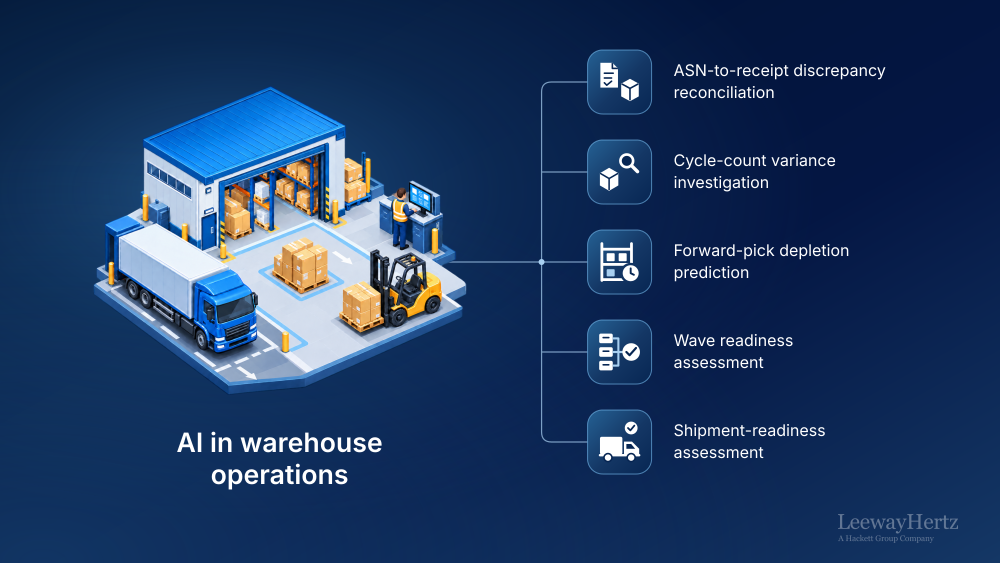
Warehouse operations manage how goods move through a facility and how each movement is recorded and controlled. They cover incoming inventory, storing and replenishing stock, maintaining inventory accuracy, releasing and picking orders, packing goods, staging and loading shipments, and completing outbound shipping activities. The operating model also extends to dock and yard coordination, labor planning, returns handled within the distribution center, warehouse master-data administration, safety and security controls, and facility-level performance management.
For warehouse managers and distribution executives, these activities are tightly coupled. A receiving discrepancy can delay putaway and create an inventory-availability problem. A poor slotting decision can increase replenishment and travel effort. An incorrect inventory status can make quarantined stock appear available to allocation. A wave released without sufficient labor or inventory can generate short picks and staging congestion. A packing exception can delay manifesting and threaten the on-time-ship target. The operating challenge is therefore not simply improving one task. At its core, warehouse operations are about maintaining the accurate and coordinated flow of inventory, work, decisions, and supporting records throughout the facility.
The technology landscape is equally interconnected. Warehouse teams commonly work across warehouse management systems, together with ERP, order management, yard, labor, quality, transportation, parcel, automation-execution, mobile scanning, labeling, and analytics platforms. Current product portfolios illustrate how modern WMS environments already combine inventory, labor, slotting, execution, yard, quality, and automation capabilities. Modern warehouse management platforms increasingly combine unified inventory visibility with slotting, labor planning, fulfillment execution, warehouse execution, yard management, returns processing, quality management, track-and-trace, and automation integration. More advanced capabilities also support resource forecasting, intelligent orchestration, and dynamic slotting to improve the coordination of high-volume warehouse operations.
AI does not need to replace these systems to create value. Its more practical role is to operate across the preparation, analysis, exception, and evidence layers that sit around system-directed warehouse execution. A receiving lead may need an ASN discrepancy reconciled against purchase orders, dock counts, seal information, and photos. An inventory control supervisor may need a cycle-count variance traced through receipts, moves, picks, adjustments, and status changes. A wave planner may need order demand, labor capacity, replenishment exposure, cutoff times, and congestion signals brought together before release. A warehouse manager may need a shift-risk brief that explains why dock-to-stock, picking productivity, or on-time ship is trending away from target.
This operating environment makes warehouse operations a strong candidate for governed AI. In MHI and Deloitte’s 2026 survey of more than 500 manufacturing and supply chain leaders, 71% of respondents said AI was disrupting supply chains, with 24% describing its impact as transformational and 48% rating the disruption significant or greater. The same report found that 56% planned to increase supply chain technology and innovation investment [1]. These figures cover the broader supply chain rather than warehouse operations alone, but they illustrate the investment context in which warehouse AI decisions are now being made.
The relevant solution, however, is not a generic warehouse chatbot. AI becomes useful when it works with the operational context behind a specific task or exception. A receiving lead may need an ASN, PO, count, seal record, photos, and supplier history brought together to investigate a discrepancy. A wave planner may need inventory availability, replenishment status, labor capacity, carrier cutoffs, and work-in-process analyzed before releasing a wave. An inventory control supervisor may need transaction history and supporting evidence assembled before approving an adjustment.
Warehouse operations also require a clear boundary between AI-assisted analysis and controlled execution. AI can classify exceptions, identify unusual patterns, predict congestion, recommend locations, or prepare decision packets. However, authoritative inventory quantities, status changes, lot and serial controls, UOM conversions, location restrictions, labor standards, and WMS transactions should remain governed by established systems, rules, and human approvals.
AI can reconcile the records, classify the discrepancy, retrieve the governing procedure, index and link photographs to the relevant OS&D case, and prepare a review packet for the warehouse or quality owner.
The operating model therefore focuses on the workflow, decision-support, exception-management, document, and governance layers inside the warehouse rather than physical automation such as robotics, conveyors, sortation, or AS/RS. It also keeps adjacent functions appropriately scoped: transportation owns carrier-side planning and execution, while the warehouse owns shipment readiness, staging, loading, and facility-side handoff.
For this reason, AI opportunities are most useful when mapped at the sub-process level. Instead of broadly defining “AI for receiving” or “AI for picking,” each use case should specify the supported activity, required data and artifacts, applicable rules, expected output, human reviewer, permitted actions, and evidence that must be retained.
- How AI is transforming warehouse operations
- Why AI use cases in warehouse operations must be mapped at the sub-process level
- Warehouse operating model and AI opportunity mapping across warehouse processes
- High-value AI use cases in warehouse operations
- How agentic AI works in warehouse operations
- How to prioritize AI use cases in warehouse operations
- Governance, risk, and responsible AI in warehouse operations
- How ZBrain operationalizes AI use cases in warehouse operations
- Future of AI in warehouse operations
How AI is transforming warehouse operations
AI changes warehouse operations by evaluating inventory records, tasks, documents, images, system events, labor capacity, and exceptions before a warehouse specialist begins the review. It can connect records distributed across WMS, ERP, YMS, LMS, QMS, parcel, labeling, and other operational systems and convert them into a reviewable work packet.
Consider a truck arriving with three pallets fewer than the quantity identified in the advance shipping notice and with visible carton damage. The warehouse may have an EDI 856 ASN, purchase order, dock appointment, gate record, seal number, blind-count entries, receipt transactions, photographs, supplier history, routing guide, and OS&D procedure. AI can reconcile the records, classify the discrepancy, retrieve the governing procedure, organize the photographs, prepare a draft OS&D report, and identify which inventory transaction needs approval. The receiving lead and inventory control supervisor still validate the physical facts and approve the consequential actions.
Warehouse work can be understood through six recurring work types.
- Transaction- and data-heavy work: Receipts, license plates, inventory balances, location moves, task histories, cycle counts, waves, picks, carton records, shipment records, labor transactions, and yard events can be reconciled across systems to identify missing, duplicated, stale, or conflicting records.
- Document- and image-heavy work: ASNs, POs, OS&D reports, bills of lading, packing slips, inspection records, dangerous-goods documents, load photographs, seal records, and facility checklists can be extracted, compared, and checked for missing or inconsistent evidence.
- Exception-heavy work: Blind-count mismatches, damaged receipts, blocked putaway, empty forward locations, count variances, short picks, pack-weight failures, label errors, late trailers, failed interfaces, and missed cutoffs can be classified by root cause, operational impact, urgency, and required reviewer.
- Knowledge- and rule-heavy work: Receiving SOPs, supplier routing guides, item compatibility rules, storage policies, lot and expiry requirements, hazardous-material procedures, customer labeling guides, safety procedures, and escalation rules can be retrieved according to the effective version and matched with the transaction under review.
- Optimization- and decision-heavy work: Putaway location selection, re-slotting, replenishment timing, wave sizing, pick grouping, labor balancing, door assignment, staging priority, and load sequencing require several constraints to be considered simultaneously. AI and optimization techniques can prepare recommendations, while deterministic hard constraints and authorized supervisors retain control over execution.
- Workflow-heavy work: Receiving-to-putaway, count-to-adjustment, release-to-pick, pick-to-pack, pack-to-ship, appointment-to-door, return-to-disposition, and exception-to-correction workflows require information to move between roles and systems. AI can maintain context, prepare the next work packet, and route unresolved cases.
The design principle is straightforward: connect a specific AI capability to a defined warehouse artifact and sub-process, specify the permitted output, and place that output inside a clear operational review boundary.
Operationalize governed AI across warehouse and distribution center operations
Connect WMS, yard, labor, quality, and shipping workflows with governed AI while preserving human control over inventory, safety, compliance, and system-changing decisions.
Why AI use cases in warehouse operations must be mapped at the sub-process level
Warehouse management is not a single workflow. A phrase such as “AI for inventory control” can refer to cycle-count selection, count variance analysis, transaction-history reconstruction, lot genealogy review, expiry-risk identification, inventory-status validation, adjustment packet preparation, or investigation of a negative balance. These activities involve different data, operational risk, rules, and reviewers.
A practical implementation model therefore decomposes warehouse work into four levels:
- Function: A major area of warehouse accountability, such as inbound receiving, inventory control, order picking, or outbound shipping. Functions contain multiple workflows and are generally too broad to implement as a single AI solution.
- Process: A recurring workflow area within the function, such as receipt validation, cycle-count execution, wave release, cartonization, or appointment management.
- Sub-process: A specific observable activity within the process with a defined trigger, system state, input artifact, output, exception set, control requirement, and accountable reviewer. Examples include reconciling a blind count with an ASN, selecting an eligible putaway location, investigating a cycle-count variance, or validating a packed carton against expected weight.
- AI-enabled opportunity: A particular AI or analytical capability applied to that sub-process. Document intelligence can extract carton-level evidence from an ASN; anomaly detection can identify unusual count variance patterns; optimization can rank eligible pick paths; computer vision can organize load-condition evidence; and natural-language generation can prepare an OS&D summary from approved records.
This definition exposes the operational dependencies hidden by broad AI labels. Sub-process mapping defines where AI must stop. A model can recommend that inventory be moved to another slot, but the WMS should validate that the destination is eligible. AI can identify an adjustment candidate, but an inventory control supervisor should approve the adjustment according to the facility’s authorization matrix. AI can flag a possible hazardous-material packing issue, but trained personnel and controlled compliance rules must determine whether the package is acceptable for transport.
The distinction is especially important because a warehouse error can propagate rapidly. An incorrect receipt can become incorrect on-hand inventory. Incorrect on-hand inventory can influence allocation and wave release. A bad location or status can create a short pick. The short pick can reduce order completeness, delay staging, and threaten shipment cutoff. By tying the original exception to its artifact, system transaction, owner, and downstream dependencies, AI can help surface the broader impact rather than treating every work queue independently.
For warehouse and DC leaders, the sub-process is therefore the most practical unit for identifying, implementing, testing, measuring, and governing AI.
Warehouse operating model and AI opportunity mapping across warehouse processes
The warehouse operating model begins before physical receipt, with appointment and inbound information, and continues through receipt, storage, inventory maintenance, fulfillment, staging, loading, and facility-level reporting. It also includes the operational support functions that keep those flows reliable: slotting, replenishment, yard coordination, labor management, WMS configuration, returns disposition, safety, quality, security, and compliance.
The model below covers core functions:
The core role map includes the warehouse manager, DC operations director, receiving lead, inventory control supervisor, slotting analyst, wave planner, shift supervisor, industrial engineer, WMS administrator, yard coordinator, EHS coordinator, and, where regulated storage applies, the quality inspector or quality organization.
The principal artifacts include the EDI 856 advance shipping notice, purchase order, receipt record, OS&D report, putaway task, slotting map, replenishment task, cycle-count sheet, variance report, lot or serial genealogy record, inventory-adjustment approval, wave plan, pick list, packing slip, carton manifest, bill of lading, GS1 logistics label, dock appointment record, seal log, load-quality photographs, engineered labor standards report, and warehouse KPI pack.
X12 defines the 856 ship notice/manifest transaction as an EDI structure that can communicate shipment contents plus order, product, packaging, marking, carrier, and configuration information, which makes it an important artifact for inbound reconciliation.
Function 1: Inbound receiving and receipt validation
Converting an expected inbound shipment into a physically verified, system-recorded receipt with discrepancies, quality status, and downstream putaway requirements properly captured and controlled.
Inbound receiving begins before unloading. The warehouse receives appointment information and, where available, an ASN describing the expected shipment. At the dock, teams confirm the trailer, seal, shipment, pallet or carton structure, quantity, product identity, condition, and any quality requirements before recording the receipt.
The function establishes the first facility-level inventory record. Errors at this point can propagate into putaway, available inventory, accounts payable matching, supplier performance, order allocation, and customer fulfillment.
Teams involved: Receiving lead, receiving associates, dock clerks, inventory control supervisor, quality inspector, yard coordinator, WMS administrator, supplier-compliance team, and warehouse manager.
What AI helps with: AI can parse ASNs and purchase orders, compare expected and received structures, reconcile blind-count entries, classify overage, shortage, and damage conditions, organize photographs, retrieve supplier routing requirements, identify prior ASN-quality patterns, and prepare OS&D and adjustment evidence.
What humans continue to own: Receiving personnel confirm physical quantity and condition. Quality personnel determine inspection or quarantine disposition where applicable. Inventory control approves inventory adjustments. The warehouse manager determines the facility-side disposition when evidence is ambiguous and hands off carrier-versus-supplier responsibility to the appropriate transportation, supplier-compliance, or commercial owner. AI prepares evidence and recommendations but does not establish physical fact or independently alter inventory.
| Process | Sub-process | Key AI-enabled opportunities |
|---|---|---|
| Inbound shipment readiness assessment | ASN and purchase-order reconciliation |
|
| Appointment and receiving-readiness validation |
|
|
| Gate and dock verification | Trailer, carrier, and seal verification |
|
| Dock-door and unloading readiness assesment |
|
|
| Receipt execution | Blind-count capture and reconciliation |
|
| Item, UOM, lot, serial, and expiry validation |
|
|
| Receipt transaction validation |
|
|
| OS&D management | Overage and shortage classification |
|
| Damage evidence preparation |
|
|
| OS&D report preparation |
|
|
| Quality and inventory-status control | Inspection requirement identification |
|
| Hold and quarantine preparation |
|
|
| Receipt closure and handoff | Receipt-close readiness assessment |
|
| Putaway-task readiness assessment |
|
Key artifacts
- EDI 856 advance shipping notice
- Purchase order
- Dock appointment
- Gate and trailer record
- Seal record
- Blind-count entries
- Receipt record
- Dock photographs
- OS&D report
- Quality inspection record
- Inventory-adjustment approval
- Putaway task
Systems involved
- WMS
- ERP or purchasing system
- EDI gateway
- Yard and appointment system
- QMS
- Mobile/RF scanning
- Image repository
- Supplier portal
- Document repository
Regulatory and control considerations: Receiving controls should preserve physical-count evidence, user identity, inventory status, and adjustment approvals. Where CTPAT applies, CBP emphasizes documented implementation of security procedures and provides sample resources for conveyance tracking, seal inventory and audit, and overage/shortage/discrepancy logs. Regulated food and pharmaceutical facilities may also require quality or quarantine controls before inventory becomes available.
Accountable roles and decision rights
- Receiving lead confirms physical receipt and first-level discrepancy classification.
- Quality inspector determines inspection or hold disposition where required.
- Inventory control supervisor approves inventory adjustments within delegated authority.
- WMS administrator resolves interface or configuration issues but does not establish the physical count.
- Warehouse manager decides escalated facility-side discrepancy treatment when evidence is ambiguous.
Highest-value opportunities
- ASN-to-receipt reconciliation: High leverage because inaccurate inbound records can contaminate every downstream inventory transaction.
- OS&D evidence preparation: Valuable because quantity, damage, seal, image, and shipment evidence is often fragmented across several sources.
- Receipt exception classification: High value because different mismatch types require different operational owners and deadlines.
- Quality-hold readiness: Valuable in regulated environments because inventory must not become allocatable before the appropriate release decision.
Example agentic workflow: Receiving discrepancy resolution
- Trigger and starting artifact: A receipt closes with a three-pallet shortage against the ASN and a damaged-carton flag from dock photographs.
- Systems and records aggregated: The workflow retrieves ASN and PO lines, appointment and gate records, blind-count entries, receipt transactions, dock photographs, carrier and seal information, and the supplier’s recent ASN-accuracy history.
- Policies and rules retrieved: It retrieves the OS&D procedure, supplier routing-guide requirements, evidence rules, inventory-adjustment policy, and applicable claim or notification deadlines.
- Analysis and work packet prepared: It reconciles quantity at carton or handling-unit level, drafts the OS&D report, organizes photographic evidence, distinguishes evidence consistent with shortage versus damage, prepares a carrier-claim or supplier-chargeback candidate for downstream review, and prepares the corresponding inventory-adjustment re quest.
- Human checkpoint: The receiving lead reconfirms the physical count. The inventory control supervisor approves or rejects the inventory adjustment. Where the evidence does not clearly distinguish carrier damage, concealed shortage, or supplier discrepancy, the warehouse manager determines the facility disposition and handoff.
- Approved handoff and evidence: The approved OS&D package is handed to the appropriate transportation, supplier-compliance, or deduction process, the WMS inventory changes only after authorized approval, and the evidence bundle is retained for claim defense, supplier performance, and audit.
Function 2: Putaway and slotting
Converting received or re-slotted inventory into an eligible storage position that balances operational constraints, travel distance, cube utilization, replenishment effort, and handling risk.
Putaway decides where inventory enters storage after receipt or internal movement. Slotting determines whether the warehouse’s current location assignment remains appropriate as demand, product mix, cube, seasonality, and operating patterns change.
These activities share location and item data but serve different time horizons. Putaway makes an execution decision for inventory at the point of movement; slotting evaluates the longer-running relationship between item demand and storage configuration.
Teams involved: Slotting analyst, receiving lead, inventory control supervisor, shift supervisor, industrial engineer, WMS administrator, and warehouse manager.
What AI helps with: AI can combine item velocity, cube, handling class, replenishment frequency, order affinity, compatibility restrictions, location utilization, and travel history to rank eligible putaway or re-slot options. It can identify honeycombing, empty-cube patterns, poor velocity placement, and excessive replenishment.
What humans continue to own: Warehouse and slotting teams establish storage policies, hard compatibility rules, reserved zones, ergonomics constraints, and campaign timing. WMS rules remain authoritative for location eligibility and task creation. AI can rank eligible choices but should not override prohibited storage, capacity, or safety constraints.
| Process | Sub-process | Key AI-enabled opportunities |
| Putaway eligibility preparation | Item storage-profile validation |
|
| Location eligibility screening |
|
|
| Putaway location assignment | Putaway candidate ranking |
|
| Consolidation and partial-location analysis |
|
|
| Space-utilization management | Honeycombing and trapped-space detection |
|
| Capacity and congestion monitoring |
|
|
| Slotting analysis | Velocity segmentation |
|
| Order-affinity and co-pick analysis |
|
|
| Replenishment-frequency analysis |
|
|
| Re-slot campaign planning | Re-slot candidate generation |
|
| Re-slot campaign sequencing |
|
|
| Post-slotting control | Slotting-change validation |
|
| Benefit realization analysis |
|
Key artifacts
- Putaway task
- Item-location master
- Slotting map
- Velocity classification
- Cube and dimensional data
- Location capacity record
- Replenishment history
- Re-slot campaign plan
- Movement history
- Compatibility matrix
Systems involved
- WMS
- Slotting application
- LMS
- ERP item master
- Dimensioning system
- WES where applicable
- BI or warehouse analytics environment
Regulatory and control considerations: Storage recommendations must remain subordinate to hard controls for location capacity, commodity compatibility, temperature or environmental conditions, hazardous-material restrictions, security, and ergonomic or safe-handling requirements. OSHA’s material-handling rule requires safe clearances, clear aisles and passageways, and stable storage that does not create a hazard from sliding or collapse.
Accountable roles and decision rights
- Slotting analyst owns slotting strategy and re-slot recommendations.
- Industrial engineer reviews travel, capacity, and labor implications.
- Inventory controller verifies movement integrity where required.
- Shift supervisor approves execution timing.
- WMS Administrator maintains approved location and strategy configuration.
Highest-value opportunities
- Putaway-location recommendation: High leverage because every inbound movement creates an opportunity to improve or degrade future travel and replenishment.
- Honeycombing detection: Valuable where apparent capacity differs from usable storage capacity.
- Re-slot campaign analysis: High value because changing demand patterns can make legacy slot assignments progressively inefficient.
- Post-campaign benefit measurement: Important because slotting proposals should be validated against actual travel, replenishment, congestion, and space outcomes.
Example agentic workflow: Re-slot campaign planning
- A weekly slotting cycle is triggered from updated demand and movement history.
- The workflow retrieves item velocity, cube, pick frequency, replenishment frequency, order affinity, location capacity, current occupancy, and compatibility rules.
- It identifies poor slot assignments and estimates travel, replenishment, and cube effects for eligible alternatives.
- It produces a proposed re-slot campaign with move sequence, expected operational benefit, hard constraints, and confidence indicators.
- The slotting analyst and industrial engineer review candidates; the shift supervisor selects the execution window.
- Only approved moves become WMS tasks, and post-campaign performance is retained for subsequent model evaluation.
Function 3: Replenishment and forward-pick maintenance
Converting reserve inventory and projected pick demand into timely replenishment tasks that maintain forward-pick availability without creating excess congestion or inventory movement.
Replenishment connects storage with order execution. Forward locations must contain sufficient inventory to support released and near-term work, but excessive early replenishment can consume pick-face capacity, create congestion, and add nonproductive movement.
The function is distinct from network inventory optimization. It concerns inventory already positioned within the facility and determines when and how it should move between reserve and active picking locations.
Teams involved: Shift supervisor, wave planner, replenishment operators, inventory control supervisor, slotting analyst, industrial engineer, and WMS administrator.
What AI helps with: Predictive analysis can estimate near-term depletion risk from order demand, allocation, wave plans, pick rate, and current location balances. AI can identify replenishments likely to become urgent, classify blocked tasks, and coordinate timing with release and labor availability.
What humans continue to own: The WMS remains authoritative for inventory availability, allocation, lot/expiry rules, eligible source and destination inventory, and task confirmation. Supervisors determine whether exceptional replenishment should be accelerated, deferred, or handled through another operational path.
| Process | Sub-process | Key AI-enabled opportunities |
| Forward-pick demand monitoring | Pick-face depletion prediction |
|
| Replenishment threshold review |
|
|
| Replenishment task generation | Replenishment requirement identification |
|
| Reserve-source candidate preparation |
|
|
| Replenishment execution planning | Task priority optimization |
|
| Replenishment route and batch preparation |
|
|
| Replenishment exception management | Blocked source investigation |
|
| Destination-capacity exception analysis |
|
|
| Wave coordination | Replenishment-to-wave dependency monitoring |
|
| Emergency replenishment escalation |
|
|
| Continuous improvement | Chronic replenishment analysis |
|
Key artifacts
- Replenishment task
- Pick-face balance
- Reserve inventory record
- Allocation and order demand
- Wave plan
- Location capacity
- Replenishment exception log
- Slotting record
Systems involved
- WMS
- OMS
- WES
- LMS
- Slotting application
- BI environment
Regulatory and control considerations: AI should not bypass lot, serial, expiry, inventory-status, compatibility, or restricted-stock rules when identifying source inventory. Where FEFO, quarantine, or controlled storage rules apply, the authoritative execution rule remains in the WMS or validated rule service.
Accountable roles and decision rights
- Shift supervisor owns operational replenishment priority.
- Wave planner coordinates replenishment dependencies with release.
- Inventory control supervisor resolves inventory-state exceptions.
- Slotting analyst addresses structural pick-face sizing problems.
- WMS administrator owns replenishment-rule configuration.
Highest-value opportunities
- Depletion-risk prediction: High leverage because late replenishment converts an internal material movement problem into a picking exception.
- Wave-replenishment dependency analysis: Valuable because it prevents work from being released against unavailable forward stock.
- Blocked-task classification: Reduces time spent diagnosing why a system-directed replenishment cannot execute.
- Chronic replenishment analysis: Identifies slotting and pick-face design problems rather than repeatedly treating symptoms.
Example agentic workflow: Forward-pick depletion prevention
- A pick face is projected to fall below the quantity needed for near-term released orders.
- AI retrieves current balance, reserve stock, allocations, waves, recent pick velocity, active replenishments, and location constraints.
- Deterministic WMS logic identifies eligible inventory; AI ranks the valid tasks by urgency and downstream effect.
- A replenishment-risk packet shows the affected orders, source candidates, expected depletion time, and any blocked prerequisites.
- The shift supervisor approves reprioritization when required, while inventory control resolves inventory discrepancies.
- Approved task priority is updated through the existing WMS workflow, and actual depletion and completion outcomes are recorded.
Function 4: Inventory control, status, and traceability
Converting physical counts, transaction history, item identity, lot or serial attributes, and inventory status into an accurate, explainable, and controlled warehouse inventory record.
Inventory control maintains trust between physical stock and WMS stock. It includes cycle-count program administration, count execution, variance investigation, adjustment approval, status management, and lot, serial, and expiry traceability.
The objective is not simply a high inventory-accuracy percentage. A mature process must explain material discrepancies, prevent inappropriate adjustments, keep restricted stock unavailable to fulfillment, and preserve traceability.
Teams involved: Inventory control supervisor, inventory control analysts, shift supervisor, quality inspector, warehouse manager, WMS administrator, and finance or audit interfaces where adjustment thresholds require them.
What AI helps with: AI can prioritize count candidates, reconstruct transaction histories, identify likely discrepancy causes, classify recurring variance patterns, trace lot or serial movement, detect status anomalies, and prepare adjustment evidence.
What humans continue to own: Cycle counters establish observed quantity. Inventory control associates determines whether recount, investigation, or adjustment is required. The quality assurance manager owns regulated disposition. Authorized personnel approve adjustments. AI should not turn statistical suspicion into an inventory change without evidence and approval.
| Process | Sub-process | Key AI-enabled opportunities |
| Cycle-count program administration | ABC count frequency management |
|
| Control-group and supplemental count selection |
|
|
| Cycle count execution | Count-procedure adherence validation |
|
| Count-result comparison |
|
|
| Variance investigation | Inventory transaction-history reconstruction |
|
| Root-cause candidate classification |
|
|
| Adjustment governance | Adjustment request preparation |
|
| Adjustment threshold and approval routing |
|
|
| Inventory-status management | Hold, damage, and quarantine status validation |
|
| Status-change history review |
|
|
| Lot, serial, and expiry control | Lot and serial genealogy reconstruction |
|
| Expiry and shelf-life exception monitoring |
|
Key artifacts
- Cycle-count schedule
- Cycle-count sheet
- Count result
- Variance report
- Transaction history
- Inventory-adjustment approval form
- Lot genealogy
- Serial genealogy
- Expiry record
- Inventory-status record
- Quality hold/release record
Systems involved
- WMS
- ERP
- QMS
- WES
- Mobile/RF devices
- BI platform
- Document repository
Regulatory and control considerations: Inventory-control processes should maintain accurate inventory records, controlled status changes, traceability, appropriate segregation of restricted or held stock, authorized adjustments, and evidence of review and approval. Lot-, serial-, and expiry-controlled inventory may require additional traceability, retention, release, storage-condition, or recall controls depending on the product, jurisdiction, and industry. These requirements make inventory identity, status, location, adjustment authority, release authority, transaction history, and retained evidence important design inputs for AI-enabled inventory-control workflows.
Accountable roles and decision rights
- Inventory control supervisor owns variance investigation and authorized adjustments.
- Quality inspector or quality unit owns regulated hold and release decisions.
- Shift supervisor supports operational root-cause correction.
- WMS administrator resolves transaction or configuration defects.
- Warehouse manager approves material exceptions according to delegated authority.
Highest-value opportunities
- Variance-history reconstruction: High value because investigations often require stitching together many transactions manually.
- Adjustment evidence assembly: High leverage because inventory changes need a clear cause, approver, and audit trail.
- Status anomaly detection: Critical where damaged, quarantined, or held inventory must remain unavailable.
- Lot/serial genealogy validation: Valuable for recall readiness and controlled product traceability.
Example agentic workflow: Cycle-count variance investigation
- A cycle count produces a material variance beyond the facility’s investigation threshold.
- AI retrieves prior counts, receipts, moves, replenishments, picks, short picks, packs, adjustments, status changes, user events, and relevant item/UOM master data.
- It applies the approved variance-investigation procedure and reason-code framework.
- The workflow prepares a chronological evidence trail, candidate root causes, unresolved conflicts, and an adjustment or recount recommendation.
- The inventory control supervisor reviews the evidence and decides whether to recount, investigate further, or approve an adjustment.
- The WMS records only the authorized disposition, and the evidence is retained for inventory-accuracy analysis and recurring-cause prevention.
Function 5: Order release and wave planning
Converting eligible customer demand, inventory availability, cutoff requirements, labor capacity, and facility constraints into controlled executable work.
Wave planning determines what work enters warehouse execution and when. Depending on the WMS and fulfillment model, the facility may use discrete waves, waveless or order-streaming logic, or combinations by channel and work type.
Teams involved: Wave planner, shift supervisor, warehouse manager, inventory control supervisor, industrial engineer, WMS administrator, and outbound leadership.
What AI helps with: AI can compare orders with inventory, replenishment readiness, labor, equipment constraints, downstream capacity, priority, and cutoff times. It can predict workload by zone, identify waves likely to produce short picks or congestion, and recommend alternative release sizes or sequencing.
What humans continue to own: Operational leadership determines service priorities and approves significant overrides. The WMS remains authoritative for allocation and release eligibility. AI should not bypass customer priority, compliance, credit, inventory status, or other configured release holds.
| Process | Sub-process | Key AI-enabled opportunities |
| Order-pool assessment | Order eligibility validation |
|
| Inventory execution-readiness assessment |
|
|
| Wave construction | Wave candidate grouping |
|
| Wave-size optimization |
|
|
| Labor and capacity balancing | Zone workload balancing |
|
| Pack and staging capacity alignment |
|
|
| Wave release control | Release-readiness assessment |
|
| Priority and cutoff sequencing |
|
|
| Wave exception management | Partial-release preparation |
|
| Blocked-wave root-cause analysis |
|
|
| Post-wave analysis | Planned-versus-actual wave performance |
|
Key artifacts
- Wave plan
- Order pool
- Allocation record
- Replenishment status
- Labor plan
- Cutoff schedule
- Pick-zone capacity view
- Wave exception report
Systems involved
- WMS
- OMS
- WES
- LMS
- ERP
- Parcel or shipping system
- BI platform
Regulatory and control considerations: AI recommendations must respect inventory status, restricted customer or product rules, regulated handling requirements, lot/expiry allocation, and WMS allocation logic. Release optimization should operate only on demand that is already eligible under authoritative business rules.
Accountable roles and decision rights
- Wave planner owns release construction and routine execution decisions.
- Shift supervisor confirms operational capacity.
- Inventory control resolves availability anomalies.
- Warehouse manager approves material service-priority overrides.
- WMS administrator owns release-rule configuration.
Highest-value opportunities
- Labor-balanced wave sizing: High leverage because poor release decisions amplify constraints across multiple downstream functions.
- Short-pick risk prediction: Valuable because nominal inventory does not always equal executable inventory.
- Zone congestion forecasting: Helps planners avoid creating bottlenecks through release timing.
- Wave readiness explanation: Reduces manual cross-system review before a planner releases work.
Example agentic workflow: Wave readiness and release review
- A planned wave approaches its scheduled release time.
- AI retrieves eligible orders, allocations, replenishments, inventory exceptions, zone workload, labor plan, work-in-process, pack capacity, staging availability, and outbound cutoffs.
- It applies approved release criteria and uses predictive analysis to identify likely bottlenecks.
- It prepares a readiness brief showing orders ready for release, at-risk SKUs, required replenishments, zone imbalances, and candidate wave-size changes.
- The wave planner and shift supervisor approve the release or modify scope.
- The authorized wave is released through the WMS, and actual execution is captured for subsequent planning evaluation.
Accelerate AI Solutions Development
Build fully functional solutions from your high-value use cases, based on specific operational needs and enterprise context.
Function 6: Order picking and short-pick resolution
Converting released order demand into physically confirmed picks while minimizing travel and resolving inventory exceptions without losing traceability.
Picking is one of the most execution-intensive warehouse functions. Depending on the operation, tasks may be discrete, batch, cluster, zone, pick-and-pass, case, pallet, or automated. Regardless of method, execution depends on the picker reaching the correct location, selecting the correct item and quantity, and confirming the required identity or lot attributes.
Teams involved: Shift supervisor, picking associates, wave planner, inventory control supervisor, industrial engineer, WMS administrator, and warehouse manager.
What AI helps with: AI can rank batch or cluster combinations, analyze pick paths, predict congestion, identify abnormal scan sequences, classify short picks, and assemble inventory-hunt evidence from alternate locations and transaction history.
What humans continue to own: Pickers confirm physical execution. Inventory control associate confirms inventory discrepancies. Supervisors determine operational exception handling. The WMS remains authoritative for allocation, lot/serial rules, substitute or alternate inventory rules, and task confirmation.
| Process | Sub-process | Key AI-enabled opportunities |
| Pick task planning | Batch and cluster formation |
|
| Picker and equipment assignment support |
|
|
| Pick-path execution | Pick sequence optimization |
|
| Congestion and queue monitoring |
|
|
| Pick validation | Item and location scan validation |
|
| Lot, serial, and quantity exception analysis |
|
|
| Short-pick management | Short-pick classification |
|
| Inventory-hunt preparation |
|
|
| Count and replenishment request preparation |
|
|
| Picking exception escalation | Customer-order impact assessment |
|
| Picking process continuous improvement | Recurrent pick-exception analysis |
|
Key artifacts
- Pick list or task
- Allocation record
- Scan history
- Pick exception
- Short-pick record
- Inventory-hunt packet
- Location balance data
- Replenishment task
- Order record
Systems involved
- WMS
- WES
- Mobile/RF or voice system
- LMS
- OMS
- Inventory-control work queue
- BI platform
Regulatory and control considerations: Pick recommendations must respect controlled inventory status, lot/serial requirements, FEFO rules where configured, restricted-product handling, and safe equipment and travel practices. AI-generated shortcuts must never override a safety rule, equipment restriction, or prohibited travel path.
Accountable roles and decision rights
- Picker confirms physical execution.
- Shift supervisor owns immediate operating exceptions.
- Inventory control supervisor owns inventory discrepancy resolution.
- Wave planner manages order-level downstream impact.
- Industrial engineer reviews systemic path and productivity issues.
Highest-value opportunities
- Short-pick root-cause classification: High value because short picks often initiate time-consuming inventory searches.
- Inventory-hunt packet preparation: Reduces manual lookup across task and transaction history.
- Batch/cluster recommendation: Valuable where order profiles create repeated grouping decisions.
- Pick-congestion prediction: Helps supervisors intervene before localized backlog affects cutoff performance.
Example agentic workflow: Short-pick investigation and recovery
- A picker confirms a short at an allocated location.
- AI retrieves the pick task, current and prior location balances, replenishment activity, recent moves, cycle counts, adjacent or overflow inventory, inventory status, and affected order.
- The workflow applies the approved short-pick investigation procedure.
- It classifies the likely cause, assembles candidate inventory locations that remain WMS-eligible, identifies downstream order impact, and prepares a count or replenishment request where appropriate.
- The shift supervisor chooses the operational recovery path; inventory control confirms any suspected stock discrepancy.
- Approved tasks or counts are created through normal WMS controls, and the final cause and recovery outcome feed exception analytics.
Function 7: Packing, cartonization, and value-added services
Converting picked inventory into verified shipping units with the correct carton, contents, documentation, services, and handling attributes.
Packing provides the final internal confirmation that picked goods have become shipment-ready units. It can include carton selection, scan verification, weight checking, dunnage or packing instructions, kitting, labeling, gift wrap, documentation insertion, and hazardous-material preparation where applicable.
Teams involved: Packing associates, shift supervisor, outbound lead, WMS administrator, quality inspector, dangerous-goods trained personnel where applicable, and customer-compliance teams.
What AI helps with: AI can recommend suitable carton options based on item dimensions, weight, fragility, order contents, and carrier constraints. It can also compare expected and actual pack attributes, detect abnormal weight or scan patterns, classify pack exceptions, retrieve customer-specific instructions, and prepare value-added-service work instructions.
What humans continue to own: Packers confirm contents and physical packing. Packaging engineering or warehouse configuration owners maintain authoritative carton and compatibility constraints in controlled logic. Qualified personnel determine dangerous-goods classification and compliance. Supervisors approve exceptions and rework.
| Process | Sub-process | Key AI-enabled opportunities |
| Cartonization | Carton candidate selection |
|
| Multi-carton split recommendation |
|
|
| Pack verification | Scan-to-order verification analysis |
|
| Expected-weight validation |
|
|
| Packing instruction management | Customer-specific packing instruction retrieval |
|
| Value-added services execution | Kitting and component verification |
|
| Labeling, gift wrap, and special-service execution |
|
|
| Hazmat packing validation | Hazardous-material data completeness validation |
|
| Documentation and label preparation support |
|
|
| Pack exception management | Pack rework classification |
|
| Carton closure | Carton-close readiness assessment |
|
Key artifacts
- Packing slip
- Carton recommendation
- Carton manifest
- Scan record
- Weight record
- VAS instruction
- Kit specification
- Hazmat documentation
- Shipping-unit record
- Rework record
Systems involved
- WMS
- Packing workstation
- Scales and dimensioners
- Labeling system
- OMS
- Parcel system
- QMS
- Document repository
Regulatory and control considerations: When a warehouse prepares hazardous materials for transportation, DOT’s hazardous materials regulations establish requirements covering functions such as packaging, shipping papers, markings, labels, and employee training; PHMSA identifies general-awareness, function-specific, safety, and security-awareness training requirements for hazmat employees. For air shipments, the current IATA dangerous goods regulations provide the industry reference for dangerous-goods preparation and handling and must be considered in addition to applicable law. AI may prepare a compliance checklist but should not independently establish a dangerous-goods classification or certify a shipment.
Accountable roles and decision rights
- Packing associate confirms physical contents.
- Shift supervisor owns routine pack-exception disposition.
- Qualified dangerous-goods personnel own applicable hazmat determinations and signoffs.
- Quality personnel own regulated inspection decisions.
- WMS administrator maintains approved pack rules and interfaces.
Highest-value opportunities
- Carton recommendation: High leverage in high-volume packing where carton choices affect materials, cube, and handling.
- Pack-weight exception analysis: Valuable because weight provides an independent signal that can reveal missing or extra contents.
- VAS instruction preparation: Reduces errors when customer-specific services vary by order.
- Hazmat readiness review: Valuable as an evidence-preparation layer while trained personnel retain compliance authority.
Example agentic workflow: Pack verification exception review
- A carton fails the configured expected-weight tolerance after all items appear scanned.
- AI retrieves order lines, scan history, expected item weights, measured carton weight, carton type, prior rework, and packing instructions.
- It applies approved tolerance and exception procedures through controlled logic.
- It prepares likely causes such as missed scan, duplicate quantity, incorrect UOM, wrong carton tare, or incomplete item master data.
- The packer and shift supervisor physically verify the carton and choose the authorized correction.
- Any correction is recorded in the WMS, and the cause is retained for pack-quality and master-data analysis.
Function 8: Outbound shipping, staging, and load verification
Converting packed shipment units into a correctly staged, documented, loaded, sealed, and handed-off outbound shipment.
Outbound shipping begins when shipment units are ready for staging and continues through lane assignment, load sequencing, shipping-document preparation, parcel manifesting, trailer loading, seal control, and final facility handoff.
The warehouse boundary ends at the controlled handoff. Carrier procurement, route planning, tendering, and transportation execution beyond the facility remain transportation-management responsibilities.
Teams involved: Shipping lead, shift supervisor, yard coordinator, warehouse manager, loaders, parcel-shipping staff, WMS administrator, and security personnel where applicable.
What AI helps with: AI can identify staging conflicts, compare carton readiness with load requirements, recommend internal loading sequence, validate shipping-document completeness, organize load photographs, detect seal-record inconsistencies, and prepare readiness exceptions before cutoff.
What humans continue to own: Shipping staff verify the physical load. The responsible warehouse role confirms seal placement and shipment release. The WMS/TMS/parcel system remains authoritative for shipment, manifest, and label transactions. AI does not independently release a truck with unresolved quantity, security, hazmat, or quality exceptions.
| Process | Sub-process | Key AI-enabled opportunities |
| Shipment staging | Shipment staging location assignment |
|
| Staging completeness monitoring |
|
|
| Shipping-document preparation | Bill-of-lading readiness |
|
| Packing-slip and shipment-document reconciliation |
|
|
| Shipping-label management | GS1 logistics-label data validation |
|
| Customer-compliance label review |
|
|
| Parcel manifesting | Parcel-service and manifest readiness |
|
| Carrier-handoff exception preparation |
|
|
| Trailer loading | Load-sequence preparation |
|
| Load-completeness reconciliation |
|
|
| Load quality verification | Load-photo organization |
|
| Security and seal control | Seal assignment validation |
|
| Shipment release | Facility-release readiness |
|
Key artifacts
- Packing slip
- Carton manifest
- Shipment record
- Bill of lading
- GS1 logistics label
- Parcel manifest
- Staging record
- Trailer-loading record
- Load photographs
- Seal record
- Dispatch handoff
Systems involved
- WMS
- TMS interface
- Parcel manifest system
- YMS
- Label-management system
- Mobile scanning
- Image repository
- Dock/door system
Regulatory and control considerations: Shipping workflows should retain label, manifest, shipment, trailer, and seal identity consistently. Dangerous-goods shipments require the applicable transport controls. CTPAT participants should align seal, conveyance, and security evidence with their documented security procedures.
Accountable roles and decision rights
- Shipping lead confirms shipment readiness.
- Shift supervisor owns operational exception disposition.
- Yard coordinator manages trailer/door coordination.
- Security personnel own applicable seal/security checks.
- Warehouse manager authorizes escalated facility-side release decisions.
Highest-value opportunities
- Shipment-readiness assessment: High value because missing cartons, unresolved holds, labels, or manifests are easier to correct before loading.
- Staging exception monitoring: Valuable because congestion can create wrong-load and missed-cutoff risk.
- Load evidence assembly: Creates a defensible record of condition, trailer, seal, and loading state.
- Label validation: High leverage where retailer or trading-partner requirements are strict.
Example agentic workflow: Outbound load readiness review
- A trailer reaches its planned loading window.
- AI retrieves shipment units, staging locations, holds, manifests, BOL data, trailer and door assignment, loading plan, customer label rules, and seal requirements.
- It validates that prerequisite records are complete and identifies exceptions.
- The workflow prepares a load-readiness packet with missing cartons, wrong-stage units, documentation conflicts, label failures, and candidate load sequence.
- The shipping lead confirms physical readiness, and the yard coordinator confirms trailer status.
- Only the approved shipment is released through the existing WMS/TMS handoff, with load photos and seal evidence retained.
Function 9: Dock and yard management
Converting inbound and outbound appointments, trailer state, door capacity, and yard movement requirements into coordinated facility access and dock execution.
Dock and yard operations sit at the boundary between transportation and warehouse execution. The facility must know what is arriving, what is waiting, which doors and labor are available, which trailers require movement, and whether a delay is creating detention exposure.
This function covers the facility side of the problem. Carrier procurement, network routing, tendering, and in-transit management remain outside the warehouse scope.
Teams involved: Yard coordinator, receiving lead, shipping lead, dock clerks, gate personnel, shift supervisor, warehouse manager, and security personnel.
What AI helps with: AI can forecast appointment risk, recommend dock door assignments, identify yard dwell, match trailers with appointments and loads, rank yard moves, and prepare detention evidence from gate, dock, and release timestamps.
What humans continue to own: Yard and warehouse leaders control physical access, door assignment overrides, yard moves, and safety-critical actions. AI should not direct an unsafe move or override facility traffic rules.
| Process | Sub-process | Key AI-enabled opportunities |
| Appointment scheduling | Appointment request validation |
|
| Appointment-slot recommendation |
|
|
| Gate management | Arrival-to-appointment matching |
|
| Gate processing exception analysis |
|
|
| Dock door management | Dock-door assignment |
|
| Door-change impact analysis |
|
|
| Yard status visibility | Trailer-pool reconciliation |
|
| Yard execution | Yard-move prioritization |
|
| Dwell and detention management | Yard-dwell monitoring |
|
| Facility-side detention evidence preparation |
|
|
| Disruption management | Late arrival and no-show impact assessment |
|
Key artifacts
- Dock appointment
- Gate record
- Trailer record
- Seal record
- Yard location
- Door assignment
- Yard-move task
- Dwell report
- Detention evidence
- Inbound/outbound load record
Systems involved
- YMS
- WMS
- Dock appointment platform
- TMS interface
- Gate system
- Telematics or yard-location source where available
- Security system
- BI platform
Regulatory and control considerations: Yard recommendations must respect traffic plans, pedestrian separation, dock safety, trailer restraint or equivalent procedures, powered-industrial-truck rules, and security policies. OSHA 1910.178 governs powered industrial trucks and includes operator training and evaluation requirements.
Accountable roles and decision rights
- Yard coordinator owns appointment and yard-move execution.
- Receiving lead and shipping lead confirm dock readiness for their respective flows.
- Security owns gate and applicable seal controls.
- Shift supervisor resolves operational conflicts.
- Warehouse manager approves major door/priority overrides.
Highest-value opportunities
- Door recommendation: Valuable because wrong door assignments create avoidable travel, queueing, and rehandling.
- Dwell-risk monitoring: High value because a facility-side delay can become a detention cost and service issue.
- Trailer-pool reconciliation: Useful where system and physical yard state frequently diverge.
- Detention evidence preparation: Reduces manual timestamp reconstruction during disputes.
Example agentic workflow: Appointment and door exception management
- An inbound appointment is projected to arrive while its planned door remains occupied.
- AI retrieves appointment, ASN, trailer, load type, door capabilities, current dock tasks, estimated completion, labor, and yard status.
- It checks hard door-eligibility and safety constraints.
- It ranks eligible alternatives and prepares the expected operational impact of reassignment versus yard hold.
- The yard coordinator and receiving lead select the response.
- The approved assignment is updated in the yard/dock system, and the decision history is retained.
Function 10: Labor management and shift execution
Converting workload, engineered standards, skill availability, attendance, work-in-process, and service priorities into a balanced facility labor plan.
Labor management operates across the full warehouse rather than within one material flow. It includes pre-shift staffing, interval-level planning, assignment, productivity measurement, incentive administration, overtime decisions, flex staffing, and intraday rebalancing.
Teams involved: Warehouse manager, shift supervisor, industrial engineer, labor-management administrator, HR or workforce interface, functional leads, and DC operations director.
What AI helps with: AI can forecast workload by activity and interval, compare workload with available skills, identify emerging bottlenecks, recommend rebalancing, explain productivity variance, and prepare overtime or flex-staffing scenarios.
What humans continue to own: Industrial engineers establish and maintain approved labor standards. Supervisors account for operating conditions, training, accommodations, safety, and employee capability. Managers approve overtime, incentive, staffing, and performance decisions. AI should not convert productivity data into unreviewed disciplinary or employment decisions.
| Process | Sub-process | Key AI-enabled opportunities |
| Engineered labor standards administration | Standard and task mapping validation |
|
| Standard-change impact analysis |
|
|
| Workload forecasting | Interval workload forecast |
|
| Work-content change detection |
|
|
| Workforce planning | Skill and certification capacity comparison |
|
| Pre-shift assignment preparation |
|
|
| Intraday shift balancing | Work-in-process and labor imbalance monitoring |
|
| Labor reassignment scenario analysis |
|
|
| Productivity management | Productivity variance decomposition |
|
| Incentive-report validation |
|
|
| Overtime and flex staffing | End-of-shift completion forecast |
|
| Continuous improvement | Structural labor-loss analysis |
|
Key artifacts
- Engineered labor standards
- Shift roster
- Attendance record
- Skill/certification matrix
- Workload forecast
- Labor assignment
- Productivity report
- Incentive report
- Overtime request
- Labor variance analysis
Systems involved
- LMS
- WMS
- Workforce-management system
- HRIS
- Time and attendance
- WES
- BI platform
Regulatory and control considerations: Labor analytics should be designed around safety, privacy, proportionality, approved labor policy, collective or employment obligations where applicable, and reliable standard versions. Productivity signals require contextual review before they are used in personnel decisions.
Accountable roles and decision rights
- Industrial engineer owns engineered labor standards.
- Shift supervisor owns intraday deployment.
- Warehouse manager approves overtime and material staffing decisions.
- HR/workforce roles govern personnel-policy implications.
- DC operations director owns broader facility performance expectations.
Highest-value opportunities
- Interval workload forecasting: High leverage because labor requirements change through the shift.
- Labor-rebalancing recommendations: Valuable when bottlenecks move from inbound to replenishment, pick, pack, or ship.
- Productivity variance explanation: Helps distinguish process loss from individual-performance assumptions.
- Overtime scenario preparation: Supports faster staffing decisions without making the labor decision autonomously.
Example agentic workflow: Intraday labor rebalancing
- Mid-shift monitoring shows picking ahead of plan while packing and staging are forecast to miss outbound cutoffs.
- AI aggregates work-in-process, remaining order demand, productivity, staffing, skills, breaks, replenishment, pack queues, and departure schedule.
- It applies approved skill, certification, labor, and staffing constraints.
- It produces several reassignment scenarios with expected throughput and residual risk.
- Shift supervisors review operational practicality, and the warehouse manager approves material overtime or flex changes.
- Approved assignments flow through existing labor processes, and plan-versus-actual outcomes are retained.
Function 11: Returns processing inside the DC
Converting a physically returned item into a verified warehouse receipt and an approved internal disposition such as restock, rework, hold, or downstream exception routing.
This function deliberately covers only the four-wall execution layer of returns. Customer authorization, refund policy, carrier return transportation, vendor recovery, liquidation strategy, and the full reverse-logistics lifecycle belong in the dedicated returns-management operating model.
Inside the DC, the immediate questions are whether the returned item is the expected item, its quantity and condition, whether identity or serial information matches, and what warehouse status and physical path should follow.
Teams involved: Returns lead, receiving associates, quality inspector, inventory control supervisor, shift supervisor, WMS administrator, and warehouse manager.
What AI helps with: Document and image analysis can compare return paperwork with received goods, classify condition evidence, retrieve disposition rules, identify serial or identity mismatches, and prepare restock, rework, or quality-review packets.
What humans continue to own: Returns staff establish the actual condition. Quality or authorized returns personnel decide disposition where judgment is required. Inventory control approves adjustments or status changes according to policy.
| Process | Sub-process | Key AI-enabled opportunities |
| Return receiving | Return authorization and shipment matching |
|
| Serial, lot, and item-identity validation |
|
|
| Condition assessment | Condition evidence capture |
|
| Condition-rule comparison |
|
|
| Disposition preparation | Restock eligibility assessment |
|
| Rework, repair, or repack routing |
|
|
| Inventory-status management | Return hold and quarantine preparation |
|
| Approved disposition execution | Restock or rework handoff |
|
| Exception handoff | Reverse-flow exception packet preparation |
|
Key artifacts
- Return authorization
- Return receipt
- Original shipment record
- Item/serial record
- Condition photographs
- Inspection record
- Disposition record
- Rework instruction
- Inventory-status transaction
Systems involved
- WMS
- Returns platform
- OMS
- ERP
- QMS
- Image repository
Regulatory and control considerations: Regulated, temperature-sensitive, serialized, or otherwise controlled products may require stricter disposition and release rules. AI should not infer saleability from appearance alone when policy requires qualified inspection or documented chain-of-custody evidence.
Accountable roles and decision rights
- Returns lead owns return-receipt execution.
- Quality inspector owns regulated condition/release decisions.
- Inventory control supervisor owns inventory-status integrity.
- Warehouse manager resolves escalated disposition issues.
Highest-value opportunities
- Return identity reconciliation: Valuable because wrong-item or serial mismatches can create inventory and financial errors.
- Condition-evidence assembly: Reduces fragmented image and note review.
- Disposition preparation: Accelerates routine cases while preserving qualified judgment.
- Exception handoff: Prevents unresolved warehouse evidence from being lost when the case moves into the broader reverse-flow process.
Example agentic workflow: DC return disposition preparation
- A returned item is received with damaged packaging and an uncertain restock status.
- AI retrieves the return authorization, original shipment, item/serial history, condition photographs, inspection criteria, and disposition rules.
- It checks identity and structures the condition evidence.
- It prepares eligible disposition candidates and clearly identifies evidence that prevents an automatic restock recommendation.
- The returns lead or quality inspector confirms the physical condition and approves disposition.
- The WMS records the approved status and location, while broader refund, carrier, or recovery work is handed to the dedicated returns workflow.
Function 12: Cross-docking and flow-through execution
Converting eligible inbound inventory directly into outbound demand or staging without unnecessary storage while preserving item, quantity, shipment, and exception control.
Cross-docking reduces intermediate handling when inbound supply can be matched with outbound requirements. The execution challenge is that timing, identity, quantity, outbound readiness, and physical dock capacity must align.
This function remains within the four-wall flow. Transportation planning determines the carrier-side movement; the warehouse determines whether the inbound unit can physically and systemically move through the facility to outbound staging.
Teams involved: Receiving lead, shipping lead, wave planner, yard coordinator, inventory control supervisor, shift supervisor, and WMS administrator.
What AI helps with: AI can identify cross-dock candidates, evaluate timing and quantity alignment, monitor inbound-to-outbound dependencies, classify exceptions, and recommend flow-through staging.
What humans continue to own: WMS allocation and eligibility remain authoritative. Supervisors manage physical flow, exceptions, and dock congestion. Inventory control personnel resolves quantity or identity mismatches.
| Process | Sub-process | Key AI-enabled opportunities |
| Cross-dock candidate identification | Inbound-to-outbound demand matching |
|
| Cross-dock eligibility validation |
|
|
| Timing coordination | Arrival-to-departure feasibility |
|
| Door and labor dependency analysis |
|
|
| Receipt and quantity control | Inbound quantity validation |
|
| Cross-dock allocation adjustment preparation |
|
|
| Flow execution | Internal flow-path preparation |
|
| Exception management | Cross-dock failure classification |
|
| Outbound handoff | Cross-dock shipment readiness |
|
Key artifacts
- ASN
- Inbound appointment
- Outbound order/load
- Cross-dock allocation
- Receipt record
- Staging record
- Departure schedule
- Discrepancy record
Systems involved
- WMS
- YMS
- OMS
- TMS interface
- WES
Regulatory and control considerations: Flow-through speed should not bypass required receiving, quality, security, hazmat, or inventory-status controls.
Accountable roles and decision rights
- Receiving lead confirms inbound receipt.
- Wave planner and shipping lead confirm outbound need.
- Shift supervisor controls execution.
- Inventory control handles discrepancies.
- Yard coordinator manages dock dependency.
Highest-value opportunities
- Cross-dock candidate identification: Reduces unnecessary storage handling.
- Timing feasibility monitoring: Prevents optimistic cross-dock plans from becoming urgent exceptions.
- Quantity mismatch resolution: High value because direct flows have limited recovery time.
- Flow-through exception coordination: Connects inbound and outbound teams around the same evidence.
Example agentic workflow: Cross-dock readiness
- An ASN contains product already allocated to an outbound load departing later in the shift.
- AI retrieves expected inbound quantity, appointment status, outbound demand, departure cutoff, dock state, and cross-dock rules.
- It assesses timing and expected quantity while preserving WMS eligibility controls.
- A flow-through packet identifies candidate units, door/staging options, time margin, and exception conditions.
- Receiving lead and shipping lead confirm the plan.
- Only physically received and approved inventory flows to outbound staging, with exceptions reverting to the normal receiving path.
Function 13: WMS master data, configuration, and operational exception administration
Converting warehouse operating policy into controlled WMS configuration, stable integrations, reliable master data, and traceable exception handling.
Warehouse execution depends on configuration that associates products, units of measure, locations, statuses, task types, allocation rules, replenishment logic, reason codes, labels, users, and interfaces with the facility’s physical process.
AI can support the administration of this environment, but configuration changes have a large blast radius. A wrong UOM conversion, location capacity, status rule, or allocation parameter can affect many transactions before the error becomes visible.
Teams involved: WMS administrator, warehouse systems team, inventory control supervisor, industrial engineer, slotting analyst, operational process owners, IT integration team, security/identity team, and warehouse manager.
What AI helps with: AI can detect configuration drift, compare current rules with approved baselines, identify suspicious master-data changes, classify interface failures, trace downstream consequences, and prepare change-review packets.
What humans continue to own: Authorized administrators approve and promote configuration. Process owners approve business logic. Security owns access. AI should not independently change production rules, permissions, inventory masters, or integrations.
| Process | Sub-process | Key AI-enabled opportunities |
| Item-master administration | Warehouse item-attribute completeness |
|
| UOM and packaging hierarchy validation |
|
|
| Location-master administration | Location capacity and attribute validation |
|
| Location-sequence and travel validation |
|
|
| Warehouse strategy administration | Putaway and replenishment rule comparison |
|
| Allocation, wave, and picking-rule validation |
|
|
| Reason-code governance | Exception taxonomy review |
|
| WMS integration administration | EDI/API message validation |
|
| Interface backlog and recurrence analysis |
|
|
| Access and role administration | WMS role and permission review support |
|
| Change management | Configuration change impact assessment |
|
| Test evidence and promotion readiness |
|
|
| Configuration governance | Production configuration-drift detection |
|
Key artifacts
- Item master
- Location master
- UOM mapping
- Strategy/rule configuration
- Reason-code library
- Interface specification
- Integration error log
- Change request
- Test evidence
- Approval record
- Role/access matrix
Systems involved
- WMS
- ERP/master-data system
- Integration platform
- EDI gateway
- Identity/access-management system
- Change-management or ticketing platform
- Test environment
- Monitoring platform
Regulatory and control considerations: Production changes should use authorized access, segregation of duties where appropriate, testing, approval, version control, and rollback procedures. AI recommendations need the same controlled change path as human-proposed configuration changes.
Accountable roles and decision rights
- WMS administrator owns technical configuration within delegated authority.
- Functional process owners approve operational intent.
- Inventory control owns inventory-control implications.
- Industrial engineer owns relevant standards/process-design implications.
- IT/security teams own integration and access controls.
- Warehouse manager approves material operational changes.
Highest-value opportunities
- Master-data completeness validation: High leverage because inaccurate master data can create repeated operational exceptions.
- Interface exception classification: Valuable because failed EDI/API messages often require cross-functional diagnosis.
- Configuration-drift monitoring: Important because an unnoticed rule change can affect a large transaction population.
- Change-impact preparation: Reduces the risk of solving one workflow problem while creating another.
Example agentic workflow: WMS configuration change review
- A proposed location-strategy change is submitted to improve putaway.
- AI retrieves current and proposed configuration, affected location/item populations, prior changes, test scenarios, and dependent replenishment/pick logic.
- It compares the proposal with the approved warehouse design and access/change policy.
- It prepares an impact packet showing affected processes, expected benefits, conflicts, test gaps, and rollback requirements.
- The WMS administrator and process owner review; material changes require Warehouse Manager or designated change-board approval.
- Only the authorized configuration is promoted through controlled deployment, with version and validation evidence retained.
Function 14: Warehouse performance, safety, security, and compliance governance
Converting warehouse operational records, observations, control evidence, and regulatory requirements into a reliable facility performance and governance view.
Warehouse performance management brings together measures such as dock-to-stock, inventory accuracy, order accuracy, picking productivity, LPMH, pack exceptions, on-time ship, dock dwell, overtime, and space utilization. Governance adds safety, security, quality, regulated-storage, dangerous-goods, and facility-control evidence.
The function is not limited to dashboard creation. A useful governance process explains why performance is changing, identifies where a metric is contradicted by source transactions, and connects operating exceptions with corrective action.
Teams involved: Warehouse manager, DC operations director, functional supervisors, industrial engineer, inventory control supervisor, EHS coordinator, quality inspector, security personnel, WMS administrator, and compliance/audit interfaces.
What AI helps with: AI can reconcile KPI sources, identify unusual trends, classify recurring causes, prepare shift and operating-review commentary, assemble safety/compliance evidence, retrieve controlling procedures, and monitor corrective actions.
What humans continue to own: Operations leadership owns performance conclusions and corrective actions. EHS owns safety interpretation and escalation. Quality owns regulated-storage decisions. Security owns facility-security controls. Authorized professionals determine reportable incidents and regulatory responses.
| Process | Sub-process | Key AI-enabled opportunities |
| KPI governance | KPI definition and source mapping |
|
| KPI data-quality validation |
|
|
| Performance reporting | Shift and daily operating-report preparation |
|
| KPI threshold and trend monitoring |
|
|
| Performance root-cause analysis | Cross-process performance decomposition |
|
| Recurring bottleneck analysis |
|
|
| Safety governance | Safety-walk evidence capture |
|
| Repeat-hazard and corrective-action monitoring |
|
|
| Security governance | Seal and conveyance-control evidence review |
|
| Visitor and restricted-area exception analysis |
|
|
| Regulated-storage governance | Quality-status and storage-condition monitoring |
|
| Lot, expiry, and traceability evidence review |
|
|
| Hazmat compliance support | Hazmat warehouse and shipment evidence readiness |
|
| Audit and compliance readiness | Evidence packet assembly |
|
| Management review | Corrective-action governance |
|
Key artifacts
- KPI scorecard
- Dock-to-stock report
- Order-accuracy report
- LPMH/productivity report
- On-time-ship report
- Safety-walk checklist
- Corrective-action log
- Security log
- Seal log
- Quality inspection record
- Compliance evidence packet
- Audit trail
Systems involved
- WMS
- LMS
- YMS
- QMS
- EHS platform
- Security/access-control system
- BI platform
- Document repository
- Change-management system
Regulatory and control considerations: OSHA’s general material-handling and powered-industrial-truck standards are directly relevant to warehouse storage and mobile-equipment controls. OSHA separately identifies warehouse hazards involving material handling, forklifts, ergonomics, slips and falls, and automation; ergonomics should therefore not be represented as a single warehouse-specific “racking and ergonomics regulation.”
Food warehouses subject to the FSMA preventive-controls framework and CGMP requirements need controls appropriate to food storage and distribution, while pharmaceutical warehouses may have additional CGMP requirements for quarantine, storage conditions, stock rotation, and lot traceability.
When the facility prepares hazardous material for transportation, DOT HMR requirements apply, with IATA requirements additionally relevant to applicable air shipments. CTPAT is a voluntary CBP partnership rather than a universal warehouse mandate; participating organizations must map the relevant minimum security criteria and retain evidence of implementation.
Customs-bonded warehouses are subject to an additional federal customs framework under 19 CFR Part 19, including requirements governing bonded operations and inventory-control and recordkeeping. Other 3PL, commodity, state, or local licensing obligations should be mapped separately according to the activity and jurisdiction rather than treated as one universal warehouse-license requirement.
Accountable roles and decision rights
- Warehouse manager owns facility operating performance.
- DC operations director owns broader distribution performance and material corrective actions.
- EHS coordinator owns facility safety governance.
- Quality organization owns regulated quality/storage controls.
- Security owner manages CTPAT or other facility-security procedures where applicable.
- The industrial engineer owns performance methodology and labor standard integrity.
- WMS administrator owns system/report data reliability within the platform boundary.
Highest-value opportunities
- KPI source reconciliation: High value because management decisions are unreliable when dashboards and source transactions disagree.
- Performance root-cause preparation: Reduces manual drill-down across inbound, inventory, labor, and outbound data.
- Safety/compliance evidence assembly: Valuable because observations, actions, photos, procedures, and closure evidence often sit in different systems.
- Recurring-exception analysis: Helps management target structural problems rather than reviewing the same exception class every shift.
Example agentic workflow: Daily warehouse operating review
- The workflow begins after the prior shift closes.
- AI retrieves approved inbound, inventory, replenishment, pick, pack, ship, yard, labor, quality, and safety measures.
- It validates metric definitions and compares results with target, plan, recent periods, and open corrective actions.
- It prepares a review pack explaining significant changes, recurring exceptions, service risk, open controls, and evidence.
- Functional supervisors validate their sections; the Warehouse Manager confirms conclusions and assigns actions.
- Approved actions are tracked through existing work-management processes, with source metrics, commentary, owners, decisions, and closure evidence retained.
Accelerate AI Solutions Development
Build fully functional solutions from your high-value use cases, based on specific operational needs and enterprise context.
High-value AI use cases in warehouse operations
Warehouse operations contain many potential AI opportunities, but their value should not be determined by how sophisticated the model sounds. The strongest candidates connect a recurring operational problem with reliable source artifacts, a measurable outcome, and a clear human decision boundary.
| AI use case | Why it is high value | Human accountability |
| ASN-to-receipt discrepancy reconciliation | Prevents inbound quantity and identity errors from propagating into available inventory | Receiving Lead confirms physical facts; Inventory Control personnel approves adjustment |
| OS&D packet preparation | Consolidates count, image, seal, shipment, and procedure evidence | Receiving Lead/Warehouse Manager approve disposition |
| Putaway-location ranking | Reduces manual comparison of velocity, cube, compatibility, and available space | Slotting/warehouse team approves strategy; WMS validates location |
| Honeycombing and space analysis | Finds fragmented capacity that simple occupancy percentages may miss | Slotting analyst determines action |
| Re-slot campaign optimization | Links velocity change with travel, replenishment, and cube effects | Slotting analyst and industrial engineer approve moves |
| Forward-pick depletion prediction | Identifies shortage risk before it reaches picking | Shift supervisor controls replenishment priority |
| Cycle-count variance investigation | Compresses transaction-history reconstruction and root-cause analysis | Inventory control supervisor owns final conclusion |
| Adjustment evidence assembly | Strengthens traceability around consequential inventory changes | Authorized inventory control approver |
| Lot/serial genealogy validation | Supports controlled inventory and recall readiness | Inventory control/quality confirms exceptions |
| Wave readiness assessment | Prevents over-release against labor, inventory, replenishment, or downstream capacity | Wave planner approves release |
| Labor-balanced wave sizing | Connects order release with practical execution capacity | Wave planner/shift supervisor |
| Pick path and cluster recommendation | Reduces repeated travel/grouping analysis | Supervisor confirms execution method |
| Short-pick inventory hunt | Reduces time spent searching WMS transaction history and alternate stock | Inventory control confirms discrepancy |
| Carton recommendation | Reduces repetitive carton-selection decisions | Packing rules and supervisor retain authority |
| Pack-weight anomaly analysis | Adds an independent check against missing/extra contents | Packer/supervisor confirms physical carton |
| Hazmat readiness preparation | Brings required evidence together before trained-person review | Qualified hazmat personnel retain compliance authority |
| Shipment-readiness assessment | Detects missing cartons, labels, manifests, holds, or staging conflicts before load | Shipping Lead releases shipment |
| Load-photo and seal evidence assembly | Improves traceability and dispute evidence | Shipping/security personnel confirm physical facts |
| Dock/door recommendation | Reduces manual coordination of appointments, door capability, labor, and dwell | Yard Coordinator approves assignment |
| Facility-side detention analysis | Provides defensible timestamps and causes | Yard/warehouse manager owns operational conclusion |
| Interval labor planning | Helps match changing workload with available skills during the shift | Shift/warehouse manager owns staffing decision |
| Productivity variance explanation | Distinguishes congestion, mix, waiting, standards, and process effects | Industrial engineer/supervisor reviews interpretation |
| Return disposition preparation | Speeds routine evidence gathering without automating condition judgment | Returns/quality role owns disposition |
| Cross-dock readiness assessment | Prevents timing and quantity mismatch in high-speed flows | Receiving lead and shipping lead approve flow |
| WMS master-data validation | Prevents repeat exceptions caused by bad UOM, cube, location, or rule data | WMS/process owner approves correction |
| Interface exception classification | Reduces diagnosis time for EDI/API failures | WMS/IT team owns resolution |
| Configuration-drift detection | Finds unintended rule changes before broad operational impact | Authorized administrator/change owner |
| KPI and compliance evidence preparation | Connects source data, procedures, actions, and evidence for operational review | Warehouse/EHS/quality owners confirm conclusions |
These use cases share four characteristics. They start with specific warehouse artifacts rather than abstract prompts. They produce a reviewable result rather than an uncontrolled transaction. They connect with an existing role that already owns the decision. And they can be measured against a sub-process baseline.
How agentic AI works in warehouse operations
Agentic AI can coordinate several analysis and workflow steps around an operational objective. Unlike a one-turn assistant, an agentic workflow can monitor an event, retrieve authorized records from several systems, invoke approved analytical or deterministic services, maintain context, prepare exceptions, and route work to the correct role.
The goal is not to allow an AI agent to “run the warehouse” independently. The useful operating pattern is to let the agent do the repetitive work of gathering evidence, comparing system state, applying approved analytical methods, monitoring deadlines, and preparing the next action while preserving explicit approval boundaries.
A governed agentic operating pattern
A warehouse agentic workflow generally follows seven stages.
- An operational event triggers the workflow. This may be a receipt discrepancy, cycle-count variance, depleted pick face, short pick, pack-weight failure, blocked wave, late trailer, failed interface, or KPI deviation.
- Authorized operational state is retrieved. The workflow collects the relevant WMS, ERP, YMS, LMS, QMS, OMS, document, image, and integration records.
- Applicable procedures and constraints are retrieved. These may include receiving SOPs, routing guides, location rules, cycle-count procedure, customer label requirements, labor rules, hazardous-material instructions, or compliance controls.
- AI and deterministic services analyze the case. AI performs classification, retrieval, prediction, anomaly analysis, optimization, document intelligence, or summarization. Exact rules and calculations remain with controlled services.
- A work packet is prepared. The packet shows evidence, candidate explanation, recommended action, confidence or uncertainty, affected downstream work, and unresolved conflicts.
- The named human checkpoint decides. The role that already holds operational authority approves, rejects, edits, or escalates the recommendation.
- Only the approved action is handed to the system of record. The resulting WMS or connected-system update and its evidence are retained.
Example 1: Receiving discrepancy resolution
- Agent role: Prepare an evidence-backed receipt-discrepancy packet.
- Starting artifacts: ASN, PO, appointment, receipt, count entries, seal record, and dock photos.
- Workflow: Reconcile carton/pallet quantity, identify damage evidence, retrieve OS&D and routing requirements, classify discrepancy, and draft the report.
- Exception handling: Separate recount, supplier discrepancy, carrier-damage, quality-hold, and uncertain-evidence paths.
- Human checkpoint: Receiving lead validates the physical record; inventory control approves adjustment; warehouse manager handles ambiguous responsibility.
- Output and evidence: Approved OS&D report, adjustment disposition, downstream claim/chargeback handoff, and retained evidence bundle.
Example 2: Inventory variance investigation
- Agent role: Reconstruct the operational history around a cycle-count variance.
- Starting artifacts: Count result, WMS balance, item/location record, prior counts, and transaction log.
- Workflow: Reconstruct receipts, moves, replenishments, picks, returns, statuses, and adjustments; identify likely root causes and missing evidence.
- Exception handling: Route UOM, master-data, physical-loss, transaction, quality-status, and unresolved cases differently.
- Human checkpoint: Inventory control supervisor confirms the disposition and approves any adjustment.
- Output and evidence: Authorized count/adjustment record with a traceable root-cause packet.
Example 3: Wave, replenishment, and picking readiness
- Agent role: Determine whether planned work can execute without predictable replenishment or short-pick failure.
- Starting artifacts: Order pool, allocation, forward stock, reserve inventory, open replenishments, labor plan, wave candidate, and cutoff schedule.
- Workflow: Forecast forward depletion, identify prerequisite replenishments, estimate zone load, and flag high-risk SKUs.
- Exception handling: Separate inventory, replenishment, labor, master-data, and hold-related risk.
- Human checkpoint: Wave planner and shift supervisor determine release scope.
- Output and evidence: Approved wave release plus recorded rationale and unresolved exception list.
Example 4: Outbound shipment readiness
- Agent role: Prepare a shipment for facility release.
- Starting artifacts: Packed cartons, shipment record, staging state, manifest, BOL data, load plan, trailer, and seal record.
- Workflow: Check completeness, locate missing units, validate documentation readiness, compare label identifiers, and organize load evidence.
- Exception handling: Route missing carton, wrong staging, documentation, hazmat, label, trailer, or security cases.
- Human checkpoint: Shipping Lead and applicable security or dangerous-goods personnel confirm readiness.
- Output and evidence: Approved facility handoff with shipment, load, photograph, and seal traceability.
The review boundary remains the central safety property. An agent may remain active for hours across several stages, but it should pause before an inventory adjustment, quality release, rule override, labor action, shipment release, dangerous-goods certification, production configuration change, or other consequential action that requires accountable human authority.
Accelerate AI Solutions Development
Build fully functional solutions from your high-value use cases, based on specific operational needs and enterprise context.
How to prioritize AI use cases in warehouse operations
Warehouse and distribution leaders should prioritize AI use cases according to operational value, data readiness, system integration, decision repeatability, safety, and governance—not according to the model or agent technology alone.
| Criterion | What to ask |
| Volume and frequency | Does the sub-process recur often enough for reduced preparation or review effort to matter? |
| Artifact availability | Are ASNs, receipts, tasks, counts, photos, inventory records, waves, labels, manifests, labor data, and outcomes accessible and usable? |
| System-state reliability | Does the WMS or other source accurately represent the operational state required for the use case? |
| Decision repeatability | Can the work be described through stable constraints, exception categories, procedures, or evidence requirements? |
| Review-boundary clarity | Is there a named receiving lead, inventory control supervisor, wave planner, shift supervisor, WMS administrator, quality inspector, or warehouse manager who can confirm the output? |
| Blast radius | If the AI is wrong, does its output remain a recommendation or work packet, or could it change inventory, release work, affect an employee, or dispatch a shipment? |
| Business impact | Can impact be measured through dock-to-stock, inventory accuracy, count closure, short picks, travel, replenishment, productivity, pack exceptions, on-time ship, dwell, or overtime? |
| Safety and regulatory materiality | Does the workflow affect powered equipment, storage safety, regulated product, hazmat, security, quality release, or controlled inventory? |
| Integration complexity | How many WMS, ERP, YMS, LMS, QMS, OMS, parcel, document, and device systems need to be connected? |
| Reusability | Can document extraction, inventory entity resolution, exception classification, approval routing, or evidence-retention patterns support other warehouse use cases? |
Start with bounded preparation and validation use cases
Strong initial candidates generally have named artifacts, repeatable exception types, accessible system records, and a limited consequence if the model is wrong.
Examples include ASN-to-receipt comparison, OS&D packet preparation, cycle-count transaction-history reconstruction, pack-weight exception analysis, label-data validation, interface-error classification, and KPI evidence preparation.
The AI output remains an analysis or draft, and the existing role makes the operational decision.
Expand into exception intelligence and cross-process coordination
Once source connectivity and data quality are reliable, organizations can move toward use cases that connect several warehouse functions.
Examples include replenishment-to-wave dependency monitoring, short-pick root-cause coordination, shipment-readiness assessment, dock-to-labor planning, cross-dock readiness, and late-change impact analysis.
These workflows may create greater operational value because they reduce handoff delay, but they require stronger real-time state management and clear ownership across departments.
Apply stricter controls to high-impact recommendations
Some use cases influence inventory availability, physical flow, labor decisions, security, regulated goods, or system configuration. They may still be valuable, but the review boundary must be more restrictive. AI may:
- Recommend eligible putaway or re-slot candidates.
- Predict short-pick or congestion risk.
- Prepare an inventory-adjustment packet.
- Identify a possible quality-status inconsistency.
- Recommend a wave-size change.
- Prepare a dangerous-goods readiness checklist.
- Rank door assignments.
- Produce an overtime scenario.
- Prepare a WMS configuration impact analysis.
AI should not independently:
- Establish a physical received quantity.
- Release quarantined inventory.
- Approve an inventory adjustment.
- Override an incompatible storage rule.
- Change a production WMS strategy.
- Release a shipment with unresolved compliance conditions.
- Certify dangerous-goods compliance.
- Direct an unsafe equipment movement.
- Make an unreviewed disciplinary or employment decision.
- Close a material safety or quality finding.
Sequence the portfolio by value and readiness
A practical portfolio can be divided into three tiers.
| Priority tier | Characteristics | Representative warehouse use cases |
| Tier 1: Preparation and validation | Defined artifacts, repeatable checks, accessible data, limited blast radius, clear reviewers | ASN reconciliation, OS&D packet, count-history reconstruction, pack exception analysis, label checks, interface classification |
| Tier 2: Exception intelligence and coordination | Multiple systems, recurring exception patterns, cross-process dependencies, role-based routing | Replenishment risk, short-pick investigation, wave readiness, dock coordination, shipment readiness, cross-dock monitoring |
| Tier 3: Decision support with higher operational impact | Material effect on inventory, capacity, labor, regulated processes, or system configuration | Dynamic re-slot recommendation, labor rebalancing, quality-status anomaly, WMS configuration change analysis, high-impact wave or shipping decisions |
Build a balanced warehouse AI portfolio
Labor reduction should not be the only value category. A balanced portfolio can generate value through:
- Cycle-time improvement: Reducing receipt investigation, count resolution, short-pick search, dock coordination, or shipment-readiness effort.
- Accuracy improvement: Detecting quantity, identity, UOM, status, label, genealogy, and configuration inconsistencies earlier.
- Throughput improvement: Better coordinating release, replenishment, picking, packing, staging, and labor.
- Space and travel improvement: Improving slotting decisions, honeycombing visibility, pick-face sizing, and movement.
- Service improvement: Reducing missed cutoffs, incomplete orders, late shipments, and preventable dock delays.
- Risk reduction: Strengthening inventory adjustment, safety, quality, hazmat, security, configuration, and compliance evidence.
- Decision support: Giving supervisors a stronger explanation of operating conditions before they intervene.
Measure value at the sub-process level
Depending on the use case, measures may include:
- ASN discrepancy rate
- Blind-count exception rate
- Dock-to-stock time
- Putaway travel
- Cube utilization
- Replenishments per SKU or pick face
- Inventory accuracy
- Cycle-count closure time
- Adjustment frequency and value
- Short-pick rate
- Inventory-hunt resolution time
- Picks or lines per labor hour
- Travel per pick
- Pack exception rate
- Carton utilization
- Shipment-readiness exception rate
- On-time ship
- Trailer dwell
- Facility-side detention events
- Overtime
- Interface failure resolution time
- Configuration-related exception rate
- Safety/compliance action aging
Four failure patterns should be avoided. The first is misaligned scope, such as treating “receiving” or “picking” as one AI workflow. The second is unreliable system state, especially where physical inventory and WMS inventory disagree. The third is bypassed governance, such as allowing AI to adjust inventory, release regulated stock, change WMS configuration, or dispatch a load without the required control. The fourth is premature benefit claims before baseline volume, accuracy, false positives, reviewer effort, exception behavior, and downstream rework have been measured.
The strongest first projects are usually high-volume, artifact-rich, and clearly reviewed sub-processes where AI can remove preparation effort while the existing warehouse role remains responsible for action.
Governance, risk, and responsible AI in warehouse operations
Warehouse AI operates close to physical work, inventory ownership, employee activity, customer commitments, regulated products, safety procedures, and system-of-record transactions. Governance therefore has to be part of the workflow design, not an approval added after a model has been deployed.
Human-in-the-loop oversight: Every use case should define what AI may read, extract, classify, predict, optimize, recommend, or draft and identify the role that confirms the output. Receiving personnel confirm physical quantity and condition. Inventory Control approves material adjustments. Quality determines regulated release. Wave Planners release work. Shift Supervisors control execution. Dangerous goods trained personnel make applicable shipping-compliance decisions. WMS Administrators control configuration. Warehouse leadership approves material operating exceptions.
Deterministic controls and authoritative system state: Generative or predictive models should not become the system of record for quantity, inventory status, lot/serial identity, location eligibility, unit conversion, configured capacity, approved labor standards, shipment identity, or hazardous-material rules. Exact calculations and hard constraints should come from the WMS or validated deterministic services. AI can explain, prioritize, or identify conflicts around those controls.
Safety boundaries: Warehouse workflows may influence associates working around powered industrial trucks, racks, docks, conveyors, automation, elevated loads, and pedestrian traffic. OSHA 1910.176 addresses general material handling and storage, while 1910.178 addresses powered industrial trucks, including operator training and evaluation. AI recommendations must remain subordinate to the facility’s approved safety rules and qualified safety leadership.
Regulated-storage boundaries: Food and pharmaceutical operations require the workflow to recognize applicable quality, environmental, quarantine, release, lot, and storage controls. The use-case design should identify exactly which products, locations, records, and approvals fall within the regulated process rather than applying generic warehouse logic.
Hazardous-material boundaries: When the warehouse performs regulated hazmat functions for transportation, required packaging, markings, labels, shipping papers, training, and modal requirements must remain anchored to authoritative rules and qualified personnel. AI can organize evidence and identify missing fields but should not hallucinate classifications, UN identifiers, packing instructions, or certification statements.
Identification and label integrity: Shipping-unit identity should remain grounded in approved GS1 and trading-partner standards. For a GS1 Logistics Label, the SSCC is the mandatory logistics-unit identifier. Generated label data should therefore be derived from controlled shipment and item masters rather than free-form model output.
Security and customs controls: CTPAT participants need documented, operation-specific security procedures and evidence; CBP’s resource library includes seal, conveyance, visitor, and OSD control examples. Customs-bonded warehouses have separate requirements under 19 CFR Part 19. The AI use-case inventory should identify which facilities and processes actually fall within these frameworks.
Worker-data proportionality: Labor and productivity workflows can involve detailed data about employee activity, location, task duration, historical performance, schedules, and exceptions. Access should be purpose-limited. Models should be tested for systematic false-positive or adverse patterns across shifts, roles, work types, experience levels, accommodations, and operating conditions. Productivity signals should not be used as unreviewed conclusions about an employee.
Source freshness and temporal integrity: Warehouse state changes continuously. A recommendation created from inventory that was accurate 20 minutes ago may already be wrong after replenishment, picking, movement, or adjustment. Each workflow should capture source timestamps, revalidate critical state immediately before system-changing action, and fail safely if material data is stale.
Model risk and uncertainty: Risks include incorrect item/entity matching, false anomaly flags, overconfident root-cause explanations, poor demand forecasts, incomplete images, stale procedures, bad master data, and optimization recommendations that omit a local constraint. Generated packets should distinguish confirmed system facts, model-derived estimates, recommendations, and unresolved questions.
Least privilege and action separation: Read, draft, recommend, approve, and write permissions should be separate. A workflow that can read WMS inventory does not automatically require authority to change it. An agent that drafts an OS&D report does not need to close a receipt. A wave-analysis agent does not need unrestricted release access. A configuration-analysis workflow should not possess production-change authority.
Risk-tiered use-case inventory: Lower-risk extraction and summarization use cases should be distinguished from higher-risk inventory, quality, labor, safety, security, shipment, and configuration recommendations. Each use case should have an accountable owner, approved source systems, permitted actions, testing criteria, confidence requirements where appropriate, mandatory approval gates, escalation behavior, and retirement criteria.
Traceability and evidence retention: Material workflows should retain the trigger event, source artifacts, system timestamps, image evidence, applicable procedure and version, model/workflow version, tool calls, calculations, generated output, confidence or reason codes, reviewer comments, approval decision, resulting system update, and later outcome.
Monitoring and intervention: Production monitoring should track exception accuracy, false positives, missed conditions, user overrides, reviewer return rate, latency, stale-data events, integration failures, downstream corrections, and incidents. Higher-impact agentic workflows should support rapid disablement or restriction when the source system, model, rule set, or integration behaves unexpectedly.
How ZBrain operationalizes AI use cases in warehouse operations
Identifying use cases is only the first step. Warehouse operations teams need a controlled way to design, build, validate, deploy, govern, and scale AI workflows across inbound scheduling, receiving, putaway, slotting, replenishment, inventory accuracy, cycle counting, picking, packing, shipping, yard and dock coordination, labor planning, exception handling, returns processing, safety monitoring, performance reporting, and warehouse governance.
This is where ZBrain helps.
ZBrain is an end-to-end AI enablement platform that supports this lifecycle through four connected stages: ZBrain Analyzer, ZBrain Design, ZBrain Solution Builder, and ZBrain Governance. The platform provides a governed path from use-case analysis to deployed agentic workflows while maintaining policies, permissions, approval points, monitoring, and runtime evidence.
ZBrain Analyzer
ZBrain Analyzer helps teams examine selected warehouse operations processes, identify AI opportunities, and document the business context, systems, data, artifacts, roles, controls, operational constraints, KPIs, and review requirements needed to evaluate each use case.
ZBrain Design
ZBrain Design creates a build-ready technical design for the selected use case. It generates the business requirements document, functional requirements, user journeys, architecture, workflow logic, data specifications, integration context, approval points, and governance considerations needed before development begins.
ZBrain Solution Builder
ZBrain Solution Builder enables teams to create, configure, and validate governed AI workflows for warehouse operations based on the technical design developed in ZBrain Design. It supports testing across routine, exception, inventory, labor, fulfillment, transportation, safety, compliance, and control scenarios before deployment.
ZBrain Governance
ZBrain Governance applies policies, access controls, human approval requirements, monitoring, and traceability throughout workflow execution. It provides guardrails, approval gates, escalation controls, kill switches, and audit trails to help organizations maintain oversight of AI outputs, reviewer actions, inventory adjustments, labor recommendations, exception decisions, and authorized system updates.
Future of AI in warehouse operations
The next stage of warehouse AI will move beyond isolated receiving, slotting, picking, or labor models toward connected operating environments that share identity, warehouse context, orchestration, policies, evidence, and observability across WMS, WES, YMS, LMS, QMS, ERP, OMS, parcel, and related platforms.
From individual exceptions to connected warehouse intelligence
Today, a receipt discrepancy, count variance, short pick, and late shipment may appear in four separate work queues. Future systems will be better able to recognize that they represent one connected chain.
An incorrect inbound quantity, for example, could be associated with a subsequent putaway discrepancy, repeated forward-pick replenishment failure, cycle-count variance, customer short, and supplier-performance issue. Rather than presenting five disconnected alerts, AI can assemble the lineage and show the Warehouse Manager where the problem began, what downstream work is affected, and which owner should act next.
More event-driven execution
Traditional warehouse management is already event-intensive, but supervisory review often remains calendar- or dashboard-driven. Agentic workflows can increasingly respond to operational events as they happen.
A replenishment risk can trigger analysis before the pick face empties. A count variance can trigger transaction reconstruction before the investigator opens the task. A pack-weight deviation can immediately assemble the relevant scans and master data. A late inbound trailer can show which waves and outbound commitments are exposed.
The future state is not unlimited autonomous intervention. It is earlier, more contextual preparation for the supervisor who already has authority to intervene.
Longer-horizon agentic workflows
A warehouse agent may eventually maintain a goal across several functions rather than ending after one task. For example, it could track an inbound product from appointment through receipt, quality review, putaway, forward replenishment, allocation, pick, pack, and shipment.
At each stage, it could verify that prerequisites are satisfied and prepare the next work packet. But physical confirmation, quality release, inventory adjustment, exceptional work release, safety decisions, and shipment handoff would continue to require the appropriate accountable role.
Continuous inventory integrity
Inventory control will move closer to continuous exception monitoring. Instead of waiting only for scheduled counts to expose problems, AI can use receipts, moves, repeated shorts, scan anomalies, status changes, unexpected task sequences, and adjustment patterns to identify inventory records that deserve earlier investigation.
This does not eliminate physical counting. It improves where investigation effort is directed and provides more evidence before a count or adjustment decision is made.
Dynamic slotting and capacity awareness
Slotting can become more continuous as demand mix and location utilization change. The operating improvement will not come from automatically moving inventory whenever a model changes its view. It will come from maintaining an up-to-date queue of high-confidence re-slot candidates, explaining why each is valuable, identifying execution constraints, and allowing the Slotting Analyst to sequence approved changes around current warehouse conditions.
Integrated labor and flow decisions
Labor, wave, replenishment, picking, packing, and dock decisions are currently often optimized within separate functional views. Connected AI can expose the tradeoffs.
A manager may see that releasing another wave will raise picking utilization but overload packing two hours later. Another scenario may show that moving four trained associates to packing improves on-time ship but increases inbound dock-to-stock. AI can quantify and explain these operating choices while management retains decision authority.
Richer image and operational evidence
Images from receiving, inspection, packing, loading, seals, and safety walks can become more useful when associated with the correct shipment, handling unit, location, task, user, and timestamp. Computer vision can assist with classification or evidence retrieval, but the value comes from connecting visual evidence to the operational record, not from treating a photograph as an isolated AI input.
Human, system, and automation orchestration
Physical automation will continue to expand, and WMS/WES platforms already coordinate human and automated resources. The workflow layer described in this article can complement that environment by explaining exceptions, coordinating cross-system dependencies, and preparing supervisory decisions. Hardware control itself remains within qualified automation and safety systems.
Stronger governance as agent scope increases
Longer-running agents create larger possible failure paths. A workflow that only drafts an OS&D report has a small action surface. A workflow that follows inventory through several processes and can call multiple enterprise systems requires stronger permissioning, state validation, monitoring, approvals, and auditability.
For that reason, warehouse AI maturity should not be measured only by how many steps an agent can perform. It should be measured by how reliably the organization can define its operational boundary, prove which records it used, stop unsafe or unsupported action, route exceptions to the right role, and reconstruct every material decision.
The competitive advantage will therefore not come only from selecting a more capable model. It will come from designing the warehouse workflow around the decision: choosing authoritative artifacts, keeping physical and digital state synchronized, separating hard constraints from probabilistic recommendations, defining permissions, assigning reviewer accountability, testing failure modes, and retaining evidence.
The future of AI in warehouse operations depends on connected execution context and enforceable governance as much as it depends on better prediction, optimization, language, or vision models.
Endnote
Warehouse operations are not a sequence of isolated receiving, picking, and shipping tasks. They form a connected operating model spanning inbound appointments, receiving, OS&D, quality status, putaway, slotting, replenishment, inventory control, wave planning, picking, packing, value-added services, staging, loading, yard operations, labor, returns, WMS administration, safety, security, and performance governance.
AI can support this operating model where work requires repeated transaction reconciliation, document and image review, exception classification, root-cause analysis, policy retrieval, prediction, optimization, evidence assembly, and workflow coordination. The strongest opportunities reduce preparation and investigation effort while giving warehouse professionals a clearer operational picture before they act.
The implementation challenge is precision. “AI for receiving,” “AI for inventory,” or “AI for picking” does not define which shipment, item, task, count, location, rule, exception, output, integration, or reviewer is involved. Sub-process mapping makes those requirements explicit.
The strongest operating model also keeps responsibility with the role that already owns the decision. Receiving teams confirm what physically arrived. Inventory control owns inventory accuracy and adjustment approval. Slotting and industrial-engineering roles own storage and process design. Wave Planners control release. Shift supervisors control execution. Quality personnel own regulated release. EHS personnel own safety governance. WMS administrators own authorized system configuration. Warehouse managers and DC operations directors remain accountable for facility performance.
AI can make those roles faster and better informed by bringing the right records, exceptions, rules, and evidence together at the point of decision. It should not erase the decision boundary itself.
Design governed AI workflows for warehouse operations to automate operations across receiving, inventory control, slotting, picking, packing, shipping, yard management, labor, and returns. Contact the ZBrain team today.
Author’s Bio


Akash's ability to build enterprise-grade technology solutions has garnered the trust of over 30 Fortune 500 companies, including Siemens, 3M, P&G, and Hershey's. Akash is an early adopter of new technology, a passionate technology enthusiast, and an investor in AI and IoT startups.
Related Products

AI Agent
Discover the right AI agent for your use case! Explore our extensive range of AI agents tailored to tackle specific challenges.
Start a conversation by filling the form
Once you let us know your requirement, our technical expert will schedule a call and discuss your idea in detail post sign of an NDA.
All information will be kept confidential.
FAQs
What is AI in warehouse operations?
AI in warehouse operations uses technologies such as document intelligence, machine learning, computer vision, optimization, natural language processing, and generative AI to analyze warehouse records, identify exceptions, predict operational risks, and prepare recommendations. It can support activities across receiving, putaway, replenishment, inventory control, wave planning, picking, packing, shipping, yard management, labor, returns, and performance management while warehouse systems and accountable personnel retain control over execution.
Which warehouse activities are best suited for AI?
The strongest candidates are high-volume, repetitive, data- or evidence-intensive activities that involve recurring exceptions or decisions. Examples include ASN-to-receipt reconciliation, OS&D evidence preparation, putaway and slotting recommendations, replenishment-risk prediction, cycle-count variance investigation, short-pick resolution, wave-readiness assessment, pack-exception analysis, shipment-readiness validation, dock coordination, and WMS interface-exception classification.
Can AI run warehouse operations without human involvement?
No. AI can analyze records, classify exceptions, predict congestion or stockout risk, recommend locations or work priorities, and prepare decision packets, but it should not independently establish physical quantities, approve inventory adjustments, release quarantined stock, override storage restrictions, change production WMS configuration, certify dangerous-goods compliance, or release shipments with unresolved control issues. Warehouse personnel and controlled systems remain responsible for physical verification, safety, inventory state, approvals, and consequential execution.
How should organizations prioritize AI use cases in warehouse operations?
Organizations should prioritize use cases at the sub-process level, considering operational impact, exception volume, manual investigation effort, data availability, system-state reliability, repeatability, integration complexity, control risk, and clarity of human ownership. A bounded use case such as “ASN discrepancy reconciliation using the PO, blind count, seal record, and dock evidence with Receiving Lead review” is easier to design, test, govern, and measure than a broad initiative such as “AI for receiving.”
What data and artifacts does warehouse AI require?
The required inputs depend on the sub-process. They may include ASNs, purchase orders, receipt records, OS&D reports, item and location masters, putaway and replenishment tasks, cycle-count sheets, transaction histories, lot or serial genealogy, wave plans, pick records, packing slips, carton manifests, bills of lading, logistics labels, dock appointments, seal records, load photographs, labor standards, quality records, and KPI reports. These artifacts often need to be connected with the current state from WMS, WES, YMS, LMS, QMS, ERP, OMS, parcel, labeling, and related operational systems.
How does agentic AI support warehouse operations?
Agentic AI can coordinate a defined warehouse workflow across multiple systems, records, rules, and roles. For example, after a receiving discrepancy or short pick occurs, an agentic workflow can retrieve the relevant transactions and evidence, apply approved procedures, analyze the exception, prepare a resolution packet, and route it to the appropriate warehouse role; after approval, permitted actions can proceed through existing systems while the evidence and decision history are retained. This allows AI to coordinate multi-step work without removing human checkpoints or WMS controls.
What risks must be governed when using AI in warehouse operations?
Key risks include inaccurate or stale inventory state, unsupported recommendations, incorrect item or location matching, unsafe operational suggestions, unauthorized inventory or configuration changes, inappropriate handling of regulated goods, sensitive employee or operational data exposure, and overreliance on model outputs. Controls should include authoritative source systems, deterministic constraints, role-based access, human approval gates, confidence and exception thresholds, state validation, monitoring, traceable evidence, and complete audit trails.
How should the value of warehouse AI be measured?
Value should be measured against the specific sub-process being improved rather than through a single warehouse-wide AI metric. Depending on the use case, measures can include dock-to-stock time, inventory accuracy, cycle-count closure time, replenishment frequency, short-pick rate, inventory-hunt resolution time, lines per labor hour, travel per pick, pack-exception rate, carton utilization, on-time ship, trailer dwell, overtime, interface-resolution time, and safety or compliance action aging.
How does ZBrain operationalize AI use cases in warehouse operations?
ZBrain supports the progression from use-case analysis to technical design, solution development, and governed operation. ZBrain Analyzer can capture the warehouse process, artifacts, systems, roles, performance measures, and governance requirements; ZBrain Design can translate that context into architecture, integrations, workflow logic, permissions, approval points, exception paths, and evaluation criteria; and ZBrain Solution Builder can be used to configure and validate the resulting agents and workflows. ZBrain Governance can then apply runtime controls around access, permitted actions, human review, exceptions, monitoring, and audit evidence while the WMS and other operational applications remain systems of record.
Insights

How to build an enterprise AI solution for a healthcare organization?
Developing an enterprise AI solution for streamlining healthcare operations involves leveraging AI technologies to optimize patient scheduling, resource allocation, and operational efficiency, ultimately improving the quality of care and patient experiences.

AI in Project Management: Use cases, benefits, techniques, solution and implementation
AI can enhance project management by automating repetitive tasks, providing data-driven insights, and improving decision-making.

How to build credit risk models using machine learning?
As the financial industry continues to evolve, ML has emerged as a powerful tool for credit risk modeling, offering advanced analytical capabilities and predictive insights.