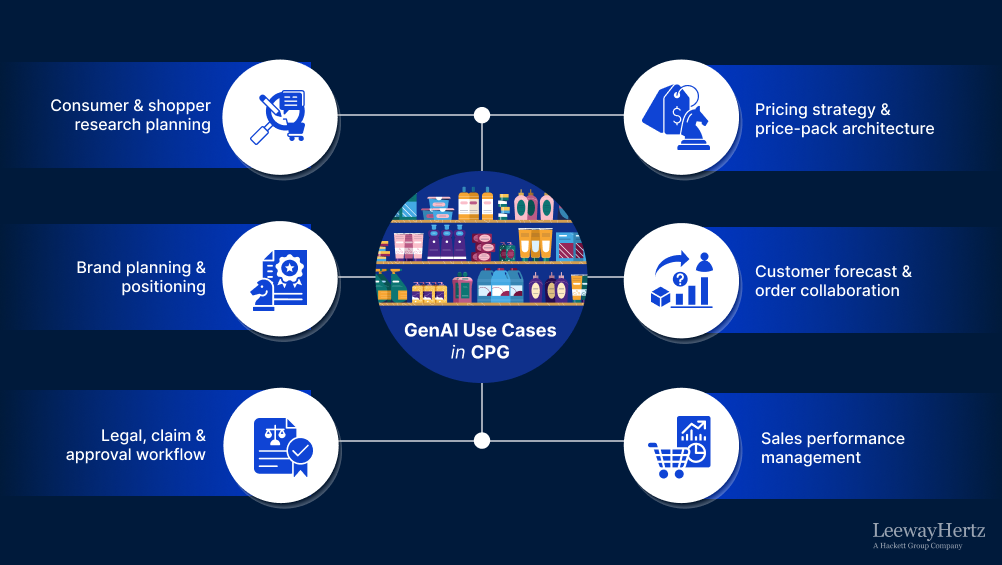
Consumer packaged goods is a practical setting for generative and agentic AI because the industry runs on data and documents, but the pressure shows up in everyday decisions. A product launch depends on formula details and label copy, while a promotion review depends on sales records and deductions, so teams spend a meaningful amount of time assembling context before they can act. The scale makes that friction expensive: worldwide consumer goods manufacturing value added is projected to reach US$4.71 trillon in 2026 [1], and food market revenue is projected at US$9.67 trillion in 2026 [2]. At that scale, a drafted summary of a product specification sheet matters only if a regulatory affairs reviewer can check it quickly, and a promotion variance explanation matters only if the category manager can use it to decide what to investigate next.
The practical value, however, does not come from a generic chatbot parked outside the workflow. It comes when AI is placed inside the workflow where the source record, the approval path, and the control already exist. A brand manager can use a draft inside the artwork review cycle, then route it to a content quality assurance reviewer before anything reaches a package or digital shelf. A demand planner can receive a short variance narrative tied to the demand forecast baseline, which lets the supply planning manager focus on the assumptions that changed rather than rebuilding the story from spreadsheets. Adoption is moving in this direction, with 71 percent reporting AI use in at least one business function, up from 42 percent in 2023 [3].
That is why use case selection should start with the shape of work rather than with the model itself. AI should be mapped at the function, process, and sub-process level because that is where a business need connects to a system of record, a document such as a batch production record, an owner such as the quality assurance manager, and the control that determines what can be released. Without that mapping, teams may identify attractive ideas that are hard to build because the data is incomplete, the workflow is disconnected, or the approval owner is unclear. With it, the organization can rank opportunities by cycle time impact, manual effort reduction, compliance need, and implementation readiness.
For consumer packaged goods, this process view is especially important because small wording changes, forecast assumptions, and quality records can carry commercial or regulatory consequences. Generative AI can prepare the of a claim rationale, while an agentic workflow can gather the supporting environmental claim substantiation file and route the packet to the regulatory affairs reviewer. The work is faster because the reviewer receives the relevant context together, and accountability is clearer because the system records who accepted, corrected, or rejected the recommendation.
This article demonstrates how generative and agentic AI can be applied at the operating-model level in consumer packaged goods. It breaks down the CPG operations into major functions, core processes, and sub-processes, and shows where AI can add practical, workflow-specific value. The focus is on helping organizations identify high-impact AI opportunities, integrate them into existing workflows, and maintain human accountability.
- How generative AI is transforming consumer packaged goods operations
- Why Gen AI use cases for consumer packaged goods must be mapped at the sub-process level
- Consumer packaged goods operating model and generative AI opportunity mapping across consumer packaged goods processes
- High-value generative AI use cases in consumer packaged goods
- How agentic AI works in consumer packaged goods workflows
- How to prioritize generative AI use cases in consumer packaged goods
- Governance, risk, and responsible AI in consumer packaged goods
- How ZBrain operationalizes generative AI use cases in consumer packaged goods
- Future of generative AI in consumer packaged goods
How generative AI is transforming consumer packaged goods operations
For a new multipack, a packaging change may start with a late retailer email. But the supporting information is often scattered: the formula specification sits in the PLM system, and artwork comments remain buried in a PDF proof. Rule-based workflow can check that required fields are complete, and a forecast model can flag schedule risk, but neither helps much when the open question is whether the revised claim matches the approved formulation. A generative model can turn those scattered inputs into a reviewable change brief, while an agentic workflow can retrieve the approved claim support and place the pack in the regulatory affairs manager’s queue for sign-off, so review time shifts from searching to judging.
Because these models handle the handoffs around systems of record, the work they change earliest is not a single department but a set of operating patterns that repeat across a packaged goods business:
-
Document-heavy work: ingredient specifications, supplier certificates, packaging artwork proofs, and purchase orders, where summarization reduces manual effort and gives quality assurance a clearer evidence packet.
-
Narrative-heavy work: brand brief updates, consumer complaint summaries, and retailer meeting recaps where drafted first versions shorten review cycles for marketing, sales, and customer care.
-
Exception-heavy work: deduction disputes, promotion claim exceptions, short shipment notices, and quality holds where classification helps teams prioritize risk and reduce backlog cost.
-
Knowledge-heavy work: labeling rules, ingredient restriction guidance, retailer content standards, and sales playbooks where retrieval gives specialists faster access to approved answers and improves compliance consistency.
-
Workflow-heavy work: new item setup, label change approval, promotion funding reconciliation, and recall evidence collection, where governed agentic steps reduce handoff delays and improve review accountability.
Transform consumer packaged goods workflows
Streamline consumer insights, product innovation, quality, food safety, supply chain, procurement, and customer operations with Gen AI to improve efficiency, compliance, traceability, and speed to market.
Why Gen AI use cases for consumer packaged goods must be mapped at the sub-process level
In consumer packaged goods, broad gen AI labels often hide very different workflows, which is why use cases need to be defined at the sub-process level. A brand team might ask for “AI for consumer packaged goods” before a flavor launch review, while one group means summarizing a sensory panel report, and another means classifying ratings and review verbatims for a possible Qs sell-out file, but the revenue growth management analyst confirms the harmonized version before it supports ACV distribution and velocity analysis. AI may classify recurring complaint themes in review verbatims, but the quality manager decides which themes should be escalated to the brand and quality teams.
A better approach is to map use cases to the consumer packaged goods operating model:
Function: The major business or control area, such as demand planning, brand management, trade promotion management, product development, packaging, quality, regulatory affairs, supply chain, or finance.
Process: The workflow area within that function, such as promotion planning, assortment review, new product launch, artwork approval, supplier documentation review, demand forecasting, order allocation, or deduction management.
Sub-process: The specific work activity, such as promotion brief drafting, claim substantiation review, packaging copy comparison, forecast exception commentary, supplier certificate summarization, retailer setup form completion, or deduction evidence assembly.
Generative AI-enabled opportunity: The specific way generative AI can support that sub-process, such as drafting a review narrative, summarizing supplier records, comparing product information across documents, preparing exception commentary, generating claim-review briefs, or assembling evidence for human review.
This level of detail matters because CPG workflows are tied to specific product data, retailer requirements, consumer-facing claims, packaging artifacts, supplier documents, quality records, approval owners, and decision rights. A generative AI workflow for packaging claim review is different from one for promotion brief drafting. A supplier documentation summary workflow is different from a trade deduction evidence workflow. A brand manager copilot is different from a demand planner assistant or a regulatory review support tool.
By mapping generative AI opportunities at the sub-process level, CPG companies can move from broad innovation ideas to executable workflows with clear business value, data requirements, review points, governance, and implementation paths.
Consumer packaged goods operating model and generative AI opportunity mapping across consumer packaged goods processes
The consumer packaged goods operating model below is organized into core industry-native functions that practitioners recognize. Each function is decomposed into its major processes and their sub-processes, and each sub-process carries the AI-enabled opportunity that applies to it.
Function 1. Consumer insights and market research
Consumer insights and market research manage the learning agenda from research design through insight activation for brand, category, innovation, and commercial teams. These teams often work across fragmented research reports, sell-out files, and product records, which slows decisions when evidence must be reconciled manually.
Generative AI helps synthesize consumer verbatims, syndicated data, and shopper signals into concise briefs and theme taxonomies. This reduces manual synthesis effort, but consumer insights managers and shopper insights leads still confirm sample limits, claims, and brand context.
| Process | Sub-process | Key AI-enabled opportunities |
| Consumer and shopper research planning | Learning agenda and research brief | Draft brief sections from customer plans and promotion calendars, retrieve prior range-review learning, and flag unanswered decisions so the consumer insights manager can reduce approval rework. |
| Survey screener and questionnaire design | Draft screener items from product specs and customer plans, compare skip logic with Stage-Gate learning goals, and flag leading wording for market research analyst review. | |
| Consumer segmentation and occasion framework | Aggregate household measures from syndicated extracts and sell-out files, classify occasions against revenue growth needs, and summarize segment tradeoffs for shopper insights lead review. | |
| Research sample plan and fieldwork tracker | Map sample quotas to the research plan, compare milestones with the promotion calendar, and flag underfilled cells to reduce fieldwork delays for market research analyst review. | |
| Syndicated panel and point-of-sale analytics | Syndicated panel data extract ingestion | Extract measure definitions and retailer hierarchies, validate them against revenue growth reporting cuts, and flag schema gaps to reduce reconciliation for market research analyst review. |
| Point-of-sale sell-out file harmonization | Map Universal Product Codes (UPCs) and week endings to finished goods specs, compare exceptions with range-review definitions, and flag mismatches for shopper insights lead review. | |
| ACV distribution and velocity analysis | Aggregate all commodity volume (ACV) distribution and velocity drivers, compare them with planogram thresholds, and summarize distribution gaps for category manager review. | |
| Voice of the consumer and social listening | Ratings and review verbatim coding | Classify review verbatims against product specs and allergen declarations, summarize defect themes with corrective and preventive action (CAPA) categories, and flag severity clusters for quality manager review. |
| Social listening topic taxonomy | Extract emerging topics from social posts, map them to approved label claims, and draft taxonomy updates that improve issue visibility for brand insights lead review. | |
| Sentiment and claim mention classification | Classify sentiment and claim mentions against approved copy and substantiation files, then flag unsupported-claim exposure to strengthen compliance for brand counsel review. | |
| Issue escalation to the brand and quality | Detect issue spikes across reviews and social posts, retrieve related quality records, and draft escalation summaries that shorten triage for quality manager review. | |
| Insight activation for innovation and campaigns | Insight brief for concept and campaign teams | Draft insight brief sections from customer plans and product specs, retrieve prior test themes, and flag evidence gaps for brand manager review. |
| Sensory panel report synthesis | Summarize sensory preference drivers, compare descriptors with formula and product specs, and flag tradeoffs that improve go or no-go decisions for sensory research partner review. | |
| Test readout and decision log | Draft readout and decision log entries from syndicated and sell-out data, compare results with Stage-Gate criteria, and flag assumptions for innovation lead review. |
Highest-value opportunities
-
Ratings and review verbatim coding: Gen AI can classify recurring themes, complaints, sentiment patterns, and product experience signals from high volumes of customer review verbatims. This helps quality, brand, and insights teams identify issues faster and prepare reviewer-ready summaries for follow-up.
-
Syndicated panel data extract ingestion: Gen AI can support the ingestion and structuring of syndicated panel data extracts by identifying fields, harmonizing formats, and summarizing key changes. This reduces manual preparation effort and helps teams move faster from raw data to insight generation.
-
Insight brief preparation: Gen AI can summarize standardized inputs such as sensory reports, sell-out files, customer plans, and research findings into structured insight briefs. These outputs can give reviewers a faster starting point for brand, category, innovation, or commercial decisions.
Together, these opportunities carry strong AI potential because they are high-volume, artifact-rich, and repeatable. By classifying, summarizing, and structuring these inputs into reviewer-ready outputs, teams can reduce manual effort and shorten learning cycle time.
Example agentic workflow. An example agentic workflow is the insight brief activation workflow. The agent plans the brief, retrieves syndicated measures and product records, drafts evidence gaps and watchouts, routes the brief through marketing operations, and records consumer insights manager confirmation.
Function 2. Brand strategy, content and creative operations
Brand strategy, content, and creative operations manage positioning, campaign planning, content production, asset governance, and approval routing. The function often faces delays because brand copy, pack data, stock keeping unit (SKU) details, and approval status sit across separate systems.
Generative AI helps with content variation, creative brief synthesis, asset tagging in digital asset management (DAM), and review packet preparation. It lowers rework, but content quality assurance reviewers, legal reviewers, and regulatory partners confirm brand safety, claims, and artwork readiness.
| Process | Sub-process | Key AI-enabled opportunities |
| Brand planning and positioning | Brand positioning and audience definition | Aggregate syndicated and sell-out signals, classify audience segments under revenue growth priorities, and summarize positioning tensions for brand manager review. |
| Occasion and need-state mapping | Map occasions from syndicated and sell-out data, compare patterns with planogram roles, and flag underserved occasions for brand strategy lead review. | |
| Brand safety and suitability rules | Classify brand safety exclusions in approved copy, retrieve prior claim language, and flag noncompliant placements for legal counsel review. | |
| Campaign brief development | Draft campaign brief sections from product specs and promotion calendars, compare objectives with revenue guardrails, and flag missing SKU details for brand manager review. | |
| Integrated marketing calendar and activation planning | Integrated marketing calendar | Aggregate promotion and supply milestones, compare timing with planning checkpoints, and flag launch conflicts for marketing operations lead review. |
| Promotion calendar alignment | Compare promotion entries with customer plan commitments, summarize timing conflicts, and flag margin or inventory risks for trade marketing manager review. | |
| Launch moment and channel plan | Propose channel sequencing from product specs and promotion timing, retrieve planning constraints, and flag channel gaps for brand manager review. | |
| Content production and DAM operations | Artwork brief intake | Extract pack copy and SKU data from artwork inputs, validate required fields against artwork workflow rules, and flag missing inputs for creative operations lead review. |
| Digital asset tagging in DAM | Classify images against packaging dielines and channel taxonomy, retrieve artwork approval status, and propose metadata tags for content governance manager review. | |
| Hero image and packaging render request | Draft render request details from packaging dielines and finished goods specifications, validate mandatory views, and flag missing visual requirements for packaging graphics manager review. | |
| Content version control and expiration | Detect copy and pack-shot mismatches across active assets and label copy, then flag expired versions to prevent off-claim use for content governance manager review. | |
| Legal, claim and approval workflow | Marketing claim substantiation review | Retrieve product specifications and analysis certificates, summarize support for proposed claims, and flag unsupported wording for regulatory affairs manager review. |
| Environmental claim substantiation file handoff | Extract environmental claim wording, compare it with substantiation evidence, and flag gaps that reduce legal rework for sustainability counsel review. | |
| Legal and regulatory copy approval | Compare label copy with nutrition, ingredient, and allergen records, validate required elements, and flag deviations for regulatory counsel review. |
Highest-value opportunities
-
Digital asset tagging in DAM: Gen AI can tag product images, campaign assets, packaging visuals, and brand content with relevant metadata in the digital asset management system. This reduces manual tagging effort, improves asset discoverability, and helps teams reuse approved assets more efficiently.
-
Artwork brief intake: Gen AI can extract and organize key information from artwork briefs, retailer requests, packaging notes, product specifications, and supporting documents. This helps reduce intake rework, clarify missing inputs, and route briefs to the right reviewers faster.
-
Legal and regulatory copy approval: Gen AI can support copy review by comparing claims, labels, packaging text, and marketing language against approved guidance and substantiation records. This can help flag potential compliance gaps earlier, shorten approval cycles, and strengthen claim and label compliance.
Together, these opportunities offer high value because they are repetitive, artifact-rich, and anchored in clear approval records. AI can reduce manual work and accelerate review cycles while preserving accountable human sign-off for final decisions.
Example agentic workflow. An example agentic workflow is artwork brief approval preparation. The workflow plans artwork checks, retrieves approved assets and product attributes, drafts copy and dieline exceptions, routes the packet through marketing operations, and records packaging graphics manager confirmation.
Function 3. Category management and shopper marketing
Category management and shopper marketing manage category strategy, range review, shopper activation, shelf planning, and retailer-ready assortment materials. Teams lose time when shopper insights, planogram rules, product attributes, and retailer requirements must be reconciled manually.
Generative AI helps convert shopper evidence and item data into range review stories, activation briefs, and item setup packets. Category managers, space planners, and customer operations managers still validate commercial assumptions before retailers use them.
| Process | Sub-process | Key AI-enabled opportunities |
| Category strategy and range review | Category management and range review | Aggregate sell-out and syndicated data, compare assortment gaps with customer plans, and draft range review stories for category manager review. |
| Shopper mission and occasion mapping | Map shopper missions from syndicated data, classify trip patterns with sell-out signals, and summarize whitespace opportunities for shopper marketing lead review. | |
| SKU rationalization | Compare SKU velocity and margin signals, flag retention or deletion candidates, and draft decision rationales for category manager review. | |
| Category scorecard preparation | Aggregate sell-out and trade spend metrics, classify revenue growth variances, and summarize gaps for sales planning partner review. | |
| Assortment and shelf planning | Planogram creation and fixture assumptions | Retrieve product dimensions and fixture rules, compare pack sizes with planogram reset assumptions, and draft fixture notes for space planner review. |
| Planogram reset process | Compare approved planograms with promotion timing, map reset sequencing, and flag capacity conflicts for customer marketing lead review. | |
| Planogram compliance audit | Detect shelf placement mismatches from store images, compare them with approved planograms, and summarize recurring noncompliance for space planner review. | |
| Shopper marketing activation | Shopper insight brief | Summarize shopper needs and occasions from syndicated and sell-out data, classify insights by revenue priorities, and draft briefs for shopper marketing lead review. |
| In-store display and feature plan | Retrieve promotion assumptions, compare display timing with packaging constraints, and draft feature plans for customer marketing lead review. | |
| Retailer-specific activation calendar | Aggregate promotion and customer plan dates, detect retailer blackout conflicts, and draft calendar updates for sales planning partner review. | |
| Customer assortment governance | UPC, GTIN, and item attribute validation | Validate UPC and Global Trade Item Number (GTIN) fields against global item data rules, then summarize exceptions for master data steward review. |
| Product specification sheet sharing | Retrieve approved product specs and finished goods specs, compare release status with Stage-Gate controls, and draft retailer-ready notes for customer operations manager review. | |
| Retailer item setup packet | Draft item setup packet sections from product specs and allergen records, validate required attributes, and flag missing fields for customer operations manager review. |
Highest-value opportunities
-
SKU rationalization: Gen AI can summarize product performance, margin, velocity, distribution, inventory, and customer feedback to help teams identify SKUs that may need to be retained, refreshed, bundled, or discontinued. This reduces manual analysis and gives category and commercial teams a clearer starting point for assortment decisions.
-
Planogram reset: Gen AI can help assemble inputs for planogram resets by summarizing store performance, shelf space requirements, product roles, sell-through patterns, and retailer constraints. This can shorten reset preparation time and support better decisions on product placement, facings, and assortment fit.
-
Retailer item setup packets: Gen AI can generate or assemble retailer item setup packets using approved product data, packaging details, pricing inputs, images, claims, logistics information, and compliance documents. This reduces manual packet assembly, helps identify missing fields, and speeds up retailer review and onboarding.
Together, these opportunities offer strong value because they depend on high-volume inputs with clear review points. Prioritizing these sub-processes can reduce manual deck and packet preparation, shorten retailer decision cycles, and improve assortment decision quality.
Example agentic workflow. An example agentic workflow is the retailer range review packet workflow. The workflow retrieves sell-out data, syndicated measures, planogram inputs, and product attributes, drafts the range review packet, routes exceptions, and records category manager confirmation.
Function 4. Revenue growth management, pricing and trade promotion optimization
Revenue growth management, pricing, and trade promotion optimization owns price pack architecture, price corridors, promotion design, trade spend planning, and post-event interpretation. Persistent value-seeking creates pressure to explain price, mix, and promotion tradeoffs faster.
Generative AI helps translate elasticity, base volume, incremental volume, cannibalization, and gross-to-net movements into business narratives. Pricing analysts, trade planning leads, and sales finance partners confirm assumptions before price, funding, or customer commitments change.
| Process | Sub-process | Key AI-enabled opportunities |
| Pricing strategy and price-pack architecture | Price pack architecture design | Map pack roles from product specifications and customer plans, compare them with price thresholds, and flag tier conflicts for revenue growth manager review. |
| Pack-size ladder and case pack rules | Extract pack counts from finished goods specs, compare case options with ladder rules, and flag choices that create shelf friction for category manager review. | |
| Recommended shelf price guardrails | Retrieve competitive price points from syndicated data, compare them with revenue guardrails, and propose exception notes for pricing analyst review. | |
| Private label price gap review | Compare branded and private-label shelf gaps, summarize range-review exceptions, and flag margin-risk categories for category analytics lead review. | |
| Elasticity, mix and margin analytics | Base volume estimation | Aggregate baseline assumptions from forecast and sell-out data, validate exclusions with forecast value-added rules, and flag questionable shifts for demand planning manager review. |
| Price elasticity input set | Extract promoted and non-promoted observations from syndicated data, classify outliers, and summarize usable input gaps for pricing analytics lead review. | |
| Cannibalization and halo effect read | Compare item movement with adjacent planogram facings, summarize cannibalization and halo patterns, and flag ambiguous transfers for category analytics lead review. | |
| Gross-to-net margin bridge | Aggregate price and deduction explanations, map variances to bridge categories, and draft exception commentary for sales finance partner review. | |
| Trade promotion planning and calendar governance | Trade promotion event setup | Extract promoted SKUs and funding terms from customer plans, draft event setup details, and flag missing mechanics for trade planning lead review. |
| Promotion calendar integration | Compare promotion timing with forecast and supply commitments, flag volume conflicts, and summarize service risks for the demand planning manager review. | |
| Billback and scanback term capture | Extract billback and scanback clauses, classify terms against funding rules, and flag ambiguous deduction exposure for sales finance partner review. | |
| Trade spend accrual forecast | Aggregate planned events and open liabilities, compare accrual assumptions with planning rules, and draft variance explanations for sales finance partner review. | |
| Trade promotion optimization and post-event analysis | Trade promotion optimization scenario | Retrieve historical lift patterns and prior event records, compare scenarios, and propose funding reallocations for the trade promotion manager review. |
| Incremental volume and lift validation | Validate incremental units against event baselines, compare variances with post-event rules, and flag overstated lift for sales finance partner review. | |
| Post-event analysis narrative | Summarize lift and spend from event records and sell-out data, map learnings, and draft narratives for trade planning lead review. |
Highest-value opportunities
-
Price elasticity input sets: Gen AI can help organize, clean, and summarize input sets used for price elasticity analysis, such as sales history, pricing changes, promotion activity, volume shifts, and retailer-level performance. This reduces analyst preparation effort and gives commercial teams a more consistent foundation for pricing decisions.
-
Trade promotion scenarios: Gen AI can support scenario preparation by summarizing past promotion performance, comparing discount structures, identifying margin and volume trade-offs, and drafting scenario narratives. This helps revenue growth management and sales teams evaluate promotion options more efficiently.
-
Post-event narratives: Gen AI can draft post-event performance summaries after promotions, pricing changes, or customer campaigns. It can explain what happened, highlight key drivers, compare expected versus actual outcomes, and prepare reviewer-ready narratives for customer planning or internal review.
Together, these opportunities fit AI well because they use repeatable data and recurring decision logic. They can reduce analyst cleansing effort, improve promotion decision quality, and shorten customer planning cycles while reviewers confirm commercial assumptions.
Example agentic workflow. An example agentic workflow is promotion event setup review. The workflow retrieves promotion history, customer plan terms, and sell-out performance, drafts event setup and lift rationale, routes exceptions, and records trade planning lead confirmation.
Function 5. Key account sales and field execution
Key account sales and field execution manage customer plans, annual negotiations, retailer-specific growth plans, field routines, and sell-out performance management. Account teams often spend significant time assembling narratives from separate promotion, assortment, and compliance records.
Generative AI helps prepare customer-ready summaries from joint business plans, sell-out files, field notes, and issue logs. Key account managers and national account leads retain control of commitments, negotiation positions, and customer-facing materials.
| Process | Sub-process | Key AI-enabled opportunities |
| Customer joint business planning | Customer joint business plan | Draft growth narratives from customer plans, compare gaps with revenue priorities, and flag unsupported commitments for key account manager review. |
| Customer scorecard and KPI tree | Aggregate key performance indicator (KPI) movements from sell-out and syndicated data, map drivers to customer plans, and summarize exceptions for national account lead review. | |
| Assortment and distribution goals | Compare current listings with customer plan targets, map distribution gaps, and propose prioritized goals for category manager review. | |
| Annual negotiation pack | Draft negotiation pack sections from customer plans and trade accruals, classify asks against revenue guardrails, and flag concessions for national account lead review. | |
| Customer forecast and order collaboration | Customer forecast intake | Extract retailer forecast changes from forecasts and purchase orders, compare them with consensus assumptions, and flag exceptions for sales planner review. |
| Point-of-sale sell-out file review | Summarize weekly sell-out movements, compare deviations with demand forecasts, and flag inflections for sales planner review. | |
| Promotion volume alignment | Compare planned lifts with forecast baselines, retrieve prior lift patterns, and propose volume adjustments for revenue growth manager review. | |
| Field execution and retail compliance | Store visit route plan | Map store priorities from promotion calendars and planograms, classify visits against reset needs, and propose route exceptions for field sales supervisor review. |
| Shelf availability check | Detect likely out-of-stocks from shelf images and sell-out data, compare service signals, and flag replenishment issues for retail execution specialist review. | |
| Display and planogram compliance report | Classify store photos against planograms and promotion timing, validate display evidence, and draft compliance exceptions for field sales supervisor review. | |
| Sales performance management | ACV distribution tracking | Aggregate distribution points from syndicated data, map changes to customer plan targets, and flag ACV gaps for key account manager review. |
| Velocity and sell-through review | Summarize SKU velocity from sell-out and syndicated data, compare trends with revenue assumptions, and flag underperforming items for sales performance manager review. | |
| Customer issue action log | Classify open items from customer plans and deduction claims, map root causes using eight disciplines (8D) problem solving, and draft actions for broker management lead review. |
Highest-value opportunities
-
Customer joint business plans: Gen AI can help assemble customer joint business plan narratives by summarizing sales performance, distribution changes, promotional activity, category priorities, margin considerations, and growth opportunities. This reduces manual deck preparation and gives account teams a stronger starting point for customer discussions.
-
Sell-out file review: Gen AI can review retailer sell-out files to identify missing fields, unusual changes, variance drivers, and inconsistencies across product, store, region, or time-period data. This shortens manual review cycles and helps account owners focus on exceptions that may affect customer planning.
-
Display compliance reporting: Gen AI can summarize display execution data, store audit notes, field images, and retailer compliance inputs to identify gaps between planned and actual execution. This helps teams prepare clearer escalation summaries and improve follow-up with sales, field, or customer teams.
Together, these opportunities are strong AI candidates because they are high-volume, recurring, and customer-sensitive. AI can reduce manual narrative assembly, shorten variance review cycles, and improve escalation quality while account owners confirm outputs before customer use.
Example agentic workflow. An example agentic workflow is the promotion volume alignment workflow. The workflow retrieves promotion events, sell-out history, and forecast baselines, drafts variance explanations and volume options, routes the pack, and records national account lead confirmation.
Function 6. Digital commerce and retail media
Digital commerce and retail media manage digital shelf content, retailer e-commerce execution, online availability, retail media activation, and performance reporting. The work is difficult because product content, pack accuracy, promotion timing, and availability signals change across retailers.
Generative AI helps enrich product information management (PIM) records, classify digital shelf issues, and summarize return on ad spend (ROAS). Digital shelf managers and retail media analysts confirm claim accuracy, pack fit, and customer-specific rules.
| Process | Sub-process | Key AI-enabled opportunities |
| Digital shelf and product content management | PIM item attribute enrichment | Extract missing attributes from product specs and label copy, compare entries with PIM field rules, and flag enrichment gaps for digital shelf manager review. |
| UPC, GTIN and item validation | Extract UPC and GTIN values from product records, compare them with item master fields, and flag hierarchy exceptions for master data steward review. | |
| Hero image and content readiness check | Compare hero image metadata with approved pack copy, classify retailer content blockers, and flag pack-shot mismatches for content operations lead review. | |
| Product detail page audit | Retrieve live product detail page copy, compare it with approved label and allergen records, and summarize content gaps for digital shelf manager review. | |
| Marketplace and retailer e-commerce operations | Retailer item setup | Extract setup values from product specs and supply commitments, map them to retailer templates, and flag incomplete fields for e-commerce operations lead review. |
| Online availability monitoring | Detect unavailable SKU-retailer pairs, compare them with inventory and sell-out signals, and summarize likely causes for e-commerce operations lead review. | |
| Substitution and out-of-stock exception review | Classify substitution exceptions from retailer feeds, compare alternatives with planogram and product specs, and flag brand-switch risks for e-commerce operations lead review. | |
| Retail media planning and activation | Audience segment brief | Summarize shopper behavior from syndicated data and customer plans, map audiences to campaign objectives, and draft a rationale for the retail media planner review. |
| Retail media campaign setup | Compare campaign setup fields with retailer media requirements, classify budget or timing mismatches, and draft corrections for the retail media operations lead review. | |
| Sponsored search keyword taxonomy | Extract brand and occasion terms from product specs and label copy, map keyword groups, and flag restricted claims for retail media planner review. | |
| Digital commerce performance analytics | Share of search reporting | Aggregate search rank outputs, compare visibility with sell-out and planogram priorities, and summarize declining terms for the digital commerce performance analyst review. |
| Digital shelf content scorecard | Classify completeness and claim issues against product specs and label records, flag high-risk discrepancies, and summarize retailer exceptions for digital shelf manager review. | |
| Retail media ROAS readout | Aggregate media spend and sell-out results, compare ROAS with promotion objectives, and summarize drivers and caveats for retail media performance analyst review. |
Highest-value opportunities
-
PIM item enrichment: Gen AI can enrich product information management records by suggesting missing attributes, improving product titles, drafting descriptions, standardizing feature bullets, and aligning item content with approved product data. This reduces manual content work and helps teams manage high SKU volumes more consistently.
-
Product detail page audit: Gen AI can review product detail pages to identify missing claims, unclear descriptions, outdated pack information, weak images, inconsistent attributes, and gaps in customer-facing content. This helps ecommerce and brand teams triage exceptions faster while ensuring updates still go through claim, pack, or legal review where required.
-
Retail media ROAS readout: Gen AI can summarize retail media performance by comparing spend, impressions, clicks, conversions, sales lift, and return on ad spend across campaigns, products, retailers, or time periods. This helps teams identify what is working, explain performance drivers, and improve future investment decisions.
Together, these opportunities offer a strong near-term return by combining high SKU volume with clear approval controls. AI can reduce manual content work, shorten exception triage, and improve retail media investment decisions without bypassing claim or pack review.
Example agentic workflow. An example agentic workflow is digital shelf exception triage. The workflow retrieves item attributes, approved assets, content status, and availability data, drafts a prioritized exception packet, routes issues, and records digital shelf manager confirmation.
Function 7. Product innovation, formulation and research and development
Product innovation, formulation, and research and development (R&D) manage the new product pipeline from concept through formula, testing, scale-up, and commercialization handoff. Teams face cycle time pressure because concept, formula, specification, and testing evidence must align before gate decisions.
Generative AI helps draft and compare concept briefs, formula requirements, specification sheets, sensory reports, shelf-life studies, and gate materials. Food scientists, technical approvers, and Stage-Gate reviewers confirm safety, feasibility, and product performance.
| Process | Sub-process | Key AI-enabled opportunities |
| NPD Stage-Gate portfolio management | Concept brief | Draft concept brief sections from consumer and customer inputs, compare claims with Stage-Gate criteria, and flag feasibility gaps for R&D project manager review. |
| New product development Stage-Gate | Retrieve project milestones and open risks, summarize gate readiness, and flag missing specs or packaging inputs for R&D project manager review. | |
| Gate review packet | Aggregate insight summaries and cost inputs, compare variances with gate exit criteria, and flag unresolved safety items for Stage-Gate committee review. | |
| Innovation portfolio prioritization | Compare concepts, forecast baselines, and resource constraints with scoring criteria, then summarize tradeoffs for portfolio governance board review. | |
| Formula, recipe and bill of materials management | Formula or recipe master | Extract ingredient percentages and allergen tags, compare them with raw material specs, and flag incomplete substitutions for food scientist review. |
| Bill of materials | Map bill of materials components to formula quantities and item records, compare mismatches with change controls, and flag data gaps for supply chain master data owner review. | |
| Raw material specification | Summarize supplier certificates and safety data sheets into raw material specs, classify hazards, and flag missing allergen limits for quality assurance technical approver review. | |
| Finished goods specification | Draft finished goods spec sections from product specs and shelf-life studies, validate quality limits, and flag approval gaps for product quality manager review. | |
| Product testing and validation | Sensory panel report | Summarize panel comments and scoring tables, classify defects against product attributes, and flag contradictory findings for sensory scientist review. |
| Shelf-life study | Extract time-point observations and failed attributes, compare them with finished goods limits, and summarize risk drivers for food safety technical approver review. | |
| Clean label requirement review | Screen ingredient statements and raw material specs against clean label requirements, retrieve substantiation evidence, and flag unsupported claims for regulatory affairs manager review. | |
| Design for manufacturability and scale-up | Design for manufacturability review | Compare formula steps and packaging constraints with line capabilities, summarize scale-up risks, and flag feasibility blockers for process engineering manager review. |
| Pilot batch record | Extract yields and deviations from pilot batch records, compare results with formula targets, and flag scale-up learnings for process development scientist review. | |
| Master production record handoff | Draft handoff sections from formula, finished goods, and packaging records, validate required controls, and flag assumptions for plant quality manager review. |
Highest-value opportunities
-
Formula masters: Gen AI can help compile and summarize formula master data by pulling together ingredient details, formulation notes, version history, allergen information, nutrition inputs, and approval status. This reduces manual compilation effort and gives product development and technical teams a clearer view of formula readiness.
-
Finished goods specifications: Gen AI can support finished goods specification preparation by organizing product attributes, packaging details, quality parameters, labeling inputs, manufacturing requirements, and master data records. This helps improve specification completeness and consistency before technical review.
-
Gate review packets: Gen AI can assemble Stage-Gate review packets by summarizing product lifecycle records, quality documents, formulation updates, test results, risk items, and open decisions. This shortens preparation time and helps reviewers focus on the decisions required at each gate.
Together, these opportunities are high-value because they draw from product lifecycle, quality, and master data records. AI can reduce compilation effort, shorten Stage-Gate cycle time, and improve specification quality while technical reviewers confirm decisions.
Example agentic workflow. An example agentic workflow is a formula-to-spec handoff. The workflow retrieves approved formula, bill of materials, shelf life, sensory, and product data, drafts specification handoff sections, routes exceptions, and records the product quality manager’s confirmation.
Function 8. Packaging, labeling and regulatory affairs
Packaging, labeling, and regulatory affairs manage pack copy, artwork, claim reviews, label compliance, regulatory impact assessment, and approval workflows. Manual comparison across copy decks, dielines, nutrition panels, and substantiation files can slow release and raise compliance risk.
Generative AI helps compare label copy, dielines, ingredient statements, allergen declarations, and claim evidence across review cycles. Labeling specialists, regulatory affairs managers, legal reviewers, and quality partners confirm every release decision.
| Process | Sub-process | Key AI-enabled opportunities |
| Packaging design and artwork lifecycle | Packaging dieline management | Compare approved dieline dimensions and copy zones with artwork briefs, then flag conflicts that create rework for packaging engineer review. |
| Artwork brief | Draft artwork brief sections from product specs and marketing inputs, classify missing mandatory label elements, and flag gaps for artwork coordinator review. | |
| Packaging artwork approval workflow | Summarize open comments across copy decks and routed proofs, compare decisions with workflow rules, and flag unresolved holds for regulatory affairs manager review. | |
| Dieline-to-pack copy verification | Compare dielines with approved label copy, map mandatory statements to panel locations, and flag omissions for labeling specialist review. | |
| Label copy and product information compliance | Label copy deck validation | Validate label copy against formula and finished goods records, classify discrepancies in claims or warnings, and flag issues for labeling specialist review. |
| Nutrition facts panel | Extract nutrient and serving information, compare nutrition panels with Federal Food, Drug, and Cosmetic Act labeling rules, and flag exceptions for regulatory affairs manager review. | |
| Ingredient review | Compare ingredient statements with formula and raw material specs, classify naming or order discrepancies, and flag exceptions for regulatory affairs manager review. | |
| Allergen mapping | Map allergens from formula and raw material specs to allergen declarations, compare callouts with approved wording, and flag inconsistencies for quality partner review. | |
| Claims and substantiation governance | Marketing claim substantiation review | Retrieve claim language and evidence, compare each claim with approved support, and flag unsupported wording for legal reviewer confirmation. |
| Environmental claim substantiation file | Aggregate supplier and recycled-content evidence, classify support against claim criteria, and flag gaps that reduce greenwashing risk for regulatory affairs manager review. | |
| Environmental marketing guidance claim check | Screen package and digital claim text against environmental marketing guidance, compare wording with evidence thresholds, and flag higher-risk claims for legal counsel review. | |
| Health and ingredient claim evidence file | Retrieve scientific references and formula data, summarize support for health claims, and flag substantiation gaps for regulatory affairs manager review. | |
| Regulatory submission and change control | Fair Packaging and Labeling Act net contents review | Compare declared net contents with finished goods specs and dielines, validate wording, and flag discrepancies for regulatory affairs manager review. |
| Food Labeling Rule Change Impact Assessment | Retrieve impacted SKUs and label records, compare rule changes with approval workflows, and propose remediation queues for regulatory affairs manager review. | |
| Translation and market-specific label review | Compare translated copy with approved source-market wording, classify mandatory wording gaps, and flag exceptions for regulatory affairs manager review. |
Highest-value opportunities
-
Dieline-to-pack copy verification: Gen AI can compare approved copy against dielines, artwork proofs, and packaging layouts to identify missing text, inconsistent claims, formatting issues, or version mismatches. This reduces manual comparison effort and helps artwork teams catch issues before release.
-
Label copy decks: Gen AI can help assemble and summarize label copy decks by pulling together approved claims, ingredient statements, nutrition details, regulatory text, pack instructions, and required disclaimers. This shortens preparation time and gives reviewers a cleaner starting point for approval.
-
Claim substantiation reviews: Gen AI can support claim substantiation reviews by comparing proposed pack or marketing claims against approved evidence, regulatory guidance, prior approvals, and brand rules. This helps legal, regulatory, and technical reviewers identify gaps earlier and make more consistent compliance decisions.
Together, these opportunities recur across most artwork cycles and have clean reviewer handoffs. AI can reduce manual comparison effort, shorten approval cycle time, and improve compliance decision quality without changing release authority.
Example agentic workflow. An example agentic workflow is pack copy compliance routing: The workflow retrieves dielines, label copy, product attributes, and quality holds, drafts discrepancy checklists, routes exceptions, and records regulatory affairs manager release confirmation.
Function 9. Demand planning, sales and operations planning and integrated business planning
Demand planning, sales and operations planning (S&OP), and integrated business planning (IBP) manage the forecast baseline, consensus forecast, demand review, launch overlays, and demand sign-off. The function often loses time reconciling customer inputs, promotion assumptions, and supply constraints before review meetings.
Generative AI helps explain forecast changes, reconcile customer forecasts with sell-out signals, draft demand review narratives, and capture assumptions. Demand planning leads, and IBP coordinators confirm forecast changes before they affect supply, inventory, or financial plans.
| Process | Sub-process | Key AI-enabled opportunities |
| Demand forecast baseline and statistical planning | Demand forecast baseline | Compare forecast baselines with sell-out trends and customer plans, summarize variance drivers, and draft assumption notes for demand planner review. |
| Demand sensing signal selection | Screen sell-out, syndicated, and promotion signals for recency and coverage, classify weak inputs, and recommend signal sets for supply chain analytics lead review. | |
| Syndicated panel data extraction | Extract brand and geography fields from syndicated data, validate mapping to forecast baselines, and flag gaps for demand planner review. | |
| MAPE and forecast bias review | Summarize error patterns, compare exceptions under mean absolute percentage error (MAPE) and bias review, and flag persistent drivers for demand planner review. | |
| Consensus forecasting and demand review | Consensus forecasting | Aggregate sales, finance, and demand planning inputs, identifies unresolved assumption conflicts, and drafts exception logs for sales planning lead review. |
| Demand review deck | Draft demand review narratives from forecast, promotion, and sell-out records, summarize material changes, and flag decisions for demand planning lead review. | |
| Forecast value-added analysis | Compare forecast versions before and after overrides, summarize degradation patterns, and flag low-value overrides for the demand planning manager review. | |
| Promotion and launch demand integration | Promotion calendar demand overlay | Retrieve approved promotion events, map assumptions to forecast baselines, and draft overlay rationales for revenue growth manager review. |
| Trade promotion event volume uplift | Compare events with historical sell-out response, summarize uplift analogs, and propose volume assumptions for the revenue growth manager review. | |
| New item launch curve | Retrieve analog SKU history and customer plans, classify launch curve archetypes, and draft ramp-up assumptions for demand planning lead review. | |
| Cannibalization adjustment | Map overlapping SKUs in planograms and sell-out files, detect source-of-volume shifts, and propose adjustments for category manager review. | |
| S&OP and IBP governance | Sales and operations planning calendar | Map forecast refreshes and supply commits to the S&OP calendar, flag late inputs, and draft follow-up tasks for IBP coordinator review. |
| Integrated business planning cycle | Aggregate forecast, supply, trade spend, and production narratives, summarize cross-functional gaps, and draft decision packets for IBP lead review. | |
| Executive demand sign-off | Summarize final forecast changes, compare open risks with supply constraints, and route unresolved exceptions for demand sponsor review. |
Highest-value opportunities
-
Demand review decks: Gen AI can help assemble demand review decks by summarizing forecasts, sell-out trends, customer assumptions, promotion plans, supply constraints, and key demand risks. This reduces manual deck preparation and gives S&OP or IBP reviewers a clearer view of the decisions that need attention.
-
Promotion overlays: Gen AI can compare promotion calendars, baseline forecasts, sell-out data, customer plans, and expected uplift assumptions to identify where promotions may affect demand. This helps planners reconcile promotional impacts more consistently before consensus forecast review.
-
Forecast value-added analysis: Gen AI can summarize forecast changes, compare forecast accuracy across planning cycles, identify where manual overrides improved or reduced accuracy, and explain recurring sources of forecast error. This supports stronger forecast governance and better planning discipline.
Together, these opportunities are high-value because they repeatedly pull from forecasts, promotions, sell-out data, and customer assumptions. AI can reduce deck preparation and reconciliation effort, shorten S&OP and IBP cycle time, and improve forecast governance.
Example agentic workflow. An example agentic workflow is demand review exception preparation: The workflow retrieves forecast baselines, promotion events, syndicated trends, and sell-out history, drafts variance explanations, routes the deck, and records demand planning lead confirmation.
Function 10. Supply planning, inventory and customer service levels
Supply planning, inventory, and customer service levels manage supply review, master production scheduling, allocation, inventory health, service performance, and constrained supply decisions. Teams face delayed decisions when supply commits, inventory aging, and customer service risks are reviewed in separate queues.
Generative AI helps summarize service misses, aging inventory, shelf-life constraints, shortage drivers, and recovery plans. Supply planners and customer service level managers confirm allocation, on-time in-full (OTIF), and customer impact decisions.
| Process | Sub-process | Key AI-enabled opportunities |
| Supply review and master production scheduling | Supply review | Summarize demand and supply gaps, compare exceptions with supply review thresholds, and draft issue narratives for supply planning manager review. |
| Master production schedule | Compare master schedules with demand forecasts and material availability, classify deviations, and draft change rationales for manufacturing planner review. | |
| Supply commit file | Validate supply commits against purchase orders and shipment notices, classify gaps with IBP rules, and flag unreliable dates for customer service level manager review. | |
| Capacity-constrained plan | Retrieve line and material constraints, compare scenarios with supply priorities, and draft exception narratives for network planner review. | |
| Inventory planning and allocation | Safety stock review | Compare forecasts, sell-out data, and aging reports with service segmentation rules, then summarize service and working-capital tradeoffs for inventory planner review. |
| Inventory aging report | Extract lot age and balances from aging reports, classify obsolescence exposure, and draft disposition summaries for inventory planner review. | |
| Shelf-life constrained allocation | Map remaining shelf life from inventory and quality records, classify lots against allocation rules, and draft customer impact options for customer service level manager review. | |
| Customer service level and OTIF management | On-time in-full scorecarding | Aggregate purchase order and shipment records, classify misses by reason code, and summarize account-level patterns for customer service level manager review. |
| Fill rate root-cause coding | Classify unfilled order lines into Lean Six Sigma define, measure, analyze, improve, and control categories, then summarize drivers for the customer service level manager review. | |
| Service-level recovery plan | Draft recovery actions from service scorecards and supply commits, compare commitments with escalation rules, and flag customer risks for customer service level manager review. | |
| Shortage, exception and scenario management | Material shortage alert | Detect late purchase order or shipment notice signals, map affected components to bills of materials, and draft SKU impact summaries for material planner review. |
| MOQ and lead-time exception | Validate quantities and dates against supplier lead-time notes, classify minimum order quantity (MOQ) trade-offs, and flag cost leakage for procurement planner review. | |
| Constrained supply allocation | Propose allocation options from supply commits and inventory aging, compare tradeoffs with guardrails, and flag off-policy impacts for supply chain director review. |
Highest-value opportunities
-
Supply commit files: Gen AI can help review and summarize supply commit files by comparing planned supply, confirmed availability, open orders, inventory positions, customer priorities, and constraint notes. This reduces manual reconciliation effort and gives planners a clearer view of supply gaps and commitment risks.
-
OTIF scorecarding: Gen AI can summarize on-time, in-full performance by customer, product, region, order type, or time period. It can help identify recurring service issues, explain variance drivers, and prepare exception summaries for supply chain, sales, and customer teams.
-
Constrained allocation: Gen AI can support constrained allocation decisions by organizing demand signals, available inventory, customer commitments, service priorities, margin considerations, and substitution options. This helps planners evaluate trade-offs more consistently before making allocation recommendations.
Together, these opportunities are strong AI candidates because they combine planning, order, inventory, and customer records. AI can reduce reconciliation effort, shorten exception cycles, and improve constrained-supply decisions while planner approval remains explicit.
Example agentic workflow. An example agentic workflow is the constrained supply allocation workflow. The workflow retrieves supply commits, schedules, order status, and inventory aging, drafts customer allocation options, routes the packet, and records supply chain director confirmation.
Function 11. Procurement and supplier management
Procurement and supplier management owns sourcing, supplier qualification, purchase order alignment, supplier scorecards, material documentation, and traceability handoffs. Sourcing and supplier quality teams often spend significant time comparing bid, certificate, and specification evidence by hand.
Generative AI helps compare supplier bids, extract certificates, summarize supplier approval files, interpret scorecard trends, and draft exception narratives. Category managers, supplier quality engineers, and quality assurance reviewers confirm sourcing, approval, and release decisions.
| Process | Sub-process | Key AI-enabled opportunities |
| Strategic sourcing and category buying | Sourcing event brief preparation | Draft sourcing brief sections from bills of materials and product specs, compare volume needs with purchase history, and flag ambiguous requirements for category manager review. |
| Supplier bid comparison | Compare supplier quotes with raw material specs and purchase terms, classify price or lead-time deviations, and flag MOQ tradeoffs for strategic sourcing manager review. | |
| Should-cost input pack preparation | Extract material and packaging assumptions from formulas and product specs, compare gaps with manufacturability inputs, and draft checklists for procurement finance manager review. | |
| Purchase order policy alignment review | Validate purchase order clauses against supplier approval files and current good manufacturing practice requirements, then flag off-policy terms for procurement operations manager review. | |
| Supplier qualification and approval | Supplier approval file preparation | Summarize certificates and quality history, classify approval gaps against Preventive Controls Qualified Individual (PCQI) expectations, and flag incomplete conditions for supplier quality engineer review. |
| Raw material specification review | Compare supplier parameters with raw material specs and allergen declarations, detect tolerance mismatches, and draft issue notes for R&D lead and supplier quality engineer review. | |
| Supplier risk and capability assessment | Classify questionnaire responses against approval files and safety data sheets, screen capability claims, and flag high-risk gaps for supplier quality manager review. | |
| Supplier performance and collaboration | Supplier scorecard review | Aggregate delivery and defect findings from purchase orders and nonconformance records, summarize trends, and flag recurring patterns for category manager review. |
| OTIF and quality metric review | Detect late or defect patterns across order and quality records, compare drivers with service rules, and draft exception narratives for materials manager review. | |
| Supplier corrective action request | Draft corrective action details from nonconformance and CAPA records, map evidence to 8D steps, and flag weak verification for supplier quality engineer review. | |
| Traceability and documentation intake | Certificate of analysis collection | Extract lot and result fields from certificates of analysis, compare values with raw material specs, and flag out-of-spec entries for quality assurance review. |
| Certificate of conformance validation | Validate supplier attestations against purchase orders and approval files, map required declarations, and flag missing statements for procurement operations manager review. | |
| Safety data sheet intake | Extract hazard and handling fields from safety data sheets, classify gaps against handling controls, and flag conflicting data for environmental health and safety manager review. | |
| Lot-level supplier traceability confirmation | Map supplier lot and shipment references to traceability records, validate Food Safety Modernization Act (FSMA) data completeness, and flag gaps for materials manager review. |
Highest-value opportunities
-
Supplier bid comparison: Gen AI can compare supplier bids across price, lead time, service levels, quality history, capacity, payment terms, and risk indicators. This reduces bid triage effort and helps sourcing teams identify the strongest options for review.
-
Supplier approval files: Gen AI can help assemble and review supplier approval files by organizing certificates, questionnaires, audit records, compliance documents, insurance details, and risk assessments. This shortens supplier approval cycles and improves the consistency of supplier risk decisions.
-
Certificate of analysis collection: Gen AI can track, extract, and summarize certificate of analysis documents for raw materials, ingredients, packaging components, or finished goods. This helps receiving, quality, and procurement teams identify missing or incomplete documentation faster and strengthen compliance controls.
Together, these opportunities stand out because they are high-volume and documentation-heavy. AI can reduce bid triage effort, shorten supplier approval and receiving cycles, improve supplier risk decisions, and strengthen documentation compliance.
Example agentic workflow. An example agentic workflow is the certificate of analysis intake exception workflow. The workflow retrieves purchase order, shipment, raw material, and supplier documentation records, drafts an exception summary, routes the case, and records quality assurance reviewer confirmation.
Function 12. Manufacturing operations, quality and food safety
Manufacturing operations, quality, and food safety manage plant execution, batch records, current good manufacturing practice routines, hazard analysis and Critical Control Points (HACCP), sanitation, deviations, nonconformances, CAPA, and traceability. Manual review can delay batch release when production, quality, and food safety evidence sit across separate records.
Generative AI helps extract and summarize batch records, hazard worksheets, deviation reports, certificates, and CAPA records. Quality assurance reviewers, PCQI reviewers, and food safety leads confirm release, disposition, and corrective action decisions.
| Process | Sub-process | Key AI-enabled opportunities |
| Production execution and batch records | Master production record preparation | Compare master production records with bills of materials and formula masters, retrieve manufacturing requirements, and flag instruction gaps for quality assurance manager review. |
| Batch production record review | Extract weights and deviations from batch records, compare them with master records, and summarize exceptions for quality assurance reviewer disposition. | |
| Line clearance checklist completion | Validate line clearance checklists against schedules and packaging dielines, flag missing sign-offs or residual material risks, and reduce startup delays for production supervisor review. | |
| Lot code and traceability assignment | Map lot codes to batch and shipment records, classify traceability links under FSMA requirements, and flag breaks for food safety lead review. | |
| CGMP, HACCP and preventive controls compliance | Current good manufacturing practice checklist completion | Classify checklist findings by facility area, compare repeats with deviation history, and summarize high-risk gaps for plant quality manager review. |
| Hazard analysis worksheet preparation | Extract ingredients and process steps from hazard worksheets, compare severity language with HACCP criteria, and flag unsupported decisions for PCQI reviewer disposition. | |
| HACCP plan review | Retrieve critical limits and monitoring steps, compare plans with hazard worksheets, and flag plan-to-hazard mismatches for food safety manager review. | |
| Preventive controls plan review | Compare preventive controls with hazard worksheets and allergen programs, classify gaps under PCQI expectations, and draft notes for PCQI reviewer action. | |
| Quality events management and continuous improvement | Deviation report review | Summarize deviation reports, retrieve linked batch records, classify probable failure modes, and draft containment questions for quality assurance investigation lead review. |
| Nonconformance report review | Extract defect and disposition evidence from nonconformance records, compare patterns with improvement methods, and flag repeat causes for quality manager review. | |
| CAPA record preparation and tracking | Compare CAPA records with source evidence, classify root cause and effectiveness checks, and draft overdue-action summaries for CAPA owner review. | |
| Food safety, sanitation and traceability management | Sanitation standard operating procedure review | Compare sanitation procedures with safety data sheets and deviation history, flag unclear contact times or verification steps, and reduce deviation risk for sanitation manager review. |
| Allergen control program review | Map ingredients and changeovers to allergen controls, classify cross-contact points, and flag sequencing or declaration gaps for food safety lead review. | |
| PCQI review | Aggregate open items from preventive control and HACCP records, classify risk-prioritized questions, and shorten review meetings for PCQI reviewer confirmation. | |
| Critical tracking event record and key data element record review | Validate critical tracking and key data records against order, shipment, and batch records, then flag traceability gaps for food safety lead review. |
Highest-value opportunities
-
Batch production records: Gen AI can summarize batch production records by identifying exceptions, missing entries, out-of-range values, hold points, and documentation gaps. This helps quality and production teams review batch records faster before release decisions.
-
Preventive controls plans: Gen AI can review preventive controls plans to highlight control points, monitoring requirements, corrective actions, verification steps, and unresolved gaps. This reduces manual compliance effort and supports more consistent food safety review.
-
Critical tracking records: Gen AI can validate critical tracking events and key data element fields across traceability records, such as lot codes, shipment events, receiving records, transformation events, and location details. This improves traceability completeness and helps teams respond faster during recall investigations.
Together, these opportunities offer a strong AI lift because they are high-volume and tied to clear review gates. Gen AI can reduce release cycle time, manual compliance effort, and recall investigation latency by summarizing exceptions and validating traceability fields.
Example agentic workflow. An example agentic workflow is batch release exception review. The workflow retrieves batch, master production, specification, and deviation records, drafts targeted release questions, routes the package, and records quality assurance reviewer disposition.
Function 13. Logistics, order management, deductions and customer finance
Logistics, order management, deductions, and customer finance owns purchase order intake, fulfillment orchestration, shipment execution, advance ship notices, deductions, chargebacks, and short-pay resolution. Teams lose cash and time when shipment evidence, promotion terms, and invoice records must be matched manually.
Generative AI helps compare deduction claims, chargeback packets, proof of delivery, promotion terms, and invoices. Deduction analysts and customer finance partners confirm recoveries, write-offs, accrual true-ups, and customer-facing responses.
| Process | Sub-process | Key AI-enabled opportunities |
| Order capture and fulfillment orchestration | Purchase order intake | Extract order attributes and promotion references from purchase orders, compare them with supply commitments, and flag conflicting lines for customer service representative review. |
| Order validation against the customer hierarchy | Classify ship-to and deal identifiers against customer plans, detect pricing mismatches, and flag exception notes for order management lead review. | |
| Allocation and available-to-promise check | Retrieve supply commits and inventory aging signals, compare them with requested quantities, and summarize service-risk options for supply planner review. | |
| Advance ship notice generation | Draft advance ship notices from confirmed order lines, validate lot and traceability fields, and flag missing data for logistics coordinator review. | |
| Warehousing, transportation and delivery execution | Case pack and pallet configuration validation | Compare order case quantities with product specs and packaging dielines, validate pallet notes, and flag nonstandard packs for warehouse supervisor review. |
| Carrier appointment scheduling | Retrieve delivery windows from orders and shipment notices, compare them with carrier confirmations, and propose appointment changes for transportation planner review. | |
| Proof of delivery collection | Extract signatures and exception notes from delivery proof, compare them with shipment notices, and flag shortage evidence for logistics coordinator review. | |
| Temperature excursion and shelf-life exception log generation | Classify excursion narratives and shelf-life variance notes, compare affected lots with shelf-life studies, and flag unresolved risks for quality manager review. | |
| Deductions, chargebacks and claims management | Customer deduction claim review | Extract amounts and deal references from deduction claims, compare them with trade events, and draft recovery or write-off recommendations for deduction analyst review. |
| Chargeback packet preparation | Aggregate debit memos and delivery exceptions, compare evidence with shipment notices, and draft dispute response sections for customer finance partner review. | |
| Billback and scanback reconciliation | Extract billback rates and scan quantities, compare them with promotion events, and flag overclaims for trade finance manager review. | |
| Shipment evidence matching | Map delivery proof and shipment notices to deduction claims, detect conflicting evidence, and summarize defensible positions for deduction analyst review. | |
| Order-to-cash service and root-cause governance | Invoice match and short-pay review | Compare invoice, purchase order, accrual, and deduction values, classify short-pay drivers, and draft adjustment recommendations for customer finance partner review. |
| OTIF dispute response | Aggregate shipment, delivery, order, and carrier records, compare service facts with OTIF methodology, and draft response language for customer service manager review. | |
| Deduction reason code governance | Classify deduction histories by reason code, map recurring drivers to improvement problem statements, and flag ambiguous claims for customer finance manager review. |
Highest-value opportunities
-
Customer deduction claims: Gen AI can review customer deduction claims by comparing claim details against customer terms, invoices, purchase orders, shipment records, and promotion agreements. This helps teams identify valid claims, questionable deductions, missing evidence, and recovery opportunities faster.
-
Shipment evidence matching: Gen AI can match shipment evidence such as advance ship notices, bills of lading, proof of delivery, carrier updates, order records, and customer receipts against claims or short-pay disputes. This reduces manual investigation effort and supports faster dispute resolution.
-
Invoice short-pay review: Gen AI can compare invoices, payments, customer remittance details, deduction reason codes, and order records to identify the likely cause of a short payment. This helps finance and order-to-cash teams prioritize recoverable amounts, reduce write-offs, and improve root-cause visibility.
Together, these opportunities offer a strong near-term return because they repeatedly compare orders, invoices, shipment notices, and claim records. AI can speed recovery decisions, lower write-offs, strengthen compliance with customer terms, and create clearer accountability.
Example agentic workflow. An example agentic workflow is a deduction recovery workup. The workflow retrieves deduction claims, invoices, promotion terms, and shipment evidence, drafts a recovery or write-off recommendation, routes the packet, and records deduction analyst confirmation.
Function 14. Technology, data and AI platform governance
Technology, data, and AI platform governance owns enterprise systems, integration, master data, analytics environments, AI enablement, security controls, and governance across the operating model. Business teams struggle when fragmented data, unclear ownership, and weak audit trails slow issue resolution.
Generative AI helps through governed retrieval, prompt libraries, human review workflows, data entitlements, audit trails, model evaluation, and agentic workflow orchestration. AI platform teams, control owners, data owners, and functional reviewers confirm outputs before production or risk-bearing action.
| Process | Sub-process | Key AI-enabled opportunities |
| Enterprise architecture and business systems enablement | Enterprise resource planning process ownership | Compare process documentation with bill of materials and production schedules, map handoff gaps to IBP, and flag ownership conflicts for enterprise architect review. |
| Supply chain planning integration | Extract interface requirements from forecasts and supply commits, compare planning handoffs with S&OP cadence, and flag data dependencies for supply planning lead review. | |
| Trade promotion management integration | Aggregate promotion, event, and accrual mappings across planning and finance systems, classify control breaks, and flag reconciliation gaps for revenue growth management owner review. | |
| Product lifecycle management integration | Compare product specs and label attributes across product lifecycle management (PLM) and item systems, then flag launch-blocking gaps for PLM owner review. | |
| Master data, product data and integration governance | MDM and PIM stewardship | Classify product and finished goods attributes against master data management (MDM) stewardship rules, compare duplicates, and flag conflicting claims for master data steward review. |
| UPC, GTIN and master data governance | Validate UPC and GTIN assignments against packaging and finished goods records, compare exceptions with artwork checkpoints, and flag publication risks for item data governance lead review. | |
| Customer hierarchy and pack configuration governance | Map customer hierarchy nodes to customer plans, compare pack configurations with price architecture, and flag relationships that create order rework for customer master data lead review. | |
| API and EDI integration monitoring | Detect anomalies in application programming interface (API) and electronic data interchange (EDI) payloads, classify failures, and summarize partner issues for integration lead review. | |
| Data cloud, analytics and AI enablement | Data cloud and analytics workspace management | Classify workspace requests by sell-out and syndicated data domains, retrieve entitlement precedent, and flag overbroad access for analytics product owner review. |
| Prompt library and retrieval corpus governance | Retrieve approved claim passages, compare prompt citations with substantiation criteria, and flag unsupported retrieval chunks for marketing claims reviewer approval. | |
| Model evaluation and human review workflow | Compare model outputs against allergen and hazard records, classify defects with food safety review rubrics, and summarize failure modes for AI governance lead review. | |
| Agentic workflow orchestration | Map task sequences from deduction claims, retrieve approval rules, and draft exception handoff notes for the revenue operations manager review. | |
| Security, compliance and AI governance | AI risk management and generative AI profile control mapping | Map AI use cases handling claim and allergen records to risk controls, classify residual gaps, and draft remediation actions for AI governance committee review. |
| SOX ITGC change control | Summarize Sarbanes-Oxley (SOX) IT general controls (ITGC) change tickets affecting accrual and schedule controls, then flag missing approvals for IT control owner review. | |
| Data entitlement and audit trail review | Retrieve access logs for sell-out and syndicated workspaces, classify exceptions against System and Organization Controls 2 (SOC 2), and flag overprivileged access for data owner review. |
Highest-value opportunities
-
MDM and PIM stewardship: Gen AI can support master data management and product information management stewardship by identifying incomplete records, duplicate attributes, naming inconsistencies, missing product fields, and data quality exceptions. This reduces manual triage and helps data stewards resolve issues faster.
-
API and EDI monitoring: Gen AI can summarize API and electronic data interchange exceptions by identifying failed transactions, mapping errors, missing fields, duplicate messages, and recurring integration issues. This shortens the issue-resolution cycle time and helps integration owners prioritize the most urgent failures.
-
Prompt library governance: Gen AI can help review prompt libraries by checking ownership, approved use cases, version history, risk classification, test results, and required review status. This strengthens compliance and accountability for AI-enabled workflows without bypassing human approval.
Together, these opportunities offer strong near-term value because they combine high-volume exception queues with clear ownership. AI can reduce manual triage, shorten issue-resolution cycle time, strengthen compliance, and improve accountability while keeping human approval in place.
Example agentic workflow. An example agentic workflow is the SKU data stewardship workflow. The workflow retrieves product specs, finished goods specs, bills of materials, and claim references, drafts stewardship exceptions, routes corrections, and records master data steward confirmation.
High-value generative AI use cases in consumer packaged goods
In consumer packaged goods, the recurring pattern is clear: high-value use cases start at high-volume entry points, run over existing artifacts, and end in fast confirmation by an accountable human reviewer. That pattern helps functions reduce manual review cycles without moving production, customer-facing, or compliance decisions outside governed review.
| Use case | Function | Why is it high-value |
| Ratings and review verbatim coding | Consumer insights and market research | Gen AI can classify high volumes of consumer reviews against a controlled topic taxonomy, so a consumer insights manager can approve themes before they enter insight briefs. |
| Campaign brief development | Brand strategy, content and creative operations | Across repeated campaign requests, Gen AI can draft first-pass campaign briefs from brand positioning and promotion calendar inputs, so a brand manager can confirm objectives before creative work starts. |
| Marketing claim substantiation review | Packaging, labeling and regulatory affairs | Gen AI can compare high volumes of pack claims with evidence files, so a regulatory affairs reviewer can confirm substantiation before copy advances to approval. |
| Retailer item setup packet | Category management and shopper marketing | Gen AI can assemble frequent retailer setup packets from item attributes and specification sheets, so a category manager can validate the submission before it reaches the retailer. |
| Product detail page audit | Digital commerce and retail media | Gen AI can compare large product detail page backlogs with approved item content, so an e-commerce content reviewer can confirm corrections before publication. |
| Post-event analysis narrative | Revenue growth management, pricing and trade promotion optimization | Gen AI can draft narratives for recurring promotion readouts using lift and spend evidence, so a revenue growth manager can approve the explanation before planning assumptions change. |
| Demand review deck | Demand planning and integrated business planning | Gen AI can summarize high-volume forecast exceptions and promotion overlays, so a demand planning manager can confirm the demand review deck before consensus forecasting. |
| Supplier bid comparison | Procurement and supplier management | Gen AI can compare high-volume supplier responses against specifications and should-cost inputs, so a senior buyer can confirm the recommended shortlist before negotiation. |
| Nonconformance report | Manufacturing operations, quality and food safety | Gen AI can classify repeated nonconformance reports and draft issue summaries, so a quality assurance reviewer can confirm disposition before any corrective action is initiated. |
| Customer deduction claim | Logistics, order management, deductions and customer finance | Gen AI can extract evidence from frequent deduction claims and proof of delivery records, so a deductions analyst can confirm the reason code before dispute response. |
A use case should be considered high-value when its business impact is clear, and its review boundary is well defined. It should reduce a recurring backlog, shorten a recurring review cycle, or improve the quality of a repeated decision, while keeping final confirmation with the role accountable for the outcome.
How agentic AI works in consumer packaged goods workflows
In consumer packaged goods workflows, delays often stem from scattered evidence rather than a lack of ideas, because product records, retailer inputs, artwork files, and trade plans are stored in different systems. An agentic workflow is a governed sequence that plans the work, retrieves approved data, drafts a reviewable output, routes exceptions, and records confirmation, with tool access limited to approved systems.
Here are a few examples:
Insight brief activation workflow
-
Role: as brief coordinator, the agent maps Stage-Gate questions so evidence gaps surface early.
-
Retrieve: it pulls syndicated measures and point-of-sale sell-out files from approved systems.
-
Draft and route: it prepares an insight brief and watchout log, then routes gaps to the innovation workflow queue.
-
Confirm: the consumer insights manager confirms the brief before it informs launch decisions.
Artwork brief approval preparation
-
Role: as an approval preparation agent, it maps packaging artwork checks so rework is caught before routing.
-
Retrieve: it gathers the artwork brief and current pack assets from approved content systems.
-
Draft and classify: it classifies copy and claim exceptions and then drafts an approval-readiness packet.
-
Confirm: the packaging graphics manager confirms readiness before artwork moves forward.
Retailer range review packet workflow
-
Role: as a range review assembler, the agent maps the retailer checklist so assumptions are explicit.
-
Retrieve: it pulls point-of-sale sell-out files and syndicated panel extracts from approved systems.
-
Draft and classify: it prepares a range review deck and classifies off-standard SKU assumptions.
-
Confirm: the category manager confirms the packet before retailer submission.
Promotion event setup review
-
Role: as a trade setup reviewer, the agent maps joint business plan terms so funding questions surface early.
-
Retrieve: it pulls promotion history and point-of-sale performance from approved trade systems.
-
Draft and route: it prepares the trade promotion event, then routes funding exceptions to the trade promotion queue.
-
Confirm: the trade planning lead confirms setup before the event is released.
This review boundary is the safety property: the agent prepares evidence and drafts, but the accountable role in the workflow confirms before any production change, customer-facing message, or other risk-bearing action.
How to prioritize generative AI use cases in consumer packaged goods
Consumer packaged goods teams often stall when AI ideas are treated as a backlog inventory rather than a delivery sequence. Score each candidate on business value and feasibility, so high-volume work such as product content drafting or trade promotion summaries moves first, with a content QA reviewer or category manager confirming outputs before release.
| Criterion | What to ask |
| Volume and frequency | Does the use case touch enough recurring CPG work, such as product content updates or promotion summaries, to reduce manual effort at scale? |
| Artifact availability | Are approved pack copy and item master records available in a usable form so the model can draft with less rework? |
| Review boundary | Can a regulatory affairs reviewer or content QA reviewer clearly approve the AI output before any customer-facing or production change? |
| Blast radius | If the AI draft is wrong, can the impact be contained before pack copy or retailer item content changes? |
| Business impact | Can the team connect the use case to fewer review hours or faster launch cycle time using current workflow baselines? |
The issue arises when the use case is framed at a broad level, such as “modernize marketing” instead of a specific workflow step like content brief drafting, which makes ownership and measurement unclear. Missing data surfaces when approved specifications or claims guidance are fragmented across systems, leading to rework before a reviewer can trust the output. Bypassed governance occurs when a draft reaches a retailer portal or consumer message before a content QA reviewer checks it, which raises compliance risk. Premature quantified savings show up when labor savings are booked before baseline review effort and rework rates are measured; the strongest first projects are the high-volume, artifact-rich, cleanly reviewed sub-processes flagged in the operating model above.
Accelerate AI Solutions Development
Build fully functional solutions from your high-value use cases, based on specific operational needs and enterprise context.
Governance, risk, and responsible AI in consumer packaged goods
Governance, risk, and responsible AI are central to scaling AI in consumer packaged goods. As AI is embedded across planning, sourcing, manufacturing, and distribution workflows, governance ensures outputs remain traceable, compliant, and aligned with food safety and quality requirements.
Human-in-the-loop (HITL) oversight: In consumer packaged goods, AI can prepare a claim substantiation summary, classify sentiment in ratings and review verbatims, or draft a campaign brief, but it should not make the business decision. Before any production change, customer-facing message, or risk-bearing action, the appropriate reviewer confirms the output, such as the regulatory affairs reviewer for claims, the brand manager for campaign copy, or the category manager for assortment and shelf planning.
Regulatory and standards alignment: Start with NIST AI RMF 1.0 for AI risk governance and NIST AI 600-1 for generative AI risks such as hallucination, data leakage, and harmful content, then connect those controls to the rules that shape consumer packaged goods work. The practical control map should cover food safety and labeling, marketing claims, packaging accuracy, and security controls, with references such as 21 Code of Federal Regulations (CFR) Part 117, FSMA Section 204, 21 CFR Part 101, 16 CFR Part 260, 15 U.S.C. §45, the Fair Packaging and Labeling Act, and United States Department of Agriculture (USDA) Food Safety and Inspection Service (FSIS) labeling rules where relevant. The EU AI Act should be treated as adjacent to global governance, especially when AI supports product-facing content or cross-market approval workflows.
Bias mitigation and evidence retention: Bias often enters when syndicated panel and point-of-sale analytics over-weight larger retailers, while social listening can overstate the preferences of highly vocal consumer groups. Reviewers should retain the named source artifacts behind the answer, such as the syndicated panel data extract and the point-of-sale sell-out file, so that an insight manager can test whether the model’s summary reflects the evidence rather than the most recent or loudest signal. For consumer research planning, the research lead should keep the survey screener and questionnaire design with the AI output, because those artifacts show who was asked and how the question was framed.
Key governance requirements: A use-case inventory should separate lower-risk drafting from higher-risk workflows, because a draft learning agenda does not carry the same exposure as an environmental claim, a nutrition label statement, or an issue escalation to brand and quality. Risk tiering, approval gates, and monitoring should apply most tightly to legal, claim and approval workflow, content production and digital asset management (DAM) operations, and assortment recommendations that affect shelf placement or retailer negotiations. Monitoring should track rejected outputs, low-confidence summaries, source gaps, and reviewer overrides, which gives quality, legal, and marketing operations clearer accountability without slowing every routine draft.
Design principles: AI answers should be retrieval-grounded in approved consumer packaged goods sources, such as claim substantiation files and brand positioning briefs, so the reviewer can see why the model reached its recommendation. Access should follow least privilege and role-based access control, which means a campaign planner can retrieve approved copy guidance while restricted quality or formula records remain outside scope. Agentic workflows should have scoped tool access, and any proposed update to a content asset, test readout, decision log, or approval status should pause for confirmation by the assigned workflow owner.
Traceability and data security: Each governed workflow needs an audit trail that captures prompts, sources, model version, reviewer disposition, approvals, and downstream actions, so internal audit and control teams can reconstruct how an AI-supported decision moved through review. Those records should be reviewable under named controls such as NIST Cybersecurity Framework (CSF) 2.0, International Organization for Standardization/International Electrotechnical Commission (ISO/IEC) 27001:2022, American Institute of Certified Public Accountants (AICPA) Trust Services Criteria (TSC) 2022, and Sarbanes-Oxley Act Sections 302 and 404, where systems affect financial reporting. Data protection should cover consumer research data, retailer data, confidential product information, and unpublished marketing content, because better AI adoption depends on proving that sensitive commercial material stays governed from intake through approval.
How ZBrain operationalizes generative AI use cases in consumer packaged goods
Identifying use cases is only the first step. Consumer packaged goods organizations need a controlled way to design, build, validate, deploy, govern, and scale AI workflows across product portfolio management, demand planning, supply planning, manufacturing, inventory management, trade promotion, distribution, quality management, and performance reporting.
This is where ZBrain helps.
ZBrain is an end-to-end AI enablement platform that supports this lifecycle through four connected stages: ZBrain Analyzer, ZBrain Design, ZBrain Solution Builder, and ZBrain Governance. The platform provides a governed path from use-case analysis to deployed agentic workflows while maintaining policies, permissions, approval points, monitoring, and runtime evidence.
ZBrain Analyzer
ZBrain Analyzer helps teams examine selected CPG processes, identify AI opportunities, and document the business context, systems, data, roles, controls, and review requirements needed to evaluate each use case.
ZBrain Design
ZBrain Design creates a build-ready technical design for the selected use case. It generates the BRD, functional requirements, user journeys, architecture, workflow logic, data details, integration context and governance considerations needed before development begins.
ZBrain Solution Builder
ZBrain Solution Builder enables teams to create, configure, and validate governed AI workflows for CPG processes based on the technical design provided by the ZBrain Design module. It supports testing across normal, exception, and control scenarios before deployment.
ZBrain Governance
ZBrain Governance applies policies, access controls, human approval requirements, monitoring, and traceability throughout workflow execution. It provides guardrails, approval gates, escalation controls, kill switches, and audit trails to help organizations maintain oversight of AI outputs, user actions, exceptions, and authorized system updates.
Future of generative AI in consumer packaged goods
In the coming years, the first trajectory is a shift to federated platforms with shared orchestration, governance, observability, and integration. Consumer packaged goods teams often run brand planning, regulatory review, retailer account work, and supply planning through separate tools, so generative AI pilots can become fragmented if each function builds its own assistant. A federated platform addresses that by giving functions room to configure workflows for their own process while using common controls for source access, prompt management, audit trails, and system connections, which means a product claim draft or promotion summary can move faster without weakening review accountability. When the output affects packaging, pricing, or a retailer-facing message, a regulatory affairs reviewer, revenue growth manager, or key account manager confirms it before it is used.
That shared layer matters because the second trajectory is the rise of long-horizon agentic workflows sustained across multi-step goals, rather than single-turn drafting tasks. In consumer packaged goods, a launch rarely moves through one clean handoff: the product brief may change while a claims file is still under review, and retailer feedback may arrive before the final sell-in story is complete. Governed agents can maintain the goal across those steps by preparing the next review packet, checking whether the latest draft still matches approved substantiation, and surfacing unresolved issues so that cycle time falls and manual coordination effort is reduced. The important boundary is not optional: at each decision point, such as approving a claim or sending a retailer response, the brand manager or regulatory affairs reviewer confirms the recommendation before it becomes an action.
As those agentic workflows become more durable, the third trajectory is the primacy of workflow design over model selection as frontier models converge. The difference between a useful deployment and a stalled pilot will depend less on choosing a single model and more on defining where the work starts, what evidence the system may use, which exceptions require escalation, and which role signs off at each control point. For consumer packaged goods, that means mapping the real path from category insight to commercial plan, or from claim request to approved copy, so that AI supports the handoffs that slow work today. Model quality will still matter, but value will come from designing the reviewable workflow around it, which gives functions clearer accountability, better decision quality, and a practical route from isolated use cases to scaled operating improvement.
Endnote
The operating model matters because consumer packaged goods work spans functions, handoffs, and review gates. This article mapped the business from function to process to sub-process, then placed generative and agentic AI where the work actually slows down. The point was not to treat AI as a generic assistant, but to show where it can reduce manual effort in a defined step that already has an owner and an expected output.
That practical placement is what makes the value credible. In consumer insights, Gen AI can draft an insight brief from approved research briefs so the consumer insights manager can confirm the recommendation faster. In commercial and supply workflows, it can extract fields from sell-out files and compare them with planning system records, which improves review quality before a category manager confirms any production change, customer-facing message, or risk-bearing action. Classification fits the same pattern, because issue themes or claim mentions only become useful when the quality manager validates the routing and escalation.
First projects should come from sub-processes that are high-volume, artifact-rich, and cleanly reviewed, because those conditions make value and feasibility easier to score. A sensible starting point is ratings and review verbatim coding, where AI can classify comments into a controlled topic set and summarize recurring issues after the brand manager confirms the output. That kind of pilot keeps scope narrow, exposes data gaps early, and creates a measurable path from manual review time to better issue visibility.
The same discipline applies to governance. AI should operate inside a recognized risk-management framework, including the NIST AI Risk Management Framework (NIST AI RMF), while respecting the industry’s quality, labeling, and advertising standards. Traceable prompts and source references show why an answer was produced, while exception logs and role-based approval show who accepted the risk.
As agentic workflows mature, the shape of value moves from one drafted artifact to governed sequences of work, such as preparing an analysis packet and routing it for review. The control point does not move because the accountable process owner still confirms before the business acts. Advantage will accrue to consumer packaged goods teams that keep AI tied to specific sub-processes, prove value under supervision, and scale only where the operating model can absorb the change safely.
Turn high-value CPG opportunities into governed AI solutions with ZBrain. Move from use-case discovery and solution design to validated, production-ready CPG workflows, with controls and human accountability built in. Contact the ZBrain team today!
Author’s Bio


Akash's ability to build enterprise-grade technology solutions has garnered the trust of over 30 Fortune 500 companies, including Siemens, 3M, P&G, and Hershey's. Akash is an early adopter of new technology, a passionate technology enthusiast, and an investor in AI and IoT startups.
Related Products

AI Agent
Discover the right AI agent for your use case! Explore our extensive range of AI agents tailored to tackle specific challenges.
Start a conversation by filling the form
Once you let us know your requirement, our technical expert will schedule a call and discuss your idea in detail post sign of an NDA.
All information will be kept confidential.
FAQs
What is the difference between generative AI and agentic AI in consumer packaged goods?
In consumer packaged goods, generative AI helps teams turn product specifications and retailer requirements into draft copy, summaries, classifications, or comparisons. Agentic AI goes further by coordinating governed steps, such as retrieving approved specifications and routing a draft claim to regulatory affairs after a policy check. The output remains a recommendation, which means a brand manager or regulatory affairs reviewer approves it before packaging artwork or trade terms change.
Why should consumer packaged goods companies look at AI at the sub-process level?
In consumer packaged goods, broad AI programs often stall because value is hidden inside narrow steps such as claim substantiation or promotion recap drafting. Sub-process focus helps teams reduce manual review where delays actually occur, so category reviews and packaging approvals move with clearer accountability. It also makes governance easier because each AI output has a defined source, workflow stage, and reviewer.
Which consumer packaged goods functions benefit most from generative and agentic AI?
In consumer packaged goods, early value usually appears where teams repeat document-heavy reviews across many stock-keeping units (SKUs) and retail accounts. Brand marketing and shopper marketing use AI to draft approved-channel copy and adapt retailer product content, reducing agency rework. Revenue growth management and supply chain planning use AI to summarize promotion results and demand exceptions, improving trade spend and forecast reviews. Product innovation and quality use AI to compare specifications with complaints, giving the quality assurance manager clearer evidence before disposition.
Which generative AI use cases are more promising in consumer packaged goods?
The most promising generative AI use cases in consumer packaged goods are those that are high-volume, document-heavy, repeatable, and tied to clear review or approval points. These use cases can reduce manual effort, shorten cycle time, and improve decision quality without removing human accountability.
-
Consumer insights and market research:
Generative AI can summarize sensory reports, classify ratings and review verbatims, draft insight briefs, and prepare first-pass survey screeners or questionnaires for review. -
Brand management and marketing operations:
Generative AI can support campaign brief creation, digital asset tagging, artwork brief intake, product content adaptation, and legal or regulatory copy review. -
Revenue growth management:
Generative AI can help prepare price elasticity input sets, summarize trade promotion scenarios, and draft post-event narratives that explain promotion performance and commercial assumptions. -
Sales and customer planning:
Generative AI can assemble customer joint business plan narratives, review sell-out files, summarize display compliance reports, and prepare customer-ready insights for account owner review. -
E-commerce and retail media:
Generative AI can enrich PIM item records, audit product detail pages, summarize retail media ROAS readouts, and identify content gaps across high-SKU catalogs. -
Product development and innovation:
Generative AI can compile formula masters, prepare finished goods specifications, summarize gate review packets, and support stage-gate documentation. -
Packaging, artwork, and claims review:
Generative AI can compare dielines with approved pack copy, assemble label copy decks, and support claim substantiation reviews while keeping release authority with legal, regulatory, or technical reviewers. -
Supply chain planning and fulfillment:
Generative AI can prepare demand review decks, summarize promotion overlays, review supply commit files, assist in OTIF scorecarding, and draft exception logs for constrained allocation decisions. -
Quality, food safety, and traceability:
Generative AI can summarize batch production record exceptions, review preventive controls plans, validate critical tracking records, and support faster investigation during quality or recall events. -
Procurement and supplier management:
Generative AI can compare supplier bids, assemble supplier approval files, review certificates of analysis, and summarize supplier risk or capability questionnaires. -
Order-to-cash and deductions management:
Generative AI can review customer deduction claims, match shipment evidence, analyze invoice short-pays, and prepare chargeback or dispute packets. -
Enterprise architecture and business systems:
Generative AI can triage MDM and PIM stewardship, API and EDI exception monitoring, and prompt library governance by reducing manual triage and improving accountability.
How does human oversight work for AI in consumer packaged goods?
In consumer packaged goods, AI safety depends on the approval gates that already protect labels, product claims, formulas, and trade terms. AI may draft an ingredient statement comparison or substantiation note, but a regulatory affairs reviewer checks labeling and claims before release. A quality assurance manager confirms formula or specification changes, while a revenue growth manager or category manager approves promotion recommendations before trade terms move into planning systems. Audit logs should record the source documents and reviewer actions so exceptions can be traced.
How should consumer packaged goods teams prioritize AI use cases?
Consumer packaged goods teams should prioritize AI where manual review slows a known commercial or compliance gate, not where a demo looks impressive. Strong candidates have approved source data and a named reviewer, which makes the first release easier to govern. Label claim substantiation and promotion recap drafting are often practical starts because a regulatory affairs reviewer or revenue growth manager can validate outputs before action.
What does ZBrain provide for consumer packaged goods AI workflows?
ZBrain is an end-to-end AI enablement platform that helps consumer packaged goods organizations operationalize AI through four connected stages:
- ZBrain Analyzer evaluates CPG processes, identifies AI opportunities, and documents the systems, data, KPIs, roles, controls, and review requirements for each use case.
- ZBrain Design converts selected use cases into build-ready technical designs covering business and functional requirements, user journeys, architecture, workflow logic, integrations, data, and governance.
- ZBrain Solution Builder enables teams to build, configure, and validate governed AI workflows across routine, exception, and control scenarios.
- ZBrain Governance applies policies, permissions, human approval gates, monitoring, escalation controls, kill switches, traceability, and audit trails throughout workflow execution.
Together, these capabilities help CPG organizations deploy scalable and auditable AI workflows across product portfolio management, demand and supply planning, manufacturing, inventory, trade promotion, quality, regulatory, finance, distribution, and customer operations. ZBrain preserves human accountability for regulatory, quality, commercial, operational, financial, and policy decisions.
How can consumer packaged goods companies start with AI without over-investing?
Consumer packaged goods companies should begin with a small number of high-value, governed workflows that already sit within established approval processes. Suitable starting points include demand review preparation, promotion planning analysis, supply chain exception handling, OTIF performance reporting, product specification and label review support, and post-event commercial performance summaries.
The focus should be on leveraging existing PLM, ERP, and trade promotion data rather than introducing new platforms or heavy system integrations. Early implementations should remain software-only, grounded in approved documents and structured enterprise data, with clear human-in-the-loop review at each decision point.
Pilot scope should remain tightly defined at the sub-process level and evaluated on measurable outcomes such as reduced manual effort, faster review cycles, and improved exception visibility. Expansion should only occur once process owners validate that the workflow maintains control, preserves accountability, and consistently improves operational efficiency without increasing governance risk.
Related Services/Solutions
ChatGPT Developers
Our ChatGPT developers are proficient in building custom OpenAI model-powered solutions designed to improve conversational experiences, streamline data access, and boost customer engagement for enhanced business outcomes.

Enterprise AI Development
Maximize your business potential with our enterprise AI development services. We build custom solutions tailored to your unique needs for optimized operations and streamlined workflows.
Generative AI Development
Leverage our generative AI development services to streamline workflows, boost productivity and drive innovation, while ensuring seamless integration with your existing systems.