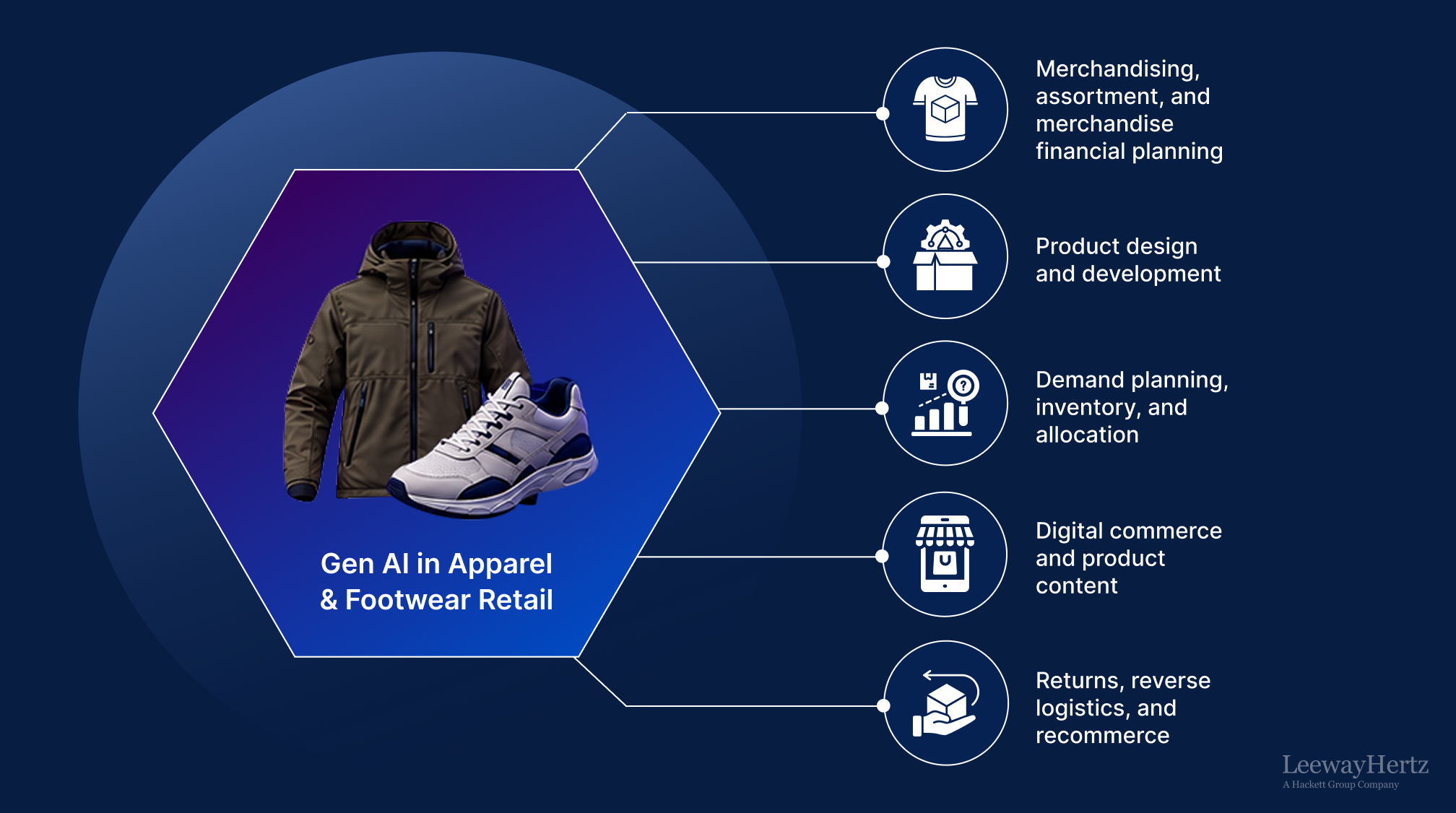
Few industries move a product through as many hands as apparel and footwear. A style starts as a trend signal and a sketch, becomes a tech pack and a bill of materials, turns into a purchase order and a critical-path commitment and arrives as inventory to be split across stores and channels. It then gets photographed and described for the web, is finally sold, and—more often than in almost any other category—comes back to be inspected, regraded, and resold. Each of those steps has its own documents, its own system, and its own decision-maker. The creative spark and the final transaction get the spotlight, but most of the cost, delay, and risk pile up in the work between them: the specifications, reconciliations, exceptions, and write-ups that keep a seasonal, SKU-heavy business moving.
That middle layer is what makes the industry such a natural fit for generative and agentic AI. Retailers already lean on analytics and machine learning where those tools are strongest—forecasting demand, optimizing size curves, setting prices, and powering recommendations. Generative AI brings a different skill set: it can read a tech pack, draft a product description, weigh a supplier quote against a should-cost, explain why a size curve broke, or distill a stack of fit comments into a clear set of revisions. Agentic AI then strings these tasks into a sequence—gathering the documents, drafting the output, flagging the risks, and routing the result to the right person—while keeping human judgment for final decisions.
Saying an AI model “helps with retail” is too vague to be meaningful. The payoff comes only when AI is aimed at a specific job—drafting a particular tech pack, reconciling specific open-to-buy, adjudicating worn-item return. And because each of those jobs sits in a different system, draws on different data, and answers to a different owner, AI integration cannot be planned at the level of “retail,” or even “merchandising” or “customer service.” Those labels are too broad to say what data the work needs, which controls apply, who signs off, or how success should be measured. The more useful question is not “where can we use AI?” but “which function, process, and sub-process can AI improve, and what governed workflow should support it?”
Answering that question means mapping AI to the operating model itself—breaking the business into functions, the processes within them, and the specific sub-processes where work actually gets done, then matching each one to a concrete, reviewable AI opportunity. Mapped this way, AI is no longer a concept layer and becomes a portfolio of workflows with clear value, defined data needs, and real accountability. This article works through that map for apparel and footwear retail, decomposing the business into specific functions and showing, process by process, where generative and agentic AI can save time and sharpen decisions while keeping people firmly in control.
- How generative AI is transforming apparel and footwear retail operations
- Why apparel and footwear retail AI use cases must be mapped at the sub-process level
- Apparel and footwear retail operating model and generative AI opportunity mapping across processes
- High-value generative AI use cases in apparel and footwear retail
- How agentic AI works in apparel and footwear retail workflows
- How to prioritize generative AI use cases in apparel and footwear retail
- Governance, risk, and responsible AI in apparel and footwear retail
- How ZBrain operationalizes generative AI use cases in apparel and footwear retail
- Future of generative AI in apparel and footwear retail
How generative AI is transforming apparel and footwear retail operations
Apparel and footwear retailers have long used analytics, planning and allocation systems, rule engines, and EDI to run their businesses. Over the past decade, many have layered on machine learning for demand forecasting, recommendations, and price and markdown optimization—though the depth of adoption still varies widely across the industry. These technologies remain important, but generative and agentic AI introduce a new class of capability.
Traditional automation follows predefined rules. Machine learning predicts, scores, classifies, and detects patterns from historical data, which is why it remains the right tool for demand forecasts, size-curve optimization, and recommendation engines. Generative AI can read, extract, summarize, draft, compare, and explain unstructured content across documents, images, and communications. Agentic AI goes further by planning and executing a sequence of steps, such as extracting a tech pack, validating it against the bill of materials, drafting a costing request, and routing it to a sourcing manager for approval.
In apparel and footwear retail, this changes how teams handle work that is:
-
Document-heavy: Tech packs, bills of materials, line sheets, purchase orders, commercial invoices, compliance certificates, factory audit reports, and wholesale chargeback packets.
-
Narrative-heavy: Product descriptions, design briefs, assortment rationales, markdown justifications, customer responses, complaint replies, sustainability claims, and merchant performance commentary.
-
Exception-heavy: Broken size curves, out-of-stock and overstock situations, production delays against the critical path, quality-inspection failures, payment and fraud flags, EDI failures, and return disputes.
-
Knowledge-heavy: Restricted-substance rules, country-of-origin and labeling requirements, routing-guide and vendor-compliance manuals, fit and sizing standards, brand guidelines, and store operating procedures.
-
Workflow-heavy: Concept-to-tech-pack development, sample and fit cycles, order-to-delivery orchestration, omnichannel fulfillment, returns disposition, and seasonal range planning.
The best apparel and footwear AI use cases usually do not remove the human from the process. Instead, they prepare the case, extract the data, draft the output, flag the risks, and route the work to the right reviewer, whether that reviewer is a designer, merchant, planner, sourcing manager, store leader, or compliance owner.
Why apparel and footwear retail AI use cases must be mapped at the sub-process level
In apparel and footwear retail, generative AI drives efficiency and accuracy across logistics, merchandising, product design, sourcing, demand planning and fulfillment—but only when applied to well-defined workflows. “AI in retail” is too broad to be useful. So are “AI in merchandising,” “AI in supply chain,” or “AI in customer service.” These categories are too high-level to define data requirements, controls, approval paths, success metrics, and implementation scope.
A better approach maps use cases to the apparel and footwear operating model:
-
Function: The major business or control area, such as merchandising, product design and development, sourcing, demand and inventory planning, digital commerce, store operations, or returns.
-
Process: The workflow area within that function, such as assortment planning, tech pack development, supplier onboarding, allocation, product content enrichment, or returns disposition.
-
Sub-process: The specific work activity, such as option-plan build, bill-of-materials assembly, factory-audit review, broken-size detection, product description drafting, or defect adjudication.
-
AI-enabled opportunity: The specific way AI can support that sub-process, such as extracting product attributes, drafting a description, classifying a return reason, or assembling a compliance pack.
This level of detail matters because apparel and footwear workflows are tied to specific documents, systems, seasons, regulations, and decision rights. Drafting a tech pack is very different from writing a markdown rationale. Answering a sizing question is different from adjudicating a worn-item return. A pre-season range plan is different from an in-season chase decision. By mapping AI opportunities at the sub-process level, retailers and brands can move from broad innovation ideas to executable workflows with clear business value, data requirements, governance, and implementation paths. The sections that follow decompose the operating model into essential core functions and highlight where generative and agentic AI can save time while keeping human judgment central to each workflow.
Transform apparel and footwear retail workflows.
Leverage AI to streamline design and development, merchandising and assortment planning, sourcing, omnichannel fulfillment, customer service, and returns—improving speed, margin, accuracy, and customer experience.
Apparel and footwear retail operating model and generative AI opportunity mapping across processes
The following sections map generative AI opportunities across the operating model of a modern apparel and footwear retailer or brand. Each function includes a short overview, a process and sub-process table, and a summary of the highest-value AI opportunities in that function.
Function 1. Merchandising, assortment, and merchandise financial planning
Merchandising sets the financial and product framework for each season: what to buy, how much, at what price, for which channels and clusters, and how to trade it through the season. The function combines merchandise financial planning (MFP), open-to-buy (OTB), assortment and option planning, store clustering, and in-season reforecasting. It is data-, document-, and narrative-heavy, with frequent trade-offs between newness, depth, margin, and risk.
Generative AI can summarize sales, sell-through, and trend signals into plan narratives, draft assortment and option rationales, and explain OTB and reforecast movements. Agentic AI can orchestrate multi-step planning workflows such as plan build, cluster assignment, and in-season reforecasting while keeping merchants accountable for financial decisions.
| Process | Sub-process | Key AI-enabled opportunities |
|---|---|---|
| Range and line planning | Trend-to-plan synthesis | Summarize trend, runway, search, and social signals, map them to planned categories and price points, draft a line-plan brief, and flag gaps versus last season for merchant review. |
| Range architecture and gap analysis | Compare planned category, silhouette, price-point, and newness mix against targets and prior-season performance, identify duplication or assortment gaps, and draft range-adjustment recommendations for merchant review. | |
| Assortment and option planning | Option plan building | Aggregate historical sell-through, attributes, and channel mix, recommend option counts by category and cluster, draft assortment rationale, and flag duplication or whitespace. |
| Merchandise financial planning | Open-to-buy reconciliation | Compare planned receipts, sales, and inventory against OTB, draft variance commentary, flag overbought or underbought categories, and recommend reallocation for review. |
| MFP variance and scenario commentary | Compare sales, margin, receipts, and inventory plans across scenarios, explain material variances and trade-offs, and draft merchandise financial planning commentary for review. | |
| Localization and clustering | Store and channel clustering | Group stores by performance, demographics, climate, and size profile, summarize cluster characteristics, and draft cluster-level assortment recommendations. |
| Size and pack planning | Size-curve and pack optimization | Analyze size-level selling and return patterns by cluster, recommend size ratios and prepack configurations, flag broken or inefficient size profiles, and draft size-plan rationale for merchant review. |
| Pre-season and in-season trading | In-season reforecasting | Detect sell-through deviations, draft reforecast and chase or cancel recommendations, and summarize markdown exposure for trading meetings. |
| Post-season review | Season hindsight analysis | Summarize sell-through, markdown rate, full-price realization, and option productivity by category, draft a hindsight narrative, and surface carryover and reorder candidates for the next plan. |
| Carryover and learning handoff | Translate season-hindsight findings into carryover, reorder, exit, and next-season planning considerations, summarize supporting evidence, and prepare recommendations for merchant review. |
The highest-value opportunities in merchandising are trend-to-plan synthesis, assortment rationale drafting, OTB variance commentary, cluster-level recommendations, and in-season reforecast narratives. These workflows are repeatable, evidence-based, and well-suited to human-in-the-loop AI that prepares the analysis while merchants own the financial call.
An example agentic workflow is in-season trade preparation. The agent aggregates sell-through, stock, and trend data, detects categories deviating from plan, drafts chase, repeat, or markdown recommendations with supporting evidence, and routes the trade pack to the merchant and planner for the weekly trading meeting.
Function 2. Product design and development
Product design and development moves a concept from trend research and design brief through tech pack, bill of materials, colorways, sampling, and fit to a development-ready, costed style. The function is creative but also intensely document- and specification-heavy, and it sits on the critical path for every season.
Generative AI can synthesize trend research, draft design briefs, generate concept variations and colorways from approved inputs, draft tech pack sections, assemble bills of materials, and summarize fit comments. Agentic AI can coordinate the development cycle, such as tech pack creation, sample tracking, and fit-comment consolidation, while designers and technical teams retain creative and approval authority.
| Process | Sub-process | Key AI-enabled opportunities |
|---|---|---|
| Trend and concept research | Trend synthesis | Aggregate runway, retail, search, and social signals into theme and color summaries, draft seasonal concept directions, and flag emerging silhouettes or materials for designer review. |
| Design brief drafting | Convert approved trend, consumer, brand, and commercial inputs into structured design briefs, summarize required themes and product attributes, and flag incomplete or conflicting requirements for designer review. | |
| Design and tech pack development | Tech pack drafting | Convert design notes and reference images into structured tech pack sections, populate measurements and construction details, and flag missing or inconsistent specifications. |
| Specification review | Check measurements, construction notes, materials, trims, and reference details across tech pack sections and prepare exception notes for technical review. | |
| Materials and colorways | Colorway and material specification | Generate colorway options from approved palettes, draft material and trim specifications and check consistency against the bill of materials. |
| Lab dip and color approval | Track lab dips, strike-offs, and color submissions against standards, summarize approval status and aging, and draft re-submission or approval notes for review. | |
| Costing handoff | Bill of materials assembly | Assemble the bill of materials from the tech pack, normalize component and consumption data, and prepare a costing-ready package for sourcing review. |
| Sampling and fit | Fit comment consolidation | Summarize fit-session comments across sizes and graded points, draft revised measurement requests, and track sample rounds against the critical path. |
| Sample tracking and evaluation | Track sample requests and rounds against the critical path, summarize evaluation comments by sample type, and flag delayed or failed samples for follow-up. | |
| Fit and grading | Grading and size-set development | Draft graded measurement specifications across the size range from the base sample, flag grading inconsistencies and points-of-measure gaps, and prepare size-set review notes for the technical team. |
The highest-value opportunities in design and development are trend synthesis, tech pack drafting, colorway generation, fit-comment consolidation, and bill-of-materials assembly. These workflows compress the development calendar by reducing manual documentation and reconciliation while keeping designers and technical developers in control of creative and fit decisions.
An example agentic workflow is tech pack preparation. The agent converts design notes and reference imagery into structured tech pack sections, assembles a draft bill of materials, flags missing measurements or trims, and routes the package to the designer and technical developer for confirmation before handoff to sourcing.
Function 3. Sourcing, supplier, and production management
The sourcing and production management function selects suppliers, negotiates and confirms costs, places and tracks purchase orders, manages the critical path or time-and-action (T&A) calendar, and governs quality and social compliance across a global vendor base. The function is document, exception, and compliance-heavy, with high stakes around cost, lead time, and ethical sourcing.
Generative AI can extract and normalize quotes and costing breakdowns, summarize supplier and audit documentation, draft purchase-order discrepancy notes, and summarize production status. Agentic AI can coordinate workflows such as supplier onboarding, costing comparison, critical-path tracking, and inspection-report review while sourcing and compliance teams retain approval authority.
| Process | Sub-process | Key AI-enabled opportunities |
|---|---|---|
| Supplier onboarding and compliance | Supplier qualification | Extract registration, ownership, certification, and capability data from onboarding packets, validate credentials, flag missing or expiring documents, and summarize exceptions for compliance review. |
| Costing and quoting | Should-cost and quote comparison | Normalize quotes into a common cost structure, compare against should-cost and prior orders, flag outliers in fabric, trim, labor, and overhead, and draft negotiation talking points. |
| Capacity and materials planning | Capacity booking and fabric commitment | Aggregate planned order volumes against supplier capacity and fabric lead times, summarize greige and trim commitments and liabilities, flag capacity or material shortfalls, and draft booking recommendations for review. |
| Purchase order and production management | PO discrepancy review | Compare purchase orders against confirmations, bills of materials, approved costs, quantities, and commercial terms, flag mismatches, and draft supplier correction requests. |
| WIP and production status tracking | Aggregate work-in-progress and production milestone updates, summarize current status and delays, identify orders requiring follow-up, and draft supplier status requests for review. | |
| Critical path and time-and-action | Critical-path exception generation | Detect milestones at risk against the T&A calendar, summarize delay drivers and downstream impact, and draft expedite or re-plan recommendations for review. |
| Quality and social compliance | Social compliance audit review | Summarize factory audit findings, classify issues by severity, identify repeat or overdue findings, and draft corrective-action and escalation notes for compliance review. |
| Quality inspection and defect review | Summarize inspection reports and defect findings, classify quality issues by type and severity, identify recurring patterns, and prepare corrective-action requests for quality-team review. | |
| Supplier performance review | Vendor scorecard and performance review | Aggregate on-time delivery, quality, defect, and compliance data by vendor, draft scorecard narratives, flag underperforming or high-risk suppliers, and prepare business-review summaries. |
| Consolidate supplier performance issues and agreed corrective actions, track commitments and due dates, flag unresolved or recurring problems, and draft follow-up summaries for sourcing review. |
The highest-value opportunities in sourcing and production are supplier qualification, quote comparison, purchase-order discrepancy detection, critical-path exception summaries, and audit and inspection review. These workflows are repetitive and documentation-heavy, making them strong candidates for AI that accelerates review while keeping sourcing, quality, and compliance owners accountable.
An example agentic workflow is a costing comparison. The agent normalizes incoming supplier quotes into a common cost structure, compares them against should-cost and historical orders, flags component-level outliers, drafts negotiation notes, and routes the comparison to the sourcing manager for the award decision.
Function 4. Buying, pricing, and promotions
Buying, pricing, and promotions turn the merchandise plan into committed buys, set the price architecture, and design markdowns and promotions to protect margin and clear inventory. The function combines buy execution, price setting, promotion and markdown planning, and competitive price intelligence. It is analytical, narrative, and exception-heavy, with constant margin and inventory trade-offs.
Generative AI can draft buy sheets and rationale, explain price and margin movements, identify markdown candidates with supporting evidence, and summarize competitive price positions. Agentic AI can coordinate workflows such as markdown candidate identification, promotion performance review, and competitor price monitoring while buyers and pricing teams retain decision authority.
| Process | Sub-process | Key AI-enabled opportunities |
|---|---|---|
| Buy execution | Buy-sheet preparation | Assemble buy quantities, sizing, and cost data into a structured buy sheet, draft buy rationale against the plan, and flag commitments that breach OTB or margin targets. |
| Price architecture planning | Price and margin setting | Summarize cost, competitive, and margin inputs supporting a proposed price, draft price-ladder commentary, and flag items below the target margin for review. |
| Price-ladder and architecture consistency review | Compare proposed prices across categories, tiers, channels, and comparable products, identify inconsistencies or margin conflicts, and draft price-architecture exceptions for review. | |
| Promotion and markdown planning | Markdown candidate identification | Identify slow-selling and aged inventory, draft markdown recommendations with sell-through and stock evidence, and summarize margin and clearance impact for sign-off. |
| Promotion setup and conflict check | Translate approved offers into promotion mechanics, validate eligibility, stacking, and exclusion rules, flag conflicts or margin-eroding overlaps, and draft a configuration summary for review. | |
| Promotion performance analysis | Promotion post-event analysis | Summarize uplift, cannibalization, and margin impact of completed promotions, draft learnings, and flag promotions for repeat or retirement. |
| Vendor funding | Markdown money and co-op reconciliation | Aggregate vendor allowances, markdown funding, and co-op commitments, match them against promotions and markdowns taken, flag unclaimed or disputed funding, and draft recovery summaries. |
| Competitive price intelligence | Competitor price monitoring | Summarize competitor price and assortment movements from approved data sources, flag price gaps on key items, and draft pricing-response options for review. |
The highest-value opportunities in buying and pricing are buy-sheet preparation, markdown candidate identification, promotion post-event analysis, and competitor price monitoring. These workflows depend on accurate evidence and clear narratives, making AI useful for assembling the case while buyers and pricing managers own the commercial decision.
An example agentic workflow is markdown planning. The agent identifies aged and slow-selling lines, drafts markdown recommendations supported by sell-through, stock cover, and margin evidence, summarizes the clearance and margin impact, and routes the markdown pack to the buyer and planner for approval.
Function 5. Demand planning, inventory, and allocation
Demand planning, inventory, and allocation translate the plan into the right stock, in the right place, at the right time, across stores, channels, and distribution centers. The function combines demand forecasting, initial allocation, replenishment, inventory balancing, transfers, and size and availability management. It is data and exception-heavy, with size-curve complexity unique to apparel and footwear.
Generative AI can draft forecasts and allocation commentary, summarize exception patterns, and explain inventory imbalances. Agentic AI can coordinate workflows such as replenishment exception handling, broken-size detection, and inter-store transfers while planners and allocators retain final authority over inventory moves.
| Process | Sub-process | Key AI-enabled opportunities |
|---|---|---|
| Demand forecasting | Forecast commentary | Draft narratives explaining forecast shifts by category, channel, and cluster, detect anomalies, summarize variance drivers, and flag unusual demand signals for planner review. |
| New-product and pre-season forecasting | Generate attribute-based forecasts for new styles with no sales history using comparable items and trend signals, summarize assumptions and confidence, and flag high-uncertainty lines for planner review. | |
| Inventory allocation | Initial allocation review | Summarize proposed allocations against capacity, size curves, and cluster profiles, flag over- or under-allocation, and draft adjustment recommendations. |
| Allocation exception and adjustment review | Identify allocation outcomes that conflict with store capacity, size profiles, cluster demand, or availability targets, summarize the cause, and draft adjustment recommendations for allocator review. | |
| Replenishment | Replenishment exception handling | Classify replenishment exceptions, identify stockout and overstock risks, draft prioritization recommendations for critical lines, and summarize service impact. |
| Inventory balancing and transfers | Inter-store transfer support | Detect imbalances and broken size runs across locations, draft transfer recommendations to consolidate sellable inventory, and summarize cost-service trade-offs. |
| Size and availability management | Broken-size detection | Identify broken or incomplete size curves at the SKU and location level, summarize affected demand, and draft replenishment or transfer actions for review. |
| Clearance and exit planning | Aged inventory and liquidation planning | Identify aged, terminal, and overstocked inventory, summarize disposition options across markdown, transfer, outlet, and liquidation channels, and draft exit recommendations for review. |
The highest-value opportunities in planning and allocation are forecast commentary, replenishment exception handling, broken-size detection, and inter-store transfer support. These workflows are high-volume and exception-prone, where AI can reduce investigation time and improve consistency while planners own the inventory decisions.
An example agentic workflow is broken-size resolution. The agent detects incomplete size curves at the SKU and location level, quantifies lost-sales risk, drafts transfer or replenishment recommendations citing stock and demand evidence, and routes the proposal to the allocator for approval.
Function 6. Omnichannel order management and fulfillment
Omnichannel order management and fulfillment orchestrate orders across e-commerce, marketplaces, and stores, sourcing each order from the optimal node and managing fraud, payment, and fulfillment exceptions. The function combines order orchestration, ship-from-store and buy-online-pickup-in-store (BOPIS), payment and fraud review, and fulfillment exception handling.
Generative AI can summarize order and inventory context, draft exceptions and customer notifications, and explain fraud or payment flags. Agentic AI can coordinate workflows such as order sourcing, exception handling, and fraud triage while keeping humans accountable for cancellations, refunds, and fraud decisions.
| Process | Sub-process | Key AI-enabled opportunities |
|---|---|---|
| Order capture and validation | Order intake and availability check | Validate incoming orders for address, payment, and inventory availability, flag incomplete or high-risk orders, and draft hold or correction notes for review. |
| Order orchestration | Sourcing-node selection support | Summarize inventory, cost, service, and capacity inputs across nodes, recommend an optimal fulfillment source, and flag orders at risk of delay or split. |
| Split-order and service-cost trade-off review | Compare fulfillment options for orders requiring multiple nodes, summarize cost, inventory, and service implications, and recommend consolidation or split-order options for review. | |
| Ship-from-store and BOPIS | Store fulfillment exception handling | Classify pick, substitution, and capacity exceptions at the store level, draft customer notifications, and summarize service-level impact for store and operations teams. |
| Pick readiness and substitution support | Assess store inventory and pick readiness, identify unavailable or mismatched items, recommend eligible substitutions or alternate nodes, and prepare exception guidance for store teams. | |
| Payment and fraud review | Fraud and payment triage | Summarize order, account, device, and behavior signals, classify fraud and payment risk, draft hold or release recommendations, and route high-risk cases for review. |
| Fulfillment exceptions | Split, delay, and cancel handling | Detect delayed, split, or stuck orders, summarize likely causes, draft customer communications with revised expectations, and route exceptions for approval. |
| Recovery and rerouting recommendation | Evaluate inventory and fulfillment alternatives for delayed or failed orders, draft rerouting, substitution, or recovery options, and route recommended actions for approval. | |
| Delivery tracking | Proactive delivery exception alerts | Monitor shipment milestones against promised delivery, detect delays or failed deliveries, draft proactive customer notifications with revised ETAs, and route high-impact cases to service personnel. |
The highest-value opportunities in order management and fulfillment are sourcing-node selection support, store fulfillment exception handling, fraud and payment triage, and split, delay, and cancel handling. These workflows are time-sensitive and high-volume, where AI reduces manual effort while final fraud, refund, and cancellation decisions remain with qualified reviewers.
An example agentic workflow is fulfillment exception handling. The agent detects a delayed or split order, retrieves inventory and node context, identifies the likely cause, drafts a customer notification with a revised expectation, and routes the case to operations and customer service for approval.
Function 7. Digital commerce and product content
Digital commerce and product content manage how products are represented, found, and merchandised online, spanning product onboarding and enrichment, catalog and taxonomy, on-site search and merchandising, and personalization.
Generative AI can extract product attributes from tech packs and supplier data, draft product detail page (PDP) copy, tag and normalize attributes, and propose search synonyms and category-page rules. Agentic AI can coordinate workflows such as product onboarding, enrichment, and catalog quality remediation while content and merchandising teams approve customer-facing output.
| Process | Sub-process | Key AI-enabled opportunities |
|---|---|---|
| Product onboarding and enrichment | PDP content drafting | Extract attributes from tech packs and supplier data, draft product titles, descriptions, and feature bullets aligned with brand voice, and flag missing attributes for review. |
| Product attribute extraction and completeness review | Extract structured attributes from tech packs, supplier files, and product records, identify missing or conflicting fields, and prepare completed attribute sets for content-team review. | |
| Catalog and taxonomy | Attribute tagging and normalization | Classify products against the taxonomy, normalize color, material, fit, and occasion attributes, and flag inconsistent or duplicate catalog entries. |
| Catalog duplicate and anomaly remediation | Detect duplicate, inconsistent, or misclassified product records, summarize likely causes and affected attributes, and draft remediation actions for catalog-team review. | |
| Imagery and visual content | Image tagging and alt-text generation | Generate descriptive alt text and structured image tags, classify on-model versus flat and angle and colorway coverage, flag missing or mismatched imagery, and prepare records for content review. |
| Imagery coverage and mismatch review | Compare required product views, colors, and image types against available assets, identify missing, duplicate, or mismatched imagery, and prepare exception lists for content review. | |
| On-site search and merchandising | Search and category-page optimization | Propose search synonyms and rules, draft category-page merchandising logic, and summarize zero-result and low-conversion queries for review. |
| Personalization | Recommendation and styling support | Draft outfit and cross-sell narratives, summarize personalization rules, and prepare styling content for review against brand and availability constraints. |
| Content localization | Localization and translation support | Adapt PDP copy, attributes, and size information for target locales, flag mistranslations and market-specific compliance issues, and prepare localized records for in-market review. |
The highest-value opportunities in digital commerce and content are PDP content drafting, attribute tagging and normalization, search and category-page optimization, and recommendation and styling support. These workflows scale poorly with manual effort across large catalogs, making them strong candidates for AI that drafts and structures content for human review. Several retailers report meaningful gains: McKinsey notes that gen AI helped a large fashion platform cut content-creation timelines from six to eight weeks to three to four days [1].
An example agentic workflow is product onboarding. The agent extracts attributes from the tech pack and supplier feed, drafts the PDP copy and structured attributes, validates them against the taxonomy and brand guidelines, flags gaps, and routes the enriched product record to the content team for approval before publication.
Accelerate AI Solutions Development
Build fully functional solutions from your high-value use cases, based on specific operational needs and enterprise context.
Function 8. Marketing, brand, and customer engagement
The marketing, brand, and customer engagement function plans and produces campaigns, manages lifecycle and loyalty communications, runs social and influencer programs, and optimizes organic discovery. The function is content, narrative, and personalization-heavy, with high volume across channels and segments.
Generative AI can draft campaign briefs and copy variants, summarize customer segments, draft lifecycle and loyalty messages, and support influencer vetting and SEO content. Agentic AI can coordinate workflows such as campaign content production, segmentation, and performance summarization while marketing teams retain brand and approval control.
| Process | Sub-process | Key AI-enabled opportunities |
|---|---|---|
| Campaign planning | Brief and concept drafting | Summarize objectives, audience, and product focus into a campaign brief, draft concept directions, and flag alignment gaps against brand guidelines for review. |
| Content production | Copy and creative variant generation | Draft channel-specific copy and creative variations from approved messaging, adapt tone by segment, and flag claims requiring legal or compliance review. |
| Brand and claims review support | Compare draft campaign content against approved messaging, brand guidelines, and claims requirements, flag inconsistencies or unsupported statements, and prepare revisions for marketing and legal review. | |
| Performance marketing | Paid media creative variant support | Draft ad copy and creative variations by channel and audience from approved campaign messaging, summarize variant rationale, and flag policy or claim risks for review. |
| Keyword and audience planning support | Summarize search, campaign, and audience signals, suggest keyword and audience options, identify overlaps or gaps, and prepare targeting recommendations for marketer review. | |
| Lifecycle, CRM, and loyalty management | Segmentation and message drafting | Summarize customer segments and behaviors, draft lifecycle and loyalty messages, and recommend audience and timing options for marketer review. |
| Social media and influencer management | Influencer vetting and brief drafting | Summarize influencer fit, audience, and prior content, draft outreach briefs, and flag brand-safety or alignment concerns for review. |
| Social content planning and engagement summarization | Summarize social trends, campaign themes, and audience responses, draft channel-specific content ideas and posting briefs, and surface recurring engagement themes for marketer review. | |
| Organic brand discovery | SEO and content optimization | Draft SEO-aligned content and metadata, summarize ranking and query trends, and recommend optimization actions for review. |
| Marketing performance | Campaign performance reporting | Aggregate spend, engagement, conversion, and revenue across channels, draft performance narratives and learnings, and flag under- or over-performing campaigns for review. |
The highest-value opportunities in marketing are copy and creative variant drafting, segmentation and message drafting, influencer vetting, and SEO and content optimization. These workflows benefit from AI that accelerates production and personalization while marketing teams maintain brand voice, claims accuracy, and approval control.
An example agentic workflow is campaign content production. The agent drafts channel-specific copy and creative variants from approved messaging, adapts tone for target segments, flags claims that require legal review, and routes the content package to the marketing team for brand approval.
Function 9. Store operations and workforce
Store operations and workforce support the physical retail estate, including labor and task management, clienteling and styling, visual merchandising and planogram compliance, loss prevention, and store communications.
Generative AI can draft schedules and task summaries, prepare clienteling outreach, summarize planogram compliance, and draft loss-prevention case notes. Agentic AI can coordinate workflows such as task distribution, clienteling preparation, and shrink-case summarization while store leaders retain operational authority.
| Process | Sub-process | Key AI-enabled opportunities |
|---|---|---|
| Labor and task management | Labor scheduling support | Draft schedules against forecast traffic, staffing availability, and labor rules, identify coverage gaps or conflicts, and prepare adjustments for manager review. |
| Shift task prioritization and briefing | Convert store tasks, campaigns, operational notices, and priorities into shift-level action lists, summarize dependencies, and flag incomplete or conflicting instructions. | |
| Clienteling and styling | Clienteling outreach preparation | Summarize customer profile, purchase history, sizing, and preferences, draft personalized outreach and styling suggestions, and flag inventory availability for associate review. |
| Visual merchandising and planograms | Planogram compliance review | Compare store photos and reports against planograms, summarize compliance gaps, and draft corrective actions for store teams. |
| Loss prevention | Shrink case summarization | Summarize transaction, exception, and surveillance context into a shrink case summary, classify likely cause, and flag cases for investigation. |
| Exception pattern and repeat-shrink analysis | Summarize recurring transaction, inventory, location, and behavioral exception patterns, identify clusters requiring investigation, and prepare evidence-based case leads for loss-prevention review. | |
| Inventory operations | Cycle count and stock-accuracy support | Reconcile cycle-count and RFID results against system inventory, classify discrepancies and shrink indicators, draft variance summaries, and flag counts for recount or investigation. |
| Store communications | Communication summarization | Summarize corporate communications into store-ready task lists, retrieve relevant procedures, and draft acknowledgment and completion notes. |
| Training and enablement | Associate product and policy support | Answer associate product, policy, and procedure questions from approved sources, draft coaching and onboarding summaries, and surface knowledge gaps for store leaders. |
The highest-value opportunities in store operations are clienteling outreach preparation, schedule and task summarization, planogram compliance review, and shrink case summarization. These workflows benefit from AI that personalizes and standardizes store work while leaders and associates retain customer and operational judgment.
An example agentic workflow is clienteling preparation. The agent summarizes a customer’s profile, purchase history, sizing, and preferences, drafts a personalized outreach message and styling suggestions, checks live inventory availability, and routes the brief to the store associate for a personal, reviewed outreach.
Function 10. Customer service and care
Customer service and care span the contact center and digital channels, sizing and product support, complaint handling, and voice-of-customer analysis. Apparel and footwear generate high volumes of fit, sizing, availability, order, and return inquiries, making this function knowledge- and exception-heavy.
Generative AI can provide agents with grounded guidance, draft after-contact summaries, answer sizing and product questions, classify complaints, and analyze review sentiment. Agentic AI can coordinate workflows such as agent assist, complaint handling, and voice-of-customer synthesis while keeping humans accountable for customer-impacting decisions.
| Process | Sub-process | Key AI-enabled opportunities |
|---|---|---|
| Contact center | Agent assist and knowledge retrieval | Surface policy, procedure, and product context in real time, recommend next actions, and draft responses grounded in approved sources for agent review. |
| After-contact summary and case documentation | Summarize customer interactions, actions taken, commitments, and unresolved issues, draft structured case notes, and flag required follow-ups for agent review. | |
| Order and return status | Order status inquiry handling (WISMO) | Retrieve order, shipment, and return status, draft personalized status responses, detect at-risk or delayed cases, and route exceptions to operations. |
| Return status and resolution support | Retrieve return shipment, receipt, inspection, refund, and exchange status, draft personalized updates, detect delayed or abnormal cases, and route exceptions to the appropriate team. | |
| Sizing and product support | Sizing and fit guidance | Retrieve size charts, fit notes, and product specifications, draft sizing guidance for the customer’s profile, and flag complex cases for specialist review. |
| Product information and availability guidance | Retrieve approved product attributes, materials, care information, features, and availability data, draft customer guidance, and flag uncertain or specialist inquiries for review. | |
| Complaint handling | Complaint classification and response | Classify complaint type, severity, and root cause, route to the correct team, and draft a response grounded in case facts and policy for review. |
| Escalation and remediation case preparation | Assemble complaint history, order and product context, prior actions, and applicable policies, summarize remediation options, and prepare escalation packages for authorized reviewers. | |
| Customer feedback and insights management | Review and sentiment analysis | Summarize reviews, surveys, and contact themes, detect emerging product or service issues, and draft insight summaries for merchandising and quality teams. |
| Quality assurance | Interaction review and QA scoring | Score service interactions for policy adherence, tone, resolution, and required disclosures, summarize coaching themes, and flag interactions for supervisor review. |
The highest-value opportunities in customer service are agent assist, sizing and fit guidance, complaint classification and response, and review and sentiment analysis. These workflows reduce manual effort and improve consistency while agents and handlers retain responsibility for sensitive responses and remediation decisions.
An example agentic workflow is complaint response support. The agent classifies the complaint, retrieves order and product history, summarizes the root cause, drafts a response grounded in policy and case facts, checks tone, and routes the draft to the customer service handler for approval.
Function 11. Returns, reverse logistics, and recommerce
Returns, reverse logistics, and recommerce manage return authorization, intake, grading, disposition, fraud, and resale across a flow that is uniquely heavy in apparel and footwear, where fit-related returns are common. McKinsey reports that US consumers returned nearly $1 trillion of merchandise in 2024 and that retailers spend roughly $200 billion annually to recover value from returns, yet many still rely on static rules and manual inspection [2]. AI-driven dispositioning that routes each item to its highest-value channel is therefore a significant margin lever.
Generative AI can classify return reasons, extract inspection data, summarize defect evidence, and draft customer and recovery communications. Agentic AI can coordinate workflows such as eligibility assessment, disposition, fraud screening, and resale routing while keeping humans accountable for refunds, fraud calls, and disposition exceptions.
| Process | Sub-process | Key AI-enabled opportunities |
|---|---|---|
| Returns authorization and intake | Eligibility and reason classification | Classify return requests against policy and warranty, classify return reasons such as fit, quality, or change-of-mind, generate return instructions, and flag exceptions for review. |
| Refund and exchange | Refund and exchange processing | Validate refund amounts, restocking and shipping fees, and exchange eligibility, draft credit memos and exchange instructions, and route anomalies for approval. |
| Refund exception and anomaly review | Identify unusual refund amounts, fee calculations, payment mismatches, or repeated exceptions, summarize the supporting evidence, and route anomalous cases for approval. | |
| Disposition and grading | Condition grading and disposition | Analyze inspection notes and item images, grade condition, recommend restock, refurbish, resale, liquidation, or recycling, and draft disposition notes for review. |
| Returns fraud identification | Fraud and abuse screening | Identify serial-return, wardrobing, and refund-abuse patterns, draft investigative summaries, and flag high-risk accounts for review. |
| Recommerce and circularity | Recommerce channel routing | Evaluate eligible returned products against resale, outlet, marketplace, liquidation, and other recovery channels, recommend a routing option, and flag value exceptions for review. |
| Resale listing generation | Generate resale titles, descriptions, condition notes, and structured product attributes from approved product and inspection data for review before publication. | |
| Returns analytics | Return root-cause and feedback loop | Identify return drivers such as fit, quality, or description issues by style and attribute, summarize recurring causes, and draft feedback for design, merchandising, and content teams. |
The highest-value opportunities in returns and recommerce are eligibility and reason classification, condition grading and disposition, fraud and abuse screening, and resale listing and routing. These workflows are high-volume and decision-rich, where AI improves consistency and value recovery while humans own refund, fraud, and disposition exceptions.
An example agentic workflow is returns disposition. The agent checks eligibility against policy and warranty, classifies the return reason, grades condition from inspection records or images, recommends the highest-value disposition channel, drafts the settlement notification, and routes the case for human review.
Function 12. Sustainability, traceability, and product compliance
Sustainability, traceability, and product compliance keep apparel and footwear aligned with restricted substance rules, labeling and claims requirements, supply chain due diligence obligations, traceability and Digital Product Passport (DPP) expectations, and ESG reporting commitments. The function is document- and regulation-intensive, with rising regulatory pressure across major markets.
Generative AI can assemble traceability and compliance evidence, screen against restricted substance lists, review labels and sustainability claims, summarize due diligence documentation and draft ESG commentary. Agentic AI can coordinate workflows such as traceability data assembly, compliance review, and reporting while compliance owners retain accountability for regulated outputs.
| Process | Sub-process | Key AI-enabled opportunities |
|---|---|---|
| Traceability and digital product passport records assembly | Traceability data assembly | Aggregate material, origin, supplier, and certification data, assemble product-level traceability and DPP records, and flag missing or inconsistent data for review. |
| DPP record validation and maintenance | Validate product passport records for completeness and consistency, identify outdated or conflicting information, and draft updates for compliance review. | |
| Restricted substances and product safety | Restricted substance screening | Compare material and component data against restricted substance lists and test reports, flag potential non-compliance, and draft follow-up requests for review. |
| Labeling and claims review | Label and claim review | Check fiber content, care, country-of-origin, and sustainability claims against requirements and evidence, and flag unsupported or non-compliant claims. |
| Market-specific labeling validation | Compare product labels and required disclosures against applicable market requirements, identify missing or inconsistent information, and prepare corrections for compliance review. | |
| Supply chain due diligence | Due diligence summarization | Summarize supplier due diligence evidence, identify gaps against policy and regulation, and draft remediation or escalation notes for review. |
| Supplier risk and remediation tracking | Consolidate supplier risk findings and remediation commitments, track outstanding actions and deadlines, and flag unresolved or recurring issues for escalation. | |
| Supply-chain transparency | Forced labor and origin-risk screening | Screen suppliers and materials for forced-labor and high-risk-origin indicators, assemble traceability and provenance evidence, flag potential exposure, and draft escalation notes for compliance review. |
| Product safety | Recall and safety-incident management | Identify products affected by a safety issue or recall using lot, style, and supplier links, assemble recall documentation and customer notices, and summarize exposure for review. |
| ESG reporting | ESG commentary drafting | Aggregate sustainability metrics and initiative status, draft reporting commentary linked to evidence, and flag data-quality issues for review. |
| Packaging and EPR | Extended Producer Responsibility reporting | Aggregate packaging, material, and volume data by market, draft EPR and packaging-compliance reporting, and flag data gaps or threshold risks for review. |
| Packaging data classification and validation | Classify packaging by material, weight, format, and market, reconcile supplier and product records, and flag incomplete or inconsistent data before reporting. |
The highest value opportunities in sustainability and compliance are traceability data assembly, restricted substance screening, label and claim review, and due diligence summarization. These workflows depend on accurate evidence and clear documentation, making AI useful for assembling and checking compliance material while qualified owners retain accountability for claims and filings.
An example agentic workflow is Digital Product Passport assembly. The agent aggregates material, origin, supplier, and certification data, assembles a product-level traceability record, flags missing or inconsistent inputs, and routes the record to the compliance team for validation before publication.
Function 13. Wholesale and B2B account management
Wholesale and B2B account management support brands that sell to department stores, multi-brand retailers, and marketplaces, covering line sheet and order management, EDI and trading-partner operations, account replenishment, and chargeback management. The function is exception-heavy, with recurring reconciliation and compliance work.
Generative AI can generate line sheets, summarize orders and account performance, extract chargeback details, and draft dispute correspondence. Agentic AI can coordinate workflows such as EDI exception handling, chargeback dispute preparation, and account review while sales and finance teams retain decision authority.
| Process | Sub-process | Key AI-enabled opportunities |
|---|---|---|
| Line sheet and order management | Line sheet generation | Assemble product, pricing, and availability data into account-ready line sheets, draft assortment recommendations by account, and flag inconsistencies for review. |
| Wholesale order intake and validation | Extract account orders, validate products, quantities, pricing, terms, and availability against approved records, flag incomplete or conflicting orders, and draft correction requests. | |
| EDI and trading-partner operations | EDI exception handling | Classify failed or incomplete EDI orders and documents, identify missing fields, draft correction requests, and summarize recurring errors for process improvement. |
| Trading-partner document and mapping validation | Compare incoming and outgoing EDI documents against partner requirements and mappings, identify missing or invalid fields, and prepare validation and correction summaries for operations review. | |
| Vendor compliance | Routing guide and shipping compliance | Validate shipments, labeling, ASNs, and carton requirements against retailer routing guides, flag likely compliance failures before shipment, and draft corrective actions to prevent chargebacks. |
| Account replenishment | Account performance and replenishment review | Summarize sell-through, stock, and order data by account, draft replenishment recommendations, and flag at-risk or underperforming doors. |
| Chargeback management | Chargeback dispute preparation | Extract chargeback reasons and evidence, compare against routing guide and compliance requirements, draft dispute or acceptance summaries, and flag recurring root causes. |
| Chargeback root-cause and recovery tracking | Classify recurring chargebacks by cause, supplier, account, shipment, or compliance issue, track dispute outcomes and recovered amounts, and draft root-cause summaries for corrective action. | |
| Drop-ship and marketplace | Drop-ship and marketplace order management | Syndicate listing content, ingest and validate drop-ship and marketplace orders, classify fulfillment and inventory exceptions, and draft resolution notes for review. |
The highest-value opportunities in wholesale are line sheet generation, EDI exception handling, account performance review, and chargeback dispute preparation. These workflows are repetitive and reconciliation-heavy, where AI reduces manual effort while account and finance owners retain decision authority.
An example agentic workflow is chargeback dispute preparation. The agent extracts the chargeback reason and supporting documents, compares them against the routing guide and compliance terms, drafts a dispute or acceptance summary, identifies recurring root causes, and routes the case to the finance and account teams for the dispute decision.
Function 14. Retail technology, data, and AI governance
Retail technology, data, and AI governance manage the core systems and information flows that connect the value chain, including PLM, PIM, ERP, OMS, WMS, and e-commerce platforms, as well as master data quality, integration operations, and AI governance. This function is foundational because generative AI in apparel and footwear retail cannot scale without clean product data, secure access, model oversight, and operational resilience.
Generative AI can detect data anomalies, summarize integration failures, explain exception patterns, and produce documentation. Agentic AI can coordinate workflows such as master-data remediation, integration exception handling, and AI governance intake while keeping humans accountable for high-impact decisions.
| Process | Sub-process | Key AI-enabled opportunities |
|---|---|---|
| Master data quality | Product and reference data remediation | Detect inconsistent product, attribute, supplier, and location data across systems, classify defects, identify affected processes, and draft remediation summaries. |
| Data-quality monitoring and duplicate detection | Continuously identify missing, duplicate, stale, or inconsistent master and reference data, summarize affected systems and downstream processes, and prioritize records for remediation. | |
| Integration operations management | Integration and EDI exception management | Classify integration and EDI failures, draft resolution notes, detect out-of-sequence events, and summarize recurring issues for the data and integration teams. |
| Recurring integration failure analysis | Aggregate repeated integration and EDI failures, identify common patterns and affected systems or partners, summarize likely root causes, and draft improvement recommendations for integration teams. | |
| IT service management | Incident triage and root-cause documentation | Classify system incidents by impact and likely resolver, summarize affected systems and probable causes from logs and tickets, and draft root-cause and remediation summaries for review. |
| Incident communication and resolution documentation | Summarize incident status, impact, actions, and resolution evidence, draft stakeholder updates and post-incident documentation, and flag unresolved follow-up actions for review. | |
| AI governance | AI use-case inventory and monitoring | Document AI use cases, owners, data sources, models, and controls, summarize output quality, drift, and exception patterns, and flag issues for review. |
| Policy and model compliance review | Check AI workflows against internal data, privacy, brand, and model-risk policies, and draft compliance summaries for review. | |
| Data privacy and access | Privacy and access governance | Review data access and consent records against policy, flag overbroad permissions or privacy exposures, and draft remediation and review summaries. |
The highest-value opportunities in technology and data are product and reference data remediation, integration and EDI exception management, AI use-case inventory and monitoring and policy and model compliance review. These workflows are essential for scaling AI safely across the business while data, integration, and governance owners retain accountability.
An example agentic workflow is AI governance intake. The agent collects use-case details, identifies data sources, classifies risk level, maps required approvals, generates documentation, and routes the use case through data governance, privacy, brand, and model-risk reviews.
Accelerate AI Solutions Development
Build fully functional solutions from your high-value use cases, based on specific operational needs and enterprise context.
High-value generative AI use cases in apparel and footwear retail
The use case map is broad, but not every workflow should be automated first. The strongest early opportunities are usually high-volume, document-heavy, exception-heavy, or narrative-heavy workflows where AI can produce a draft, a recommendation, or a case pack for human review.
| Use case | Function | Why is it high-value |
|---|---|---|
| Tech pack and bill-of-materials preparation | Product design and development | Shortens product development cycles and reduces time-to-market by improving specification readiness and review efficiency. |
| Assortment and option-plan rationale | Merchandising, assortment, and merchandise financial planning | Improves merchandising decisions and speed by increasing clarity and confidence in assortment choices. |
| Open-to-buy variance commentary | Merchandising, assortment, and merchandise financial planning | Enhances financial control by improving visibility into plan deviations and reducing reactive decision-making. |
| Supplier quote comparison and costing | Sourcing, supplier, and production management | Strengthens cost efficiency and negotiation outcomes through improved pricing transparency and reduced comparison effort. |
| Critical-path exception summaries | Sourcing, supplier, and production management | Reduces delays in product development and sourcing decisions by improving visibility of schedule risks. |
| Product content and PDP enrichment | Digital commerce and product content | Improves conversion and catalog scalability by increasing content consistency, speed, and quality across SKUs. |
| Broken-size detection and transfer support | Demand planning, inventory, and allocation | Increases sales recovery and inventory efficiency by reducing lost sales from size gaps. |
| Markdown candidate identification | Buying, pricing, and promotions | Improves margin protection and inventory sell-through by enabling earlier, better-informed clearance actions. |
| Omnichannel fulfillment exception handling | Omnichannel order management and fulfillment | Improves customer experience and operational efficiency by reducing delays, cancellations, and manual intervention. |
| Returns disposition and recommerce routing | Returns, reverse logistics, and recommerce | Increases recovery value from returns, improving overall margin performance. |
| Customer service agent assist and sizing support | Customer service and care | Improves response speed and service consistency while reducing agent workload. |
| Clienteling preparation | Store operations and workforce | Enhances customer conversion and retention through more relevant, timely, and personalized engagement. |
| Restricted-substance and label-claim review | Sustainability, traceability, and product compliance | Reduces compliance risk and strengthens regulatory confidence in product claims and materials. |
| Wholesale chargeback dispute preparation | Wholesale and B2B account management | Improves revenue recovery and reduces financial leakage from disputed deductions. |
| Master-data and product-data remediation | Retail technology, data, and AI governance | Improves operational accuracy and downstream decision quality by strengthening data reliability across systems. |
These use cases work well because they support human review rather than bypassing it. They also create measurable value through reduced cycle time, fewer errors, stronger documentation, better exception handling, improved margin recovery, and improved customer and employee experience.
How agentic AI works in apparel and footwear retail workflows
Generative AI can draft, summarize, classify, and retrieve. Agentic AI can coordinate a workflow. In apparel and footwear retail, this distinction matters because many valuable use cases require multiple steps across systems, documents, partners, policies, and approvals.
For example, a tech pack handoff is not just a writing task. It may require interpreting design notes, drafting tech pack sections, assembling a bill of materials, validating measurements and trims, preparing a costing request, comparing supplier quotes, and routing the package for approval. An agentic AI workflow can coordinate these steps, while the designer, technical developer, and sourcing manager remain accountable for creative, fit, and cost decisions.
This shift is becoming more relevant as enterprise software moves from embedded copilots to task-specific agents. Gartner predicts that 40 percent of enterprise applications will include task-specific AI agents by the end of 2026, up from less than 5 percent in 2025, and projects that agentic AI could drive roughly 30 percent of enterprise application software revenue by 2035 [3].
Examples of agentic AI workflows in apparel and footwear retail include:
- A development agent that converts design notes into tech pack sections, assembles the bill of materials, flags missing specifications, prepares a costing request, and routes the package to the technical and sourcing teams.
- A merchandising agent that aggregates sell-through, stock, and trend data, drafts chase, repeat, and markdown recommendations, and prepares the weekly trade pack for the merchant and planner.
- An allocation agent that detects broken size curves and imbalances, drafts transfer and replenishment actions, and routes the proposal to the allocator.
- A product-content agent that extracts attributes, drafts PDP copy, validates against taxonomy and brand guidelines, and routes enriched records to the content team.
- A returns agent that checks eligibility, classifies the reason, grades the condition, recommends disposition, drafts the settlement notification, and routes the case for review.
- A compliance agent that assembles traceability and Digital Product Passport (DPP) data, screens against restricted-substance lists, flags gaps, and routes records to the compliance team.
Agentic workflows should be designed with approval gates. The agent can prepare, recommend, route, and update. But the retailer or brand should define where human review is mandatory, what evidence must be retained, which systems can be updated after approval, and how exceptions escalate when the workflow touches pricing, fraud, refunds, customer communications, sourcing commitments, or compliance issues.
How to prioritize generative AI use cases in apparel and footwear retail
An apparel and footwear brand should not prioritize AI use cases only because they sound innovative. The strongest candidates combine business value, workflow fit, data readiness, control readiness, and scalability.
| Prioritization criterion | What apparel and footwear retailers should evaluate |
|---|---|
| Business value | Margin protection, productivity, speed to market, sell-through, cost reduction, customer experience, and cycle-time improvement. |
| Workflow fit | Whether the work is document-heavy, knowledge-heavy, exception-heavy, narrative-heavy, repetitive, or dependent on manual coordination. |
| Data readiness | Whether the required data, such as tech packs, bills of materials, product attributes, sell-through, inventory, contracts, and policies, is available, accurate, permissioned, and connected. |
| Human review model | Whether a qualified owner, such as a designer, merchant, planner, sourcing manager, store leader, or compliance officer, can review, approve, reject, or correct AI output. |
| Control and compliance impact | Whether the workflow affects pricing, claims, restricted substances, labeling, fraud, refunds, or customer commitments that require governance. |
| Integration complexity | How many systems, partners, and approval paths does the workflow span across PLM, PIM, ERP, OMS, WMS, and e-commerce platforms? |
| Exception frequency | Whether the workflow experiences recurring delays, disputes, missing data, or manual escalations, AI can help standardize. |
| Scalability | Whether the pattern can be reused across categories, brands, channels, regions, or business lines. |
A practical first wave should focus on bounded workflows with strong human review and clear operational evidence. Examples include tech pack and bill-of-materials preparation, assortment rationale drafting, product content enrichment, broken-size detection, markdown candidate identification, customer service agent assist, and returns disposition. These use cases typically have structured inputs, measurable cycle times, and clear approval owners.
More sensitive use cases, such as final pricing and markdown decisions, fraud and refund determinations, sustainability claims and regulatory filings, supplier compliance decisions, and customer remediation, require stronger governance and should keep final accountability with designated merchandising, finance, compliance, or customer-experience personnel.
Governance, risk, and responsible AI in apparel and footwear retail
Generative AI in apparel and footwear retail must operate inside the organization’s existing governance, risk, compliance, and control environment. The most important principle is clear accountability. AI can assist with drafting, summarization, classification, routing, and workflow coordination, but the responsible person must remain accountable for consequential decisions, regulated outputs, and customer commitments.
Key governance requirements include:
- Human review for pricing and markdown decisions, fraud and refund determinations, sustainability and product-safety claims, regulatory filings, supplier compliance decisions, customer remediation, and material commercial judgments.
- Source-grounded outputs that reference approved product data, tech packs, contracts, policies, size and fit standards, brand guidelines, and operational systems.
- Audit trails that capture inputs, outputs, prompts, model versions, reviewer actions, approvals, rejections, escalations, and downstream system updates across PLM, PIM, ERP, OMS, WMS, and e-commerce platforms.
- Role-based access control so AI retrieves only the product, customer, pricing, supplier, or financial data that the user and workflow are authorized to access.
- Data-protection controls for customer data, employee data, supplier and pricing agreements, designs and intellectual property, and confidential commercial information.
- Model and agent monitoring for accuracy, completeness, hallucination risk, bias, latency, adoption, exception rates, and brand and claim integrity.
- Escalation procedures for low-confidence outputs, conflicting guidance, unusual customer impact, claim sensitivity, or regulatory exposure.
- Third-party and vendor risk review for AI platforms, models, infrastructure, and integrations connected to operational systems.
- Alignment with privacy obligations, product-safety and labeling rules, restricted-substance and traceability regulations, advertising and claims standards, cybersecurity, operational resilience, records retention, and internal audit requirements.
Governance should not be treated as a blocker. It is what makes AI usable in apparel and footwear retail. A well-governed AI workflow provides stronger documentation, clearer exception tracking, more consistent execution, better auditability, and clearer accountability than unmanaged manual work.
Accelerate AI Solutions Development
Build fully functional solutions from your high-value use cases, based on specific operational needs and enterprise context.
How ZBrain operationalizes generative AI use cases in apparel and footwear retail
Identifying use cases is only the first step. Apparel and footwear retailers need a controlled way to design, build, validate, deploy, govern, and scale generative AI workflows across trend sensing, assortment planning, product development, merchandising, inventory planning, allocation, pricing, promotions, store operations, e-commerce, returns, supplier management, customer service, and enterprise reporting.
This is where ZBrain helps.
ZBrain is an end-to-end AI enablement platform that supports this lifecycle through four connected stages: ZBrain Analyzer, ZBrain Design, ZBrain Solution Builder, and ZBrain Governance. The platform provides a governed path from use-case analysis to deployed agentic workflows while maintaining policies, permissions, approval points, monitoring, and runtime evidence.
ZBrain Analyzer
ZBrain Analyzer helps teams examine selected apparel and footwear retail processes, identify generative AI opportunities, and document the business context, systems, data, artifacts, roles, controls, and review requirements needed to evaluate each use case.
ZBrain Design
ZBrain Design creates a build-ready technical design for the selected use case. It generates the business requirements document, functional requirements, user journeys, architecture, workflow logic, data specifications, integration context, and governance considerations needed before development begins.
ZBrain Solution Builder
ZBrain Solution Builder enables teams to create, configure, and validate governed generative AI workflows for apparel and footwear retail processes based on the technical design developed in ZBrain Design. It supports testing across routine, exception, seasonal, commercial, and control scenarios before deployment.
ZBrain Governance
ZBrain Governance applies policies, access controls, human approval requirements, monitoring, and traceability throughout workflow execution. It provides guardrails, approval gates, escalation controls, kill switches, and audit trails to help organizations maintain oversight of AI outputs, reviewer actions, exceptions, and authorized system updates.
Future of generative AI in apparel and footwear retail
Generative AI in apparel and footwear retail will evolve from copilots to workflow agents. The first wave helps teams draft, summarize, search, classify, and retrieve information across design, merchandising, sourcing, commerce, service, and returns workflows. The next wave will coordinate larger operational sequences across systems, partners, and functions, with humans entering at key review and decision points.
Several shifts are likely to define the next stage:
-
From generic assistants to specialized agents built for specific workflows such as tech pack development, assortment planning, allocation, product content enrichment, and returns disposition.
-
From isolated pilots to reusable AI workflows deployed across design, merchandising, sourcing, planning, commerce, store operations, service, and finance.
-
From manual review of every step to human approval at defined control points for pricing, claims, fraud, refunds, sourcing commitments, and customer-impacting decisions.
-
From centralized AI experimentation to federated adoption across functions under enterprise governance and compliance oversight.
-
From static knowledge search to active workflow orchestration.
-
From productivity-only measurement to broader measurement of speed to market, sell-through, margin recovery, exception reduction, compliance quality, and customer experience.
The direction of travel is consistent with the broader industry signal: the State of Fashion 2026 describes AI moving from a competitive edge to a business necessity, with leading players already deploying generative AI automation for routine work in select functions [4]. The long-term pattern is not full automation without oversight. It is a workflow redesign in which AI coordinates repetitive operational tasks while teams focus on creativity, judgment, relationships, and control.
Retailers and brands that succeed will not necessarily be the ones with the most AI pilots or the largest number of models. They will be the organizations that connect AI to how the business actually runs, at the function, process, and sub-process level, while building governance, integration, and accountability into every workflow.
Endnote
Generative AI has the potential to reshape apparel and footwear retail work, but only if it is applied at the right level of detail. Broad statements such as “AI in retail” or “AI in merchandising” are not enough. Real value comes from mapping AI to specific workflows, such as tech pack and bill-of-materials preparation, assortment and option-plan rationale, open-to-buy variance commentary, supplier quote comparison, product content enrichment, broken-size detection, markdown candidate identification, omnichannel fulfillment exception handling, returns disposition, customer service agent assist, clienteling preparation, and restricted-substance and label-claim review.
The operating model is complex, spanning design and development, merchandising, sourcing, planning, omnichannel commerce, marketing, store operations, customer service, returns, compliance, wholesale, and the underlying technology and data foundation. Across all these functions, generative AI can extract product and document data, summarize evidence, draft narratives and content, classify exceptions, retrieve policy and compliance guidance, and coordinate multi-step workflows. Agentic AI extends this value by connecting tasks across PLM, PIM, ERP, OMS, WMS, and e-commerce systems while keeping human review in place.
For apparel and footwear retailers and brands, the path forward is clear and practical. Build a sub-process-level opportunity map. Prioritize workflows with strong value and clear ownership for review. Connect AI to approved product, commercial, and operational data. Run controlled pilots. Deploy with governance and auditability. Scale through reusable agents, orchestration patterns, and shared controls.
The future of apparel and footwear retail AI will not be defined by generic chatbots. It will be defined by governed, workflow-specific agents that help organizations bring products to market faster, merchandise and price more effectively, serve customers better, strengthen controls, recover more value from returns, and give teams more time to focus on creativity and judgment where it matters most.
Accelerate AI solution development to streamline your apparel and footwear retail workflows and drive operational efficiency—start mapping your AI opportunities today with ZBrain!
Author’s Bio


Akash's ability to build enterprise-grade technology solutions has garnered the trust of over 30 Fortune 500 companies, including Siemens, 3M, P&G, and Hershey's. Akash is an early adopter of new technology, a passionate technology enthusiast, and an investor in AI and IoT startups.
Related Products

AI Agent
Discover the right AI agent for your use case! Explore our extensive range of AI agents tailored to tackle specific challenges.
Start a conversation by filling the form
Once you let us know your requirement, our technical expert will schedule a call and discuss your idea in detail post sign of an NDA.
All information will be kept confidential.
FAQs
What are the best generative AI use cases in apparel and footwear retail?
High-value generative AI use cases are typically document-heavy, narrative-heavy, exception-prone, or repetitive, in which AI can draft or summarize information for human review. Examples include:
- Tech pack and bill-of-materials preparation – Converts design inputs into structured specifications and costing-ready packages.
- Assortment and option-plan rationale – Summarizes trend, sell-through, and cluster evidence into assortment recommendations.
- Supplier quote comparison – Normalizes quotes and flags component-level cost outliers for sourcing review.
- Product content and PDP enrichment – Extracts attributes and drafts descriptions at catalog scale.
- Broken-size detection and transfer support – Identifies incomplete size curves and drafts inventory actions.
- Markdown candidate identification – Surfaces aged inventory with sell-through and margin evidence.
- Omnichannel fulfillment exception handling – Manages delayed, split, and stuck orders with human review.
- Returns disposition and recommerce routing – Routes returned items to their highest-value channel.
- Customer service agent assist and sizing support – Helps agents retrieve context and draft grounded responses.
How is generative AI different from traditional AI in apparel and footwear retail?
Traditional AI typically predicts, scores, classifies, or detects patterns based on historical data, which is why it remains the right tool for demand forecasting, size-curve optimization, and recommendations. Generative AI, in contrast, can read, summarize, draft, compare, explain, and retrieve information from documents, images, and systems. Agentic AI extends this by coordinating multi-step workflows across PLM, PIM, ERP, OMS, WMS, e-commerce platforms, and approval paths.
What is agentic AI in apparel and footwear retail?
Agentic AI refers to AI systems that plan and execute sequences of workflow steps under defined controls. For example, a development agent can:
-
Convert design notes into tech pack sections
-
Assemble the bill of materials and flag missing specifications
-
Prepare a costing request and compare supplier quotes
-
Route the package for technical and sourcing review
-
Update workflow systems after approval
This ensures workflow continuity, accelerates repetitive tasks, and maintains human accountability.
Which apparel and footwear retail functions benefit most from generative AI?
Generative AI can add value across most functions, particularly those involving high-volume documents, complex workflows, and regulatory oversight. Key areas include:
- Product design and development
- Merchandising, assortment, and planning
- Sourcing, supplier, and production management
- Demand planning, inventory, and allocation
- Digital commerce and product content
- Marketing, store operations, and customer service
- Returns, reverse logistics, and recommerce
- Sustainability, traceability, and product compliance
Should AI make pricing, fraud, or compliance decisions?
Biopharma teams should prioritize workflows that deliver clear business value, have available source artifacts, involve repeated manual effort, and have defined review ownership. Strong early candidates are high-volume, artifact-rich sub-processes where generative AI can reduce drafting time, evidence collation, review cycles, or rework without bypassing human accountability.
Use cases should be scored against:
- Cycle-time or effort reduction
- Source artifact readiness
- Workflow fit
- Review ownership
- Compliance impact
- Integration complexity
How can smaller brands and independent retailers use generative AI?
Smaller organizations can start with bounded, high-impact workflows that require limited infrastructure investment. Examples include:
- Product content and PDP drafting
- Customer service and sizing support
- Tech pack and specification drafting
- Markdown and assortment rationale support
- Returns eligibility and disposition support
- Policy and procedure search and internal knowledge management
- These workflows provide measurable efficiency and margin benefits without requiring a full-scale AI transformation.
How should apparel and footwear retailers prioritize generative AI use cases?
Apparel and footwear retailers should prioritize generative AI use cases based on business value, workflow fit, data readiness, human review requirements, control and compliance impact, integration complexity, exception frequency, and scalability. The strongest initial use cases are typically bounded, high-volume workflows with reliable data, measurable outcomes, and clear human ownership.
Good starting points include tech pack and bill-of-materials preparation, assortment rationale drafting, product content enrichment, broken-size detection, markdown candidate identification, customer service agent assist, and returns disposition. More sensitive workflows involving pricing, fraud, refunds, regulatory filings, sustainability claims, or supplier compliance should require stronger governance and clearly defined human approval.
What governance is required for AI agents in apparel and footwear retail?
Effective AI governance ensures reliability, compliance, and accountability. Key requirements include:
- Role-based access to product, customer, pricing, supplier, and financial data
- Audit trails capturing inputs, outputs, prompts, model versions, and reviewer actions
- Human review for critical pricing, claim, fraud, refund, and compliance decisions
- Output monitoring for accuracy, bias, hallucination, and brand integrity
- Data protection for customer, supplier, design, and financial information
- Model and agent documentation for validation and compliance
- Escalation procedures for exceptions, low-confidence outputs, or regulatory sensitivity
- Alignment with privacy, product safety, labeling, traceability, advertising claims, cybersecurity, and internal audit frameworks
How can apparel and footwear retailers measure ROI from generative AI?
Retailers can measure generative AI ROI by comparing workflow performance before and after implementation against clearly defined business and operational KPIs. Depending on the use case, these may include productivity gains, reduced cycle time, lower operating costs, fewer errors and exceptions, faster speed to market, improved sell-through, stronger margin recovery, and better customer or employee experience.
ROI should be evaluated at the workflow level rather than through broad AI adoption metrics. For example, a retailer implementing AI for tech pack preparation can measure reductions in preparation and review time, while AI for returns disposition can be evaluated through processing efficiency and improved recovery value. Prioritizing use cases with measurable outcomes and clear ownership makes it easier to demonstrate business value and determine which AI initiatives should be scaled.
How does ZBrain support generative AI use cases in apparel and footwear retail?
ZBrain provides an end-to-end AI enablement platform for apparel and footwear retailers to identify, design, validate, deploy, govern, and scale generative AI workflows across trend sensing, assortment planning, product development, merchandising, inventory planning, allocation, pricing, promotions, store operations, e-commerce, returns, supplier management, customer service, and enterprise reporting.
- ZBrain Analyzer: Helps teams examine selected apparel and footwear retail processes, identify generative AI opportunities, and document the business context, systems, data, artifacts, roles, controls, KPIs, and review requirements needed to evaluate each use case.
- ZBrain Design: Converts selected use cases into build-ready technical designs, including business requirements, functional requirements, user journeys, architecture, workflow logic, data specifications, integration context, approval points, and governance considerations.
- ZBrain Solution Builder: Enables teams to create, configure, and validate governed generative AI workflows based on the design developed in ZBrain Design. It supports testing across routine, exception, seasonal, commercial, and control scenarios before deployment.
- ZBrain Governance: Applies policies, access controls, human approval requirements, monitoring, traceability, escalation controls, kill switches, and audit trails throughout workflow execution.
ZBrain’s role is enablement rather than autonomous decision-making. It helps define where generative AI assists, augments, or acts within apparel and footwear retail workflows, while final approvals and risk-bearing decisions remain with accountable roles across merchandising, planning, product development, pricing, inventory, store operations, e-commerce, supplier management, customer service, and enterprise operations.
Insights

Enterprise AI solutions for logistics: Enhancing operational excellence
Building an enterprise AI solution in logistics involves leveraging advanced technologies to automate processes, gain insights, and make data-driven decisions within logistics operations.

AI for financial document processing: Enhancing accuracy and speed
In the financial landscape, AI-powered document processing emerges as a key tool, reshaping the way institutions handle and derive insights from various financial documents.

AI for enterprises: Redefining industry standards
AI for enterprises strategically deploys AI technologies and methodologies within large-scale organizations to enhance various operational aspects.