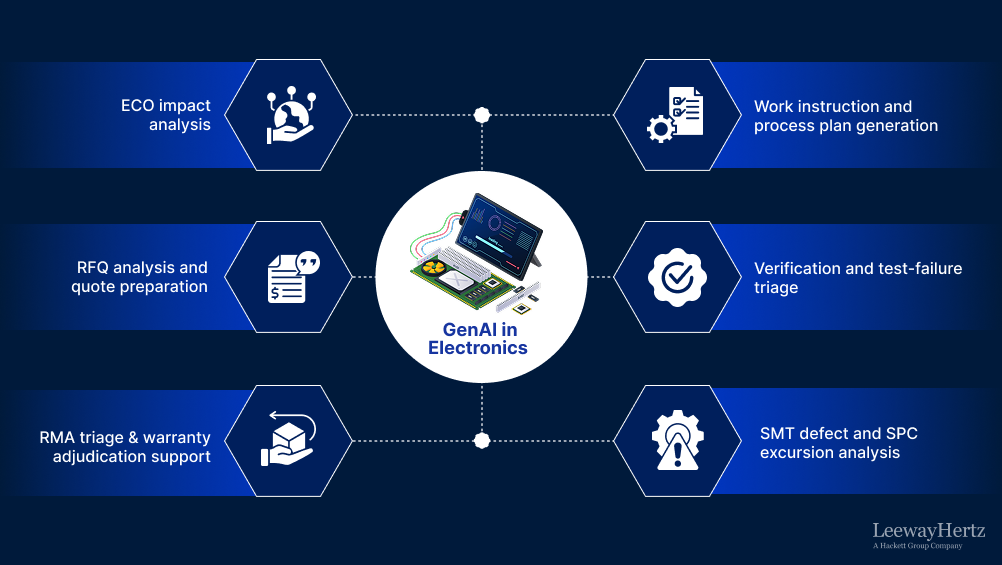
Electronics is one of the preferred industries for generative and agentic AI because its work sits at the intersection of design data, engineering documents, component decisions, regulatory evidence, manufacturing exceptions, and high-volume production workflows. An electronics organization does far more than design and build products. It writes and verifies RTL, develops firmware, lays out PCBs, manages bills of materials, qualifies components, evaluates product change notices, prepares certification dossiers, audits supplier quality, investigates field failures, drafts test programs, and supports technical inquiries. These activities create a dense trail of records, decisions, and handoffs across fabrication plants, foundries, electronics manufacturing services providers, distributors, suppliers, and field-service partners.
The scale and complexity of this environment continue to grow. According to the Semiconductor Industry Association [1], double-digit semiconductor market growth in 2025 reflects a broader shift, with electronics teams operating in a faster, more demand-intensive environment. Gartner also projects global semiconductor revenue to exceed USD 1.3 trillion in 2026, driven by demand for AI processing, data center networking, power, and memory [2]. As electronics products become more software-defined, component-constrained, compliance-intensive, and globally distributed, the practical opportunity for AI is not novelty. It is helping teams assemble reliable evidence faster, interpret complex records more consistently, and move from issue to decision through controlled workflows.
Traditional analytics and machine learning already help electronics teams forecast demand, detect defects, optimize yield, and predict equipment failures. Generative AI adds a new layer by extracting insights from datasheets, engineering change records, test reports, supplier declarations, service notes, and regulatory documents. It can draft design-review summaries, explain code, generate test scaffolding, compare component alternatives, and prepare compliance narratives. Agentic AI extends this further by coordinating multi-step workflows across PLM, ERP, MES, EDA, QMS, ALM, CRM, and service systems while keeping human review at defined control points.
The value of generative AI in electronics comes from embedding it into real engineering and operational workflows, not from isolated pilots or generic chatbots. A design or production decision often depends on evidence spread across schematics, netlists, BOMs, datasheets, supplier notices, test reports, quality records, and compliance documents. Whether the task is assessing an end-of-life notice, investigating an SMT defect, preparing an 8D report, reviewing RoHS evidence, or triaging warranty returns, AI must understand the workflow, source systems, artifacts, standards context, and human review requirements behind the decision.
That is why GenAI use cases in electronics should be mapped at the operating-model level. Instead of asking, “Where can AI be applied?”, leaders should ask, “Which function, process, and sub-process can AI improve, what evidence does the workflow require, which system does it touch, and who must approve the next action?” This level of mapping turns GenAI from a broad automation idea into a practical operating capability with clear data requirements, review boundaries, controls, and success metrics.
This article examines how generative and agentic AI can be applied across the electronics operating model. It breaks down electronics operations—from semiconductor and product design to component engineering, sourcing, NPI, manufacturing, test, quality, compliance, documentation, sales, service, finance, and technology governance—into major functions, core processes, and sub-processes. The focus is on identifying high-impact AI opportunities that reduce manual review effort, improve decision quality, accelerate cycle times, and maintain human accountability in the workflows where engineering, production, compliance, and customer outcomes are at stake.
- How generative AI is transforming electronics operations
- Why electronics AI use cases must be mapped at the sub-process level
- Electronics operating model and generative AI opportunity mapping across electronics processes
- High-value generative AI use cases in electronics
- How agentic AI works in electronics workflows
- How to prioritize generative AI use cases in electronics
- Governance, risk, and responsible AI in electronics
- How ZBrain operationalizes generative AI use cases in electronics
- Future of generative AI in electronics
How generative AI is transforming electronics operations
fElectronics teams have long relied on EDA tools, rules engines, analytics, robotic process automation, and machine learning to improve design productivity, detect defects, optimize yield, and reduce operational errors. These technologies remain important, but generative and agentic AI introduce a different kind of capability. Instead of only following rules or predicting outcomes from historical data, they can interpret complex records, generate review-ready outputs, and coordinate work across systems.
Traditional automation works well when a process is structured, and the required fields are complete. Machine learning is effective for pattern-based use cases such as automated optical inspection, yield prediction, demand forecasting, and predictive maintenance. Generative AI adds value in the less structured parts of electronics work, where decisions often depend on datasheets, schematics, BOMs, supplier notices, test reports, inspection records, engineering change documents, compliance declarations, emails, and service notes spread across multiple systems.
This is especially clear in engineering change workflows. Before approving a component substitution or design update, teams often need to compare the supplier’s note with the current BOM, qualification evidence, inventory position, and compliance status. Generative AI can assemble this scattered context into a reviewable change summary, highlight missing evidence, draft a rationale for substitution, and prepare the case for engineering review. Agentic AI can extend the workflow by retrieving the required records, checking affected parts or assemblies, routing exceptions to the right owner, and pausing for approval before any controlled update is made.
In practice, this changes how electronics teams handle several types of work:
- Design and code-heavy work: RTL and HDL, testbenches, embedded firmware, PCB layout rules, simulation setups, design-rule checks, and validation scripts.
- Document-heavy work: Datasheets, schematics, BOMs, ECOs, certificates of conformance, material declarations, inspection reports, service manuals, and certification files.
- Narrative-heavy work: Design-review notes, failure-analysis reports, 8D and CAPA narratives, supplier scorecards, audit summaries, and certification rationales.
- Exception-heavy work: Component shortages, end-of-life notices, product change notifications, ECO impacts, SMT and assembly defects, test failures, yield excursions, NCRs, and field returns.
- Knowledge-heavy work: IPC, JEDEC, IEC, ISO, UL, FCC, RoHS, REACH, derating rules, design guidelines, export-control guidance, and internal SOPs.
- Workflow-heavy work: NPI readiness checks, ECO management, RFQ-to-quote, supplier onboarding, compliance evidence review, RMA processing, and field-service escalation.
The strongest GenAI pattern in electronics is to prepare decisions for expert review rather than automate them without oversight. Generative AI prepares the case, structures the evidence, drafts the output, flags risks, and routes the work to the accountable reviewer. The engineer, planner, buyer, quality manager, compliance specialist, or service owner still confirms the decision before a production change, customer-facing response, compliance update, or risk-bearing action moves forward.
This is how generative AI transforms electronics operations. It reduces the time teams spend searching, comparing, rewriting, and assembling evidence while preserving human accountability where engineering judgment, quality control, regulatory compliance, and customer commitments matter most.
Why electronics AI use cases must be mapped at the sub-process level
Generative AI can improve speed, accuracy, and consistency across electronics operations, but only when it is applied to specific, well-defined workflows. Broad AI labels in electronics are useful for framing the topic, but they are not specific enough to execute. To become buildable and governable, each opportunity must be tied to a defined workflow, required data, expected output, connected system, accountable reviewer, and control point.
This is why electronics organizations need to map generative AI opportunities at the function, process, and sub-process levels. A product change notification, for example, may trigger several different workflows. A component engineer may need an impact summary across affected BOMs. A compliance specialist may need to check whether the change affects RoHS, REACH, or certification evidence. A supply planner may need to assess inventory exposure, last-time-buy requirements, or production risk. Each workflow uses different records, sits in a different queue, and requires approval from a different owner.
Sub-process mapping makes these differences visible. In product change notification impact planning, generative AI can draft an impact summary from the supplier notice and affected BOMs so the component engineer can confirm whether an engineering change request is needed. In the compliance requirement baseline review, it can compare supplier declarations with RoHS or REACH obligations and flag gaps for the compliance manager. In the NPI gate checklist alignment, it can summarize open validation evidence against the gate checklist, so the program manager can review blockers before the gate is marked complete.
A practical operating-model map defines four layers:
- Function: The major business or control area, such as semiconductor design, product engineering, component management, sourcing, manufacturing, quality, regulatory compliance, or after-sales service.
- Process: The workflow within that function, such as RTL verification, ECO management, SMT process control, material-declaration management, supplier qualification, or RMA processing.
- Sub-process: The specific activity where work actually changes, such as testbench generation, obsolescence risk assessment, solder-defect classification, RoHS exemption review, supplier-response comparison, or warranty eligibility validation.
- GenAI-enabled opportunity: The way generative AI supports that sub-process, such as generating verification stimuli, drafting a substitution rationale, classifying a defect mode, summarizing a compliance gap, or preparing a review packet for approval.
This level of detail matters because electronics workflows are tied to specific files, systems, standards, and decision rights. Generating an HDL testbench is very different from assessing component obsolescence risk. Reviewing a supplier declaration is different from preparing a CE Declaration of Conformity. Drafting a failure-analysis report is different from approving a warranty claim. Each activity needs different source data, review criteria, audit evidence, and human accountability.
Sub-process mapping turns generative AI from a broad automation idea into an executable workflow. It helps teams define the inputs, outputs, approval paths, risk controls, and success metrics for each use case. It also prevents high-risk decisions from being treated like simple drafting tasks. The goal is not to ask where generative AI can be applied in general, but to identify which specific workflows can be improved, what evidence the AI must use, and who must confirm the results before production, compliance, or customer-facing actions proceed.
The next section applies this structure across the electronics operating model, connecting major functions, processes, and sub-processes to practical generative and agentic AI opportunities that can be integrated, governed, and measured.
Transform Electronics Operations With GenAI
Leverage ZBrain Builder to design and deploy governed generative and agentic AI workflows across electronics operations, improving speed, traceability, review efficiency, and control.
Electronics operating model and generative AI opportunity mapping across electronics processes
The following sections map generative AI opportunities across the operating model of a modern electronics organization, organized into a comprehensive set of industry-native functions. Each function includes a short overview, a process and sub-process table, a summary of the high-value AI opportunities within that function, and an example agentic workflow. These opportunities focus on software-driven workflows where generative AI prepares, compares, or drafts outputs, while qualified reviewers confirm decisions at the appropriate control points.
Function 1. Product strategy and portfolio planning
Product strategy and portfolio planning set product line direction across roadmap planning, SKU strategy, OEM and ODM requirement intake, lifecycle and obsolescence planning, and New Product Introduction (NPI) investment decisions. The function is highly document- and lifecycle-driven, combining customer requirements, Product Change Notification (PCN) records, end-of-life notices, and bill of materials (BOM) data, with frequent portfolio exceptions that require review and coordination.
Generative AI can extract requirements and lifecycle clauses, normalize and compare BOM and approved vendor list (AVL) records and draft roadmaps, business cases and gate narratives. Agentic AI can orchestrate multi-step workflows such as PCN impact assessment, SKU rationalization, and NPI gate alignment, while keeping product, supply chain, and finance owners accountable for portfolio decisions.
| Process | Sub-process | Key AI-enabled opportunities |
|---|---|---|
| Market and portfolio planning | Product line roadmap planning | Aggregate customer demand notes and end-of-life notices, compare roadmap dependencies under Advanced Product Quality Planning (APQP), and flag portfolio gaps that slow investment decisions for product line manager review. |
| SKU rationalization | Classify duplicate BOM variants and AVL entries, compare demand exposure using Lean Six Sigma Define, Measure, Analyze, Improve, and Control (DMAIC) segmentation, and propose retire, merge, or retain actions for product line manager review. | |
| OEM requirement intake | Extract performance and lifecycle clauses from original equipment manufacturer (OEM) engineering change request packages, map them to APQP deliverables, and flag requirement gaps that delay scoping for systems engineer review. | |
| ODM strategy alignment | Compare original design manufacturer (ODM) BOM assumptions with approved manufacturer list (AML) coverage, map differences to Design for Manufacturing (DFM) criteria, and draft alignment exceptions for product line manager review. | |
| Product definition and requirements | PLM product requirement baseline review | Retrieve approved engineering change request and schematic capture file records from product lifecycle management (PLM), summarize baseline deltas against APQP deliverables, and flag unresolved requirement conflicts for systems engineer review. |
| Customer-specific requirement capture | Extract customer-specific test and labeling clauses from engineering change request attachments, map them to design validation evidence, and flag contract-to-requirement gaps for program manager review. | |
| Form, fit, and function design review | Compare printed circuit board (PCB) layout and board stackup drawing attributes, map form, fit, and function differences to Design for Assembly (DFA) rules, and flag interface risks for hardware engineering review. | |
| Regulatory compliance evidence review | Classify regulatory clauses in the RoHS declaration of conformity and Federal Communications Commission (FCC) Supplier’s Declaration of Conformity, compare them with BOM country releases, and flag missing evidence for compliance manager review. | |
| Lifecycle and obsolescence planning | End-of-life roadmap review | Aggregate end-of-life notices across BOM usage, summarize affected assemblies under PCN review, and propose last-time-buy or redesign priorities for product line manager review. |
| PCN impact planning | Extract supplier date and specification changes from PCN documents, compare affected BOM and AVL records, and flag validation impacts that strengthen release decisions for product change board review. | |
| Alternate part strategy alignment | Compare candidate alternate parts in the AML against BOM constraints, map qualification gaps to Production Part Approval Process (PPAP) requirements, and propose approval paths for component engineering review. | |
| Obsolescence risk disposition | Classify obsolescence exposure from end-of-life notices and return records, apply Failure Mode and Effects Analysis (FMEA) risk priority number scoring, and propose disposition options for supply chain planning review. | |
| Launch business case and gate alignment | NPI business case creation | Draft NPI business case sections from BOM cost assumptions and demand signals, classify risks against gate review criteria, and flag weak revenue or readiness evidence for portfolio steering committee review. |
| NPI gate checklist alignment | Validate NPI gate checklist completion, retrieve missing engineering validation evidence, and flag gate blockers that shorten approval cycles for program manager review. | |
| Product cost target review | Extract cost drivers from the BOM and AVL, compare them with DFM cost-down assumptions, and flag target-cost gaps for finance business partner review. | |
| Margin and inventory exposure review | Aggregate inventory exposure by BOM and end-of-life notice, compare margin scenarios under NPI gate review, and flag write-down or repricing risks for finance controller review. |
High-value GenAI opportunities in product strategy include PCN impact planning, SKU rationalization, and NPI gate checklist alignment. These workflows combine supplier notices, BOM records, and gate evidence with repeatable comparison logic, making them strong candidates for AI augmentation while product change boards retain approval authority.
An example of an agentic workflow is a PCN impact assessment. The agent retrieves PCN records and BOM usage from PLM, pulls demand and supply exposure from the supply chain planning platform, drafts an impact summary against PCN review criteria, and routes the package to the product change board for confirmation. By automating affected-part reconciliation, product teams can focus on roadmap direction and investment trade-offs.
Function 2. Semiconductor and IC design
Semiconductor and IC design covers the chip-development lifecycle from specification and register transfer level (RTL) design through functional verification, physical design, design-for-test, IP management, and tapeout across digital, analog/mixed-signal, and system-on-chip (SoC) products. The function is highly code-centric, document-heavy, and constraint-driven, with iterative cycles and frequent debug, review, and signoff exceptions.
Generative AI can generate and explain RTL, testbenches, assertions, and scripts, summarize specifications and prior results, and draft debug and review narratives. Agentic AI can orchestrate multi-step flows such as verification regression triage, timing-closure iteration, and tapeout-readiness assembly, while keeping design engineers accountable for design intent and signoff.
| Process | Sub-process | Key AI-enabled opportunities |
|---|---|---|
| Specification and architecture | Specification requirement capture and review | Extract functional, power, and performance requirements from the product specification and applicable standards, map them to architecture deliverables, and flag conflicting or ambiguous requirements for design architect review. |
| Microarchitecture trade-off exploration | Summarize power, performance, and area (PPA) trade-offs across candidate microarchitectures, compare configuration options against specification targets, and flag exploration risks for review. | |
| Component selection against AVL and AML | Screen BOM line items against the AVL and AML, retrieve PCN context, and flag sourcing or lifecycle exceptions for component engineer review. | |
| Engineering change request intake | Classify engineering change request submissions by affected schematic file and BOM, summarize rationale under change control, and flag incomplete impact statements for change control board review. | |
| PCB layout and stackup engineering | PCB placement review | Compare component placement in the PCB layout with the BOM, apply DFA constraints, and flag density, polarity, or keepout conflicts for PCB designer review. |
| Board stackup and integrity review | Retrieve impedance and material requirements from release records, draft board stackup annotations under DFM, and flag unresolved fabrication or signal-integrity constraints for signal integrity engineer review. | |
| Design for manufacturing layout review | Detect manufacturability risks in the PCB layout and Gerber file package, map findings to DFM criteria, and summarize fabrication-impact exceptions for manufacturing engineer review. | |
| Design for test access review | Map test pads and nets in the PCB layout to the test coverage report, compare gaps against DFT criteria, and flag low-access nets for test engineer review. | |
| Design data package release | Gerber file package validation | Validate the Gerber file package and drill file against release criteria, summarize missing layers or naming conflicts, and flag package exceptions for PCB layout lead review. |
| ODB++ file package validation | Validate the ODB++ file package against the PCB layout and BOM, flag layer or component metadata inconsistencies, and summarize supplier-intake exceptions for PCB design release engineer review. | |
| IPC-2581 data package validation | Compare the IPC-2581 data package with the PCB layout and BOM under APQP release controls, and summarize mismatched attributes for product data manager review. | |
| Fabrication and assembly drawing release review | Compare fabrication drawing and assembly drawing notes with the Gerber package, classify missing tolerances or revision markers, and flag release blockers for engineering documentation manager review. | |
| Design collaboration and revision control | ECAD and MCAD alignment | Compare connector locations and keepouts across PCB layout and assembly drawing records, map conflicts to DFA constraints, and summarize interference risks for mechanical computer-aided design (MCAD) liaison review. |
| PLM and EDA revision synchronization | Compare revision identifiers across the engineering change order and schematic capture file, and flag PLM-versus-EDA synchronization gaps for product data manager review. | |
| Engineering change order control | Summarize engineering change order scope from the engineering change request and BOM, classify impacted artifacts under change control, and flag approval gaps for change control board review. | |
| Engineering change notice release | Draft engineering change notice release text from the approved engineering change order and BOM, validate distribution against change control, and flag unclear effective dates for release manager review. |
High-value GenAI opportunities in product design include component selection against the AVL and AML, DFM layout review, and engineering change order control. These workflows are artifact-rich and bounded by clear sign-off, making them strong candidates for AI augmentation while engineers maintain configuration accountability.
An example agentic workflow is engineering change order impact analysis. The agent retrieves the engineering change request, BOM, schematic capture file, PCB layout, and revision history from PLM and ECAD systems. It then drafts an affected-artifact summary with cost and lead-time implications, routes exceptions through an issue management queue, and sends the package to the change control board for confirmation. By automating cross-artifact reconciliation, engineering teams can focus on design intent and validation.
Function 4. Software, firmware, and secure development
This function manages embedded software and firmware requirements, backlog execution, secure development evidence, release management, defect history, and product software validation. The function is code, evidence, and workflow-driven, spanning issue tracking, source control, DevOps, and validation records with recurring release-documentation and patch-prioritization work.
Generative AI can generate and explain firmware and test scaffolding, summarize release and security evidence, and trace defects to validation records. Agentic AI can orchestrate multi-step workflows such as release-evidence assembly, vulnerability remediation tracking, and field-issue reproduction, while keeping engineering, security, and quality reviewers accountable for approvals.
| Process | Sub-process | Key AI-enabled opportunities |
|---|---|---|
| Embedded software requirements and backlog management | Firmware requirement traceability | Map firmware requirements to backlog items and Git commit references, compare missing requirement-to-test links, and flag release-blocking gaps for firmware engineering lead review. |
| Application lifecycle management backlog grooming | Classify backlog items against the engineering change request and NPI gate criteria, summarize duplicate stories, and propose priority candidates for product owner review. | |
| Defect history triage | Classify historical firmware defects from issue records and field failure analysis reports, summarize recurrence patterns, and flag likely Corrective and Preventive Action (CAPA) candidates for quality engineering manager review. | |
| Customer issue linkage | Retrieve customer issue narratives from the service system, map them to return records and open firmware defects, and flag high-recurrence symptoms for service engineering lead review. | |
| Secure development lifecycle controls | Secure Software Development Framework control mapping | Map pull request records and build attestations to the Secure Software Development Framework (SSDF) control matrix, compare missing evidence, and flag unsupported controls for security engineering manager review. |
| Threat model review | Compare the firmware threat model with application programming interface (API) changes, apply Spoofing, Tampering, Repudiation, Information disclosure, Denial of service, and Elevation of privilege (STRIDE) threat modeling, and flag unresolved mitigations for security architect review. | |
| Secure code review evidence | Retrieve pull request review records and static analysis findings, summarize reviewer coverage, and flag weak approvals for security engineering manager review. | |
| Vulnerability remediation tracking | Aggregate Common Vulnerabilities and Exposures (CVE) findings and software bill of materials (SBOM) entries, summarize aging and exploitability context, and flag overdue firmware fixes for product security incident response lead review. | |
| Build, release, and DevOps management | Version-controlled source release | Compare Git tag and release branch references under change control, validate source-release manifest completeness, and flag unapproved commits for DevOps release manager review. |
| DevOps build pipeline evidence | Retrieve build logs and signed artifact hashes, summarize failed-stage patterns, and flag incomplete provenance records for release quality manager review. | |
| Firmware release note preparation | Draft firmware release notes from merged issue records and engineering change notice references, summarize customer-visible changes, and flag ambiguous fixes for product owner review. | |
| Release approval record review | Aggregate release candidate evidence from the NPI gate checklist and test coverage report, summarize open conditions, and flag missing signoffs for software release board review. | |
| Product software validation and field issue support | Software test coverage report review | Compare the test coverage report with firmware requirements, summarize uncovered high-risk code paths, and flag coverage gaps for test engineering lead review. |
| Regression test evidence review | Retrieve regression test logs and failed-case screenshots, summarize recurring failures, and flag release-blocking regressions for validation manager review. | |
| Design validation test firmware evidence | Aggregate firmware build identifiers and validation logs, compare pass-fail evidence against release criteria, and flag unverified firmware configurations for validation manager review. | |
| Field issue reproduction package preparation | Extract device configuration and firmware version from return and failure analysis records, summarize reproduction steps, and flag safety-relevant patterns for service engineering lead review. |
High-value GenAI opportunities in software and firmware include firmware requirement traceability, vulnerability remediation tracking, and firmware release note preparation. These workflows span issue tracking, source control, DevOps, and quality records, making them strong candidates for generative AI augmentation while engineering, security, and quality reviewers retain approval.
An example agentic workflow is firmware release evidence assembly. The agent retrieves issue records, pull requests, build logs, engineering change order data, and test coverage links from controlled engineering systems. It then drafts firmware release notes and a release approval record, routes unresolved gaps to the release manager, and sends the package for confirmation. By automating evidence reconciliation, engineering teams can focus on patch prioritization and release judgment.
Function 5. New product introduction (NPI) and validation gates
New product introduction and validation gates function owns the structured path from concept approval to production readiness through NPI gate reviews, Engineering Validation Test (EVT), Design Validation Test (DVT), Production Validation Test (PVT), and launch-readiness evidence. The function is evidence and gate-driven, requiring consolidated validation results and checklist completion at high-volume control points.
Generative AI can extract and summarize validation evidence, compare results against gate criteria, and draft decision-ready gate narratives. Agentic AI can orchestrate multi-step workflows such as gate-readiness assembly, validation-report review, and PPAP evidence packaging, while keeping program, validation, and quality owners accountable for launch decisions.
| Process | Sub-process | Key AI-enabled opportunities |
|---|---|---|
| NPI gate governance | NPI gate review scheduling | Retrieve NPI gate checklist status, compare prerequisite completion against gate criteria, and propose agenda and blocker exceptions for NPI program manager review. |
| NPI gate checklist completion | Extract evidence from the BOM and engineering change order, map gaps to gate review requirements, and flag incomplete checklist items for NPI program manager review. | |
| Cross-functional readiness signoff | Aggregate signoff inputs from the NPI gate checklist and control plan, classify unresolved dependencies against exit criteria, and flag readiness risks for cross-functional gate board review. | |
| Gate action item closure | Summarize open actions from the NPI gate checklist and CAPA record, retrieve linked owners, and flag stale closure evidence for NPI program manager review. | |
| Engineering Validation Test (EVT) execution | EVT plan creation | Extract design risks from the schematic capture file and netlist, map them to EVT objectives, and draft test-plan sections for validation engineering manager review. |
| EVT report review | Summarize deviations and pass-fail evidence in the EVT report, compare results with acceptance criteria, and flag incomplete failure-analysis links for validation engineering manager review. | |
| Highly Accelerated Life Test execution | Retrieve stress-step notes and failure observations, summarize emerging patterns under accelerated reliability testing, and flag repeat mechanisms for reliability engineering manager review. | |
| High Temperature Operating Life testing evidence review | Aggregate chamber logs and measurement attachments into the high-temperature operating life evidence set, compare anomalies with EVT evidence, and flag missing traceability for reliability engineering manager review. | |
| Design Validation Test execution | DVT protocol execution | Retrieve protocol steps and linked DVT report evidence, compare execution status against requirements, and flag skipped or retested conditions for validation lead review. |
| DVT report review | Summarize failures and acceptance evidence in the DVT report, compare conclusions with DVT criteria, and flag unsupported claims for product engineering manager review. | |
| Design FMEA worksheet update | Extract new failure modes from the DVT report and field failure analysis report, map them to the design FMEA worksheet, and propose risk updates for the product engineering manager review. | |
| Test coverage report review | Compare the test coverage report with the netlist and boundary-scan test file, map untested nodes to DFT expectations, and flag coverage gaps for test engineering manager review. | |
| Production Validation Test (PVT) and launch readiness | PVT build readiness review | Validate BOM and AVL readiness, compare gaps against PVT entry criteria, and flag material or quality blockers for manufacturing engineering manager review. |
| PVT report review | Summarize yield and deviation evidence in the PVT report, compare findings with the process FMEA worksheet, and flag unresolved process risks for manufacturing quality manager review. | |
| PPAP evidence package review | Aggregate the control plan and inspection plan, classify omissions against PPAP submission requirements, and flag supplier evidence gaps for supplier quality manager review. | |
| APQP handoff | Map deliverables from design FMEA and process FMEA records to APQP phase-gate outputs, summarize residual risks, and flag owner gaps for quality program manager review. |
High-value GenAI opportunities in NPI include completing gate checklists, reviewing DVT reports, and packaging PPAP evidence. These workflows sit at high-volume control points where evidence must be extracted, compared with gate requirements, and flagged, making them strong candidates for AI augmentation while gate boards retain launch authority.
An example agentic workflow is gate-readiness evidence assembly. The agent retrieves the NPI gate checklist, DVT report, PVT report, open issue actions, and MES build records from controlled systems, drafts a readiness summary with source links, flags blocking gaps, and routes the package to the NPI program manager for confirmation. By automating evidence chasing, program teams can focus on the quality of launch decisions.
Accelerate AI Solutions Development
Build fully functional solutions from your high-value use cases, based on specific operational needs and enterprise context.
Function 6. BOM and component engineering
BOM and component engineering support the bill of materials, component selection rules, alternates, lifecycle risk, approved source lists, and component-level compliance attributes. The function is data- and document-driven, combining datasheets, BOM records, and change objects, and handling frequent shortages, obsolescence, and qualification exceptions.
Generative AI can extract and normalize part attributes, compare alternates, and summarize availability, compliance, and form-fit-function trade-offs. Agentic AI can orchestrate multi-step workflows such as obsolescence mitigation, alternate-part qualification, and PCN impact assessment, while keeping component engineering and sourcing owners accountable for part-release decisions.
| Process | Sub-process | Key AI-enabled opportunities |
|---|---|---|
| Engineering and manufacturing BOM management | Engineering BOM creation | Extract part numbers and reference designators from the schematic capture file and PCB layout, classify missing fields against NPI gate criteria, and draft a BOM exception log for component engineer review. |
| Manufacturing BOM alignment | Compare the engineering BOM with the pick-and-place file, map placement and packaging gaps against DFM rules, and flag unresolved manufacturing BOM deltas for manufacturing engineering review. | |
| BOM redline review | Compare BOM redlines with the engineering change order, summarize affected reference designators and cost drivers, and flag unsupported changes for configuration manager review. | |
| PLM BOM release control | Validate released-part status and effectivity dates in the BOM, retrieve linked change evidence, and flag release blockers for PLM configuration manager review. | |
| Approved source list management | AVL maintenance | Classify supplier qualification records against the AVL, retrieve PPAP evidence for high-risk commodities, and flag expired approvals for sourcing manager review. |
| AML maintenance | Aggregate manufacturer part status and quality notes into the AML, compare entries with PPAP evidence, and flag unqualified manufacturers for component engineering review. | |
| Authorized distributor preference setting | Retrieve franchise authorization evidence and inventory terms for distributors tied to the AVL, compare service levels under supplier controls, and propose preference changes for strategic sourcing review. | |
| Form, fit, and function cross-reference review | Compare candidate alternates against the BOM and schematic capture file, map electrical differences to DVT criteria, and flag non-equivalent matches for product engineer review. | |
| Component selection and alternate qualification | Parametric search and datasheet screening | Extract voltage and package attributes from manufacturer datasheets for requested parts, classify fit against design FMEA severity drivers, and flag out-of-range candidates for component engineer review. |
| Alternate part qualification review | Compare alternate datasheets with the current BOM item, summarize form, fit, function, and compliance gaps, and draft a qualification rationale for product engineer review. | |
| Counterfeit avoidance screening | Screen distributor certificates and traceability fields against the AVL, retrieve supplier approval evidence, and flag unverifiable offers for supplier quality engineer review. | |
| Minimum order quantity and lead-time check | Aggregate supplier quote text and ERP item records for BOM components, compare minimum order quantity and lead-time constraints against sourcing criteria, and flag constrained items for sourcing manager review. | |
| Lifecycle, compliance, and change monitoring | Product Change Notification (PCN) review | Extract affected manufacturer part numbers and change dates from the PCN, map impacted BOM items, and summarize risk and disposition options for component engineering review. |
| End-of-life notice review | Extract last-order dates and replacement recommendations from the end-of-life notice, map usage across the BOM, and flag critical assemblies for lifecycle management review. | |
| Last-time-buy decision support | Aggregate demand forecasts and inventory for BOM items named in the end-of-life notice, compare scenarios under PCN review, and draft last-time-buy options for supply planning review. | |
| RoHS declaration of conformity linking | Retrieve RoHS declaration of conformity documents, extract substance-scope and exemption fields, and flag missing or expired declarations for compliance manager review. |
High-value GenAI opportunities in component engineering include parametric search and datasheet screening, PCN review, and manufacturing BOM alignment. These workflows use consistent inputs from datasheets, BOM records, and change objects, making them strong candidates for GenAI adoption while component engineers retain part-release accountability.
An example agentic workflow is component obsolescence mitigation. The agent ingests an end-of-life notice, identifies affected BOMs in PLM, and retrieves form-fit-function alternates, inventory exposure, and supply constraints from ERP and planning systems. It then drafts a last-time-buy versus redesign recommendation and routes it to the component engineering lead for confirmation. By automating impact analysis, teams can focus on alternate selection and continuity decisions.
Function 7. Sourcing, procurement, and supplier management
Sourcing, procurement, and supplier management support supplier qualification, sourcing events, authorized distributor strategy, purchase commitments, commercial risk, and supplier collaboration. The function is document-heavy and exception-driven, combining supplier records, quotations, and corrective-action evidence, with recurring continuity and quality exceptions.
Generative AI can normalize supplier documents, compare quotations, and summarize corrective-action responses and continuity risk. Agentic AI can orchestrate multi-step workflows such as end-of-life supply mitigation, RFQ preparation, and supplier corrective action handling, while keeping sourcing, commodity, and supplier-quality owners accountable for sourcing decisions.
| Process | Sub-process | Key AI-enabled opportunities |
|---|---|---|
| Supplier qualification and onboarding | AVL onboarding | Extract supplier profile data from onboarding forms, classify gaps against AVL entry requirements under APQP, and flag missing certifications for sourcing manager review. |
| AML onboarding | Compare manufacturer part data against the BOM, map qualification evidence to AML fields under PPAP, and summarize evidence gaps for component engineer review. | |
| Supplier audit evidence review | Retrieve supplier audit evidence and classify control plan gaps under APQP, then flag high-risk omissions for supplier quality engineer review. | |
| Authorized distributor qualification | Screen distributor authorization evidence, compare covered line cards with the AML, and flag franchise or traceability gaps for procurement compliance manager review. | |
| Sourcing event and award management | RFQ package preparation | Aggregate BOM and Gerber file package content, classify completeness against NPI gate criteria, and draft request for quotation (RFQ) clarifications for commodity manager review. |
| Minimum order quantity negotiation | Compare supplier quotation tiers with BOM demand assumptions, summarize excess inventory exposure, and draft counteroffer ranges for commodity manager review. | |
| Purchase price variance baseline | Compare awarded unit prices with prior BOM standards, classify purchase price variance (PPV) drivers using DMAIC logic, and summarize baseline exceptions for finance controller review. | |
| Award recommendation review | Compare supplier quotation packages against AVL status and AML coverage, summarize price and lead-time trade-offs, and flag off-policy award structures for strategic sourcing manager review. | |
| Supplier risk and continuity management | Allocation risk review | Map allocation notices to affected BOM items, classify revenue exposure using FMEA risk priority number scoring, and summarize constrained parts for supply planning manager review. |
| Broker buy approval review | Screen broker quotation evidence against the AVL and AML, compare traceability claims with lot documentation, and flag counterfeit-exposure gaps for procurement compliance manager review. | |
| Counterfeit avoidance control verification | Validate AVL sourcing and AML coverage against inspection controls, retrieve missing traceability references, and flag counterfeit-control exceptions for supplier quality engineer review. | |
| End-of-life supply mitigation | Extract lifecycle dates from the end-of-life notice, map affected components to the BOM, and propose last-time-buy or alternate-source actions for the component engineering manager review. | |
| Supplier quality collaboration | Supplier corrective action request issuance | Draft supplier corrective action request (SCAR) problem statements from inspection defects and return records, classify severity under Eight Disciplines (8D) problem solving, and route containment requests for supplier quality engineer review. |
| SCAR response review | Summarize supplier corrective action responses, compare root-cause evidence with the CAPA record, and flag weak verification plans for supplier quality engineer review. | |
| Material declaration follow-up | Extract missing substance fields from the RoHS declaration of conformity, compare supplier submissions with BOM coverage, and draft follow-up requests for environmental compliance manager review. | |
| PCN supplier response review | Classify supplier PCN responses by form, fit, function, and timing, map affected parts to the BOM, and flag validation or inventory actions for component engineer review. |
High-value GenAI opportunities in sourcing include SCAR response review, RFQ package preparation, and end-of-life supply mitigation. These workflows draw on structured supplier, BOM, and lifecycle records with clean review boundaries, making them strong candidates for AI augmentation while sourcing and supplier-quality owners retain sign-off.
An example agentic workflow is end-of-life supply mitigation. The agent plans the mitigation review from the affected BOM, then retrieves end-of-life notices, AML records, inventory, and demand data from controlled planning systems. It drafts last-time-buy and alternate-source options and routes the package to the commodity manager for confirmation. By automating continuity analysis, sourcing teams can focus on negotiation and supplier strategy.
Function 8. Supply chain planning and inventory management
Supply chain planning and inventory management handle demand and supply balancing, allocation, procurement planning, inventory exposure, lifecycle supply planning, and fulfillment readiness. The function is analysis-oriented and exception-driven, connecting BOM, lifecycle, return, and failure records across long and volatile component lead times.
Generative AI can summarize demand shifts, PCN exposure, and inventory health, draft planning commentary, and explain variances. Agentic AI can orchestrate multi-step workflows such as PCN demand-impact review, constrained-supply replanning, and repair-parts planning, while keeping supply planning and service-parts owners accountable for committed plans.
| Process | Sub-process | Key AI-enabled opportunities |
|---|---|---|
| Demand and constrained supply planning | SKU-level demand plan creation | Extract SKU-level demand signals from sales forecasts and BOM records, classify exceptions against Sales and Operations Planning (S&OP) demand-review cadence, and summarize demand drivers for demand planner review. |
| Constrained supply plan review | Compare constrained supply plan exceptions with the BOM and open purchase order report, flag component shortages against S&OP supply-review cadence, and summarize constraint drivers for supply planner review. | |
| Scenario simulation | Retrieve scenario assumptions from the BOM and end-of-life notice, compare trade-offs under Integrated Business Planning (IBP) scenario review, and draft option summaries for supply planning director review. | |
| Allocation prioritization | Classify allocation requests by customer commit and margin exposure, compare them against IBP allocation rules, and flag exceptions for sales operations manager review. | |
| Inventory policy and parameter management | Safety stock policy maintenance | Aggregate usage variability from ERP history and BOM records, classify items using ABC-XYZ segmentation, and propose safety-stock parameter changes for inventory planning manager review. |
| Minimum order quantity parameter maintenance | Extract supplier minimums from AVL and supplier quote files, compare usage classes under economic order quantity (EOQ) review, and flag minimum order quantity mismatches for material planner review. | |
| Lead-time parameter maintenance | Retrieve receipt history from ERP records and AVL data, detect lead-time shifts under Statistical Process Control (SPC) review, and propose parameter updates for material planner review. | |
| Inventory exposure review | Classify on-hand balances by demand age and lifecycle status, compare exposure against slow-moving inventory thresholds, and summarize reserve-risk drivers for inventory controller review. | |
| Procurement and lifecycle supply planning | Purchase requisition plan release | Validate planned purchase requisitions against AVL and AML records, flag off-contract sources under materials requirements planning (MRP) release review, and draft release exceptions for procurement manager review. |
| End-of-life inventory analysis | Extract affected components from end-of-life notices and BOM records, map last-time-buy demand through PCN review, and summarize exposure scenarios for lifecycle supply planner review. | |
| PCN demand impact | Compare PCN details with the BOM and engineering change notice, classify affected SKUs, and draft demand-impact summaries for supply planner review. | |
| Excess and obsolete disposition | Classify excess inventory using BOM and end-of-life data, compare disposition options under obsolete inventory review, and draft recovery recommendations for inventory controller review. | |
| Fulfillment and service parts readiness | ERP order promising | Retrieve available-to-promise (ATP) exceptions from ERP order lines and constrained supply plans, compare commit dates, and draft customer-impact summaries for order management supervisor review. |
| Channel allocation review | Aggregate channel orders from backlog records and distributor allocation files, classify requests against S&OP allocation rules, and flag channel conflicts for channel operations manager review. | |
| Authorized distributor replenishment support | Screen distributor replenishment requests against AVL and AML records, compare quantities under Collaborative Planning, Forecasting, and Replenishment (CPFR) review, and draft exception notes for distribution account manager review. | |
| Repair parts availability planning | Retrieve repair demand from return records and field failure analysis reports, classify parts under IPC-7711/7721 repair criteria, and propose replenishment actions for service parts planner review. |
High-value GenAI opportunities in supply chain planning include constrained supply plan review, PCN demand impact, and repair parts availability planning. These workflows connect BOM, lifecycle, return, and failure records, making them strong candidates for AI augmentation while supply planning and service-parts reviewers retain decision authority.
An example agentic workflow is PCN demand-impact review. The agent retrieves the PCN, engineering change notice, BOM, planned orders, and supply exceptions from controlled PLM, ERP, and planning systems. It then drafts an affected-SKU exposure summary, recommends reschedule or last-time-buy actions, and routes them to the lifecycle supply planner for confirmation. By automating reconciliation, planners can focus on continuity and working-capital decisions.
Function 9. Manufacturing engineering, process planning, and execution
This function manages routings, work instructions, surface-mount technology (SMT) process parameters, PCB assembly controls, process-risk planning, statistical process control, and continuous improvement. The function is document-heavy and exception-driven, turning design intent into controlled setup instructions and keeping the process in control once it runs.
Generative AI can convert drawings and placement data into reviewer-ready routings and work instructions, draft process-risk and changeover narratives, and explain process excursions. Agentic AI can orchestrate multi-step workflows such as launch-readiness setup validation, process FMEA drafting, and SPC excursion handling, while keeping manufacturing and process engineers accountable for process ownership.
| Process | Sub-process | Key AI-enabled opportunities |
|---|---|---|
| Process routing and work instruction planning | Manufacturing routing creation | Draft manufacturing routing steps from the BOM and assembly drawing, map operations to the NPI gate checklist, and flag missing tooling or supplier constraints for manufacturing engineer review. |
| Work instruction authoring | Draft operator work instruction sections from the assembly drawing and PCB layout, classify soldering requirements against IPC J-STD-001 soldering process control, and flag ambiguous callouts for production supervisor review. | |
| Assembly drawing translation | Extract orientation and polarity callouts from the assembly drawing, compare them with the BOM, and flag discrepancies that could slow first-article builds for process engineer review. | |
| Fabrication drawing manufacturability review | Extract stackup and drill notes from the fabrication drawing, compare them with the Gerber file package, and flag fabrication risks for manufacturing engineer review. | |
| Design for manufacturing, assembly, and test reviews | PCB design | Screen the PCB layout and Gerber file package for manufacturability constraints, compare findings against DFM rules, and draft exception summaries for manufacturing engineer review. |
| Design for assembly review | Compare the assembly drawing and BOM against DFA criteria, classify high-risk placements or orientation dependencies, and propose simplification actions for process engineer review. | |
| Design for test review | Map schematic nets and test coverage gaps against DFT criteria, summarize coverage risks, and flag untestable circuitry for test engineer review. | |
| Test access requirement verification | Validate test-point requirements from the netlist and PCB layout against DFT criteria, compare missing access to the test coverage report, and flag coverage exceptions for test engineer review. | |
| SMT and PCB assembly setup | Pick-and-place file validation | Extract reference designators and rotations from the pick-and-place file, compare them with the BOM, and flag machine-setup exceptions for SMT process engineer review. |
| Centroid file validation | Compare component coordinates and polarity markers in the centroid file with the PCB layout, summarize mismatches, and flag exceptions for SMT process engineer review. | |
| XYRS placement file validation | Validate reference designator and coordinate data in the XYRS placement file, compare results with the ODB++ file package, and flag launch-blocking inconsistencies for SMT process engineer review. | |
| Solder paste inspection setup | Draft solder paste inspection setup checks from the Gerber package and IPC-2581 stencil data, classify pad-level risks under soldering controls, and flag review points for process engineer review. | |
| Process risk and control planning | Process FMEA worksheet creation | Draft process FMEA entries from the assembly drawing and control plan, retrieve comparable failure modes, and flag incomplete cause-control linkages for process engineer review. |
| FMEA risk priority number scoring | Retrieve historical rating rationales from process FMEA and CAPA records, compare them with FMEA scoring guidance, and flag inconsistent ratings for cross-functional team review. | |
| Control plan creation | Draft control plan characteristics from the process FMEA worksheet and assembly drawing, map controls to APQP expectations, and flag unowned reaction plans for quality engineer review. | |
| Inspection plan creation | Draft inspection checkpoints from the control plan and assembly drawing, classify criteria against IPC-A-610 inspection requirements, and flag unclear accept-reject thresholds for quality engineer review. | |
| Process control, maintenance, and improvement | SPC excursion commentary | Summarize SPC trends from process data, draft excursion narratives, classify likely causes, and flag out-of-control conditions for process engineer review. |
| Defect-mode analysis | Classify solder and assembly defects, link them to likely process causes, and draft corrective recommendations for process engineer review. | |
| Equipment maintenance log summarization | Summarize equipment logs, downtime, and anomaly signals, draft maintenance commentary, and flag recurring issues for maintenance engineer review. | |
| Continuous-improvement support | Summarize loss and variation data using DMAIC logic, draft yield-improvement hypotheses, and prioritize opportunities for manufacturing engineering manager review. |
High-value generative AI opportunities in manufacturing engineering include work instruction authoring, pick-and-place file validation, process FMEA worksheet creation, and SPC excursion commentary. These workflows recur during NPI, engineering changes, and steady-state production, making them strong candidates for AI augmentation while engineers retain process ownership.
An example agentic workflow is PCB assembly launch-readiness setup. The agent retrieves the BOM, assembly drawing, pick-and-place file, Gerber package, and control plan from controlled engineering and manufacturing systems. It then drafts reviewer-ready routing steps and validation exceptions, flags launch-blocking inconsistencies, and routes the package to the manufacturing engineer for confirmation. By automating setup translation, engineers can focus on process control and yield.
Function 10. Test engineering and validation
This function oversees the test programs, fixtures, and validation processes that confirm functionality and quality across development, production (automated test equipment, in-circuit test, functional test), and characterization. The function is code-heavy and data-driven, with recurring debug and yield-analysis work that consumes engineering time.
Generative AI can generate and explain test code and limits, summarize tests and yield data, and draft validation and characterization reports. Agentic AI can orchestrate multi-step workflows such as test-failure triage, yield-excursion analysis, and validation reporting, while keeping test engineers accountable for test integrity and disposition.
| Process | Sub-process | Key AI-enabled opportunities | |
|---|---|---|---|
| Test development and coverage | Test-program generation support | Generate test scripts and sequences from the specification and netlist, draft test limits, explain legacy test code, and flag coverage gaps for test engineer review. | |
| Test-coverage analysis | Summarize functional and structural coverage against the netlist and boundary-scan test file, identify untested conditions, and draft coverage commentary for test engineering lead review. | ||
| Boundary-scan and DFT review | Map boundary-scan nets to DFT criteria, summarize access limitations, and flag low-coverage nodes for test engineer review. | ||
| Fixture and equipment readiness | Generate fixture and setup documentation from the PCB layout and test plan, summarize calibration requirements, and draft verification notes for test engineer review. | ||
| Production test execution | Test-failure triage | Cluster production test failures by signature, retrieve prior cases and relevant test code, and draft debug hypotheses for test engineer review. | |
| Yield-excursion analysis | Aggregate bin and parametric data, build a failure Pareto, correlate against lot and process factors, and draft excursion narratives for test engineering manager review. | ||
| Test-data summarization | Aggregate parametric and bin data across lots, draft test-summary commentary, and flag drift and outliers for test engineer review. | ||
| Characterization and validation | Summarize characterization results across process and temperature corners, draft margin and trend commentary, and flag specification violations for product engineer review. | ||
| Measurement system analysis support | Summarize gauge repeatability and reproducibility (Gauge R&R) and Measurement System Analysis (MSA) results, draft commentary, and flag measurement-system risks for quality engineer review. |
High-value GenAI opportunities in test engineering include test-program generation support, test-failure triage, and yield-excursion analysis. These workflows are code- and data-heavy and consume significant engineering time during ramp and production, making them strong candidates for AI augmentation while test engineers retain disposition.
An example agentic workflow is yield-excursion analysis. The agent detects a yield drop, then aggregates bin and parametric data, lot genealogy, and prior excursion cases from MES and test systems. It builds a failure Pareto with candidate causes, drafts an excursion narrative, and routes it to the test engineering manager for confirmation. By automating data collation, test teams can focus on root-cause confirmation and corrective action.
Accelerate AI Solutions Development
Build fully functional solutions from your high-value use cases, based on specific operational needs and enterprise context.
Function 11. Quality management, reliability, and corrective action
Quality management, reliability, and corrective action cover product and process quality from incoming inspection through nonconformance, CAPA, supplier quality, reliability testing, and field failure feedback. The function depends heavily on narratives, evidence, and exceptions, and is governed by standards such as IPC, ISO 9001, and IATF.
Generative AI can extract inspection and test data, draft nonconformance and 8D narratives, summarize failure and reliability evidence, and retrieve standards guidance. Agentic AI can orchestrate multi-step workflows such as CAPA evidence assembly, failure-analysis intake, and supplier corrective action, while keeping quality and reliability owners accountable for disposition.
| Process | Sub-process | Key AI-enabled opportunities |
|---|---|---|
| Incoming and in-process quality control | IPC-A-610 acceptability inspection | Extract board-side location and defect notes from the inspection plan, classify visual defects against IPC-A-610 criteria, and flag acceptance ambiguities for manufacturing quality engineer review. |
| IPC J-STD-001 soldering process control | Retrieve soldering limits from the control plan, summarize process-control deviations against IPC J-STD-001 requirements, and flag recurring joint issues for manufacturing quality engineer review. | |
| Automated optical inspection defect report review | Classify automated optical inspection (AOI) defect report callouts by component and defect type, aggregate shift patterns using SPC signals, and flag high-yield-loss patterns for manufacturing quality engineer review. | |
| Solder paste inspection report review | Extract solder paste inspection (SPI) measurements and stencil-location notes, compare them with SPC limits, and summarize volume or offset excursions for process engineer review. | |
| Nonconformance and corrective action management | Nonconformance record triage | Classify nonconformance record descriptions by severity and affected BOM items, map them to CAPA thresholds, and flag escalation candidates for quality engineer review. |
| CAPA record initiation | Draft CAPA record sections for problem statement and containment from the nonconformance record, classify required fields against procedure logic, and flag incomplete inputs for CAPA owner review. | |
| 8D problem-solving narrative preparation | Draft D1 through D5 narrative elements in the CAPA record, retrieve supporting inspection evidence, and flag containment or root-cause gaps for quality manager review. | |
| Five Whys root cause analysis | Map failure statements from the CAPA record to the process FMEA worksheet, propose Five Whys analysis paths, and flag unsupported causal links for quality engineer review. | |
| Failure analysis and field quality feedback | FRACAS intake triage | Extract symptoms and serial details from the return record, classify them under Failure Reporting, Analysis, and Corrective Action System (FRACAS) intake categories, and flag safety indicators for reliability engineer review. |
| Field failure analysis report review | Summarize field failure analysis report findings, compare observed modes with the design FMEA worksheet, and flag unresolved evidence gaps for failure analysis engineer review. | |
| Return defect coding | Classify return narratives into defect code and failure mode, map codes to failure analysis taxonomy, and flag ambiguous cases for service quality analyst review. | |
| Mean time between failures trend review | Aggregate return records and field failure analysis reports by product, summarize mean time between failures (MTBF) trend breaks, and flag review priorities for reliability engineer review. | |
| Reliability and supplier quality | Reliability test report review | Summarize highly accelerated life test, life-test, and stress results, compare failures against reliability targets, and flag unresolved mechanisms for reliability engineering manager review. |
| Derating and standards guidance | Retrieve applicable IPC, JEDEC, and IEC requirements, summarize derating and qualification rules, and draft compliance notes for reliability engineer review. | |
| Supplier corrective action and containment review | Draft SCAR problem statements and validate supplier containment evidence against the control plan, then flag weak proof or lot-coverage gaps for supplier quality engineer review. | |
| Measurement System Analysis and Gauge R&R review | Extract measurement-method requirements from the inspection plan and control plan, summarize MSA and Gauge R&R exceptions, and flag measurement-system concerns for quality engineer review. |
High-value GenAI opportunities in quality and reliability include AOI defect report review, CAPA record initiation, failure analysis intake, and reliability test report review. These workflows combine high volume, unstructured narratives, and clean review boundaries, making them strong candidates for AI augmentation while quality engineers retain judgment.
An example agentic workflow is CAPA evidence assembly. The agent plans the corrective action scope from a new nonconformance, then retrieves AOI defect reports, return records, reliability results, and prior CAPA records from controlled quality and service systems. It drafts an Eight Disciplines problem statement and evidence checklist, then routes the package to the quality engineer for confirmation. By automating evidence collation, quality teams can focus on containment and root-cause decisions.
Function 12. Regulatory compliance, product certification, EHS, and sustainability
This function covers product compliance evidence, environmental declarations, equipment authorization, export controls, certification maintenance, and environment, health, safety, and sustainability reporting. The function depends heavily on documents and regulations, requiring accurate records, clear links between requirements and evidence, and defined ownership of compliance and safety decisions.
Generative AI can extract product and material data, summarize standards and regulatory updates, draft declarations and dossiers, and aggregate safety and emissions records. Agentic AI can orchestrate multi-step workflows such as material-declaration management, certification preparation, and incident reporting, while keeping compliance, safety, and sustainability owners accountable for final decisions.
| Process | Sub-process | Key AI-enabled opportunities | |
|---|---|---|---|
| Environmental product compliance | RoHS declaration of conformity collection | Extract supplier Restriction of Hazardous Substances (RoHS) declaration fields, compare them with the BOM, and flag missing part-level attestations for compliance engineer review. | |
| RoHS evidence review | Classify material evidence from supplier RoHS declarations and test reports, summarize substance-limit exceptions by part number, and flag incomplete exemptions for product compliance engineer review. | ||
| REACH material data review | Extract substance and article identifiers from supplier material declarations, map them to the BOM under Registration, Evaluation, Authorization and Restriction of Chemicals (REACH) review, and flag substance-of-very-high-concern gaps for regulatory specialist review. | ||
| WEEE labeling evidence | Retrieve Waste Electrical and Electronic Equipment (WEEE) label artwork and assembly drawing references, compare placement evidence against NPI gate requirements, and flag missing crossed-bin symbol proofs for product compliance engineer review. | ||
| Equipment authorization and electromagnetic compliance | FCC supplier’s declaration of conformity preparation | Draft FCC Supplier’s Declaration of Conformity sections from EVT evidence and product identification data, compare required statements against FCC equipment authorization criteria, and flag missing attestations for regulatory specialist review. | |
| FCC equipment authorization evidence package review | Aggregate schematic capture file and PCB layout evidence, map it to FCC equipment authorization categories, and flag package gaps for certification manager review. | ||
| EMI test evidence review | Summarize electromagnetic interference (EMI) plots and lab observations from EVT evidence, compare failures with FCC limits, and flag unresolved risks for product safety engineer review. | ||
| EMC test evidence review | Compare electromagnetic compatibility (EMC) results in the DVT report with gate acceptance criteria, summarize deviations by product configuration, and flag retest needs for product safety engineer review. | ||
| Export, certification, and change governance | Export administration regulations classification | Classify product descriptions and BOM attributes against Export Administration Regulations (EAR) criteria, retrieve prior determinations for SIM’s review. | |
| Supplier declaration traceability | Aggregate RoHS declarations and supplier material declarations, map each declaration to BOM line items, and flag expired or unlinked files for supplier quality engineer review. | ||
| Certification renewal calendar maintenance | Retrieve expiration dates from FCC declaration files and certification records, compare them with equipment authorization maintenance requirements, and draft renewal-task summaries for certification manager review. | ||
| Environment, health, safety, and sustainability | Classify product descriptions and BOM attributes against Export Administration Regulations (EAR) criteria, retrieve prior determinations for SIM’s review. | ||
| ESG and customer sustainability response generation | ESG and customer sustainability response generation |
Draft responses to customer environmental, social, and governance (ESG) and supply-chain questionnaires, summarize program status, and flag evidence gaps for sustainability manager review. |
High-value GenAI opportunities in compliance and stewardship include RoHS evidence review, FCC equipment authorization packaging, product change compliance impact assessment, and incident reporting. These workflows are artifact-rich with clear review ownership, making them strong candidates for AI augmentation while compliance and safety owners retain final approval.
An example agentic workflow is material-declaration management. The agent aggregates supplier RoHS and REACH declarations, validates substances against thresholds, and flags missing or non-compliant data. It then drafts follow-up requests and a product-level declaration, and routes the package to the compliance engineer for confirmation. By automating evidence chasing, compliance teams can focus on exemptions and release decisions.
Function 13. Technical documentation and product content
This function covers the content that supports the electronic product, including datasheets, user and service manuals, application notes, release notes, and localized content. The function depends heavily on documents and content reuse, with frequent updates tied to design changes, firmware releases, compliance updates, and service feedback.
Generative AI can draft and update documentation from engineering data, summarize changes, retrieve approved content, and support translation and localization. Agentic AI can orchestrate multi-step workflows such as change-driven documentation updates and content-consistency review, while keeping writers and engineers accountable for editorial decisions.
| Process | Sub-process | Key AI-enabled opportunities |
|---|---|---|
| Product datasheets and specifications | Datasheet drafting and update | Draft datasheet sections from engineering and validation data, update parameters after design changes, and flag inconsistencies with source records for product marketing engineer review. |
| Specification consistency review | Compare datasheet parameters against the DVT report and BOM, summarize mismatches, and flag unsupported claims for applications engineering review. | |
| Manuals and application content | User and service manual drafting | Generate first-pass user and service manual content from product and process data, standardize structure against IPC-7711/7721 repair references where applicable, and flag gaps for documentation manager review. |
| Application note and design-guide drafting | Draft application notes from reference designs and test data, summarize use cases, and retrieve approved technical content for applications engineer review. | |
| Release and change documentation | Release-note generation | Generate release notes from engineering change notice and firmware-change records, summarize customer-visible changes, and flag breaking changes for product owner review. |
| Change-driven documentation update | Detect approved engineering change orders, identify affected documents and parameters, and draft synchronized updates for technical writer review. | |
| Content management and localization | Content consistency and reuse review | Detect inconsistencies and outdated parameters across documents, identify reusable content blocks, and draft single-sourcing recommendations for content manager review. |
| Translation and localization support | Generate first-pass translations, maintain terminology consistency, and flag localization gaps for linguist review. | |
| Safety and labeling content preparation and review | Draft warnings, labeling, and compliance statements from applicable requirements, and flag missing notices for compliance manager review. |
High-value GenAI opportunities in technical documentation include datasheet drafting and update, release-note generation, and change-driven documentation update. These workflows are repetitive and directly tied to engineering changes, making them strong candidates for AI augmentation while writers and engineers retain editorial control.
An example agentic workflow is change-driven documentation update. The agent detects an approved engineering change order, identifies affected datasheets, manuals, and release notes. It then drafts synchronized updates with changed parameters highlighted, flags inconsistencies for resolution, and routes the revised content to the technical writer for confirmation. By automating synchronization, documentation teams can focus on clarity and accuracy.
Function 14. Sales operations, quoting, and channel support
This function supports channel readiness, authorized distributor enablement, customer requirement intake, order management, allocation coordination, and revenue operations handoffs. The function is document-driven and inquiry-heavy, combining technical product knowledge, pricing logic, and high-volume customer interaction.
Generative AI can extract requirements from RFQs, retrieve product and availability guidance, draft quotes and channel communications, and summarize order exceptions. Agentic AI can orchestrate multi-step workflows such as RFQ-to-promise handling, configuration validation, and order exception resolution, while keeping sales and revenue operations owners accountable for pricing and commitments.
| Process | Sub-process | Key AI-enabled opportunities |
|---|---|---|
| Quoting and configuration support | RFQ intake and qualification | Extract customer part requirements from the RFQ package, classify fit against the AML and BOM, and flag incomplete or nonstandard requests for sales operations manager review. |
| Configured BOM quote preparation | Retrieve component attributes from the BOM, compare requested alternates against AVL and AML records, and draft configured quote assumptions for sales engineer review. | |
| Product availability promise review | Aggregate supply status for quoted parts, retrieve lifecycle notice context tied to the BOM, and summarize promise risks for supply chain planner review. | |
| Form, fit, and function substitution review | Compare candidate alternates against the BOM and schematic capture file, retrieve design FMEA risk notes, and flag form, fit, and function gaps for applications engineer review. | |
| Channel enablement and launch support | Authorized distributor data package review | Retrieve approved product attributes from the NPI gate checklist, validate RoHS and FCC declaration coverage, and draft distributor data package notes for channel manager review. |
| Price book update review | Detect lifecycle or configuration changes in the engineering change notice, compare affected BOM records with price book entries, and flag controlled updates for revenue operations manager review. | |
| SKU launch readiness analysis | Validate the NPI gate checklist and DVT report status, and flag missing channel setup fields for product manager review. | |
| PCN channel communication | Draft channel communication from the PCN and engineering change notice, summarize affected SKUs and last-time-buy dates, and flag unclear obligations for channel communications manager review. | |
| Customer requirements, order, and compliance response | Customer-specific requirement intake | Extract customer-specific requirements from the RFQ package, map them to the BOM and AVL, and flag conflicts against APQP checkpoints for account manager review. |
| Order entry and exception handling | Extract order details from purchase orders and electronic data interchange (EDI), validate against pricing and terms, and flag credit, configuration, or availability holds for order management supervisor review. | |
| Contract and terms review | Extract key commercial and warranty terms from customer agreements, compare them against standard terms, and flag deviations for commercial operations manager review. | |
| Compliance and export evidence review | Retrieve RoHS, FCC, and export-control evidence, summarize applicability by customer part number, and flag expired or uncertain items for compliance manager review. | |
| Demand signals and revenue operations | Forecast handoff to supply chain planning | Aggregate account forecast changes, map demand deltas to the BOM and end-of-life constraints, and summarize assumption shifts for supply chain planner review. |
| Allocation request triage | Classify customer allocation requests by urgency, retrieve backlog and end-of-life context, and flag priority conflicts for supply chain planning manager review. | |
| Backlog review | Summarize open backlog by customer commitment, compare promised dates with lifecycle constraints, and flag orders needing replanning for revenue operations manager review. | |
| OEM opportunity tracking | Aggregate OEM opportunity notes, map target programs to the NPI gate checklist, and draft next-action summaries for sales operations manager review. |
High-value GenAI opportunities in sales operations include RFQ intake and qualification, configured BOM quote, and product availability promise. These workflows combine RFQs, BOM records, lifecycle notices, and planning signals, making them strong candidates for AI augmentation while reviewers retain customer-facing commitments.
An example agentic workflow is RFQ-to-promise handling. The agent extracts requirements from an inbound RFQ, validates the configuration against AML and BOM rules, and retrieves lifecycle and supply status from controlled commercial and planning systems. It then drafts qualification notes and availability promise language, and routes exceptions to the sales engineer for confirmation. By automating lookups, sales teams can focus on customer relationships and the quality of commitments.
Function 15. Customer service, warranty, returns, and technical support
This function provides post-sale support from issue intake through troubleshooting, return merchandise authorization (RMA), repair, warranty adjudication, technical support, and field quality feedback. The function is document-driven and exception-heavy with high customer impact and recurring failure patterns.
Generative AI can classify symptoms, draft return records, retrieve product and troubleshooting knowledge, and cluster field trends. Agentic AI can orchestrate multi-step workflows such as RMA triage, warranty adjudication, and CAPA escalation, while keeping service and quality owners accountable for warranty and disposition decisions.
| Process | Sub-process | Key AI-enabled opportunities |
|---|---|---|
| Support intake and case triage | Customer issue capture | Extract customer-described symptoms from chat transcripts and service emails, classify them against failure modes in field analysis records, and draft an intake summary for service engineer review. |
| Service case classification | Classify incoming cases against symptom and severity patterns in the design FMEA worksheet, compare classifications with FMEA risk scoring, and flag high-risk cases for support operations manager review. | |
| Product SKU and serial lookup | Retrieve serial-number and BOM matches from ERP and PLM records, validate warranty-relevant configuration under change control, and flag mismatches for warranty analyst review. | |
| Troubleshooting knowledge article matching | Retrieve related troubleshooting content across test coverage and field analysis evidence, compare matches against DFT assumptions, and summarize relevant steps for support agent review. | |
| RMA management | RMA record creation | Draft return merchandise authorization record fields from customer evidence and product identifiers, validate required data against intake rules, and flag missing attachments for returns coordinator review. |
| Warranty entitlement check | Compare the RMA record with shipment history and serial configuration, validate entitlement exceptions under PCN review, and summarize coverage rationale for warranty analyst review. | |
| Return disposition coding | Classify returned units into repair or replace codes using return record details, map probable causes to process FMEA categories, and flag ambiguous dispositions for returns coordinator review. | |
| Repair or replacement authorization | Propose repair or replacement authorization from return record evidence, compare failure severity with inspection criteria, and draft exception notes for warranty manager review. | |
| Repair, rework, and failure analysis | Repair note capture | Summarize technician repair notes into standardized defect and action fields, map observations to the BOM, and flag unclear root-cause statements for repair supervisor review. |
| IPC-7711/7721 rework, modification, and repair | Retrieve applicable rework instructions from the assembly drawing and BOM, compare proposed steps with IPC-7711/7721 requirements, and flag deviations for repair supervisor review. | |
| Field failure analysis report creation | Draft field failure analysis report sections covering symptom chronology and suspected failure mode, aggregate return history under Five Whys analysis, and flag unsupported conclusions for failure analysis engineer review. | |
| No-trouble-found review | Compare no-trouble-found return patterns with test coverage and boundary-scan evidence, detect repeat diagnostic gaps, and summarize suspected risks for test engineering manager review. | |
| Technical support and field-quality feedback | Field-application engineering escalation support | Summarize case context and prior troubleshooting steps, retrieve errata and known issues, and draft escalation packages for field-application engineer review. |
| Warranty claim coding | Classify warranty claims by component and defect mode, map codes to process FMEA categories, and flag inconsistent coding for warranty analyst review. | |
| Return trend clustering | Aggregate return records and field failure analysis text, cluster recurring symptoms using DMAIC problem-definition logic, and summarize meaningful return trends for quality manager review. | |
| CAPA escalation and PCN impact review | Flag recurring failure modes against CAPA history and compare affected serial populations with PCN scope, then draft escalation and customer-impact summaries for quality manager review. |
High-value generative AI opportunities in customer service include service case classification, RMA record creation, return trend clustering, and field-application engineering escalation support. These workflows combine high case volume with structured return and field failure records, making them strong candidates for AI augmentation while service and quality owners retain adjudication.
An example agentic workflow is RMA-to-CAPA escalation. The agent classifies a return request, validates warranty entitlement against serial and shipment data, and correlates the symptom with known failure modes and CAPA history. It then drafts the return record and escalation rationale, and routes exceptions to the quality manager for confirmation. By automating triage, service teams can focus on resolution and early visibility into repeat field issues.
Function 16. Finance, product costing, technology, data, and AI governance
This function brings together two enterprise backbone areas. The first is product economics, covering cost rollups, standard costs, variance analysis, margin management, and inventory accounting. The second is the technology, data, and AI governance layer that connects product, manufacturing, quality, supply chain, and service systems. The function depends on reconciliation and control, combining BOM, supplier, and ERP records with sensitive design and quality evidence, access rights, and entitlement checks.
Generative AI can reconcile price and change records, draft cost and variance commentary, and govern retrieval, extraction, and classification across sensitive engineering evidence. Agentic AI can orchestrate multi-step workflows such as cost-rollup exception handling, controlled-data access review, and AI governance intake, while keeping finance and governance owners accountable for cost and compliance decisions.
| Process | Sub-process | Key AI-enabled opportunities |
|---|---|---|
| Product cost and standard costing | BOM cost rollup | Extract component quantities and approved manufacturer parts from the BOM, compare supplier price changes against the AVL, and flag rollup exceptions for cost accounting manager review. |
| Supplier price update review | Compare supplier price change notices with AVL and AML records, classify affected BOM items under PCN review, and flag price breaks that sharpen PPV decisions for procurement finance manager review. | |
| Standard cost creation | Draft standard cost file assumptions from the BOM and NPI gate checklist, validate changed cost drivers, and flag unsupported inputs for plant controller review. | |
| Margin, variance, and inventory accounting | Margin bridge and PPV analysis | Aggregate revenue and standard cost movements and PPV lines, summarize drivers against the BOM and AVL history, and draft bridge commentary for product line finance manager review. |
| Engineering change order cost approval | Extract component and labor impacts from the engineering change order, compare assumptions against the BOM, and flag margin-impacting changes for product finance manager review. | |
| Excess, obsolete, and warranty accrual | Extract aged inventory, end-of-life exposure, and return-trend evidence, classify reserves under Sarbanes-Oxley (SOX) reporting, and flag unsupported accrual assumptions for inventory accounting manager review. | |
| Enterprise platforms and data governance | PLM, ERP, and MES integration | Map BOM and pick-and-place fields across PLM, ERP, and MES against APQP handoff expectations, detect master-data conflicts, and flag production-release blockers for integration lead review. |
| BOM and source-list master data stewardship | Extract part numbers and lifecycle states from BOM, AVL, AML, and PCN records, compare them under change control, and flag inconsistent masters for data governance lead review. | |
| Engineering change order data lineage | Map engineering change request and engineering change order relationships under change control, summarize affected items, and flag broken lineage for configuration manager review. | |
| Controlled data and AI enablement | Controlled technical data access | Screen Gerber package and schematic capture file access requests against export-control markings, retrieve entitlement evidence, and flag overbroad permissions for export control officer review. |
| Retrieval corpus curation for design and quality records | Retrieve EVT, DVT, and field failure analysis records from controlled repositories, classify them by NPI gate context, and flag stale or duplicate chunks for data governance lead review. | |
| Model gateway policy configuration | Classify model requests referencing Gerber packages and failure analysis reports by sensitivity, compare them against AI gateway policies, and flag policy exceptions for AI governance lead review. | |
| Security and AI governance | NIST AI Risk Management Framework mapping | Map AI use cases that summarize design FMEA worksheets and test coverage reports to NIST AI Risk Management Framework functions, classify residual risks, and draft control gaps for AI risk committee review. |
| EU Artificial Intelligence Act readiness | Classify AI uses that retrieve DVT reports and return records under EU Artificial Intelligence Act risk categories, compare documented controls to transparency obligations, and flag readiness gaps for legal compliance lead review. | |
| SOC 2 and SOX controls evidence | Aggregate access logs, cost-master changes, and approval records against System and Organization Controls 2 (SOC 2) Trust Services Criteria and SOX requirements, summarize evidence gaps, and draft auditor-ready explanations for compliance manager review. |
High-value GenAI opportunities in this function include BOM cost rollup, supplier price update review, and controlled technical data access. These workflows reconcile BOM, supplier, and ERP records and handle repeated entitlement checks across clear review boundaries, making them strong candidates for AI augmentation while finance and governance owners retain accountability.
An example agentic workflow is a controlled technical data access review. The agent retrieves requester entitlements from the identity and data governance platform, retrieves Gerber packages and fabrication drawings from controlled PLM and ECAD repositories. It then drafts an Export Administration Regulations disposition, and routes the case to the export control officer for confirmation. By automating entitlement triage, governance teams can focus on sensitive-data accountability.
High-value generative AI use cases in electronics
The electronics use-case landscape is broad, but not every workflow should be prioritized first. The strongest opportunities are usually high-volume, document-heavy, code-heavy, exception-heavy, or narrative-heavy workflows where generative AI can prepare a draft, recommendation, exception summary, evidence pack, or review packet for human confirmation.
High-value use cases in electronics usually follow a governed draft-and-confirm pattern. Generative AI works over existing artifacts such as specifications, BOMs, datasheets, PCNs, ECOs, test reports, inspection records, supplier declarations, service notes, and compliance documents. It prepares the case, highlights risks or missing evidence, and routes the output to the role that already owns the decision.
| High-value use case | Primary function | Why it matters |
|---|---|---|
| Verification testbench and stimulus generation | Semiconductor and IC design | Generates UVM components, constrained-random stimulus, directed tests, and assertions, helping verification teams accelerate coverage closure while engineers retain signoff judgment. |
| Verification and test-failure triage | Semiconductor and IC design / Test engineering | Clusters simulation, regression, and ATE failures by signature, retrieves prior cases, and drafts debug hypotheses, reducing time spent on first-pass failure analysis. |
| Datasheet and reference-design analysis | Product design / BOM and component engineering | Extracts electrical parameters, pinouts, derating limits, package details, and application guidance, helping engineers compare parts faster and reduce manual datasheet review. |
| ECO impact analysis | Product design and ECAD collaboration | Assesses change impact across schematics, PCB layouts, BOMs, documents, inventory, and compliance records, helping change boards review affected artifacts with less manual cross-checking. |
| PCN and EOL impact planning | Product strategy / BOM and component engineering | Maps supplier change and end-of-life events to affected BOMs, SKUs, inventory, and alternates, helping teams respond faster to lifecycle risk and avoid late production disruption. |
| NPI gate readiness evidence assembly | NPI and validation gates | Pulls evidence from EVT, DVT, PVT, BOM, supplier, quality, and MES records, helping program teams reduce evidence chasing and identify gate blockers earlier. |
| Firmware release evidence and release-note drafting | Software, firmware, and secure development | Summarizes commits, issues, test evidence, vulnerabilities, and customer-visible changes, helping firmware teams shorten release documentation cycles without bypassing approval. |
| RFQ analysis and quote preparation | Sourcing, procurement, and sales operations | Extracts customer requirements, supplier prices, lead times, MOQs, terms, and availability signals, helping teams reduce quote turnaround time and improve award or promise decisions. |
| Supplier risk and counterfeit screening | Sourcing and supplier management | Reviews distributor authorization, traceability evidence, supplier status, broker offers, and quality history, helping procurement teams flag sourcing and authenticity risks before purchase approval. |
| Constrained-supply and allocation planning | Supply chain planning and inventory management | Summarizes shortages, affected orders, available inventory, customer priority, margin impact, and allocation options, helping planners make faster shortage-response decisions. |
| Work instruction and process plan generation | Manufacturing engineering and execution | Drafts routings, operator instructions, setup notes, and inspection steps from BOMs, drawings, layouts, and process requirements, reducing NPI and changeover documentation effort. |
| SMT defect and SPC excursion analysis | Manufacturing engineering / Quality management | Summarizes process trends, classifies solder and assembly defects, and links likely causes, helping process engineers respond faster to quality excursions. |
| Yield-excursion analysis | Test engineering and validation | Aggregates bin data, parametric results, failure Paretos, lot history, and process context, helping test engineers investigate yield drops with clearer evidence. |
| 8D, CAPA, and NCR drafting | Quality management and corrective action | Assembles inspection evidence, nonconformance details, containment actions, root-cause inputs, and corrective actions, helping quality teams improve report consistency and closure speed. |
| Failure-analysis case assembly | Quality, reliability, and service | Aggregates symptoms, test results, repair notes, images, lot data, and return history, helping engineers build stronger FA cases and detect recurring failure patterns. |
| RoHS, REACH, and material-declaration management | Regulatory compliance and product certification | Validates supplier declarations, substance data, exemptions, and missing evidence, helping compliance teams reduce supplier follow-up effort and improve traceability. |
| Certification dossier preparation | Regulatory compliance and product certification | Assembles test reports, BOMs, design evidence, labels, declarations, and standards mappings, helping certification teams reduce submission delays and spot missing documentation. |
| Technical documentation drafting and update | Technical documentation and product content | Drafts and updates datasheets, manuals, application notes, service procedures, and release notes, helping teams keep product content aligned with engineering changes. |
| RMA triage and warranty adjudication support | Customer service, warranty, and returns | Classifies returns, validates warranty eligibility, and correlates symptoms to known failure modes, helping service teams shorten RMA cycles while preserving human adjudication. |
| Technical-support agent assist | Customer and technical support | Retrieves datasheets, app notes, errata, service manuals, and prior cases, helping support teams draft faster, more consistent, product-grounded responses. |
| BOM cost rollup and PPV analysis | Finance and product costing | Reconciles BOM changes, supplier prices, cost masters, and variance drivers, helping finance teams reduce manual review effort and improve margin visibility. |
| Engineering data quality and controlled access review | Technology, data, and AI governance | Detects inconsistent BOM, part, revision, and supplier data and screens sensitive design-file access, helping teams improve data trust and protect controlled technical information. |
These use cases work well because they do not require generative AI to make final engineering, quality, compliance, commercial, or customer-impacting decisions. Instead, they reduce the effort required to assemble evidence, compare records, draft outputs, and prepare cases for expert review.
A use case earns priority when the business value is clear and the review boundary is well defined. The practical test is simple: repeated record work should get faster, missing evidence should become easier to detect, and the accountable reviewer should be able to confirm the output before it affects production, compliance records, customer commitments, or external communication.
How agentic AI works in electronics workflows
Generative AI can draft, summarize, classify, generate, and retrieve information. Agentic AI goes a step further by coordinating a workflow across systems, records, roles, and approval points. In electronics, this distinction matters because many high-value use cases are not single-step writing tasks. They require the AI system to gather evidence from controlled systems, compare artifacts, draft review materials, route exceptions, and pause for confirmation before any production, compliance, supplier, or customer-facing action proceeds.
For example, an ECO workflow is not just a writing task. It may require reading the proposed change, identifying affected BOM lines and documents, checking inventory and supplier impacts, assessing cost and lead-time implications, drafting the change package, and routing it for change board approval. An agentic AI workflow can coordinate these steps, while the responsible engineer remains accountable for the change decision.
This shift is becoming more relevant as enterprise software moves from embedded copilots to task-specific agents, and as EDA, PLM, ERP, MES, QMS, and supply chain platforms add more agentic capabilities into their core workflows.
The core design principle is controlled coordination. A well-designed agentic workflow plans the task, retrieves approved evidence, compares records, drafts an output for review, routes exceptions to the right queue, and waits for confirmation from the assigned role. Its access remains limited to approved engineering, supply chain, manufacturing, quality, compliance, service, and finance systems. It also retains source links, decision history, exception logs, and reviewer confirmations so the workflow can be audited later.
Examples of agentic AI workflows in electronics include:
Product change notification impact workflow
The agent retrieves supplier PCN records, affected BOM usage, inventory exposure, and qualification evidence from approved lifecycle and planning systems. It drafts an impact summary, flags validation or supply exceptions, and routes the package to the product change board for confirmation.
Engineering change order impact package
The agent retrieves the engineering change request, BOM, schematic capture file, PCB layout, and revision history from PLM and ECAD systems. It drafts an affected artifact summary with cost and lead time implications, routes exceptions through an issue management queue, and sends the package to the change control board for confirmation.
Gate readiness evidence workflow
The agent retrieves the NPI gate checklist, EVT report, DVT report, PVT evidence, open issue records, and MES build data from approved systems. It drafts a readiness summary with source links, highlights unresolved blockers, and routes the package to the NPI program manager for confirmation.
Verification debug triage workflow
The agent ingests regression results, simulation logs, coverage reports, and relevant RTL references. It clusters failing tests by likely root cause, drafts debug hypotheses with supporting evidence, and routes prioritized failures to the verification engineer for confirmation.
End-of-life mitigation workflow
The agent ingests an end-of-life notice, identifies affected BOMs in PLM, and retrieves form, fit, and function alternates, inventory exposure, and supply constraints from ERP and planning systems. It drafts a last-time buy versus redesign recommendation and routes the package to the component engineering lead or commodity manager for confirmation.
Corrective action evidence workflow
The agent plans the corrective action scope from a new nonconformance, then retrieves AOI defect reports, return records, reliability results, and prior CAPA records from controlled quality and service systems. It drafts an Eight Disciplines problem statement and evidence checklist, then routes the package to the quality engineer for confirmation.
Material declaration management workflow
The agent aggregates supplier RoHS and REACH declarations, validates substances against thresholds, and flags missing or non-compliant data. It then drafts follow-up requests and a product-level declaration, and routes the package to the compliance engineer for confirmation.
RMA to CAPA escalation workflow
The agent classifies a return request, validates warranty entitlement against serial and shipment data, and correlates the symptom with known failure modes and CAPA history. It then drafts the return record and escalation rationale, and routes exceptions to the quality manager for confirmation.
This structure makes agentic AI practical in electronics. The agent prepares the evidence and drafts the output, while the accountable owner confirms the decision before the workflow affects design signoff, production release, supplier qualification, compliance records, warranty decisions, customer commitments, or safety documentation.
How to prioritize generative AI use cases in electronics
An electronics organization should not prioritize generative AI use cases only because they sound innovative. The real question is which sub-processes should move first based on business value, workflow fit, data readiness, review clarity, and implementation feasibility. The strongest early candidates are high-volume, artifact-rich workflows where generative AI can draft, compare, summarize, or route information while an accountable reviewer confirms the output before it affects production, compliance records, supplier decisions, or customer-facing communication.
A practical prioritization framework should score each use case against the following criteria:
| Criterion | What electronics organizations should evaluate |
|---|---|
| Business value | Can the use case reduce engineering review time, improve quality response, shorten sourcing cycles, reduce manual compliance follow-up, improve customer responsiveness, or support better margin and inventory decisions? |
| Volume and frequency | Does the sub-process recur often across product lines, BOM revisions, supplier updates, test cycles, quality records, service cases, or compliance evidence reviews? |
| Workflow fit | Is the workflow design-heavy, code-heavy, document-heavy, knowledge-heavy, exception-heavy, narrative-heavy, or dependent on repeated manual coordination? |
| Artifact availability | Are the required artifacts available, current, permissioned, and connected, such as BOMs, schematics, PCB layouts, datasheets, ECOs, PCNs, test reports, inspection records, supplier declarations, service notes, or ERP records? |
| Review boundary | Is there a clear accountable role, such as a design engineer, change control owner, component engineer, quality engineer, compliance specialist, planner, buyer, finance reviewer, or service manager, who can approve, reject, or correct the AI output? |
| Control and compliance impact | Does the workflow affect design signoff, production release, certifications, material compliance, safety records, export controls, supplier qualification, warranty decisions, or customer commitments? |
| Blast radius | If the AI output is incomplete or wrong, is the effect limited to a draft or internal summary, or could it affect safety, compliance, production, cost, or customer obligations? |
| Integration complexity | How many systems, data owners, suppliers, APIs, and approval paths are involved across PLM, EDA, ERP, MES, QMS, ALM, CRM, service, and document control systems? |
| Exception frequency | Does the workflow frequently involve debug, defects, shortages, change requests, supplier exceptions, validation gaps, warranty escalations, or missing evidence that AI can help standardize? |
| Scalability | Can the workflow pattern be reused across products, product lines, sites, suppliers, business units, or customer programs after the first deployment? |
| Measurable impact | Can the team connect the use case to measurable outcomes such as shorter ECO review time, faster RFQ turnaround, reduced CAPA drafting effort, fewer compliance evidence gaps, faster RMA triage, or lower manual reconciliation effort? |
A practical first wave should focus on bounded workflows with strong evidence availability and clean human review. Good candidates include ECO impact analysis, PCN and EOL impact planning, obsolescence mitigation, NPI gate readiness evidence assembly, firmware release note preparation, RFQ analysis, 8D and CAPA drafting, test failure triage, material declaration management, RMA triage, and technical documentation updates. These use cases usually have repeatable inputs, measurable cycle times, clear approval owners, and a defined point where the AI output can be confirmed before use.
More sensitive use cases should move later or require stronger governance. These include design signoff, certification submission decisions, export control classifications, supplier qualification approvals, warranty liability determinations, safety incident conclusions, and any workflow that updates controlled product, compliance, or customer-facing records. In these areas, generative AI can still prepare evidence and draft recommendations, but final accountability should remain with designated personnel in engineering, quality, compliance, EHS, finance, or service.
The final scoring review should test for common stall patterns. A use case is too broad when it is framed as “AI for electronics” rather than tied to a specific sub-process, such as work instruction authoring or SPC excursion commentary. It may lack readiness if source artifacts are incomplete, outdated, or disconnected. It may pose governance risk if it bypasses owner approval or accesses controlled records without a review gate. It may also be overstated if savings are estimated before baseline cycle time, queue volume, or rework effort is measured.
The strongest first projects are the high-volume, artifact-rich, cleanly reviewed sub-processes identified in the operating model above. They allow electronics teams to prove value quickly while building the data, integration, approval, and audit foundations needed for more complex agentic AI workflows.
Governance, risk, and responsible AI in electronics
Generative AI in electronics must operate within the organization’s existing engineering, quality, compliance, cybersecurity, and risk control framework. The most important principle is accountability. AI can assist with drafting, summarization, classification, generation, retrieval, and workflow coordination. However, responsible personnel must remain accountable for design decisions, production releases, supplier qualifications, certifications, quality dispositions, warranty decisions, and customer commitments.
Human review at control points
Human review should be mandatory wherever a generative AI output can affect controlled product data, production activity, compliance evidence, customer communication, or financial exposure. For example, generative AI may summarize customer-specific requirements and prepare a draft product requirement baseline, but the product manager or systems engineering reviewer should confirm the baseline before it is entered into PLM. The same principle applies to design data package release, NPI gate checklist alignment, engineering change approval, material compliance review, warranty adjudication, and certification evidence preparation. Generative AI may compare records, classify exceptions, or draft review materials, but the accountable reviewer confirms the decision before the workflow proceeds.
Regulatory, standards, and assurance alignment
Governance should align generative AI workflows with the standards and controls already relevant to electronics organizations. NIST AI RMF 1.0 can provide the foundation for AI risk management, while NIST AI 600 1 can guide controls specific to generative AI. Cybersecurity and software governance should align with NIST CSF 2.0 and NIST SP 800 218, SSDF Version 1.1, especially when generative AI supports firmware, secure development, or controlled technical data review.
Product and market constraints should be mapped separately. Workflows that support equipment authorization, electromagnetic compatibility, material compliance, export control, or market access may need controls aligned with applicable product regulations, trade rules, and internal assurance requirements. For AI systems used in or affecting the EU market, Regulation (EU) 2024/1689 should also be considered as part of the governance review.
Retrieval grounded outputs and evidence retention
Generative AI outputs used in electronics workflows should be grounded in approved sources. These may include PLM records, EDA and ECAD repositories, BOMs, schematics, PCB layouts, datasheets, supplier declarations, test reports, QMS records, ERP data, MES records, service notes, and controlled documentation. Uncontrolled retrieval can bring obsolete requirements, outdated supplier evidence, or superseded design files into current work.
Each governed workflow should retain the source artifacts used to generate the generative AI output. For example, a GenAI summary used in PCN impact planning should cite the supplier notice, the affected BOM records, the inventory exposure, and the qualification evidence. A material declaration workflow should retain the supplier RoHS and REACH declarations, extracted fields, validation results, and reviewer dispositions. This makes decisions traceable and allows audit, quality, and compliance teams to reconstruct the rationale for a requirement baseline, an NPI gate decision, an obsolescence disposition, or the acceptance of a certification record.
Bias and decision quality controls
In electronics, bias is often less about protected-class decisions and more about operational over-anchoring. An AI system may over rely on a familiar supplier, a legacy SKU, a preferred ODM strategy, or historical sourcing patterns, even when the current evidence has changed. Governance should require the model to show the evidence it used, compare alternatives where appropriate, and flag missing or conflicting inputs.
This is especially important in product line roadmap planning, alignment of alternate part strategies, supplier selection, disposition of obsolescence risk, allocation prioritization, and warranty trend analysis. The category manager, component engineer, supply planner, quality engineer, or product owner should be able to see the source evidence and confirm whether the recommendation is still valid.
Access control, tool limits, and data protection
AI agents should follow least privilege access. A workflow should retrieve only the records needed for the task and only from systems the user and workflow are authorized to access. Role-based access control should apply to design files, source code, supplier commercial terms, customer requirements, export controlled technical data, quality records, warranty records, and release packages.
Tool access should also be scoped. An agent may retrieve BOM records, compare PCN evidence, draft a change summary, or route an exception, but it should not update controlled records, release design packages, approve supplier qualifications, send customer notices, or change production instructions without confirmation from the assigned owner. Data protection controls should also prevent proprietary design data, firmware code, supplier agreements, and customer information from being exposed to unauthorized models or external environments.
Monitoring, escalation, and auditability
Governed AI workflows should be monitored for accuracy, completeness, missing sources, hallucination risk, reviewer overrides, exception rates, latency, workflow drift, and operational impact. Low-confidence outputs, conflicting requirements, high-risk classifications, repeated reviewer corrections, or missing evidence should trigger escalation.
Each workflow should keep an audit trail of prompts, retrieved sources, model version, generated output, workflow actions, reviewer decisions, approvals, rejections, escalations, and downstream system updates. This audit trail is critical when GenAI supports design signoff, production release, NPI gate decisions, certification evidence, supplier qualification, export review, warranty decisions, or safety documentation.
Governance should not be treated as a blocker to electronics AI adoption. It is what makes AI reliable, scalable, and auditable. A well-governed AI workflow can improve documentation quality, strengthen exception tracking, make review decisions more consistent, and give engineering, quality, compliance, and operations teams clearer accountability than unmanaged manual processes.
Accelerate AI Solutions Development
Build fully functional solutions from your high-value use cases, based on specific operational needs and enterprise context.
How ZBrain operationalizes generative AI use cases in electronics
Identifying use cases is only the first step. Electronics organizations need a controlled way to design, build, validate, deploy, govern, and scale gen AI workflows across product design, engineering change management, component sourcing, supplier quality, manufacturing, test and inspection, demand planning, supply chain, warranty and returns, field service, compliance management, commercial operations, and enterprise reporting.
This is where ZBrain helps.
ZBrain is an end-to-end AI enablement platform that supports this lifecycle through four connected stages: ZBrain Analyzer, ZBrain Design, ZBrain Solution Builder, and ZBrain Governance. The platform provides a governed path from use-case analysis to deployed agentic workflows while maintaining policies, permissions, approval points, monitoring, and runtime evidence.
ZBrain Analyzer
ZBrain Analyzer helps teams examine selected electronics processes, identify generative AI opportunities, and document the business context, systems, data, artifacts, roles, controls, and review requirements needed to evaluate each use case.
ZBrain Design
ZBrain Design creates a build-ready technical design for the selected use case. It generates the business requirements document, functional requirements, user journeys, architecture, workflow logic, data specifications, integration context, and governance considerations needed before development begins.
ZBrain Solution Builder
ZBrain Solution Builder enables teams to create, configure, and validate governed generative AI workflows for electronics processes based on the technical design developed in ZBrain Design. It supports testing across routine, exception, regulated, and control scenarios before deployment.
ZBrain Governance
ZBrain Governance applies policies, access controls, human approval requirements, monitoring, and traceability throughout workflow execution. It provides guardrails, approval gates, escalation controls, kill switches, and audit trails to help organizations maintain oversight of AI outputs, reviewer actions, exceptions, and authorized system updates.
Future of generative AI in electronics
Federated platforms will connect fragmented electronics workflows
A component substitution request rarely stays within a single tool. The sourcing note may sit in procurement, the bill of materials may sit in product lifecycle management, and the quality history may be buried in earlier supplier correspondence. The first trajectory will be toward federated platforms with shared orchestration, governance, observability, and integration. In electronics, this matters because functions can keep their own systems while using common controls for how generative AI drafts a supplier comparison, retrieves approved specifications, or prepares a review packet. This reduces manual handoffs and gives the procurement manager, component engineer, or quality manager clearer accountability before any production change is approved.
The move toward agentic AI is already visible in enterprise software. Gartner predicts that by 2030, 50% of cross-functional supply chain management solutions will use intelligent agents to autonomously execute decisions in the ecosystem. For electronics companies, this points to a future where AI is not limited to drafting summaries or answering questions. It increasingly coordinates planning, sourcing, inventory, supplier, and service workflows under defined human controls.
Long-horizon agents will manage multi-step goals
Once that shared operating layer is in place, the next trajectory is the rise of long-horizon agentic workflows sustained across multi-step goals. Instead of treating each engineering change, test exception, supplier response, or customer return as a separate prompt, governed agents can hold the goal over time, assemble the next draft when new evidence appears, and pause at defined control points so that the release manager, senior buyer, quality reviewer, compliance specialist, or service owner confirms the decision. That pattern is especially important in electronics, where a small wording change in a component specification, supplier notice, test report, or customer communication can create downstream cost, compliance, availability, or safety risk.
Generative AI will also reshape engineering and design toolchains. More design, verification, simulation, and review work can be accelerated when generative AI is embedded into controlled EDA and engineering workflows. The same pattern can extend into PCB design review, firmware release evidence, test coverage analysis, and validation reporting.
Workflow design will matter more than model selection
As these workflows mature, the third trajectory will be the primacy of workflow design over model selection. Electronics organizations will gain less from debating the model in isolation and more from defining where approved data enters the process, what evidence a reviewer must see, which systems an agent can access, and when the workflow should stop rather than continue. The future is less about a generic assistant and more about disciplined workflow architecture. Better-designed review paths can improve decision quality, reduce rework, and make AI adoption easier to scale across engineering, sourcing, manufacturing, quality, compliance, finance, and service operations.
The long-term pattern is not full automation without oversight, but it is governed workflow redesign. Generative and agentic AI will coordinate repetitive engineering and operational tasks, assemble evidence as new information emerges, and route exceptions to the appropriate owner. Electronics organizations that succeed will be the ones that connect AI to how their operations actually run at the function, process, and sub-process levels, while building governance, integration, and accountability into every workflow.
Endnote
Generative AI can create meaningful value in electronics when applied to workflows where engineering, supply chain, quality, compliance, and service teams already spend time reviewing records and making decisions. The opportunity is not simply to add AI to electronics operations, but to apply it where complex records, approvals, and operational handoffs shape how work gets done.
This is why the operating-model view matters. It shows where generative AI can extract evidence, compare records, draft outputs, classify exceptions, and prepare review packets without bypassing the people who own the decision. Agentic AI takes generative AI from task support to workflow coordination, helping teams move work across systems while preserving review, approval, and control.
The strongest path starts with workflows that have clear inputs, repeated review effort, and defined accountability. ECO impact analysis, component obsolescence mitigation, NPI gate readiness, CAPA drafting, material declaration review, RFQ support, RMA triage, and documentation updates are good early candidates because they combine high operational value with clean review boundaries.
The future of generative AI in electronics will be shaped less by generic chatbots and more by governed, workflow-specific agents. Organizations that connect AI to real operating-model workflows, keep outputs grounded in approved sources, and retain human confirmation at risk-bearing moments will be better positioned to reduce rework, improve traceability, strengthen compliance, and give experts more time for design intent, judgment, and problem solving.
Operationalize GenAI across the electronics value chain with ZBrain. Build governed AI workflows that reduce manual effort, accelerate reviews, and support better decisions across design, production, quality, compliance, and service. Get in touch with the ZBrain team today!
Author’s Bio


Akash's ability to build enterprise-grade technology solutions has garnered the trust of over 30 Fortune 500 companies, including Siemens, 3M, P&G, and Hershey's. Akash is an early adopter of new technology, a passionate technology enthusiast, and an investor in AI and IoT startups.
Related Products

AI Agent
Discover the right AI agent for your use case! Explore our extensive range of AI agents tailored to tackle specific challenges.
Start a conversation by filling the form
Once you let us know your requirement, our technical expert will schedule a call and discuss your idea in detail post sign of an NDA.
All information will be kept confidential.
FAQs
What are the best generative AI use cases in electronics?
High-value generative AI use cases are typically design-heavy, code-heavy, document-heavy, narrative-heavy, exception-prone, or repetitive, in which AI can draft, generate, or summarize information for human review. Examples include:
-
Verification testbench and stimulus generation – Generates UVM components, stimulus, and assertions for engineer review.
-
Datasheet and reference-design analysis – Extracts parameters and guidance to accelerate component selection and design.
-
ECO impact analysis – Assesses change impact across BOMs, documents, and inventory.
-
Component obsolescence mitigation – Detects EOL events and drafts last-time-buy or redesign recommendations.
-
SPC excursion and defect-mode analysis – Summarizes process excursions and classifies defects.
-
8D and CAPA narrative drafting – Assembles evidence and drafts corrective-action reports.
-
Material-declaration management – Validates supplier data against RoHS and REACH thresholds.
-
RMA triage and warranty adjudication support – Classifies returns and drafts triage and decision recommendations.
-
Technical-support agent assist – Retrieves documentation and prior cases to draft grounded responses.
What is the difference between generative AI and agentic AI in electronics?
In electronics, generative AI is best used to draft, summarize, classify, and compare controlled engineering content. It can prepare bill of materials (BOM) notes or engineering change order (ECO) summaries, reducing manual effort in design release reviews. Agentic AI adds governed workflow coordination, such as retrieving approved requirements and routing an ECO draft for review. A design engineer or configuration manager approves the result before any changes to production records.
How is generative AI different from traditional AI in electronics?
Traditional AI typically predicts, scores, classifies, or detects patterns based on historical data—the basis for automated optical inspection, yield prediction, and predictive maintenance. Generative AI, in contrast, can read, summarize, draft, compare, explain, generate, and retrieve information from design files, documents, and systems. Agentic AI extends this by coordinating multi-step workflows across PLM, ERP, MES, EDA, QMS, and approval paths.
Why should electronics companies evaluate AI at the sub-process level?
In electronics product launches, a single handoff, such as a component substitution review or compliance evidence check, can delay an otherwise ready release. Sub-process scoping isolates the queue and the source record, making cycle-time reduction easier to measure. A component engineer or regulatory compliance manager can validate the AI summary at the handoff, improving decision quality before the workflow proceeds.
What is agentic AI in electronics?
Agentic AI refers to AI systems that plan and execute sequences of workflow steps under defined controls. For example, an agent can:
-
Read a proposed engineering change
-
Assess impact across BOMs, documents, and inventory
-
Draft the change package
-
Route the case for review and approval
-
Update workflow systems after the decision
This ensures workflow continuity, accelerates repetitive engineering tasks, and maintains human accountability.
Which electronics functions benefit most from generative and agentic AI?
-
Engineering and PLM: AI can help draft ECO impact notes, summarize design changes, and flag affected BOMs, layouts, or inventory for review by design engineering managers.
-
Supply chain and procurement: AI can summarize allocation notes, compare component risks, and support faster decision-making for constrained or end-of-life parts.
-
Quality and regulatory compliance: AI can draft nonconformance summaries, support certification evidence checks, and prepare records for review by quality or compliance teams.
-
Service and failure analysis: AI can classify RMA notes, summarize recurring issues, and support triage before board- or module-level failures are investigated.
-
Manufacturing and test operations: AI can summarize production exceptions, test failures, and process deviations, helping teams prioritize follow-up actions and reduce manual review effort.
How should electronics organizations prioritize AI use cases?
Electronics organizations should evaluate AI opportunities based on:
-
Business value: Engineering throughput, cycle-time, cost, yield and quality, risk, and customer responsiveness
-
Workflow fit: Design-heavy, code-heavy, document-heavy, knowledge-intensive, exception-prone, narrative-heavy, or repeatable tasks
-
Data readiness: Availability, accuracy, permissions, and integration of design, BOM, test, and supplier data
-
Human review model: Qualified owners can review, approve, reject, or correct AI outputs
-
Control and compliance impact: Improvements in auditability, standards adherence, and compliance
-
Integration complexity: Number of systems, suppliers, and approval paths involved
-
Scalability: Reusability across products, lines, sites, and business units
High-value early use cases are typically well-bounded workflows with clear review points, such as ECO impact analysis, obsolescence mitigation, 8D drafting, test failure triage and material declaration management.
What governance is required for generative AI and AI agents in electronics?
Electronics organizations should evaluate AI opportunities based on:
-
Business value: Engineering throughput, cycle-time, cost, yield and quality, risk, and customer responsiveness
-
Workflow fit: Design-heavy, code-heavy, document-heavy, knowledge-intensive, exception-prone, narrative-heavy, or repeatable tasks
-
Data readiness: Availability, accuracy, permissions, and integration of design, BOM, test, and supplier data
-
Human review model: Qualified owners can review, approve, reject, or correct AI outputs
-
Control and compliance impact: Improvements in auditability, standards adherence, and compliance
-
Integration complexity: Number of systems, suppliers, and approval paths involved
-
Scalability: Reusability across products, lines, sites, and business units
High-value early use cases are typically well-bounded workflows with clear review points, such as ECO impact analysis, obsolescence mitigation, 8D drafting, test failure triage and material declaration management.
How does ZBrain operationalize generative AI workflows in electronics?
ZBrain provides an end-to-end AI enablement platform for electronics organizations to identify, design, validate, deploy, govern, and scale gen AI workflows across product design, engineering change management, component sourcing, supplier quality, manufacturing, test and inspection, demand planning, supply chain, warranty and returns, field service, compliance management, commercial operations, and enterprise reporting.
- ZBrain Analyzer: Helps teams examine selected electronics processes, identify AI opportunities, and document the business context, systems, data, artifacts, roles, controls, KPIs, and review requirements needed to evaluate each use case.
- ZBrain Design: Converts selected use cases into build-ready technical designs, including business requirements, functional requirements, user journeys, architecture, workflow logic, data specifications, integration context, approval points, and governance considerations.
- ZBrain Solution Builder: Enables teams to create, configure, and validate governed AI workflows based on the design developed in ZBrain Design. It supports testing across routine, exception, regulated, and control scenarios before deployment.
- ZBrain Governance: Applies policies, access controls, human approval requirements, monitoring, traceability, escalation controls, kill switches, and audit trails throughout workflow execution.
ZBrain’s role is enablement rather than autonomous decision-making. It helps define where AI assists, augments, or acts within electronics workflows, while final approvals and risk-bearing decisions remain with accountable roles across product engineering, quality, compliance, manufacturing, supply chain, sourcing, field service, warranty, commercial, and enterprise operations.
Related Services/Solutions
ChatGPT Developers
Our ChatGPT developers are proficient in building custom OpenAI model-powered solutions designed to improve conversational experiences, streamline data access, and boost customer engagement for enhanced business outcomes.

Enterprise AI Development
Maximize your business potential with our enterprise AI development services. We build custom solutions tailored to your unique needs for optimized operations and streamlined workflows.
Generative AI Development
Leverage our generative AI development services to streamline workflows, boost productivity and drive innovation, while ensuring seamless integration with your existing systems.
Related Insights
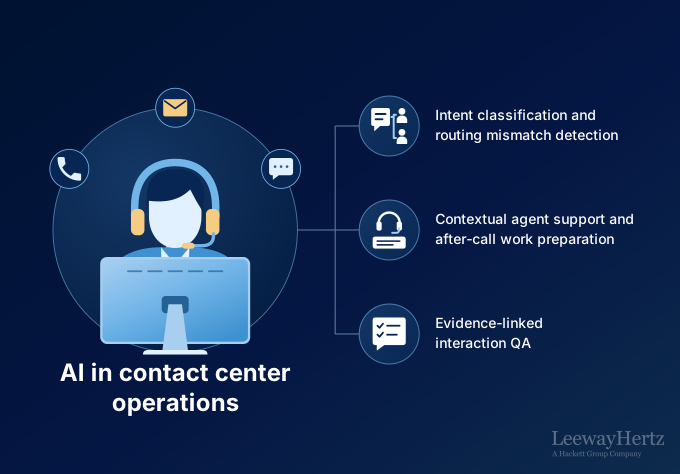
AI in Contact Center Operations: Use Cases & Agentic Workflows
Explore how AI supports contact center operations across routing, workforce management, quality assurance, coaching, compliance, escalation, and performance governance.
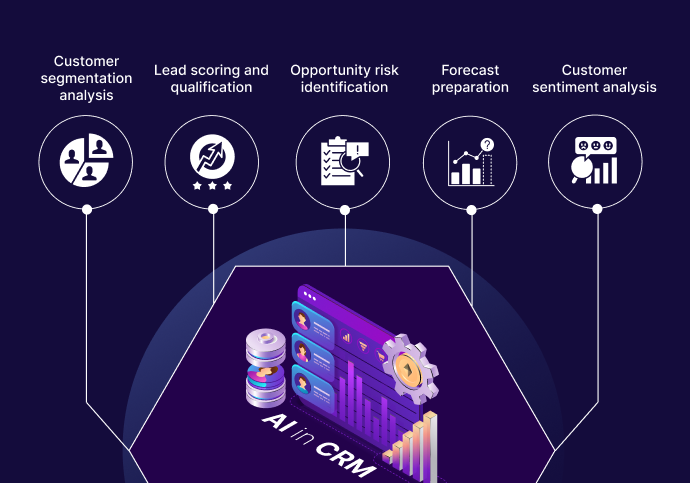
AI in Customer Relationship Management: Processes, Use Cases, and Enterprise Operating Model
AI opportunities in CRM become clearer when the operating model is decomposed across functions, processes, and sub-processes.

Agentic AI in customer service: Integration approaches, implementation frameworks and measurable business impact
Agentic AI transforms customer service by enabling autonomous agents to handle specific operational functions and coordinate to deliver seamless customer experiences

Customer service automation: Enhancing efficiency and customer satisfaction
Customer service automation transforms how businesses handle customer interactions by leveraging advanced technologies such as AI-driven chatbots, machine learning, and integrated software systems.

Adopting AI for customer success: Shaping a new era of user assistance
Customer success is a strategic approach where businesses proactively guide customers through a product journey to ensure they achieve their desired outcomes, thereby enhancing customer satisfaction, loyalty, and advocacy.

Generative AI in travel: Navigating the future of tailored tourism
Generative AI allows travel companies to provide real-time updates and personalized recommendations to travelers, guiding them through the complex world of travel information.

AI in fleet management: Use cases, benefits, architecture, technologies and solution
AI-driven fleet management systems use real-time data on traffic and road conditions to calculate the most efficient vehicle routes.

Conversational AI: Use cases, types and solution
Conversational AI is a subset of artificial intelligence that enables human-like interactions between computers and humans using natural language.

AI in LTV model: Applications and ML techniques
AI and ML have reshaped the way businesses estimate and leverage LTV, offering unprecedented accuracy, insights, and personalized strategies.