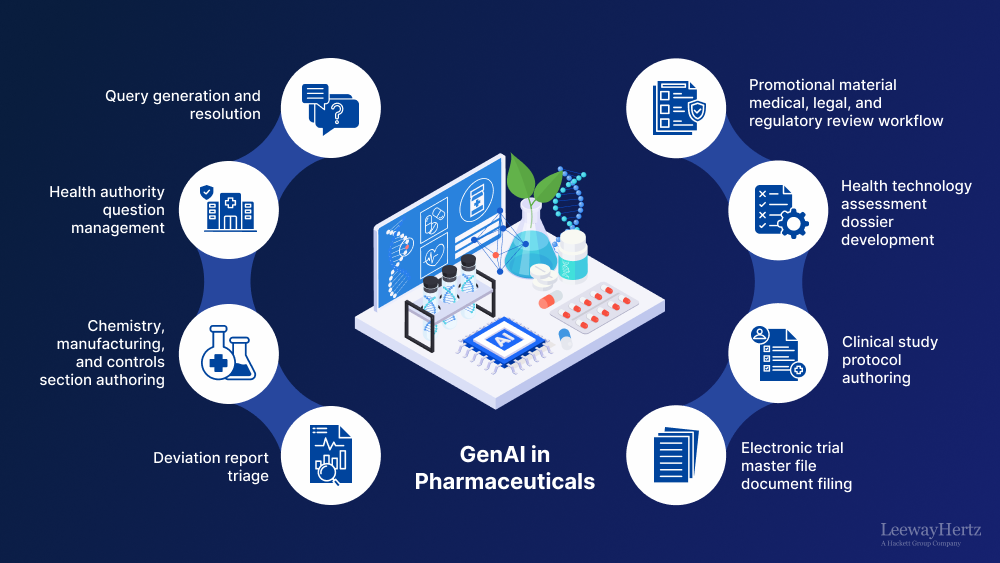
These activities create an ideal environment for generative and agentic AI. Traditional analytics and machine learning already help pharma teams predict molecular properties, assess risk, detect anomalies, and classify records. Generative AI extends this capability by reading and extracting evidence from regulated documents, drafting scientific and compliance narratives, comparing records against standards, retrieving controlled guidance, and summarizing complex clinical, regulatory, quality, and operational contexts. Agentic AI goes further by coordinating multi-step workflows across approved systems while keeping human reviewers accountable at each control point.
The value opportunity is increasingly visible. Deloitte [1] estimates that AI could unlock $5 billion to $7 billion in value for life sciences companies, while McKinsey [2] places the generative AI opportunity in biopharmaceutical operations alone at $4 billion to $7 billion annually.
However, the value of generative AI in pharmaceuticals does not come from isolated pilots or generic chatbots. It comes from embedding AI into real, regulated workflows. A regulatory affairs manager preparing a health authority response needs AI that can connect agency questions to approved source evidence. A medical writer drafting a clinical study report needs AI that can work with protocols, statistical outputs, safety narratives, and approved study materials. A quality assurance reviewer assessing a deviation needs AI that can compare investigation details against SOPs, batch records, and prior related events. Similarly, a pharmacovigilance physician, CMC author, or medical information specialist needs AI that understands the workflow, the source systems, the regulatory context, and the output required for human review.
That is why generative AI use cases in pharmaceuticals should be mapped at the operating-model level. Instead of asking where GenAI can be applied, leaders should ask which function, process, and sub-process it can improve, and what governed workflow should support it. This approach helps organizations identify high-value opportunities across the pharmaceutical value chain while preserving the accountability, traceability, and review discipline the industry depends on.
This article explores how generative and agentic AI can support pharmaceutical operations at the operating-model level. It breaks pharmaceutical operations into industry-native functions, decomposes each function into processes and sub-processes. The focus is on helping pharmaceutical organizations identify practical AI opportunities that fit into existing systems, support governed decision-making, and keep human accountability central.
- How generative AI is transforming pharmaceutical operations
- Why pharmaceutical AI use cases must be mapped at the sub-process level
- Pharmaceuticals operating model and generative AI opportunity mapping across pharmaceutical processes
- High-value generative AI use cases in pharmaceuticals
- How agentic AI works in pharmaceutical workflows
- How to prioritize generative AI use cases in pharmaceuticals
- Governance, risk, and responsible AI in pharmaceuticals
- How ZBrain operationalizes generative AI use cases in pharmaceuticals
- Future of generative AI in pharmaceuticals
How generative AI is transforming pharmaceutical operations
Pharmaceutical teams have relied for years on analytics, rules engines, statistical models, laboratory automation, and robotic process automation to improve efficiency and consistency. These technologies remain important, but generative and agentic AI introduce a different class of capability.
Traditional automation follows predefined rules. Machine learning predicts, scores, detects, or classifies based on historical patterns. Generative AI can read, summarize, draft, compare, explain, and transform regulated content. Agentic AI can go further by coordinating a sequence of workflow steps, such as retrieving a toxicology study report, extracting relevant findings into a draft module input, flagging traceability gaps, and routing the package to a regulatory affairs lead for confirmation.
Consider batch release review. A release decision may depend on a manufacturing deviation in one system, a laboratory investigation in another, and a supplier email thread explaining a raw material delay. A rules engine can advance the case when required fields are complete, and a predictive model can score the likelihood that similar deviations previously led to rework. At that point, a generative model can turn scattered evidence into a draft deviation summary, while an agentic workflow routes unresolved evidence gaps to the quality assurance reviewer. This changes how expert time is used, with less effort spent rebuilding the record and more focused on assessing whether the evidence supports the conclusion.
In pharmaceuticals, this changes how teams handle work that is:
- Document-heavy: Batch production records, regulatory submission modules, clinical study reports, supplier quality agreements, and certificates of analysis, where extracting key evidence into a draft review packet reduces manual copying and gives reviewers a consistent starting point.
- Narrative-heavy: Adverse event case narratives, deviation investigations, medical information responses, benefit-risk assessments, and health authority response drafts, where model-generated first drafts help specialists spend more time checking causality, rationale, traceability, and wording.
- Exception-heavy: Out-of-specification results, out-of-trend signals, product complaints, change control impact questions, and supply allocation exceptions, where classifying issues with cited evidence helps teams prioritize high-risk cases sooner.
- Knowledge-heavy: Standard operating procedure interpretation, labeling precedent research, protocol eligibility questions, and chemistry, manufacturing, and controls history, where retrieval grounded in approved sources reduces ambiguity in day-to-day guidance.
- Workflow-heavy: Clinical trial startup, promotional review, regulatory variation preparation, and corrective and preventive action follow-up, where governed agents can prepare next-step tasks, identify blockers, and route work across functions so cycle time is not lost between handoffs.
The strongest pharmaceutical GenAI use cases usually do not remove the human from the process. Instead, the system prepares the case, retrieves evidence, drafts the output, flags gaps, and routes the work to the right reviewer. Before any production change, customer-facing message, submission content, or other risk-bearing action is advanced, the designated reviewer for that workflow confirms the output. This shortens review cycles without weakening regulated accountability.
Why pharmaceutical AI use cases must be mapped at the sub-process level
Pharmaceutical AI use cases become actionable only when they are tied to specific workflows, artifacts, systems, review points, and accountable owners. “AI for pharma” is too broad to be useful. So are categories such as “AI for R&D,” “AI for quality,” or “AI for regulatory.” These labels may work for strategy discussions, but they are too high-level to define data requirements, controls, approval paths, success metrics, or implementation scope.
Consider an early discovery meeting where one team wants AI to summarize disease biology, while another wants help deciding which compound analogs should advance into the next design-make-test-analyze cycle. On a portfolio slide, both may appear to be discovery AI use cases. In practice, they touch different scientific sources, lab records, assay outputs, decision points, and review paths. Treating them as a single use case blurs scope, risk, and ownership.
The work becomes executable only when it is named at the sub-process level, tied to a specific artifact, placed at a defined review point, and assigned to an accountable owner before any changes to study plans, making requests, submission inputs, or regulated decisions.
A better approach maps use cases to the pharmaceutical operating model:
- Function: The major business or control area, such as research and discovery, clinical development, pharmacovigilance, CMC, manufacturing operations, quality, regulatory affairs, or medical affairs.
- Process: The workflow within that function, such as protocol and study design, individual case safety report processing, CMC dossier management, batch disposition, deviation management, or medical information response handling.
- Sub-process: The specific activity within the workflow, such as clinical study protocol authoring, MedDRA coding and seriousness assessment, eCTD Module 3 quality dossier assembly, deviation summary drafting, or response letter preparation.
- AI-enabled opportunity: The specific way AI can support that sub-process, such as extracting findings, drafting a narrative, comparing evidence against controlled standards, classifying evidence gaps, preparing reviewer-ready summaries, or assembling a submission-ready package.
This level of detail matters because pharmaceutical workflows are tied to specific regulations, controlled documents, validated systems, scientific owners, and decision rights. A workflow for drafting a CIOMS case narrative differs from that for authoring a CMC section. A protocol amendment rationale is different from a promotional claim substantiation review. A deviation investigation summary is different from a batch release recommendation.
For example, in disease biology and target rationale review, AI can summarize selected literature and internal findings into a draft target rationale memo, which the translational science lead confirms before it informs target selection. During assay selection and qualification, potential assay methods are assessed against predefined qualification criteria, and a draft assay qualification summary is created. The bioassay development lead then confirms the selected approach before it is included in the test plan.
Mapping AI at the sub-process level moves pharmaceutical organizations from broad innovation ideas to executable workflows with clear value, data requirements, governance, and review boundaries. The operating model should not begin with a tool catalog; it should begin with how work moves from scientific rationale to regulated evidence.
Transform Pharmaceutical Operations With Generative AI
Leverage GenAI to streamline clinical development, regulatory affairs, pharmacovigilance, quality, manufacturing, medical affairs, market access, and commercial review workflows while strengthening traceability, governance, and reviewer accountability.
Pharmaceuticals operating model and generative AI opportunity mapping across pharmaceutical processes
The following sections map generative AI opportunities across the operating model of a modern pharmaceutical organization. The model is organized into essential industry-native functions, each covering major processes, representative sub-processes, and AI-enabled opportunities.
Function 1. Discovery research, translational medicine, and preclinical development
Discovery research, translational medicine, and preclinical development cover early scientific work from disease biology and target rationale through candidate nomination, translational hypotheses, and investigational new drug-enabling nonclinical packages. These workflows depend on research data, assay outputs, electronic lab notebook records, laboratory information management systems, literature evidence, compound registries, and nonclinical study reports.
Generative AI can help teams summarize evidence, compare assay and study records, draft rationale documents, and prepare nonclinical module inputs. Agentic AI can coordinate evidence retrieval across research, lab, and regulatory systems while keeping scientific and regulatory reviewers responsible for final decisions.
| Process | Sub-process | Key AI-enabled opportunities |
|---|---|---|
| Target identification and validation | Disease biology and target rationale review | Retrieve omics, literature, pathway, and internal study evidence, summarize confidence levels and evidence gaps in the target rationale dossier, compare findings against DMTA cycle decision criteria to reduce manual evidence collation for discovery biology lead review. |
| Target validation experiment planning | Draft target validation study plans from prior ELN entries, map controls and readouts against target validation requirements, and flag missing replication or orthogonal evidence to shorten planning cycles for translational biology lead review. | |
| Assay selection and qualification | Compare assay candidates against qualification criteria, extract performance thresholds from SOPs and prior assay reports, and flag robustness gaps to reduce rework before screening launch for assay development scientist review. | |
| Lead discovery and optimization | DMTA cycle planning | Aggregate design hypotheses, synthesis capacity, assay queues, and decision gates, summarize bottlenecks from ELN and LIMS records, propose next-cycle priorities to reduce coordination effort for project team lead review. |
| Compound design and analog prioritization | Propose analog series from compound registry structures and assay trend summaries, compare predicted liabilities against DMTA cycle priorities, and flag low-evidence design hypotheses to improve candidate selection for medicinal chemistry lead review. | |
| Make request and synthesis tracking | Extract route assumptions and reagent constraints from make request forms, summarize synthesis status from ELN entries, and flag stalled syntheses to shorten handoff delays for chemistry operations manager review. | |
| Test data capture and assay result review | Validate assay result tables against raw instrument files and ELN entries, classify exceptions using data integrity principles, and summarize potency or selectivity shifts to reduce manual reconciliation for assay biology lead review. | |
| Translational medicine strategy | Biomarker strategy and assay plan | Draft biomarker strategy sections from omics analyses and investigator brochure evidence, compare assay feasibility against translational objectives, flag evidence gaps to strengthen traceability for translational medicine lead review. |
| Patient stratification hypothesis development | Classify subgroup evidence from real-world data, omics clusters, and protocol precedents, map assumptions to feasibility constraints, and flag weak enrichment logic to improve decision quality for translational medicine lead review. | |
| Translational endpoint selection | Compare candidate endpoints against protocol precedents and investigator brochure claims, summarize measurement burden and feasibility risks, and propose endpoint rationale options for clinical pharmacology lead review. | |
| Preclinical and IND-enabling studies | GLP nonclinical study planning | Draft GLP study planning checklists from SOPs and historical protocols, map dose, schedule, and specimen requirements, and flag resource conflicts to reduce planning rework for toxicology study director review. |
| Toxicology study report review | Summarize dose findings, clinical observations, pathology narratives, and deviations, validate traceability to LIMS datasets, and flag unresolved interpretation gaps to reduce manual review effort for toxicology study director review. | |
| Safety pharmacology package preparation | Aggregate cardiovascular, respiratory, and CNS safety outputs, compare study coverage against package requirements, and draft gap summaries to improve submission readiness for nonclinical safety lead review. | |
| IND nonclinical module inputs | Draft IND nonclinical module inputs from toxicology reports, safety pharmacology summaries, and certificates of analysis, map evidence to eCTD readiness, and flag missing cross-references to shorten filing preparation for regulatory affairs lead review. |
The highest-value opportunities in this function are test data capture and assay result review, toxicology study report review, and IND nonclinical module inputs. These workflows combine repeated evidence reconciliation, artifact-rich lab and study records, and clear human review boundaries.
An example agentic workflow is IND nonclinical evidence assembly. The agent plans the IND nonclinical evidence checklist and retrieves toxicology reports, assay results, and study notes from approved systems. It then drafts an eCTD-aligned module input with cited gaps, routes it through the regulatory workflow, and waits for regulatory affairs lead confirmation.
Function 2. Chemistry, manufacturing, and controls (CMC)
Chemistry, manufacturing, and controls covers pharmaceutical development, drug substance and drug product control strategy, specifications, stability, analytical methods, technology transfer, and lifecycle management. CMC work is highly document and evidence-intensive because teams must reconcile development records, batch history, stability data, specifications, certificates of analysis, and regulatory commitments.
Generative AI can support CMC teams by drafting structured dossier sections, comparing specifications against evidence, summarizing stability trends, and identifying change impacts. Agentic AI can coordinate multi-step workflows across development, quality, regulatory, and publishing systems.
| Process | Sub-process | Key AI-enabled opportunities |
|---|---|---|
| Pharmaceutical development and quality by design | Quality target product profile definition | Draft QTPP assumptions from intended dosage form, route, strength, and patient-use attributes, compare claims against development inputs, and flag unresolved product targets to shorten development alignment for the pharmaceutical development lead review. |
| Critical quality attribute identification | Extract assay, dissolution, impurity, and stability signals, classify likely critical quality attributes, and summarize evidence gaps to reduce workshop rework for analytical development lead review. | |
| Critical process parameter mapping | Map unit-operation variables to proposed critical quality attributes, compare batch trends against risk assumptions, and flag parameters needing tighter control to improve scale-up decisions for process engineering lead review. | |
| Design space and control strategy development | Propose design space rationale and control strategy linkages, retrieve supporting study evidence and flag unsupported ranges to shorten dossier drafting for CMC lead review. | |
| Drug substance and analytical control | API route selection | Compare route scouting summaries, impurity risks, and batch outcomes, summarize route trade-offs for CMC content, and flag scale-up uncertainties to improve route selection for process chemistry review. |
| Drug substance specification development | Draft proposed specification text from certificate of analysis history and analytical records, compare limits against prior evidence, and flag justification gaps to strengthen compliance for analytical development review. | |
| Impurity profile assessment | Aggregate impurity results from certificates of analysis and OOS investigation reports, classify recurring degradants and qualification gaps, and summarize risk themes to reduce manual reconciliation for quality control lead review. | |
| Analytical method transfer package preparation | Draft method transfer package sections from SOP requirements and validation evidence, extract acceptance criteria and transfer conditions, and flag missing evidence to shorten transfer readiness for analytical development review. | |
| Drug product, formulation, and stability | Excipient compatibility assessment | Screen compatibility observations from lab data and stability reports, classify interaction signals and flag formulation risks that could delay drug product specification setting for formulation scientist review. |
| Drug product formulation screening | Compare formulation screening results, batch attributes, and certificate of analysis data, summarize candidate strengths and trade-offs, and flag weak evidence to speed formulation governance for formulation development review. | |
| Stability protocol drafting | Draft storage condition, test interval, pull point, and acceptance criteria sections, validate alignment with stability strategy, flag inconsistent commitments to reduce protocol rework for stability lead review. | |
| Stability report preparation | Summarize stability trends from timepoint data and certificates of analysis, compare narratives against the protocol, and flag unexplained excursions to improve reporting quality for quality assurance review. | |
| CMC dossier and product lifecycle management | CMC section authoring | Draft CMC narratives from master production records, stability reports, and certificates of analysis, classify content against eCTD readiness, and flag traceability gaps to shorten authoring cycles for regulatory CMC review. |
| eCTD Module 3 quality dossier assembly | Retrieve approved specifications, batch records, validation excerpts, and stability reports, validate document placement and cross-references, and flag missing hyperlinks to reduce publishing rework for submission operations review. | |
| ICH Q12 established conditions assessment | Classify process parameters, specification elements, and control strategy statements, compare proposed reporting categories, and flag ambiguous commitments to strengthen lifecycle governance for regulatory CMC review. | |
| Change control record impact assessment | Compare proposed manufacturing changes against Module 3 dossier content and established conditions, summarize affected commitments and flag filing risks to improve accountability for change control board review. |
The highest-value GenAI opportunities in this function are CMC section authoring, eCTD Module 3 quality dossier assembly, and change control impact assessment. These workflows are artifact-rich, repetitive, and tightly connected to submission quality and lifecycle governance.
An example agentic workflow is Module 3 dossier readiness. The agent plans the required quality sections and retrieves development records, certificates of analysis, deviation and change control records, and stability reports. It then drafts placement notes and traceability gaps, routes the package through publishing, and asks the regulatory CMC reviewer to confirm submission readiness.
Function 3. Clinical development
Clinical development owns clinical strategy, protocol design, benefit-risk framing, clinical content, and study reporting from early clinical planning through registration packages. This function depends on protocols, investigator brochures, informed consent forms, clinical study reports, statistical outputs, safety data, and eCTD clinical modules.
Generative AI can help draft and compare controlled clinical content, summarize study evidence, identify protocol inconsistencies, and prepare clinical submission inputs. Agentic AI can coordinate drafting and review workflows across clinical, medical writing, safety, regulatory, and data systems.
| Process | Sub-process | Key AI-enabled opportunities |
|---|---|---|
| Clinical development strategy | Clinical development plan preparation | Aggregate indication rationale, target population assumptions, and prior protocol decisions, draft clinical development plan scenarios, and flag go/no-go questions to reduce strategy rework for clinical development physician review. |
| IND clinical strategy | Retrieve clinical pharmacology rationale, first-in-human assumptions, and investigator brochure safety positions, compare content against IND readiness needs, and draft clinical strategy text to shorten assembly for regulatory clinical lead review. | |
| Benefit-risk hypothesis development | Aggregate efficacy endpoint rationale, exposure assumptions, and safety observations, compare findings with medical review and signal outputs, propose benefit-risk hypotheses for clinical development physician review. | |
| Protocol and study design | Clinical study protocol authoring | Draft schedule-of-activities, endpoint, eligibility, and assessment-window language, compare planned controls against downstream eCRF concepts, and flag inconsistencies to reduce authoring cycle time for protocol lead review. |
| Trial protocol feasibility assessment | Aggregate site constraints, target population criteria, and visit burden, map design elements to feasibility risks, and flag enrollment barriers for clinical operations lead review. | |
| Informed consent form core language development | Draft plain-language purpose, risk, benefit, alternatives, and withdrawal sections, compare required elements against study requirements, and flag site-specific gaps to reduce ethics-review rework for clinical scientist review. | |
| Case report form concept review | Compare planned endpoints and assessments with CRF concepts, map fields to source-data expectations, and flag missing capture points to reduce downstream query volume for clinical data manager review. | |
| Investigator documents and safety updates | Investigator brochure authoring | Retrieve nonclinical, clinical pharmacology, and emerging safety summaries, compare updates with medical review outputs, and draft investigator brochure sections to reduce manual reconciliation for clinical development physician review. |
| Development safety update report clinical contribution | Summarize enrollment, exposure, efficacy signals, and safety trends, classify event narratives and emerging risks, and draft DSUR clinical contributions for patient safety physician review. | |
| Protocol amendment clinical rationale drafting | Compare protocol language, accumulated deviations, and feasibility feedback, draft amendment rationale, and flag operational and medical decision points for protocol governance committee review. | |
| Clinical study reporting and submission content | Clinical study report authoring | Draft efficacy, safety, disposition, and protocol-deviation sections from approved tables, listings, and figures, compare claims against source evidence, and flag unresolved narratives to shorten CSR finalization for medical writer review. |
| eCTD Module 2.5 clinical overview inputs review | Summarize integrated efficacy, safety, clinical pharmacology, and benefit-risk positions, map evidence to Module 2.5 headings, and flag unsupported claims for clinical regulatory lead review. | |
| eCTD Module 2.7 clinical summary inputs review | Aggregate study-level efficacy, safety, biopharmaceutics, and clinical pharmacology summaries, map content to Module 2.7 structure, flag cross-study inconsistencies for regulatory medical writer review. | |
| CSR appendix coordination | Retrieve signed Form FDA 1572, protocol versions, investigator listings, and TMF documents, validate appendix completeness, and flag missing or outdated artifacts to reduce filing delays for CSR publishing lead review. |
The highest-value opportunities are clinical study protocol authoring, clinical study report authoring, and eCTD Module 2.7 clinical summary inputs. These workflows combine structured templates, repeated evidence reuse, and clear review boundaries.
An example agentic workflow is clinical study report drafting. The agent plans the CSR outline and retrieves the final protocol, amendment history, approved tables, listings, figures, safety narratives, and TMF references. It then drafts GCP-aligned CSR sections, routes unresolved claims and appendix gaps, and waits for CSR lead confirmation.
Function 4. Clinical operations
Clinical operations owns trial execution from feasibility and site activation through monitoring, enrollment, trial master file completeness, closeout, and inspection readiness. These workflows involve high volumes of site documents, activation checklists, monitoring notes, electronic case report forms, protocol deviations, and eTMF artifacts.
Generative AI can classify documents, draft site correspondence, summarize feasibility responses, prepare monitoring follow-ups, and identify missing essential documents. Agentic AI can coordinate site activation, monitoring, and TMF workflows while keeping clinical operations owners accountable.
| Process | Sub-process | Key AI-enabled opportunities |
|---|---|---|
| Site feasibility and selection | Trial protocol feasibility assessment | Extract eligibility criteria, visit burden, and lab requirements from protocols, compare them with prior site performance evidence, and summarize feasibility constraints for clinical trial manager review. |
| Site feasibility questionnaire management | Classify site questionnaire responses against protocol and equipment requirements, draft clarification requests and flag capacity constraints to reduce manual follow-up for site activation specialist review. | |
| Investigator qualification review | Compare investigator CVs, Form FDA 1572 details, and prior study experience, flag specialty coverage or enrollment-capacity gaps, and summarize selection risks for clinical operations lead review. | |
| Site selection recommendation | Aggregate site responses, enrollment history, and protocol constraints, compare site fit against target population and capacity, and propose site selection recommendations for clinical trial manager review. | |
| Clinical trial site start-up and activation | Site activation start-up checklist | Map informed consent, form FDA 1572, contract, and training dependencies, flag missing owners and due dates, and summarize activation blockers for site activation specialist review. |
| Essential document collection | Retrieve essential document requirements, classify missing or expired items, and draft targeted site follow-ups to reduce manual chasing for site activation specialist review. | |
| Ethics submission tracking | Aggregate ethics submission dates, approval conditions, and ICF version status, detect stalled packages, and draft escalation summaries for clinical project manager review. | |
| Form FDA 1572 collection and review | Extract investigator, facility, IRB, and sub-investigator entries, compare them with site records, and flag mismatches or missing signatures for CRA review. | |
| Study execution and risk-based monitoring | Risk-based monitoring plan execution | Aggregate EDC query trends, enrollment changes, and protocol deviation signals, classify site risk, and propose monitoring priorities for CRA review. |
| Source data verification and review | Compare source document excerpts with eCRF fields, classify discrepancies by impact and flag high-risk data issues to reduce manual verification effort for CRA review. | |
| Protocol deviation tracking | Classify deviation narratives against protocol requirements, summarize recurrence patterns by site, and flag deviations affecting participant safety or data integrity for clinical trial manager review. | |
| Randomization and trial supply management oversight | Aggregate randomization transactions, kit shipment notes, and visit schedules, detect missed dispense or resupply-delay narratives, and draft oversight summaries for trial supply lead review. | |
| Trial master file and closeout | Trial master file plan setup | Map protocol milestones, country requirements, and role ownership into the eTMF plan, classify required artifacts by inspection criticality, and flag unclear ownership for TMF manager review. |
| eTMF document filing | Classify uploaded ICF, Form FDA 1572, and investigator brochure documents, extract metadata, and flag misfiled or duplicate records to reduce filing rework for TMF specialist review. | |
| Essential document quality control | Validate metadata, signatures, dates, and version lineage, compare records with protocol requirements, and flag inspection-critical defects for TMF quality reviewer review. |
The highest-value opportunities are essential document collection, source data verification and review, and eTMF document filing. These workflows are high-volume, repetitive, and tied to clear clinical operations review roles.
An example agentic workflow is a clinical trial site activation document follow-up. The agent plans the next activation follow-up and retrieves Form FDA 1572, ICF, investigator brochure, training, and ethics approval status. It then drafts a site-ready request with evidence links and waits for the site activation specialist’s confirmation.
Function 5. Biostatistics and clinical data management
Biostatistics and clinical data management cover statistical design, data capture, data cleaning, medical coding, database lock, analysis datasets, tables, listings, and figures. These workflows depend on protocols, case report forms, EDC systems, coding dictionaries, laboratory transfers, data review listings, and statistical analysis plans.
Generative AI can draft data review packages, prepare query text, summarize coding exceptions, compare laboratory and EDC records, and support traceable handoffs from clinical data to study reporting.
| Process | Sub-process | Key AI-enabled opportunities |
|---|---|---|
| Statistical design and analysis planning | Statistical analysis plan development | Draft SAP sections covering estimands, endpoints, analysis populations, and missing data handling, and compare them against protocol language, flag ambiguities for lead biostatistician review. |
| Sample size and power calculation | Retrieve enrollment, endpoint, variance, and dropout assumptions, compare parameters with feasibility inputs, and flag inconsistent assumptions before deterministic power calculations for lead biostatistician review. | |
| Randomization scheme specification | Draft randomization scheme language, map stratification factors to protocol requirements, and flag allocation concealment or treatment ratio conflicts for randomization statistician review. | |
| Interim analysis planning | Summarize interim analysis boundaries, information fractions, and stopping criteria, compare them with governance expectations, and flag unclear decision authorities for the data monitoring committee statistician review. | |
| EDC and CRF build | Case report form design | Map protocol assessments to CRF modules, compare fields against data standards, and flag duplicate or nonessential data points to reduce site burden for clinical data manager review. |
| Electronic case report form build | Validate eCRF build metadata against approved CRFs, compare configuration evidence with validation requirements, and flag missing audit trail or role-permission settings for EDC build lead review. | |
| Edit check specification | Draft edit check logic from the eCRF and data validation plan, classify checks by risk priority, and flag overly broad queries to reduce investigator workload for CDM lead review. | |
| Data validation planning | Aggregate critical data elements from protocol and CRF, map them to data integrity expectations, and draft data validation plan sections for clinical data manager review. | |
| Data cleaning, coding, and reconciliation | Query generation and resolution | Classify open discrepancies by risk category, retrieve prior query responses and draft concise query text to reduce manual triage for clinical data manager review. |
| MedDRA coding worksheet review | Compare adverse event verbatims with MedDRA conventions, classify likely coding mismatches and flag medically significant outliers for medical coder review. | |
| WHO Drug coding record review | Compare medication verbatims with WHO Drug coding conventions, retrieve synonym and ingredient evidence, and flag uncertain preferred names for medical coder review. | |
| Laboratory data reconciliation | Detect mismatches between central laboratory transfers and eCRF lab pages, flag unit, date, or reference range issues, and summarize reconciliation needs for clinical data manager review. | |
| Database lock and analysis outputs | Data review meeting package preparation | Aggregate open queries, coding exceptions, protocol deviations, and lab reconciliation issues, summarize trends and decisions needed, shorten database lock readiness review for data review physician review. |
| Database lock checklist | Validate freeze status, coding completion, reconciliation evidence, and unresolved dependencies, compare exceptions with data integrity expectations, and flag lock blockers for CDM lead review. | |
| Analysis dataset specification | Draft dataset specification sections for population flags, derived endpoints, and traceability variables, compare derivations against SAP expectations, and flag ambiguous logic for statistical programming lead review. |
The highest-value generative AI opportunities are query generation and resolution, data review meeting package preparation, and analysis dataset specification. These sub-processes support faster data cleaning, stronger traceability, and smoother database lock readiness.
An example agentic workflow is the data review meeting package workflow. The agent retrieves open query, coding, lab reconciliation, and analysis dataset status data, drafts a prioritized issue package, routes owner queues, and records clinical data manager confirmation.
Accelerate AI Solutions Development
Build fully functional solutions from your high-value use cases, based on specific operational needs and enterprise context.
Function 6. Regulatory affairs
Regulatory affairs owns regulatory strategy, application planning, submission content coordination, eCTD publishing, labeling, health authority responses, commitments, and post-approval lifecycle management. These workflows require close coordination across clinical, quality, CMC, safety, labeling, and publishing teams.
Generative AI can support dossier planning, submission readiness checks, response drafting, labeling comparison, and regulatory commitment tracking. Agentic AI can coordinate evidence retrieval and review routing across regulatory information management, document management, quality, and publishing systems.
| Process | Sub-process | Key AI-enabled opportunities |
|---|---|---|
| Regulatory strategy and application planning | IND application assembly planning | Extract planned study, sponsor, investigator, and protocol elements, map missing documents against submission readiness, and flag assembly gaps for regulatory strategy lead review. |
| NDA planning | Aggregate CSR, Module 2.7 clinical summary, and CMC milestones, compare completeness against submission readiness, and propose section priorities for regulatory strategy lead review. | |
| ANDA pathway assessment | Compare proposed product attributes, approved label claims, and CMC assumptions, classify quality and labeling risks, and flag unresolved product sameness issues for regulatory strategy lead review. | |
| BLA planning | Map CSR, process performance qualification, certificate of analysis, and Module 3 dependencies, compare readiness milestones, and propose critical path actions for regulatory strategy lead review. | |
| Submission authoring, publishing, and readiness | Form FDA 1571 preparation | Extract sponsor, protocol, investigator, and submission details, validate form fields against source records, and flag exceptions to reduce manual re-keying for regulatory operations lead review. |
| eCTD publishing and submission readiness | Validate leaf titles, granularity, hyperlinks, bookmarks, lifecycle operators, and required documents, flag publishing findings to reduce rework for publishing lead review. | |
| Module 2.5 clinical overview coordination | Retrieve clinical endpoint, safety, and benefit-risk evidence from CSRs and Module 2.7 summaries, summarize inconsistencies, and draft issue logs for clinical regulatory lead review. | |
| Module 3 quality dossier coordination | Compare batch records, certificates of analysis, stability reports, and change records with Module 3 dossier content, classify CMC gaps, and flag issues for CMC regulatory lead review. | |
| Regulatory information management and commitments | Product registration data maintenance | Extract country, dosage form, strength, indication, and approval status, validate master data against registration records, and flag discrepancies for RIM lead review. |
| Submission sequence tracking | Aggregate submission dates, sequence numbers, lifecycle operators, and health authority status, compare sequence status with publishing readiness, flag late or inconsistent entries for regulatory operations lead review. | |
| Health authority questions management | Classify agency questions by clinical, safety, labeling, and CMC topic, retrieve supporting evidence, and draft response outlines to accelerate response cycles for regulatory strategy lead review. | |
| Regulatory commitment tracking | Extract due dates, owners, and promised deliverables from commitment logs and change records, compare status against lifecycle obligations, and flag overdue or ambiguous commitments for regulatory affairs lead review. | |
| Labeling and post-approval lifecycle | Approved label maintenance | Compare regional approved label text with core labeling and prescribing information, classify deviations and flag material differences for labeling lead review. |
| Prescribing information update coordination | Retrieve safety, efficacy, and dosage changes from safety reports and clinical study reports, draft prescribing information redlines, and flag unresolved medical judgments for labeling committee review. | |
| Carton artwork regulatory review | Compare carton artwork against approved label and prescribing information, detect missing strength, route, storage, or warning statements, and flag high-risk discrepancies for labeling lead review. | |
| CMC change filing assessment | Classify manufacturing, analytical, and specification changes, map filing impact against dossier commitments, and flag borderline changes for CMC regulatory lead review. |
The highest-value GenAI opportunities are eCTD publishing and submission readiness, health authority question management, and CMC change filing assessment. These workflows are deadline-driven, evidence-heavy, and well-suited to AI-assisted comparison and response drafting.
An example agentic workflow is the health authority response workflow. The agent plans the response package and retrieves the question letter, clinical study report, stability report, change control record, and prior commitments. It then drafts response outlines with evidence links, routes unresolved issues, and records regulatory strategy lead confirmation.
Function 7. Pharmacovigilance and drug safety
Pharmacovigilance and drug safety cover adverse event intake, individual case safety report processing, duplicate detection, medical review, expedited reporting, signal management, aggregate safety reporting, and safety compliance. These workflows are high-volume, time-sensitive, and governed by strict reporting expectations.
Generative AI can extract case details, draft narratives, summarize causality and expectedness evidence, support duplicate review, and prepare aggregate safety content. Agentic AI can coordinate intake, follow-up, narrative drafting, and medical review while keeping safety decisions with qualified reviewers.
| Process | Sub-process | Key AI-enabled opportunities |
|---|---|---|
| Safety case intake and triage | Adverse event intake | Extract reporter, patient, product, event, and source metadata from emails, call notes, and forms, validate mandatory fields, and flag incomplete cases to reduce intake rework for the safety operations manager review. |
| Duplicate case detection | Detect likely duplicate reports by comparing demographics, product exposure, event terms, and receipt dates, summarize match rationale, and route uncertain matches for case processing lead review. | |
| Serious adverse event triage | Classify incoming events against seriousness criteria, compare reporter terms with coded concepts, and flag potentially reportable serious cases for medical safety physician review. | |
| Product complaint safety intake handoff | Map product complaint narratives to suspected adverse event fields, retrieve batch and certificate context, and flag safety-relevant complaints for pharmacovigilance intake lead review. | |
| ICSR processing | ICSR data entry | Extract patient, suspect product, dosage, event chronology, outcome, and reporter data, validate field provenance, and flag conflicting values for case processor review. |
| MedDRA coding and seriousness assessment | Classify verbatim event terms, propose preferred terms and seriousness indicators, and flag ambiguous clinical concepts for safety coding specialist review. | |
| Causality assessment | Summarize temporal association, dechallenge, rechallenge, comorbidities, and concomitant medications, compare evidence, and flag weak or conflicting information for medical safety physician review. | |
| Expectedness assessment | Compare coded adverse events with approved label, prescribing information, or investigator brochure, summarize expectedness evidence, and flag mismatches for medical safety physician review. | |
| Narrative preparation and expedited reporting | CIOMS narrative preparation | Draft chronological CIOMS narrative sections from case data, coding worksheets, and drug coding records, summarize missing context, and flag unsupported assertions for medical safety physician review. |
| CIOMS I form generation | Draft CIOMS I form fields from ICSR data, validate patient, product, event, and reporter consistency, and flag missing mandatory elements for pharmacovigilance quality lead review. | |
| Expedited reporting due date tracking | Compare receipt date and country criteria, retrieve missing clock-start evidence, and flag ambiguous deadlines for reporting coordinator review. | |
| ICH E2B transmission readiness | Validate ICSR transmission readiness, compare required E2B fields with source case data, and flag schema or narrative inconsistencies for safety submissions specialist review. | |
| Signal management and aggregate safety reports | Medical review and safety signal management | Aggregate case series, disproportionality outputs, literature abstracts, label context, summarize benefit-risk considerations, and flag emerging risks for safety governance committee review. |
| Development safety update report preparation | Aggregate exposure, SAE tables, and risk updates, draft DSUR safety sections, and flag inconsistent study narratives for medical safety physician review. | |
| Periodic safety update report preparation | Aggregate marketed case data, regulatory actions, and label changes, summarize interval safety findings, and flag benefit-risk inconsistencies for aggregate report lead review. | |
| Periodic benefit-risk evaluation report preparation | Compare cumulative safety, efficacy, exposure, and risk minimization evidence, draft PBRER sections, and flag unresolved evidence gaps for medical safety physician review. |
The highest-value generative AI opportunities are duplicate case detection, CIOMS narrative preparation, and medical review and safety signal management. These workflows are high-volume or high-consequence and require strong human medical review.
An example agentic workflow is the expedited safety case narrative workflow. The agent plans the case completion checklist, retrieves source correspondence, ICSR data, and label context. It then drafts the CIOMS narrative and CIOMS I form, routes ambiguous issues of seriousness, causality, expectedness, and deadlines to the medical safety physician, and records confirmation.
Function 8. Manufacturing operations
Manufacturing operations cover shop-floor execution for drug substance, drug product, packaging, batch documentation, in-process controls, serialization, and release-ready production records. These workflows depend on master production records, electronic batch records, production orders, equipment data, certificates of analysis, deviations, and quality release queues.
Generative AI can summarize batch record anomalies, draft shift handover notes, compare records against procedures, and prepare release-readiness summaries. Agentic AI can coordinate evidence across manufacturing, quality control, quality assurance, and supply chain systems.
| Process | Sub-process | Key AI-enabled opportunities |
|---|---|---|
| Production readiness and master records management | Master production record maintenance | Map proposed edits to change control records, compare impacted instructions with SOPs, and flag unmanaged changes to reduce rework for MSAT lead review. |
| Material staging and line clearance | Validate staged material identifiers against batch production records, retrieve line-clearance instructions, and flag missing or mismatched materials for QA floor specialist review. | |
| Electronic batch record setup | Compare production order data with the electronic batch record, retrieve applicable master production record steps, and flag configuration gaps for manufacturing systems owner review. | |
| Drug substance and drug product execution | Active pharmaceutical ingredient (API) campaign execution | Aggregate equipment status, material readiness, and prior deviation themes, summarize campaign-start constraints, and flag risks for production supervisor review. |
| Drug product batch manufacturing | Draft shift execution summaries from the electronic batch record, classify open observations against master production record requirements, and flag documentation gaps for production supervisor review. | |
| Critical process parameter monitoring | Detect unusual parameter patterns in batch time series, summarize batch context against process performance evidence, and flag lots needing closer assessment for process engineer review. | |
| In-process control testing coordination | Retrieve sampling requirements from batch records, compare QC queue status from LIMS, and draft priority updates to reduce handoff delays for QC liaison review. | |
| Packaging, labeling, and serialization | Packaging line execution | Summarize packaging order requirements from batch records, compare setup notes with SOPs, and flag unresolved readiness items for packaging supervisor review. |
| Carton artwork verification at packaging | Compare carton artwork against approved label and prescribing information, extract mismatched strength, route, or language elements, and flag discrepancies for QA packaging specialist review. | |
| Serialization data capture | Aggregate serialization exception messages, compare affected counts with batch records, and flag unresolved status gaps for serialization operations lead review. | |
| Batch production record packaging reconciliation | Extract component usage, reject, and return entries, compare reconciliation notes with SOPs, flag unexplained variances for QA packaging specialist review. | |
| Batch release readiness and process verification | Electronic batch record review | Extract missing signatures, late entries, and open comments, classify exceptions, and draft reviewer-ready issue summaries to shorten the release cycle time for QA batch release specialist review. |
| Batch production record exception review | Classify batch exceptions against deviation records, summarize recurrence and product-impact context, and propose disposition questions for QA disposition lead review. | |
| Certificate of analysis reconciliation | Compare certificate of analysis results with release specifications, retrieve linked OOS investigation references, and flag unresolved test entries for QC release lead review. | |
| Continued process verification trending | Aggregate process parameter and quality attribute narratives from batch records, compare trends with annual product review evidence, and draft signal explanations for MSAT process owner review. |
The highest-value GenAI opportunities are electronic batch record review, batch production record exception review, and continued process verification trending. These workflows reduce manual record review, shorten release cycle time, and strengthen evidence quality for batch disposition.
An example agentic workflow is a batch release readiness review. The agent retrieves the production order, electronic batch record, certificate of analysis, deviation records, and open quality issues. It then drafts exception summaries and reconciliation questions, routes the package to the QA batch release queue, and records QA confirmation.
Function 9. Quality assurance and quality control
Quality assurance and quality control own the pharmaceutical quality system, batch disposition, deviation management, CAPA governance, OOS and OOT investigations, QC testing, stability, validation oversight, data integrity, and inspection readiness. These workflows are evidence-heavy and often require manual assembly across batch records, lab systems, audit trails, SOPs, and quality events.
Generative AI can draft investigation summaries, compare quality records against standards, summarize CAPA evidence, identify data integrity exceptions, and assemble inspection-ready evidence packs.
| Process | Sub-process | Key AI-enabled opportunities |
|---|---|---|
| Pharmaceutical quality system and SOP governance | ICH Q10 pharmaceutical quality system oversight | Aggregate quality event metrics, summarize management review trends from deviations, CAPA, and change records, and flag recurring process weaknesses for quality unit review. |
| SOP lifecycle management | Compare SOP revisions, map impacted training and batch record references, and flag inconsistent effective-date language to reduce document-control rework for document control manager review. | |
| Quality agreement governance | Extract supplier responsibilities from quality agreements, classify deviation, change notification, and audit clauses, and flag missing obligations for the supplier quality manager review. | |
| Annual product review and product quality review | Aggregate batch, deviation, certificate of analysis, and stability evidence, summarize recurring trends, flag unresolved signals for qualified person review. | |
| Deviation, OOS, OOT, and CAPA management | Deviation report triage | Classify deviation narratives by product, system, and severity, retrieve linked batch context, and flag potential quality impacts for QA operations manager review. |
| Deviation investigation support | Draft investigation sections from batch exceptions, QC results, and operator statements, compare root-cause hypotheses, and flag weak evidence links for QA manager review. | |
| Out-of-specification investigation | Draft OOS investigation sections from lab worksheet observations and certificate discrepancies, compare retest rationale, flag assignable-cause gaps for QC laboratory manager review. | |
| Out-of-trend investigation | Detect trend shifts across stability results and certificate history, summarize probable method, product, or storage contributors, and flag lots requiring escalation for QC stability lead review. | |
| CAPA effectiveness check | Retrieve CAPA commitments, compare recurrence and QC observations after implementation, and flag weak or overdue evidence for quality systems manager review. | |
| QC laboratory and stability operations | Sample receipt and LIMS login | Extract chain-of-custody and sample identifiers from protocols and batch records, validate LIMS fields and flag discrepancies for QC sample coordinator review. |
| Certificate of analysis issuance | Compare approved test results with certificate specifications, summarize release exceptions, and flag missing analyst, method, or approval evidence for QA release manager review. | |
| Stability protocol execution | Retrieve scheduled pulls, summarize missed timepoints and condition excursions, and flag protocol-impacting deviations for stability program manager review. | |
| Stability report review | Aggregate timepoint results and certificate history, detect emerging trends and draft reviewer questions for QC stability lead review. | |
| Validation, data integrity, and audit trails | Validation master plan approval | Compare validation scope with PPQ protocol and system inventory, classify gaps and flag missing owner approvals for validation governance board review. |
| Computer system validation review | Summarize user requirement, test, and deviation evidence, compare traceability, and flag unresolved anomalies for validation lead review. | |
| GAMP 5 validation assessment | Classify application category, supplier risk, and intended use, map controls to validation expectations, and flag over- or under-tested functions for CSV manager review. | |
| ASTM E2500 verification package review | Retrieve critical requirement evidence, compare acceptance documentation with verification expectations, and flag incomplete rationales for validation QA manager review. | |
| ALCOA+ data integrity review | Screen audit trail events linked to batch records and certificates of analysis, classify attribution, timing, completeness, and consistency concerns, and flag high-risk records for data integrity officer review. |
The highest-value GenAI opportunities are deviation investigation support, OOS investigation support, CAPA effectiveness checks, and ALCOA+ data integrity review. These workflows reduce manual evidence assembly and strengthen compliance traceability while keeping final judgment with QA, QC, and data integrity owners.
An example agentic workflow is a deviation investigation and evidence assembly. The agent retrieves the deviation report, batch record exceptions, LIMS results, SOPs, CAPA history, and validation references. It then drafts a risk-aligned investigation summary with evidence gaps, routes the package through the quality system, and asks the QA manager to confirm disposition.
Function 10. Supply chain and external manufacturing
Supply chain and external manufacturing cover demand planning, supply planning, materials availability, external manufacturing coordination, batch release dependencies, distribution, cold chain, serialization, and supply continuity. These workflows are complex because planning decisions depend on quality events, batch status, supplier notifications, market demand, logistics records, and regulatory constraints.
Generative AI can summarize constrained-supply scenarios, supplier change impacts, batch release dependencies, and temperature excursion evidence. Agentic AI can coordinate planning, external manufacturing, quality, and logistics workflows while preserving final decision rights.
| Process | Sub-process | Key AI-enabled opportunities |
|---|---|---|
| Integrated demand and supply planning | Demand forecast consolidation | Aggregate customer orders, tender signals, and launch assumptions, compare exceptions against planning tolerances, and summarize demand shifts for the demand planning manager review. |
| Supply plan and allocation review | Compare supply scenarios, available-to-promise positions, market constraints, and batch release dependencies, flag shortages, and draft allocation rationales for the supply planning manager review. | |
| Inventory target setting | Compare demand variability, lead times, shelf-life limits, and service-level assumptions, summarize working-capital tradeoffs, propose target changes for supply chain finance review. | |
| Materials, procurement, and supplier handoffs | Active pharmaceutical ingredient (API) supplier qualification input | Extract GMP certificates, audit observations, and certificate history, classify supplier evidence gaps, and flag missing documentation for supplier quality manager review. |
| Excipient supplier qualification input | Classify specifications, allergen statements, residual solvent declarations, and certificate trends, summarize onboarding gaps, and route exceptions for supplier quality manager review. | |
| Supplier change notification assessment | Map supplier change details to affected materials, markets, and CMC commitments, compare regulatory impact, and draft disposition options for change control board review. | |
| Quality agreement setup with suppliers | Draft clauses for deviation notification, batch release documentation, data integrity, and audit rights, compare obligations against SOP expectations, and flag negotiation gaps for supplier quality manager review. | |
| External manufacturing oversight | External manufacturing production schedule coordination | Retrieve slot confirmations, component availability, and quality release milestones, compare constraints against supply commitments, and summarize late-batch risks for external manufacturing operations lead review. |
| Batch record transfer and review | Validate transferred batch record fields against master production records, extract missing signatures and parameter variances, and draft exception summaries for QA release lead review. | |
| Deviation and CAPA follow-up with external manufacturers | Summarize open deviations, CAPA commitments, and due-date evidence, classify severity, and flag overdue effectiveness checks for quality operations manager review. | |
| Product quality review inputs from external sites | Aggregate site-level yields, deviation trends, complaint links, and certificate results, compare inputs with product quality review needs, and flag data gaps for product quality lead review. | |
| Distribution, cold chain, and serialization | Temperature excursion documentation | Extract temperature logger curves, lane details, and shipment timestamps, classify product-impact questions, and draft disposition summaries for QA disposition lead review. |
| Serialization data exchange | Compare EPCIS event files, commissioning records, and shipment confirmations, flag data mismatches, and route exception summaries for serialization operations manager review. | |
| DSCSA exception handling | Classify exception records by suspect product, missing transaction information, and verification failure, retrieve related EPCIS and certificate evidence, and draft resolution packets for trade operations manager review. |
The highest-value GenAI opportunities are supply plan and allocation review, batch record transfer and review, and temperature excursion documentation. These workflows connect planning, quality, and release decisions while preserving accountable review.
An example agentic workflow is external batch release and allocation triage. The agent retrieves production schedules, allocation constraints, batch records, deviations, CAPA records, and certificates of analysis. It then drafts a release-risk and allocation impact summary, routes the package to external manufacturing operations, and records confirmation before the next planning action.
Accelerate AI Solutions Development
Build fully functional solutions from your high-value use cases, based on specific operational needs and enterprise context.
Function 11. Medical affairs
Medical affairs owns medical strategy, scientific communication, medical information, field medical engagement, publication planning, congress support, investigator-sponsored research review, and medical input to content governance. These workflows require alignment with approved labels, prescribing information, clinical evidence, safety context, and medical review standards.
Generative AI can support literature synthesis, scientific response drafting, field insight summarization, medical review preparation, and evidence consistency checks. Agentic AI can route safety, off-label, or compliance-sensitive items to the right owners.
| Process | Sub-process | Key AI-enabled opportunities |
|---|---|---|
| Medical strategy and evidence planning | Medical plan development | Aggregate clinical study outcomes, approved label indications, and benefit-risk evidence, map evidence gaps, and draft medical plan objectives for medical director review. |
| Publication plan input | Retrieve clinical study endpoints and clinical summary sections, compare evidence with label language, and propose publication evidence priorities for publication lead review. | |
| Medical input into congress strategy | Summarize clinical study data, investigator brochure updates, and approved label boundaries, classify congress themes, and propose prioritized evidence topics for congress strategy lead review. | |
| Scientific content and medical information | Scientific response letter development | Retrieve approved label, prescribing information, and clinical study references, summarize evidence, and draft citation-linked response letters for medical information specialist review. |
| Medical information inquiry intake | Classify inquiry text against approved label and safety triggers, flag potential adverse event or off-label cases, and summarize intake rationale for medical information specialist review. | |
| Literature search and evidence summary | Retrieve indexed literature and clinical study endpoints, screen against target populations and summarize citation-linked evidence strength for the medical director review. | |
| Label and prescribing information alignment | Compare draft response text with approved label and prescribing information, detect unsupported phrasing and flag deviations for MLR committee review. | |
| Field medical excellence | Field medical insight capture | Extract scientific topics and stakeholder questions from MSL notes, map them to label and protocol themes, and summarize trends for medical excellence lead review. |
| MSL visit planning | Retrieve KOL history, compare open questions with label and investigator brochure updates, and propose compliant discussion objectives for MSL manager review. | |
| Insight tagging and triage | Classify field insights against label topics, protocol questions, and safety triggers, detect emerging evidence-gap patterns, and flag priority items for medical affairs operations review. | |
| Medical review and external research | Promotional material MLR review | Compare annotation packet claims with approved label and prescribing information, retrieve supporting clinical study references, and flag unsupported or imbalanced statements for MLR committee review. |
| Claim substantiation review | Validate promotional claims against clinical study tables and approved labeling, compare citation support and flag evidence gaps for MLR medical lead review. | |
| Investigator-sponsored study concept review | Screen ISS concepts against protocol precedent, compare rationale with investigator brochure safety context, summarize merit, feasibility, and compliance risks for medical director review. | |
| Real-world evidence study concept input | Map RWE concepts to approved label populations and outcomes, compare endpoints with protocol precedent, and propose evidence-quality considerations for RWE lead review. |
The strongest GenAI opportunities are scientific response letter development, literature evidence summaries, insight tagging and triage, and claim substantiation review. These workflows reduce manual evidence handling while preserving medical judgment.
An example agentic workflow is the scientific response letter workflow. The agent retrieves inquiry details, approved label, prescribing information, clinical study reports, and relevant references. It then drafts a citation-linked response, routes adverse event exceptions to safety, flags off-label issues, and waits for medical information specialist confirmation.
Function 12. Market access, pricing, and HEOR
Market access, pricing, and health economics and outcomes research cover access strategy, pricing, reimbursement, payer evidence, health technology assessment dossiers, real-world evidence, and post-launch evidence generation. These workflows require consistent reuse of clinical, economic, humanistic, and real-world evidence across markets and payer contexts.
Generative AI can maintain evidence dossiers, draft payer objection responses, summarize real-world evidence updates, and compare dossier content against local requirements. Agentic AI can coordinate evidence refreshes across regulatory, medical, market access, and MLR workflows.
| Process | Sub-process | Key AI-enabled opportunities |
|---|---|---|
| Market access and pricing strategy | Access landscape assessment | Aggregate HTA guidance, classify coverage restrictions, summarize access barriers from approved label and prescribing information evidence for market access lead review. |
| Payer evidence need identification | Map payer questions to clinical, safety, outcomes, and economic evidence gaps, retrieve evidence from clinical study reports and label sources, and sharpen evidence planning for HEOR lead review. | |
| Pricing and reimbursement scenario planning | Compare analog pricing assumptions, summarize HTA precedent notes and flag reimbursement-risk narratives for pricing committee review. | |
| HEOR and real-world evidence | HEOR study plan | Draft HEOR study plan sections, retrieve endpoint definitions from protocols, and validate research questions to reduce protocol rework for HEOR lead review. |
| Real-world evidence protocol development | Retrieve eligibility criteria and endpoint definitions, map variables to claims or EHR data dictionaries, and draft protocol sections for epidemiology lead review. | |
| Burden of illness evidence synthesis | Extract cost, epidemiology, and quality-of-life endpoints from publications and study reports, classify evidence tables, and summarize gaps for HEOR lead review. | |
| Comparative effectiveness evidence review | Screen abstracts, compare endpoints from clinical study reports and comparator labels, and summarize certainty ratings for medical affairs lead review. | |
| HTA and payer dossier development | HTA dossier development | Draft clinical, economic, and humanistic value sections from CSRs, approved labels, and budget impact models, flag missing appendices for access dossier lead review. |
| Value dossier maintenance | Retrieve newly approved claims and evidence updates, compare them with global value dossier tables, and draft change summaries for value dossier owner review. | |
| Payer objection response preparation | Classify payer objections from CRM notes, retrieve approved rebuttal evidence and draft response options for payer account lead review. | |
| Budget impact evidence narrative | Summarize utilization assumptions, compare population inputs with epidemiology tables and approved labels, and flag unsupported narrative claims for pricing committee review. | |
| Post-launch access evidence | Formulary decision tracking | Extract formulary tier, restriction, and rationale details from payer policy updates, map them to trackers, and flag access losses for market access operations lead review. |
| Real-world evidence update summary | Aggregate new outcomes tables, compare findings with value dossier evidence, and summarize payer-relevant changes for access evidence lead review. | |
| Payer advisory board insight capture | Summarize payer advisory board themes, classify evidence requests and draft action items for market access strategy lead review. |
The strongest generative AI opportunities are value dossier maintenance, payer objection response preparation, real-world evidence update summaries, and HTA dossier development. These use cases reduce manual refresh effort and improve evidence consistency across markets.
An example agentic workflow is value dossier evidence refresh. The agent retrieves approved label changes, CSR excerpts, value dossier sections, RWE tables, and payer objections, drafts updated evidence tables and response language, routes the package through review, and waits for value dossier owner confirmation.
Function 13. Commercial strategy, brand, and omnichannel engagement
Commercial strategy, brand, and omnichannel engagement cover brand planning, launch readiness, promotional content operations, customer engagement, field enablement, campaign analytics, and content reuse across channels. These workflows involve high volumes of claims, references, content modules, review annotations, channel rules, and customer engagement records.
Generative AI can support promotional packet preparation, claim library maintenance, content tagging, compliant message reuse, field call planning, and campaign performance reporting. Agentic AI can coordinate promotional review workflows while keeping medical, legal, and regulatory approval intact.
| Process | Sub-process | Key AI-enabled opportunities |
|---|---|---|
| Brand strategy and launch planning | Brand plan development | Summarize market assumptions and on-label value propositions, compare strategic pillars against review criteria, and flag claim-dependent positioning choices for brand lead review. |
| Indication prioritization | Compare indication-level efficacy, safety, access, and unmet-need evidence, summarize evidence gaps, and flag trade-off assumptions for commercial strategy lead review. | |
| Launch readiness checklist | Aggregate launch milestone evidence from labels, SOPs, and review packets, map open content tasks to review checkpoints, and flag delayed workstreams for launch excellence lead review. | |
| Competitive message testing | Classify competitor claims and tested message variants, compare support against clinical study endpoints, and flag overreaching statements for brand team review. | |
| Promotional content operations | Promotional review annotation packet preparation | Extract claim text, retrieve supporting references, draft annotation packets and flag missing citations to reduce MLR submission rework for MLR coordinator review. |
| MLR review workflow support | Classify reviewer comments by medical, legal, and regulatory concern, summarize unresolved decisions, and flag off-label or substantiation gaps for MLR chair review. | |
| Claim library maintenance | Validate active claim entries against approved labels and prescribing information, detect duplicate or expired wording, and propose retirement or reuse decisions for content governance lead review. | |
| Reference linking and version control | Retrieve approved references, compare citation anchors, validate version lineage and flag stale links to reduce remediation cycles for content QA lead review. | |
| Omnichannel campaign planning | Customer segmentation and targeting | Classify HCP targets by specialty, indication relevance, and engagement history, map rationales to label boundaries, and flag low-fit audiences for customer analytics lead review. |
| Channel mix planning | Aggregate channel performance summaries, compare planned messages with approved label boundaries, and propose channel reallocations for omnichannel engagement lead review. | |
| Next-best-action rules definition | Draft rule rationales from engagement histories, retrieve allowable message claims, and flag rules needing human exception handling for sales operations lead review. | |
| Content modularization and tagging | Map approved content modules to claims, audiences, channels, and expiration dates, classify reuse constraints, and flag missing metadata for content operations lead review. | |
| Field engagement and commercial analytics | HCP call planning | Retrieve engagement notes, territory priorities, and formulary context, summarize on-label discussion themes, and propose call objectives for district sales manager review. |
| Field feedback capture | Classify field feedback into objection, access, competitor, and safety themes, summarize potential adverse-event mentions, and flag compliance-sensitive items for pharmacovigilance liaison review. | |
| Campaign performance reporting | Aggregate response, reach, and drop-off data, and summarize performance by approved message, flag underperforming tactics for commercial analytics lead review. | |
| Market share and prescription trend analysis | Compare prescription trends and market share dashboards with approved indication scope, validate data lineage and summarize variance drivers for the commercial analytics director review. |
The highest-value GenAI opportunities are promotional review annotation packet preparation, claim library maintenance, content modularization and tagging, and MLR workflow support. These workflows reduce review rework, improve claim traceability, and speed compliant content operations.
An example agentic workflow is promotional review packet preparation. The agent retrieves approved label language, prescribing information, and clinical study references. It then drafts content, prepares the annotation packet, flags missing support, routes the package through the promotional review system, and records MLR coordinator confirmation.
Function 14. Technology, data, and governance
Technology, data, and governance provide the foundation for scaling AI safely across pharmaceutical operations. This function owns enterprise systems, data architecture, integrations, analytics, cybersecurity, validation, model lifecycle controls, AI governance, and regulated workflow enablement.
Generative and agentic AI can support data lineage documentation, validation planning, AI use case intake, model monitoring, access control review, prompt logging, and human approval workflow management. This function is essential because AI cannot scale in pharma without validated systems, controlled data access, audit trails, and governance.
| Process | Sub-process | Key AI-enabled opportunities |
|---|---|---|
| GxP system ownership and enterprise architecture | Research informatics and lab data platform management | Extract assay metadata from research informatics and LIMS records, compare protocol deviations with SOPs, and flag data integrity gaps for research informatics system owner review. |
| Clinical operations and data capture platform management | Classify eCRF build requests, compare them with protocol requirements, and summarize amendment setup risks for clinical data management lead review. | |
| Regulatory information management platform management | Retrieve submission metadata, compare form and dossier status against readiness criteria, and flag ownership gaps for regulatory operations lead review. | |
| Pharmacovigilance and safety platform management | Extract case fields, classify ICSR discrepancies and draft exception summaries for pharmacovigilance system owner review. | |
| Quality management and validation platform management | Aggregate change control and CAPA metadata, map platform ownership controls and flag unresolved handoffs for quality systems owner review. | |
| Data platform, integration, and lineage | Data, analytics, and AI platform management | Map data products to validation plans, classify AI use cases by GxP boundary, and flag release prioritization risks for data platform owner review. |
| ERP and supply chain planning integration | Compare ERP and planning integration mappings with master production records, flag product-lot mismatches for supply chain IT owner review. | |
| Commercial content and customer engagement data integration | Extract customer engagement metadata, compare content tags with review annotation packets, and flag off-label routing risks for commercial data steward review. | |
| Data lineage and provenance capture | Map source-to-target lineage across LIMS, ERP, quality, regulatory, and analytics platforms, summarize provenance gaps, and route unresolved transformations for data governance lead review. | |
| Validation and regulated system controls | Computer system validation planning | Draft validation plan sections covering intended use, GxP impact, data flows, and supplier responsibilities, flag missing evidence for validation manager review. |
| GAMP 5 validation execution | Compare executed test evidence with SOP requirements and workflow controls, summarize failed or blocked scripts, and draft deviation links for QA validation lead review. | |
| ASTM E2500 verification approach | Retrieve critical requirement evidence, compare acceptance documentation with verification expectations, and flag incomplete rationales for validation QA manager review. | |
| Electronic records and signatures control testing | Retrieve audit-trail samples and signature events, compare them with SOP controls, flag missing attribution or review evidence for QA compliance reviewer. | |
| AI governance and model risk management | AI risk management framework alignment | Classify AI use cases that draft regulated content, summarize control gaps and approval boundaries, and improve decision accountability for AI governance committee review. |
| Generative AI profile assessment | Compare retrieval prompts and generated responses against governance controls, flag hallucination, privacy, and provenance gaps for AI risk owner review. | |
| AI supporting regulatory decision-making assessment | Screen AI-supported analyses proposed for submissions, summarize credibility evidence gaps and flag nonconfirmatory outputs for regulatory science lead review. | |
| EU AI Act impact assessment | Classify AI capabilities against applicable obligations, map provider and deployer responsibilities, and flag high-risk documentation gaps for privacy and AI governance counsel review. | |
| Model monitoring and human approval workflow | Detect drift, threshold breaches, unapproved prompt changes, and reviewer override patterns, summarize impact, and route exceptions for accountable reviewer confirmation. |
The highest-value generative AI opportunities are data lineage and provenance capture, computer system validation planning, AI use case risk assessment, and model monitoring with human approval workflows. These capabilities create the governance foundation needed to deploy AI safely across pharmaceutical functions.
An example agentic workflow is the GxP validation impact workflow. The agent retrieves the change control record, validation master plan, executed test evidence, and data lineage records, drafts a CSV impact summary with data integrity gaps, routes the package to the validation manager, and waits for final disposition confirmation.
Accelerate AI Solutions Development
Build fully functional solutions from your high-value use cases, based on specific operational needs and enterprise context.
High-value generative AI use cases in pharmaceuticals
In pharmaceuticals, high-value generative AI use cases start at operational choke points where large volumes of regulated text or structured records must be reviewed before work can move forward. These use cases run over existing artifacts, such as protocols, batch records, safety case forms, submission modules, or review packets, and end with confirmation by a defined reviewer. This pattern reduces manual effort and cycle time without bypassing accountability.
| Use case | Function | Why it is high-value |
|---|---|---|
| Adverse event intake | Pharmacovigilance and drug safety | High inbound case volumes make GenAI useful for extracting reporter details, event chronology, and follow-up needs from intake records, while a safety case processor approves the case record before submission, reducing manual effort and strengthening compliance. |
| Clinical study protocol authoring | Clinical development | Protocol teams reuse endpoint, eligibility, and visit-schedule language across studies, so GenAI can draft sections from approved inputs while the clinical development lead approves changes, shortening authoring cycles and improving consistency. |
| Electronic trial master file document filing | Clinical operations | Large document inflows make GenAI useful for classifying essential documents, extracting metadata, and flagging missing fields, while a trial master file manager accepts filings to reduce backlog and support inspection readiness. |
| Query generation and resolution | Biostatistics and clinical data management | High-volume data discrepancies make GenAI useful for drafting query text, grouping repeated issues, and summarizing site responses, with the clinical data manager approving each query to reduce repetitive review effort. |
| Chemistry, manufacturing, and controls section authoring | Chemistry, manufacturing, and controls | Submission teams handle repeated method, stability, and control-strategy narratives, so GenAI can assemble draft text from approved sources while the regulatory CMC reviewer approves filing content, shortening dossier preparation. |
| Health authority questions management | Regulatory affairs | Question rounds create concentrated narrative work, so GenAI can compare agency questions with source evidence and draft response outlines while the regulatory affairs lead approves responses, improving response quality and cycle time. |
| Electronic batch record review | Manufacturing operations | Batch release queues contain repeated documentation exceptions, so GenAI can summarize record anomalies and supporting evidence while the quality unit approves disposition, shortening release review. |
| Deviation report triage | Quality assurance and quality control | Frequent deviations create intake backlogs, so GenAI can summarize event facts, classify likely impact, and suggest investigation routing while the quality assurance reviewer approves triage, reducing rework. |
| Promotional content review and approval | Commercial strategy, brand, and omnichannel engagement | High content volumes make GenAI useful for checking claim support, preparing annotation packs, and flagging version inconsistencies, with medical, legal, and regulatory reviewers approving annotations before routing, reducing review cycle time. |
| Health technology assessment dossier development | Market access, pricing, and health economics and outcomes research | Recurring dossier refreshes give GenAI a clear role in updating evidence summaries and drafting objection narratives, while the health economics or market access reviewer approves content, reducing rework and response time. |
A pharmaceutical use case earns high-value status when its business value is easy to trace through less rework, shorter review queues, clearer compliance evidence, or lower cost in a named workflow. It also needs a clean review boundary, where the medical reviewer, quality unit, regulatory lead, or safety physician can approve the output before it affects a patient, a batch, a filing, or an external response.
How agentic AI works in pharmaceutical workflows
Generative AI can draft, summarize, extract, classify, and retrieve information. Agentic AI coordinates workflows around those capabilities. In pharmaceuticals, this distinction matters because high-value work rarely sits in one document or one system. A dossier gap, batch release question, adverse event follow-up, or clinical study report section often depends on evidence spread across study reports, lab records, quality systems, regulatory repositories, safety databases, and review notes.
An agentic workflow in pharmaceuticals follows a governed sequence. The system plans the work, retrieves approved source material, prepares a draft or evidence pack, checks for gaps, routes the output for review, and waits for human confirmation before any risk-bearing action is taken. Tool access remains limited to approved clinical, regulatory, quality, manufacturing, safety, or lab systems, reducing manual effort while keeping review accountability clear.
Examples of agentic AI workflows in pharmaceuticals include:
Investigational new drug nonclinical evidence assembly
An IND nonclinical evidence agent retrieves toxicology study reports, assay results, and study notes from approved source systems. It drafts eCTD-aligned module inputs, flags traceability gaps, and routes the package to the regulatory affairs lead for readiness confirmation.
Module 3 dossier readiness workflow
A Module 3 readiness agent retrieves development records, analytical method documents, certificates of analysis, stability data, deviation records, and manufacturing process descriptions from approved systems. It identifies missing evidence, drafts placement notes, summarizes traceability gaps, and routes the package to the regulatory CMC reviewer before submission content is finalized.
Clinical study report drafting workflow
A CSR drafting agent retrieves the final protocol, amendment history, statistical outputs, tables, listings, figures, safety narratives, and prior approved language. It drafts GCP-aligned report sections, flags unresolved claims or appendix gaps, and routes the draft to the CSR lead for publishing readiness confirmation.
Clinical trial site activation document follow-up
A site activation agent retrieves Form FDA 1572 status, informed consent form status, investigator brochure status, site contract status, ethics approval records, and required training evidence from approved trial systems. It drafts site-ready follow-up requests with evidence links and routes the packet to the site activation specialist before activation-ready status is confirmed.
Deviation investigation support
A deviation investigation agent retrieves the deviation record, batch record entries, environmental monitoring results, equipment logs, SOP requirements, prior related deviations, and CAPA history. It prepares an investigation summary, identifies likely evidence gaps, drafts initial CAPA language, and routes the case to the quality assurance reviewer before any investigation conclusion or production decision is advanced.
Adverse event follow-up workflow
A safety case agent extracts information from intake forms, emails, call notes, lab attachments, and follow-up correspondence. It identifies missing seriousness, causality, concomitant medication, or outcome details, drafts follow-up questions, and routes the case to the safety case processor or pharmacovigilance physician before submission or escalation.
In regulated pharmaceutical workflows, the control point must remain human. The agent prepares evidence, drafts content, identifies gaps, and routes work, but the accountable owner confirms the output before it affects a regulatory filing, batch disposition, site activation status, safety submission, customer-facing response, or production change.
How to prioritize generative AI use cases in pharmaceuticals
Pharmaceutical organizations should not select generative AI use cases only because they sound innovative. The strongest use cases combine business value, workflow fit, data readiness, control readiness, and scalability. This discipline matters because many agentic AI projects fail when costs rise, business value is unclear, or risk controls are inadequate.
Each use case should be scored against clear prioritization criteria, then sequenced based on where GenAI can prepare a reviewer-ready draft, evidence pack, exception summary, or governed workflow for an accountable process owner to confirm.
| Criterion | What pharma teams should evaluate |
|---|---|
| Volume and frequency | Does the workflow produce enough recurring narratives, records, exceptions, or review tasks to create material reviewer time savings? |
| Artifact availability | Are the required CSRs, batch records, safety narratives, quality records, submission files, or review materials available in controlled repositories with usable metadata? |
| Review boundary | Which accountable role, such as the pharmacovigilance physician, quality unit, regulatory affairs reviewer, clinical data manager, or medical reviewer, confirms the output before it is used? |
| Blast radius | If an extraction, draft, comparison, or summary is wrong, can a reviewer contain the issue before it affects patient safety, a batch, a filing, a label, or a regulatory commitment? |
| Economic story | Can the function link reduced drafting time, fewer review cycles, lower rework, faster closure, or better inspection readiness to a named workflow? |
| Control and compliance impact | Does the workflow improve documentation, traceability, audit trails, ALCOA+ adherence, exception tracking, or reviewer visibility rather than weakening them? |
| Integration complexity | How many validated systems, data sources, approval paths, and business owners does the workflow span across research, clinical, regulatory, safety, quality, manufacturing, and commercial platforms? |
Pharmaceutical AI portfolios often stall for predictable reasons. Some pilots start at the wrong altitude, with use cases defined too broadly to test workflow fit. Others stall because the required source data, metadata, or system access is not ready. Later-stage pilots can lose momentum when governance is added too late, reviewer accountability is unclear, or the value case cannot be traced to a named workflow.
A practical first wave should focus on high-volume, artifact-rich, cleanly reviewed sub-processes already flagged in the operating model, such as CSR authoring, deviation and CAPA drafting, ICSR processing, eCTD publishing readiness, and promotional MLR support. More sensitive uses, such as workflows that influence batch disposition, submission commitments, causality determinations, or label content, require stronger validation evidence and must keep final accountability with designated personnel.
Governance, risk, and responsible AI in pharmaceuticals
Generative AI in pharmaceuticals must operate within the organization’s existing governance, quality, regulatory, and control environment. Governance starts at the review point, and the most important principle is clear accountability: AI can assist with evidence retrieval, drafting, summarization, classification, and workflow coordination, but the responsible human owner remains accountable for consequential decisions and regulated outputs.
- Human-in-the-loop oversight: In pharmaceuticals, the highest-risk AI-enabled decision points often sit inside familiar handoffs, such as toxicology study report review, IND nonclinical module inputs, deviation investigation support, batch record review, or safety case processing. AI may draft a summary, compare evidence, or classify gaps, but the study director, regulatory affairs reviewer, quality assurance reviewer, clinical scientist, safety physician, or quality unit confirms the output before any production change, customer-facing message, submission content, batch disposition, or other risk-bearing action moves forward.
- Regulatory and standards alignment: Governance should connect AI behavior to controlled pharmaceutical workflows rather than treating AI as a separate technology lane. Frameworks such as the NIST AI Risk Management Framework and the NIST Generative AI Profile can help teams manage risks related to hallucination, provenance, misuse, data leakage, and unsupported outputs. In regulated pharmaceutical settings, this AI governance layer should align with applicable FDA expectations for electronic records, GLP, cGMP, IND and NDA submissions, biologics requirements, and AI-supported regulatory decision-making. It should also reflect established validation, quality risk management, cybersecurity, documentation, and human oversight principles used across global pharmaceutical programs.
- Bias mitigation and evidence retention: Bias can enter early in the workflow, especially when target rationale review overweights familiar pathways, patient stratification relies on narrow datasets, or medical and safety summaries rely on incomplete source material. Reviewers should retain the source artifacts that shaped each output, such as literature search records, assay qualification reports, clinical study reports, safety narratives, or quality records. This allows accountable reviewers to challenge the basis for an AI-generated conclusion instead of reviewing only a polished summary.
- Use-case inventory and risk tiering: Pharmaceutical organizations should maintain a use-case inventory that distinguishes low-risk drafting and summarization from higher-risk sub-processes such as critical quality attribute identification, protocol and study design, safety pharmacology package preparation, causality assessment, batch disposition support, or submission commitment tracking. Risk tiering should determine approval gates, validation expectations, monitoring requirements, and escalation paths for low-confidence, conflicting, or incomplete outputs.
- Grounding, access, and workflow controls: Outputs should be based on approved pharmaceutical sources, such as controlled procedures, validated study documents, quality records, current regulatory guidance, approved labeling, and authorized repositories. Least-privilege and role-based access controls should limit what the model can retrieve, while scoped tool access should define what an agent can and cannot do. For example, an agent may prepare a draft change rationale or summarize a lifecycle management record, but it should not update the record until the change control owner confirms the action.
- Traceability, monitoring, and data security: Each governed workflow needs an audit trail that captures prompts, approved sources, model version, reviewer disposition, approvals, and any downstream system action. These records should support review under requirements and frameworks such as 21 CFR Part 11, the NIST Cybersecurity Framework 2.0, ISO/IEC 27001:2022, and the AICPA Trust Services Criteria. Monitoring should track accuracy, completeness, unsupported claims, missing citations, model drift, access exceptions, reviewer overrides, and exception rates. Data protection must also cover study data, formulation knowledge, nonclinical reports, safety records, quality documentation, and regulatory correspondence.
Governance is not a blocker to pharmaceutical AI adoption. When designed well, governed AI workflows can create more transparency, stronger documentation, better traceability, and clearer accountability than unmanaged manual work.
How ZBrain operationalizes generative AI use cases in pharmaceuticals
Identifying use cases is only the first step. Pharmaceutical organizations need a controlled way to design, build, validate, deploy, govern, and scale generative AI workflows across drug discovery, clinical development, regulatory affairs, pharmacovigilance, quality management, manufacturing, supply chain, medical affairs, commercial operations, market access, and enterprise reporting.
This is where ZBrain helps.
ZBrain is an end-to-end AI enablement platform that supports this lifecycle through four connected stages: ZBrain Analyzer, ZBrain Design, ZBrain Solution Builder, and ZBrain Governance. The platform provides a governed path from use-case analysis to deployed agentic workflows while maintaining policies, permissions, approval points, monitoring, and runtime evidence.
ZBrain Analyzer
ZBrain Analyzer helps teams examine selected pharmaceutical processes, identify generative AI opportunities, and document the business context, systems, data, artifacts, roles, controls, and review requirements needed to evaluate each use case.
ZBrain Design
ZBrain Design creates a build-ready technical design for the selected use case. It generates the business requirements document, functional requirements, user journeys, architecture, workflow logic, data specifications, integration context, and governance considerations needed before development begins.
ZBrain Solution Builder
ZBrain Solution Builder enables teams to create, configure, and validate governed generative AI workflows for pharmaceutical processes based on the technical design developed in ZBrain Design. It supports testing across routine, exception, regulated, and control scenarios before deployment.
ZBrain Governance
ZBrain Governance applies policies, access controls, human approval requirements, monitoring, and traceability throughout workflow execution. It provides guardrails, approval gates, escalation controls, kill switches, and audit trails to help organizations maintain oversight of AI outputs, reviewer actions, exceptions, and authorized system updates.
Future of generative AI in pharmaceuticals
The next phase of generative AI in pharmaceuticals will be defined less by standalone copilots and more by governed, cross-functional workflows that connect evidence, systems, reviewers, and decisions.
From isolated copilots to governed enterprise workflows
In the next few years, generative AI in pharmaceuticals will move beyond isolated copilots and become part of governed enterprise workflows. This shift is necessary because pharmaceutical work rarely sits within a single function or system. A regulatory question may depend on submission history, while the supporting evidence may sit across clinical, safety, quality, manufacturing, and regulatory systems. The practical need, therefore, is a shared foundation that can coordinate access, apply governance, capture observability, and connect AI outputs to approved workflows.
This direction reflects a broader enterprise shift toward agent-enabled applications. Gartner [3] projects that 40 percent of enterprise applications will include task-specific AI agents by the end of 2026, up from less than 5 percent in 2025. It also projects that 33 percent [4] of enterprise software applications will include agentic AI by 2028, up from less than 1 percent in 2024. For pharmaceutical organizations, the implication is not simply more automation. It is the need to make AI workflows governable, traceable, and reviewable before they affect regulated processes.
Federated platforms for cross-functional adoption
Federated platforms will become increasingly important as pharmaceutical organizations scale AI across research, regulatory affairs, pharmacovigilance, medical affairs, manufacturing, quality, and commercial operations. These platforms can provide common orchestration, access control, monitoring, and governance patterns without forcing every function into the same workflow design.
This matters because each pharmaceutical function has its own source systems, artifacts, review roles, and risk boundaries. A pharmacovigilance workflow may need safety databases and case narratives, while a quality workflow may need batch records, SOPs, deviations, CAPA history, and environmental monitoring records. A federated approach helps reduce duplicated setup, gives compliance teams clearer review trails, and allows accountable reviewers to confirm AI-supported outputs before they affect submissions, safety actions, quality records, or external communications.
Longer-horizon agentic workflow support
Once the shared foundation is in place, the next shift will be longer-horizon agentic workflow support. Instead of stopping after a single summary, draft, or classification task, agentic workflows can sustain progress across multi-step pharmaceutical goals.
In pharmacovigilance, an agentic workflow could assemble source narratives, compare them with approved case-handling guidance, identify missing follow-up details, and prepare a draft case assessment for safety physician review before reporting action is taken. In quality, the same pattern could help structure a deviation investigation by retrieving procedure language, batch context, prior deviations, and CAPA history while a quality assurance reviewer confirms conclusions before any controlled record is updated.
The value is not autonomy for its own sake. It is shorter cycle time, stronger evidence traceability, better reviewer focus, and clearer accountability at the exact points where pharmaceutical decisions carry patient, regulatory, or product-quality risk.
Workflow design as the differentiator
As governed AI workflows mature, model selection will become less important than workflow design. Frontier models will continue improving in their ability to summarize, classify, retrieve, reason over, and draft pharmaceutical content. The stronger differentiator will be whether organizations have defined the handoffs, source systems, review roles, escalation rules, validation expectations, and evidence capture needed for reliable use in controlled environments.
A medical affairs team, for example, may gain more from a well-designed review path for scientific response drafting than from switching between similar frontier models without changing the approval process around the output. A regulatory team may see more impact from structured evidence retrieval and response routing than from a standalone drafting assistant. A quality team may gain more from traceable investigation support than from generic summarization.
The future of generative AI in pharmaceuticals will therefore be shaped by process architecture. Models will provide the language, reasoning, and retrieval layer, but workflow design will determine whether AI reduces manual effort, improves decision quality, strengthens compliance evidence, and gives each reviewer a clear point of control.
Endnote
Generative AI has the potential to reshape pharmaceutical work, but only when it is applied at the right level of detail. High-level generative AI opportunities can set direction, but execution requires defined workflows, source data, outputs, control points, and accountable owners. Real value comes from mapping AI to specific workflows such as toxicology study report review, CMC section authoring, clinical study report drafting, eCTD publishing readiness, ICSR narrative preparation, deviation and CAPA management, promotional MLR review, and HTA dossier maintenance.
The pharmaceutical operating model is complex, spanning discovery, CMC, clinical development, clinical operations, biostatistics and data management, regulatory affairs, pharmacovigilance, manufacturing, quality, supply chain, medical affairs, market access, commercial engagement, and the underlying technology and governance layer. Across these functions, generative AI can extract evidence, summarize regulated records, draft narratives, classify exceptions, retrieve approved guidance, and prepare reviewer-ready outputs. Agentic AI extends this value by coordinating multi-step workflows across research, clinical, regulatory, safety, quality, manufacturing, and enterprise systems while keeping human review in place.
For pharmaceutical organizations, the path forward is to build a sub-process-level opportunity map, prioritize workflows with strong value, available source artifacts, and clear review ownership, and connect AI to approved data and validated systems. From there, pharmaceutical organizations can run controlled pilots, deploy with governance, auditability, and role-based access, and scale through reusable agents, components, and orchestration patterns. Generic chatbots will not define the future of pharmaceutical AI. It will be defined by governed, workflow-specific agents that help organizations reduce manual effort, strengthen controls, improve decision quality, and give experts more time to apply judgment where patient, regulatory, and product-quality risk is highest.
Operationalize GenAI across pharma workflows with ZBrain. ZBrain helps pharmaceutical enterprises build governed AI workflows across key functions, reducing manual effort while strengthening traceability and review efficiency. Connect with the ZBrain team today!
Author’s Bio


Akash's ability to build enterprise-grade technology solutions has garnered the trust of over 30 Fortune 500 companies, including Siemens, 3M, P&G, and Hershey's. Akash is an early adopter of new technology, a passionate technology enthusiast, and an investor in AI and IoT startups.
Related Products

AI Agent
Discover the right AI agent for your use case! Explore our extensive range of AI agents tailored to tackle specific challenges.
Start a conversation by filling the form
Once you let us know your requirement, our technical expert will schedule a call and discuss your idea in detail post sign of an NDA.
All information will be kept confidential.
FAQs
What is the difference between generative AI and agentic AI in pharmaceuticals?
Generative AI helps draft, summarize, extract, classify, and retrieve information from controlled source documents. Agentic AI coordinates a governed sequence across documents, workflow queues, tools, and approval paths. For example, in a regulatory response or pharmacovigilance case review, agentic AI may prepare the next action or evidence pack, but a regulatory affairs reviewer, safety reviewer, or other accountable owner confirms the output before filing, case disposition, or escalation.
Which pharmaceutical functions can benefit most from generative and agentic AI?
Early value often appears in functions with high document volume, repeated review cycles, and clear approval boundaries. These include:
-
Regulatory affairs: dossier gap checks, health authority response drafting, eCTD readiness support
-
Clinical development and operations: protocol authoring, CSR drafting, site document review, protocol deviation summaries
-
Pharmacovigilance: adverse event intake, ICSR narrative preparation, follow-up question drafting
-
Quality and manufacturing: deviation summaries, CAPA drafting, batch record review, OOS/OOT investigation support
-
Medical affairs and MLR: scientific response drafting, literature summaries, claim-reference checks
-
Market access and HEOR: value dossier updates, HTA dossier maintenance, payer response preparation
Why should pharmaceutical organizations evaluate AI at the sub-process level?
Sub-process mapping separates low-risk drafting from higher-risk decisions. In a labeling change assessment, one step may involve document comparison, while another may affect a regulated submission commitment. Evaluating AI at this level helps teams define controls, assign review ownership, and target real cycle-time bottlenecks instead of funding broad AI programs with unclear value.
What governance applies to AI in US pharmaceutical workflows?
Governance begins when AI outputs may support a regulated record, an FDA submission, an inspection response, a quality decision, or an external communication. Controls should align with 21 CFR Part 11 for electronic records and signatures, 21 CFR Parts 210 and 211 for cGMP, and relevant clinical, nonclinical, regulatory, and biologics requirements. Validation and AI-specific controls should reflect GAMP 5, FDA guidance on AI supporting regulatory decision-making for drug and biological products, ICH Q9(R1), and the NIST AI Risk Management Framework. For global programs, EU AI Act expectations may also be relevant.
How should pharmaceutical organizations prioritize generative AI use cases?
A practical prioritization model should score each use case on value and feasibility. The strongest candidates usually have:
-
High volume and frequency
-
Available, approved source documents
-
A clear review boundary
-
Limited blast radius if an output is wrong
-
A measurable economic story, such as lower rework or faster cycle time
-
Strong traceability and auditability
-
Manageable integration complexity
Workflows that influence batch disposition, submission commitments, causality determinations, or label content should be treated as higher risk and require stronger validation evidence and controls.
Where is agentic AI most useful in pharmaceutical operations?
Agentic AI is most useful when work spans multiple systems, documents, and approval steps. Examples include health authority response preparation, Module 3 dossier readiness, site activation follow-up, deviation investigation support, safety case follow-up, and batch release readiness review. In these workflows, the agent can gather evidence, prepare drafts, flag gaps, and route work while the accountable owner remains responsible for confirmation.
How should pharmaceutical organizations measure ROI from generative AI?
ROI should be measured at the workflow level, not only at the model or platform level. Useful measures include:
-
Reduced drafting time for CSRs, regulatory responses, medical information replies, or CMC sections
-
Fewer review cycles for protocols, dossier sections, promotional materials, or quality records
-
Faster query closure in clinical data management and site follow-up workflows
-
Lower deviation rework through better evidence collation and investigation summaries
-
Shorter dossier preparation time for eCTD modules, HTA dossiers, and health authority responses
-
Improved inspection readiness through stronger traceability, metadata completeness, and audit trails
-
Reduced manual evidence collation across clinical, regulatory, safety, quality, and manufacturing workflows
The strongest ROI cases connect AI support to a named sub-process, a baseline effort metric, a reviewer role, and a measurable operational outcome.
What risks should pharmaceutical organizations manage when using generative AI?
Key risks include unsupported outputs, hallucinated claims, incomplete source retrieval, weak audit trails, data leakage, biased summaries, unclear reviewer ownership, and overreliance on AI-generated text. These risks can be reduced through retrieval-grounded outputs, approved repositories, validation, access controls, reviewer approval gates, and monitoring for exceptions and overrides.
How does ZBrain support generative AI use cases in the pharmaceutical industry?
ZBrain provides an end-to-end AI enablement platform for pharmaceutical organizations to identify, design, validate, deploy, govern, and scale AI workflows across drug discovery, clinical development, regulatory affairs, pharmacovigilance, quality management, manufacturing, supply chain, medical affairs, commercial operations, market access, and enterprise reporting.
- ZBrain Analyzer: Helps teams examine selected pharmaceutical processes, identify AI opportunities, and document the business context, systems, data, artifacts, roles, controls, KPIs, and review requirements needed to evaluate each use case.
- ZBrain Design: Converts selected use cases into build-ready technical designs, including business requirements, functional requirements, user journeys, architecture, workflow logic, data specifications, integration context, approval points, and governance considerations.
- ZBrain Solution Builder: Enables teams to create, configure, and validate governed AI workflows based on the design developed in ZBrain Design. It supports testing across routine, exception, regulated, and control scenarios before deployment.
- ZBrain Governance: Applies policies, access controls, human approval requirements, monitoring, traceability, escalation controls, kill switches, and audit trails throughout workflow execution.
ZBrain’s role is enablement rather than autonomous decision-making. It helps define where gen AI assists, augments, or acts within pharmaceutical workflows, while regulated decisions and final approvals remain with accountable roles across clinical, regulatory, quality, safety, manufacturing, medical, commercial, and market access functions.
Related Services/Solutions
ChatGPT Developers
Our ChatGPT developers are proficient in building custom OpenAI model-powered solutions designed to improve conversational experiences, streamline data access, and boost customer engagement for enhanced business outcomes.

Enterprise AI Development
Maximize your business potential with our enterprise AI development services. We build custom solutions tailored to your unique needs for optimized operations and streamlined workflows.
Generative AI Development
Leverage our generative AI development services to streamline workflows, boost productivity and drive innovation, while ensuring seamless integration with your existing systems.
Related Insights
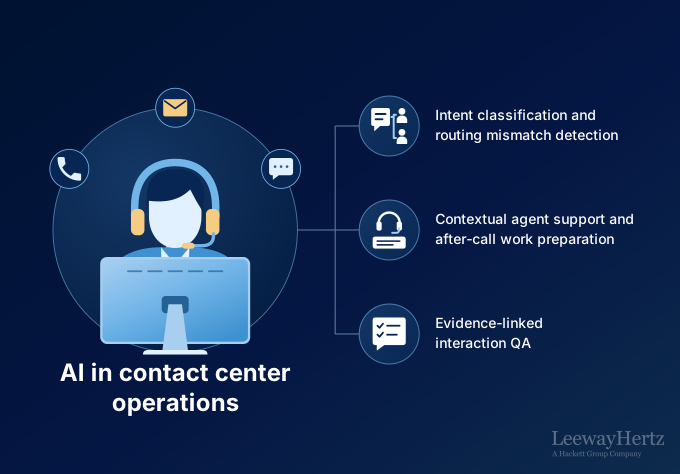
AI in Contact Center Operations: Use Cases & Agentic Workflows
Explore how AI supports contact center operations across routing, workforce management, quality assurance, coaching, compliance, escalation, and performance governance.
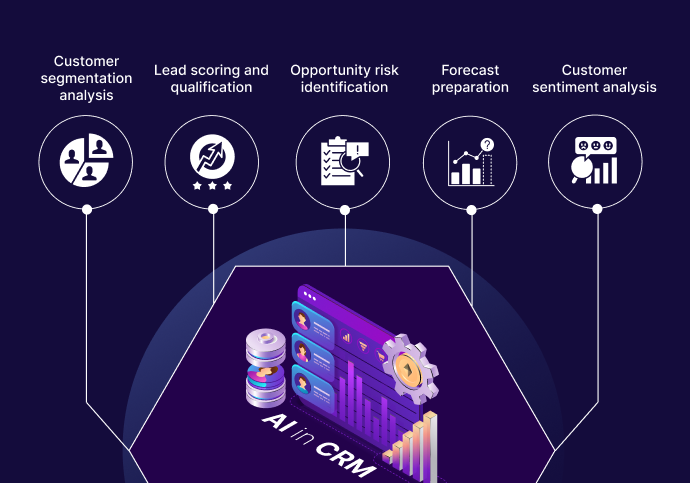
AI in Customer Relationship Management: Processes, Use Cases, and Enterprise Operating Model
AI opportunities in CRM become clearer when the operating model is decomposed across functions, processes, and sub-processes.

Agentic AI in customer service: Integration approaches, implementation frameworks and measurable business impact
Agentic AI transforms customer service by enabling autonomous agents to handle specific operational functions and coordinate to deliver seamless customer experiences

Customer service automation: Enhancing efficiency and customer satisfaction
Customer service automation transforms how businesses handle customer interactions by leveraging advanced technologies such as AI-driven chatbots, machine learning, and integrated software systems.

Adopting AI for customer success: Shaping a new era of user assistance
Customer success is a strategic approach where businesses proactively guide customers through a product journey to ensure they achieve their desired outcomes, thereby enhancing customer satisfaction, loyalty, and advocacy.

Generative AI in travel: Navigating the future of tailored tourism
Generative AI allows travel companies to provide real-time updates and personalized recommendations to travelers, guiding them through the complex world of travel information.

AI in fleet management: Use cases, benefits, architecture, technologies and solution
AI-driven fleet management systems use real-time data on traffic and road conditions to calculate the most efficient vehicle routes.

Conversational AI: Use cases, types and solution
Conversational AI is a subset of artificial intelligence that enables human-like interactions between computers and humans using natural language.

AI in LTV model: Applications and ML techniques
AI and ML have reshaped the way businesses estimate and leverage LTV, offering unprecedented accuracy, insights, and personalized strategies.