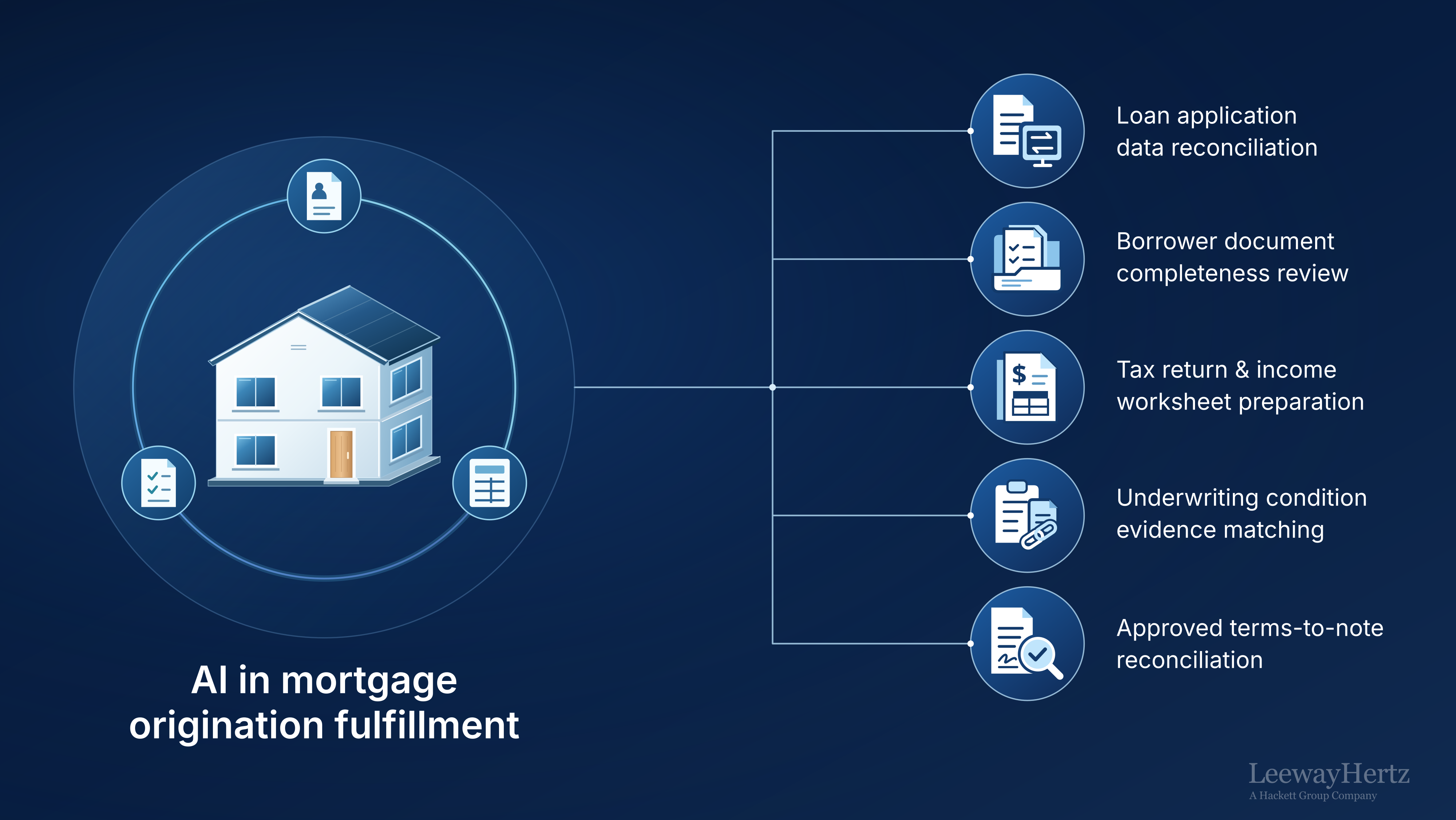
Mortgage origination fulfillment is the coordinated operational work required to move a residential mortgage application through processing, verification, underwriting support, closing preparation, funding and post-closing file completion. It connects borrower information, credit and income evidence, property valuation, title and insurance requirements, automated underwriting findings, disclosures, closing conditions and investor documentation requirements.
A single mortgage file can contain the Uniform Residential Loan Application (URLA/Form 1003), pay statements, W-2s, tax returns, bank statements, credit reports, verification of employment (VOE), verification of assets (VOA), automated underwriting system (AUS) findings, appraisal reports, title commitments, insurance evidence, loan estimates, closing disclosures and executed closing documents. These records are maintained across the loan origination system (LOS), borrower point-of-sale (POS) platform, document repository, verification services, underwriting systems, pricing and disclosure platforms, closing tools and post-closing applications.
The operational challenge in mortgage origination fulfillment is maintaining consistency as loan information changes. Updated income calculations can affect debt-to-income ratios (DTI) and underwriting conditions, revised property valuations can alter loan-to-value ratios (LTV) and collateral eligibility, and changes in pricing or settlement charges can require disclosure and closing-document updates. Each change must be reconciled with the supporting evidence and communicated to the appropriate teams.
AI helps manage these dependencies by extracting information from borrower documents, reconciling loan data, retrieving applicable underwriting guidelines, identifying discrepancies, and preparing evidence for review. The objective is to improve evidence preparation, exception detection and workflow coordination without transferring decision-making authority. Underwriters retain responsibility for credit and eligibility decisions, compliance specialists oversee regulatory requirements, and authorized closing and funding personnel control closing readiness and disbursement.
The practical value of AI emerges at the sub-process level, where the source documents, governing rules, calculations, exceptions, reviewers and downstream handoffs are clearly defined.
This article maps AI opportunities across the mortgage origination fulfillment operating model, covering functions, processes, sub-processes, artifacts, controls, accountable roles and agentic workflows. It also examines high-value use cases, prioritization, governance and how ZBrain supports AI implementation from opportunity analysis through design, solution development and governed production operations.
- How AI is transforming mortgage origination fulfillment operations
- Why AI use cases in mortgage origination fulfillment must be mapped at the sub-process level
- AI opportunities across mortgage origination fulfillment functions
- High-value AI use cases in mortgage origination fulfillment
- How agentic AI works in mortgage origination fulfillment workflows
- How to prioritize AI use cases in mortgage origination fulfillment
- Governance, risk, and responsible AI in mortgage origination fulfillment
- How ZBrain operationalizes AI use cases in mortgage origination fulfillment
- Future of AI in mortgage origination fulfillment
How AI is transforming mortgage origination fulfillment operations
AI in mortgage lending supports evidence preparation and workflow coordination across mortgage origination fulfillment activities. The objective is not to replace mortgage underwriting or established automation infrastructure. It is to reduce the manual effort required to establish that the information used at one stage remains consistent with the evidence and decisions recorded at another.
Consider a conventional purchase loan involving a borrower who recently changed employers. The URLA lists current base salary and bonus income. The pay statements show year-to-date compensation, W-2s reflect income from a previous employer, and a third-party employment verification report confirms the new employment arrangement. The processor must obtain and organize acceptable documentation, while the underwriter must determine which income can be used under the applicable underwriting requirements.
AI can extract pay frequency, base compensation, bonus history, employment dates and year-to-date earnings. It can compare those fields with the URLA, LOS income record and verification report, calculate candidate income figures using approved methods, and identify inconsistencies or missing support.
The mortgage underwriter still determines qualifying income, resolves the treatment of variable earnings and identifies any additional documentation or AUS resubmission needed. AI does not convert document extraction into an underwriting decision.
Understanding where AI can support mortgage fulfillment starts with recognizing the different types of work involved across the loan lifecycle.
Document-heavy work: URLA records, pay statements, tax returns, bank statements, credit reports, appraisal reports, title commitments, insurance declarations, AUS findings, closing disclosures and executed loan documents require extraction, classification, completeness review and comparison.
Calculation-heavy work: Qualifying income, DTI, LTV, combined loan-to-value ratio (CLTV), reserves, funds to close, escrow estimates, mortgage insurance inputs and applicable fee-tolerance calculations require verified inputs and controlled formulas.
Exception-heavy work: Missing documents, inconsistent employment dates, unexplained deposits, omitted liabilities, stale verifications, collateral discrepancies, open underwriting conditions, title requirements, disclosure differences and funding-document defects require investigation.
Knowledge-heavy work: Applicable underwriting and investor requirements, government-backed loan program guidelines, Regulation Z, TRID requirements, lender overlays and investor eligibility matrices must be applied in the correct loan context.
Workflow-heavy work: Application intake, document collection, verification ordering, underwriting submission, condition clearing, appraisal and title coordination, closing preparation, funding and post-closing review require information to move across teams and systems with clear ownership.
AI is most effective when these activities remain connected to deterministic calculations, established verification services, approved rule engines and authoritative systems of record. It can extract, classify, calculate through controlled tools, compare, draft and route. It should not independently approve credit, waive a condition, accept an appraisal, determine regulatory disclosure compliance, authorize closing, release funds or certify investor delivery readiness.
Why AI use cases in mortgage origination fulfillment must be mapped at the sub-process level
While terms such as “AI mortgage underwriting,” “automated loan processing,” and “AI-powered mortgage closing” describe broad areas of application, translating them into implementable AI solutions requires a more granular understanding of the underlying processes, operational dependencies, data requirements, and decision-making responsibilities.
For example, income verification may involve W-2 and pay statement extraction, variable-income averaging, tax-return analysis, self-employment cash-flow calculation, employment continuity checks, verification-report reconciliation and qualifying-income comparison with the LOS. Each activity involves distinct documentation requirements, calculation methods, validation criteria, and levels of human judgment, making it important to identify where AI can provide meaningful support.
A more structured approach is to map AI opportunities to specific functions, processes, and sub-processes within the mortgage origination fulfillment operating model:
Function: A major operational domain, such as loan processing, income verification, underwriting condition management, collateral review, closing or funding.
Process: A defined workflow within that domain, such as pay statement reconciliation, AUS findings review, title exception tracking, fee comparison or closing-document validation.
Sub-process: The specific activity where a source artifact is extracted, calculated, compared, validated, drafted, routed or recorded, such as reconciling year-to-date earnings or checking whether an updated appraisal requires underwriting revalidation.
AI-enabled opportunity: A specific AI capability applied to the sub-process while preserving the governing rule, source evidence, reviewer, output and authorized action boundary.
Sub-process mapping also helps account for differences among mortgage loan programs. Conventional conforming loans and government-backed lending programs have distinct underwriting, documentation, and eligibility requirements. Jumbo and non-QM transactions may follow investor-specific qualification and documentation standards. Consequently, an AI use case designed for one borrower segment or loan program may not be directly applicable to another.
To account for these variations, each AI use case should clearly define its triggering event, source artifacts, applicable loan program and requirements, system of record, policy or rule version, calculation logic, exception criteria, accountable reviewer, expected output, and evidence-retention requirements.
Build governed AI workflows for mortgage origination fulfillment
Streamline loan processing, verification, underwriting support, closing and post-closing operations while maintaining human oversight of critical decisions.
AI opportunities across mortgage origination fulfillment functions
The mortgage origination fulfillment operating model encompasses the key activities involved in advancing a loan from application intake and processing through verification, underwriting support, closing, funding, and post-closing quality and delivery readiness.
It is organized into four connected lifecycle stages:
- Application intake and loan processing
- Verification, underwriting and collateral fulfillment
- Closing, funding and settlement
- Post-closing quality and delivery readiness
The functions below identify teams, artifacts, systems, controls, accountable roles, AI-enabled opportunities, human authority boundaries, high-value activities and agentic workflow patterns.
A. Application intake and loan processing
Function 1: Mortgage application intake and disclosure-trigger management
Mortgage application intake and disclosure-trigger management converts submitted borrower and transaction information into a structured loan record while identifying the regulatory and operational requirements that begin when an application is received.
This function captures the URLA, borrower and property attributes, requested loan details and initial supporting records. It also distinguishes the lender’s internal documentation checklist from the statutory application trigger for covered mortgage disclosures.
Teams involved: Mortgage loan officers (MLOs), loan processors, processing assistants, disclosure specialists, mortgage operations managers and lending compliance personnel.
Key artifacts: URLA/Form 1003, initial application record, borrower authorizations, purchase contract where available, preliminary credit and income records, application timestamp, loan estimate and disclosure-delivery evidence.
Systems involved: POS platform, LOS, document management system, credit-reporting interfaces, disclosure engine, e-signature platform and workflow management tools.
Regulatory and control considerations: ECOA and Regulation B, Fair Credit Reporting Act (FCRA), Regulation Z, TRID application and disclosure timing requirements, applicable consumer privacy and information-security requirements, and internal record-retention controls. For covered transactions, receipt of the six defined application elements triggers the loan estimate obligation even if the lender has not received the documents it normally requests for underwriting.
Accountable roles: Loan processor, loan officer, disclosure specialist, processing manager and lending compliance officer.
What AI helps with: Document intelligence extracts URLA and supporting-record data. Entity resolution identifies borrower and property inconsistencies. Classification organizes received documents. Rule-based monitoring evaluates application and disclosure milestones. Natural-language generation prepares missing-information requests without confusing processing completeness with disclosure requirements.
What humans continue to own: Processors validate file information and request missing documents. Disclosure specialists and compliance personnel confirm applicable legal timing and disclosure requirements. Credit decisions remain with authorized lending roles.
| Process | Sub-process | Key AI-enabled opportunities |
|---|---|---|
| Application capture | URLA-to-LOS field reconciliation | Document intelligence compares borrower, employment, income, loan purpose, occupancy, property and requested-loan fields with the LOS record. |
| Document intake | Initial document classification and indexing | Classification organizes pay statements, W-2s, tax returns, bank statements, purchase contracts and other submitted documents by borrower and document type. |
| Application data validation | Borrower and property data reconciliation | Entity resolution identifies discrepancies in borrower names, addresses, identifiers, and property information across application records and supporting documents. |
| Disclosure-trigger management | Six-element application completeness assessment | Rule-based monitoring identifies when the six regulatory application elements have been submitted and prepares timing evidence for disclosure-team review. |
| Application completeness and file setup | Loan-specific document checklist preparation | Rule evaluation identifies additional documents needed for processing based on loan program and borrower characteristics without delaying required initial disclosures. |
| Borrower follow-up | Initial missing-information request drafting | Natural-language generation prepares targeted requests for missing processing or underwriting information using approved borrower communication templates. |
Highest-value opportunities: URLA-to-LOS reconciliation reduces errors that otherwise propagate through verification, underwriting and closing. Accurate application milestone capture is especially important because a processing checklist cannot override the disclosure timing rules.
Example agentic workflow: Application intake and disclosure readiness
- Trigger: A borrower submits application information through the POS or another authorized channel.
- The agent structures the received URLA data, identifies the six application elements, timestamps the relevant submission event and compares the information with the LOS.
- It classifies any supporting documents already received and prepares separate disclosure and processing readiness views.
- Missing verification documents appear in the processing view, while the disclosure view identifies the application trigger and applicable timing requirements.
- Human checkpoint: The disclosure specialist validates the timing requirements, and the processor reviews initial information and document requests.
- The confirmed application record, disclosure status, document inventory and reviewer actions remain traceable in their authoritative systems.
Function 2: Loan processing and fulfillment pipeline coordination
Loan processing and fulfillment pipeline coordination manages document collection, verification requests, third-party dependencies and loan milestone readiness throughout the active fulfillment process.
A processor must keep the loan file current while borrower submissions, employment and asset verification, appraisal orders, title work, underwriting decisions and closing requirements arrive at different times. The operational problem is not only collecting documents; it is understanding which unresolved item prevents the loan from advancing and which team is responsible for the next action.
Teams involved: Loan processors, processing assistants, fulfillment managers, loan officers, verification specialists, appraisal and title coordinators and underwriting support personnel.
Key artifacts: Processing checklist, document inventory, outstanding-item tracker, borrower follow-up correspondence, verification orders, third-party status records, LOS milestone history and underwriting submission checklist.
Systems involved: LOS, borrower portal, document repository, vendor management platform, third-party verification services, and pipeline reporting tools.
Regulatory and control considerations: Borrower data protection, document-age requirements, applicable verification consent requirements, internal processing controls, disclosure milestone dependencies and documented escalation procedures.
Accountable roles: Loan processor, senior processor, processing manager and fulfillment operations manager.
What AI helps with: Document classification and intelligent document processing (IDP) organize borrower submissions, extract relevant attributes, and support completeness and document-validity checks. Information extraction and text classification help identify and categorize processing exceptions, while anomaly detection flags unusual or inconsistent third-party verification responses.
What humans continue to own: Processors confirm documentation status and communicate with borrowers and third parties. Fulfillment managers resolve escalations. AI prepares and prioritizes work but does not waive documentation or underwriting conditions.
| Process | Sub-process | Key AI-enabled opportunities |
|---|---|---|
| Loan document collection | Outstanding document identification and completeness verification | Document classification and information extraction categorize received borrower documents, identify relevant document attributes, and compare the extracted information against the applicable processing and underwriting documentation checklist to flag missing or incomplete submissions. |
| Loan document validation | Document currency and validity verification | Intelligent document processing (IDP) and rule-based validation extract document dates, reporting periods, and relevant attributes to flag documents that may be stale, expired or otherwise require validity review under applicable loan program requirements. |
| Third-party verification coordination | Verification order status tracking and exception identification | Information extraction and anomaly detection analyzes available order statuses, vendor responses, and exception records to identify delayed, incomplete, or failed employment, asset, appraisal, title, and flood-related verification requests. |
| Loan pipeline monitoring | Loan milestone dependency and delay analysis | Predictive analytics and dependency analysis use historical processing patterns and current loan-level information to identify potential delays associated with outstanding documents, underwriting conditions, third-party responses, and disclosure milestones. |
| Processing exception resolution | Processing exception identification and routing | Text classification and information extraction categorize documented exceptions by issue type and identify the appropriate responsible team using defined routing rules, supporting timely investigation and resolution. |
| Borrower documentation follow-up | Consolidated document request generation | Natural language generation (NLG) drafts borrower-specific follow-up requests based on verified outstanding documentation requirements and approved communication templates, helping reduce repetitive or conflicting requests. |
Highest-value opportunities: Outstanding document identification and completeness verification help processors identify missing or incomplete submissions before underwriting review. Loan milestone dependency and delay analysis supports earlier identification of processing bottlenecks, while consolidated document request generation reduces repetitive borrower follow-ups and the risk of conflicting documentation requests.
Example agentic workflow: Loan processing exception coordination
- Trigger: A loan enters active processing with outstanding borrower documentation and third-party verification orders.
- The agent retrieves the document inventory, order statuses, loan milestones, current checklist and borrower communication history.
- It identifies missing or stale evidence, overdue requests and dependencies affecting underwriting submission or closing.
- The agent prepares an action queue organized by item, responsible role, outstanding evidence and target date.
- Human checkpoint: The processor verifies the findings and initiates appropriate requests. The processing manager reviews escalated delays.
- Confirmed status changes and communication records are retained in the LOS and associated workflow systems.
B. Verification, underwriting and collateral fulfillment
Function 3: Income and employment verification
Income and employment verification prepares and reconciles the evidence used to assess a borrower’s qualifying income and employment status.
The work differs across salaried, hourly, variable-income and self-employed borrowers. A W-2 wage earner may require pay statement, W-2 and employment verification review. A self-employed borrower may require personal and business tax returns, Schedule C, Schedule E, K-1s, business income schedules and current financial information. Some income or employment components may qualify for automated validation through an approved underwriting and verification process, subject to applicable eligibility, findings and documentation requirements.
Teams involved: Loan processors, income analysts, mortgage underwriters, verification specialists, underwriting managers and quality-control reviewers.
Key artifacts: Pay statements, W-2s, VOE and verification of income (VOI) reports, tax returns, K-1s, Schedule C, Schedule E, business financial statements, income calculation worksheets, verification report identifiers and AUS findings.
Systems involved: LOS, income calculation tools, employment and payroll verification services, tax transcript interfaces, document repository and underwriting workbench.
Regulatory and control considerations: Applicable ATR/QM requirements, agency and investor income documentation rules, lender overlays, verification-report eligibility, documentation-age requirements and permitted employment verification methods. Verification-of-current-employment requirements, timing rules and acceptable alternatives depend on the applicable loan program, investor guidance and transaction facts.
Accountable roles: Mortgage underwriter, income analyst, senior underwriter and underwriting manager.
What AI helps with: Intelligent document processing (IDP) and information extraction structure wage, employment and business-income information from supporting documents. Entity resolution and cross-document reconciliation identify discrepancies among borrower-reported employment details, income records and third-party verification reports. Machine learning-based trend analysis supports the identification of fluctuations in variable earnings, while approved calculation logic prepares income averaging and self-employment worksheets. Retrieval-augmented generation (RAG) retrieves relevant underwriting guidance and documentation requirements for underwriter review.
What humans continue to own: Underwriters determine eligible qualifying income, employment stability, acceptable documentation and the need for additional evidence. AI does not independently select judgmental income adjustments or certify a validated component.
| Process | Sub-process | Key AI-enabled opportunities |
|---|---|---|
| Wage income verification | Pay statement-to-W-2 reconciliation |
|
| Employment history verification | Employment history and compensation reconciliation | Entity resolution and information extraction match employer identities, employment dates and compensation details across the URLA, employment records and third-party verification reports to identify inconsistencies requiring review. |
| Variable income assessment | Bonus, overtime and commission income trend analysis | Machine learning-based trend analysis and information extraction structure historical bonus, overtime and commission earnings, identify material fluctuations and support income averaging calculations using approved methodologies. |
| Self-employed income analysis | Tax return and business income worksheet preparation | IDP and information extraction identify relevant tax return schedules, business income, expenses and potential adjustment items, organizing them into source-linked worksheets for calculation and underwriting review. |
| Qualifying income reconciliation | Qualifying income-to-LOS and AUS reconciliation | Information extraction and anomaly detection identify discrepancies between verified income evidence, approved qualifying-income calculations, LOS records and AUS submissions, supporting investigation of inconsistent underwriting inputs. |
| Current employment verification | Verification-of-current-employment requirements checking | Information extraction and RAG identify verification dates and relevant employment evidence while retrieving applicable timing, documentation and permitted-alternative requirements for underwriter confirmation. |
Highest-value opportunities: Tax return and business income worksheet preparation reduces repeated extraction and calculation effort, particularly for self-employed borrowers. Qualifying income-to-LOS and AUS reconciliation helps identify discrepancies that may affect DTI, underwriting findings and loan eligibility. Verification-of-current-employment requirements checking supports timely identification of outstanding employment evidence before applicable underwriting or closing milestones.
Example agentic workflow: Self-employed income and employment evidence review
- Trigger: A loan file receives personal and business tax returns, K-1s and supporting self-employment documentation.
- The agent classifies the source records, identifies the relevant borrower and business entities, and extracts the income fields needed by the lender’s approved calculation method.
- It prepares a calculation worksheet, compares periods and identifies missing schedules, contradictory information or treatment requiring underwriting judgment.
- It also records the relevant current-employment or business-existence evidence requirements and their timing.
- Human checkpoint: The mortgage underwriter reviews allowable adjustments, qualifying income and evidence sufficiency.
- Approved figures, source documents, calculation methodology, reviewer changes and final underwriting treatment remain in the loan file.
Function 4: Asset, liability and credit verification
Asset, liability and credit verification prepares the evidence needed to assess borrower funds, debt obligations, reserves and qualifying ratios.
The function reconciles account information, source-of-funds evidence, credit liabilities and funds-to-close requirements. It also distinguishes documented assets from assets that meet the applicable program’s requirements for use in the transaction.
Teams involved: Loan processors, asset verification specialists, mortgage underwriters, credit specialists and underwriting quality-control personnel.
Key artifacts: Bank statements, VOA reports, brokerage records, gift letters, earnest money evidence, credit reports, credit supplements, payoff statements, liability schedules, reserve worksheets and cash-to-close calculations.
Systems involved: LOS, asset verification services, credit-reporting services, AUS, financial-document repository, calculation tools and settlement-data interfaces.
Regulatory and control considerations: Agency and investor asset documentation rules, source-of-funds and reserve requirements, FCRA, ATR/QM requirements where applicable, identity and fraud controls, and authorized consumer-data access.
Accountable roles: Mortgage underwriter, loan processor, asset specialist, credit specialist and underwriting manager.
What AI helps with: IDP and information extraction structure account balances, ownership details, transaction records and credit liabilities from financial documents. Entity resolution and anomaly detection help identify discrepancies across account statements, verification reports, credit records and borrower-reported information. Classification supports the identification of deposits requiring source-of-funds review.
What humans continue to own: Underwriters determine asset eligibility, acceptable sourcing and liabilities to include in qualification. AI identifies exceptions but does not make source-of-funds or credit eligibility judgments.
| Process | Sub-process | Key AI-enabled opportunities |
|---|---|---|
| Asset verification and reconciliation | Bank statement-to-asset verification report reconciliation | IDP, information extraction and entity resolution identify and match account ownership, balances, account identifiers and reporting periods across bank statements and verification reports, supporting discrepancy identification and reconciliation. |
| Source-of-funds verification | Large-deposit identification and source-of-funds review | Classification and anomaly detection analyze bank transaction descriptions, amounts and patterns to flag deposits meeting applicable review criteria. |
| Funds-to-close and reserves assessment | Eligible funds and reserve calculation verification | Information extraction and AI-assisted reconciliation organize documented balances, earnest money, gift funds, borrower contributions and other relevant amounts for comparison with calculated funds-to-close and reserve requirements. |
| Credit liability verification | Credit report-to-URLA liability reconciliation | Information extraction and entity resolution match reported credit obligations against borrower-declared liabilities, identifying potentially omitted, duplicated or inconsistent debts requiring underwriting review. |
| DTI calculation review | Monthly debt obligation reconciliation | Information extraction and anomaly detection identify discrepancies among credit obligations, documented monthly payments and proposed housing expenses, supporting verification of DTI calculations performed using approved methods. |
| Gift fund verification | Gift documentation and transfer evidence reconciliation | Document classification, information extraction and entity resolution compare gift letters, donor information, account records and transfer evidence to identify missing documentation, party mismatches or unsupported transfers for reviewer assessment. |
Highest-value opportunities: Credit report-to-URLA liability reconciliation helps identify omitted or inconsistent obligations that may materially affect borrower qualification. Large-deposit identification and source-of-funds review supports more efficient investigation of transactions requiring additional documentation. Eligible funds and reserve calculation verification also helps identify discrepancies between documented assets and the amounts used to establish funds-to-close and reserve sufficiency, while preserving underwriting authority over asset eligibility.
Example agentic workflow: Asset and liability reconciliation
- Trigger: Updated account statements, an asset verification report and credit supplement become available.
- The agent compares account balances, identifies potential duplicate transfers and flags deposits meeting the applicable review criteria.
- It reconciles liabilities against the URLA and LOS and prepares a funds-to-close and DTI comparison.
- The agent produces an exception packet showing relevant source transactions, differences and documentation gaps.
- Human checkpoint: The processor collects missing evidence, and the underwriter determines eligible funds, reserve treatment and qualifying debts.
- Confirmed data and approved calculations are recorded through existing LOS controls.
Function 5: AUS findings, underwriting support and condition management
AUS findings, underwriting support and condition management connect loan data and documentation with the applicable automated underwriting assessment and human underwriting process.
The function handles findings interpretation, input reconciliation, supporting evidence, underwriting condition creation, condition tracking and resubmission readiness. It must distinguish an AUS recommendation from the lender’s final underwriting and credit responsibilities.
Teams involved: Mortgage underwriters, underwriting assistants, loan processors, underwriting managers, credit risk teams and compliance specialists.
Key artifacts: AUS findings, URLA, verified income and asset records, DTI and LTV calculations, underwriting approval, condition register, condition evidence, exception notes and resubmission history.
Systems involved: LOS, automated underwriting system, underwriting workbench, rules engine, document repository and condition management platform.
Regulatory and control considerations: Applicable agency eligibility and documentation requirements, lender overlays, ATR/QM, ECOA and Regulation B, AUS data integrity, delegated underwriting authority and fair lending controls.
Accountable roles: Mortgage underwriter, senior underwriter, underwriting manager and designated credit or exception approver.
What AI helps with: IDP and information extraction structure AUS findings, documentation messages and underwriting conditions. Entity resolution aligns related borrower, loan and document records across source evidence, LOS records and AUS inputs, while anomaly detection flags inconsistencies among them. Text classification organizes underwriting conditions by requirement, responsibility and timing, while semantic search and RAG help associate submitted documents with relevant conditions and retrieve applicable underwriting guidance
What humans continue to own: Authorized underwriters determine eligibility, underwriting approval, condition satisfaction and guideline exception treatment. AI does not replace the established automated underwriting or credit approval process, approve or deny credit, or silently clear conditions.
| Process | Sub-process | Key AI-enabled opportunities |
|---|---|---|
| AUS findings review | AUS findings and documentation requirement extraction | IDP and information extraction structure AUS recommendations, findings messages, documentation requirements and relevant verification references into review-ready records, allowing underwriters to identify outstanding evidence and assess the findings. |
| Underwriting data reconciliation | LOS-to-AUS submission reconciliation | Entity resolution and anomaly detection help identify inconsistencies between borrower, income, asset, liability, property and loan attributes across supporting evidence, LOS records and AUS submissions, preparing discrepancies for underwriting review. |
| Underwriting condition management | Underwriting condition classification and assignment | Text classification and information extraction categorize underwriting conditions by documentation requirement, responsible role, timing and review status, supporting condition assignment and tracking through established workflow rules. |
| Underwriting condition verification | Condition-to-document evidence matching | Semantic search and information extraction identify documents potentially relevant to specific underwriting conditions, compare extracted evidence with the stated requirements and flag missing or contradictory information for authorized reviewer assessment. |
| Underwriting change assessment | Underwriting input change-impact analysis | Entity resolution, information extraction and anomaly detection identify changes in income, assets, liabilities, property information or loan terms across updated loan records and documents and flag potentially affected calculations, underwriting conditions or AUS inputs for further review. |
| Underwriting exception review | Underwriting guideline exception evidence preparation | RAG and information extraction retrieve relevant underwriting guidelines and lender overlays, associate them with documented loan exceptions and prepare source-linked evidence for authorized exception assessment. |
Highest-value opportunities: LOS-to-AUS submission reconciliation helps identify discrepancies between supporting documentation and the information used in automated underwriting assessments. Condition-to-document evidence matching reduces manual document searches and repeated information requests by organizing potential supporting evidence for underwriter review. Underwriting input change-impact analysis also helps identify changes that may require recalculation, additional documentation or AUS resubmission, while preserving authorized underwriting decisions and condition-clearance controls.
Example agentic workflow: Conditional approval evidence preparation
- Trigger: An underwriter issues conditional approval with income, asset and property conditions.
- The agent extracts each condition, associates it with its evidence requirements and tracks relevant incoming records.
- It compares new evidence with the LOS and identifies changes that affect approved calculations or AUS inputs.
- It prepares a condition review packet showing candidate support, unresolved items, source conflicts and possible resubmission dependencies.
- Human checkpoint: The underwriter reviews the evidence and records the actual condition disposition. The processor coordinates borrower and vendor follow-up.
- The condition history, related findings version, reviewer action and source evidence remain attached to the loan.
Function 6: Property valuation and collateral review
Property valuation and collateral review prepares the appraisal, valuation and property information necessary to establish collateral eligibility.
The required process may involve a traditional appraisal, an agency-permitted valuation alternative, property data collection or specialized property review. The applicable pathway depends on the loan program, AUS findings, property characteristics and current investor requirements.
Teams involved: Appraisal management personnel, collateral analysts, appraisal reviewers, mortgage underwriters, property data specialists and compliance personnel.
Key artifacts: Appraisal report, valuation findings, property data collection record, purchase contract, appraisal review notes, condominium project documentation and collateral conditions.
Systems involved: Appraisal management tools, LOS, collateral assessment systems and document repository.
Regulatory and control considerations: Appraisal independence, applicable appraisal regulations and professional standards, investor valuation requirements, appraisal bias risk, property eligibility rules and collateral change controls.
Accountable roles: Appraisal reviewer, collateral underwriter, mortgage underwriter, appraisal manager and compliance officer.
What AI helps with: IDP and information extraction structure appraisal details, property characteristics and supporting valuation records. Entity resolution and anomaly detection identify discrepancies between appraisal reports, purchase contracts and recorded loan information. Semantic search retrieves relevant appraisal evidence, prior records or applicable guidance to support review of potential valuation inconsistencies. Document classification and information extraction support repair-condition tracking and condominium project documentation review.
What humans continue to own: Qualified appraisers establish appraisal opinions. Authorized collateral and underwriting personnel assess acceptability, valuation alternatives and collateral exceptions. AI does not make an independent appraisal determination.
| Process | Sub-process | Key AI-enabled opportunities |
|---|---|---|
| Valuation requirements assessment | Appraisal and alternative-valuation eligibility review | Information extraction and RAG organize relevant loan, property and AUS attributes and retrieve applicable valuation requirements to support reviewer assessment of the permitted valuation pathway. |
| Appraisal document validation | Appraisal report completeness verification | IDP and document classification identify required appraisal sections, exhibits, dates, signatures and property details, flagging missing or incomplete information against the applicable documentation checklist. |
| Property data reconciliation | Appraisal-to-LOS property attribute reconciliation | Information extraction and entity resolution compare property addresses, unit counts, property types, occupancy-related information and physical characteristics across appraisal reports, purchase contracts and loan records to identify discrepancies. |
| Appraisal review and clarification | Appraisal discrepancy identification and clarification preparation | Information extraction, semantic search and anomaly detection identify inconsistencies in property descriptions, comparable-sale information, reported adjustments and supporting explanations, preparing source-linked questions for appraisal reviewer assessment without independently determining appraisal acceptability. |
| Collateral condition management | Repair and completion evidence verification | Document classification and information extraction associate appraisal-related repair or completion conditions with inspection reports, completion certifications and other supporting evidence, flagging incomplete or inconsistent records for reviewer confirmation. |
| Condominium and project eligibility review | Condominium project documentation completeness verification | Document classification, information extraction and RAG organize project questionnaires, insurance evidence, budget records and other required documents, retrieve applicable project documentation requirements and identify gaps for specialist review. |
Highest-value opportunities: Appraisal report completeness verification and appraisal-to-LOS property attribute reconciliation help identify missing documentation and inconsistent property information before collateral approval or closing. Appraisal discrepancy identification and clarification preparation support more efficient specialist review by organizing potentially conflicting report details and supporting evidence. Repair and completion evidence verification also helps track outstanding collateral conditions, while appraisal acceptability and property eligibility determinations remain with authorized reviewers.
Example agentic workflow: Collateral discrepancy review
- Trigger: A completed appraisal arrives with an appraisal review flag or changed property information.
- The agent extracts the relevant property and valuation fields and compares them with the LOS, purchase contract and prior evidence.
- It identifies missing information and inconsistencies requiring clarification or review.
- The agent prepares a collateral packet with source references, affected loan attributes and open questions.
- Human checkpoint: The appraisal reviewer and underwriter evaluate the findings and determine the appropriate disposition.
- The reviewed report, clarifications, approvals and changes remain traceable.
Accelerate AI Solutions Development
Build fully functional solutions from your high-value use cases, based on specific operational needs and enterprise context.
Function 6: Reinsurance settlements, cash application and collections
Reinsurance settlement administration manages the transition from approved receivable and payable balances to authorized settlement and cash records. It includes periodic account settlements, cash calls, remittance matching, collection follow-up and dispute resolution.
A booked recoverable, an agreed settlement balance and actual cash received are distinct financial positions and should be maintained separately.
Teams involved: Reinsurance technical accounting, collections, ceded operations, treasury, broker accounting and finance teams.
What AI helps with: Entity resolution helps match incoming remittances with outstanding reinsurance balances, while multi-source reconciliation compares settlement statements, receivables and payment records. Anomaly detection identifies unmatched receipts, duplicate payments and unexplained settlement differences. Classification organizes aged recoverables by aging period, outstanding amount and collection status, while pattern analysis identifies recurring payment delays. Retrieval-grounded analysis gathers approved balances, settlement records and relevant correspondence. Natural-language generation uses this information to draft collection correspondence for review and authorization.
What humans continue to own: Treasury and accounting teams authorize payments, netting, write-offs and cash application. Reinsurance managers approve collection and dispute strategies. AI prepares settlement evidence, matches transactions and drafts correspondence but does not authorize cash movement or compromise balances.
| Process | Sub-process | AI-enabled opportunities |
|---|---|---|
| Settlement preparation | Periodic settlement statement reconciliation | Multi-source reconciliation compares approved statements of account with receivable, payable and settlement records. |
| Net settlement eligibility review |
|
|
| Cash-call administration | Cash-call eligibility evidence preparation |
|
| Cash-call request package preparation |
|
|
| Cash application | Remittance-to-receivable matching | Entity resolution matches incoming bank and broker remittance information with outstanding reinsurance balances using contract, currency, statement and payment references. |
| Unapplied cash and settlement difference investigation |
|
|
| Recoverable collections | Recoverable aging and collection prioritization |
|
| Collection correspondence preparation |
|
Key artifacts and systems: Settlement statements, approved cash calls, remittance advices, bank records, aged receivables, correspondence, reinsurance subledger and treasury systems.
Regulatory and control considerations: Settlement authorization, contractual netting rights, segregation of duties, bank detail security, payment control and financial-record retention.
Accountable roles: Reinsurance accounting manager, collections analyst, ceded reinsurance manager and treasury approver.
Highest-value opportunities: Remittance-to-receivable matching, unapplied cash and settlement difference investigation, and recoverable aging and collection prioritization can improve the efficiency of recurring cash and collection controls.
Example agentic workflow
- Settlement intake: The agent retrieves a broker remittance or reinsurer payment record together with the relevant outstanding balances.
- Transaction matching: Entity resolution identifies potential matches using counterparty, contract, statement and payment references.
- Difference analysis: Anomaly detection identifies short payments, unmatched receipts or inconsistent amounts.
- Evidence preparation: The agent assembles the supporting statements, transaction records and correspondence for unresolved differences.
- Human review: The reinsurance accounting or collections team confirms cash allocation and determines any required follow-up.
- Controlled completion: Authorized personnel approve the cash application, and unresolved items remain open for collection or reconciliation.
Function 7: Reinsurance collateral and counterparty credit administration
Reinsurance collateral administration maintains evidence of qualifying security and counterparty information relevant to ceded reinsurance balances and applicable credit-for-reinsurance treatment.
Collateral requirements vary according to the cedent’s jurisdiction, reinsurer status and the governing rules. For example, U.S. statutory requirements distinguish authorized, unauthorized, certified and reciprocal-jurisdiction reinsurers. A uniform collateral percentage or treatment should not be assumed across counterparties.
Teams involved: Ceded reinsurance finance, collateral operations, treasury, credit risk, legal, compliance and statutory reporting.
What AI helps with: Document intelligence helps collateral teams extract and compare information from letters of credit, trust agreements and supporting security records. Entity resolution reconciles counterparty identities and collateral references, while anomaly detection identifies approaching expirations, missing documentation and unusual balance movements. Multi-source reconciliation supports the investigation of trust and funds-withheld differences. Data validation prepares the inputs required for approved collateral adequacy and credit-for-reinsurance calculations, with regulatory and contractual determinations remaining with the responsible specialists.
What humans continue to own: Treasury, legal, credit-risk and statutory-reporting specialists determine acceptable collateral, required actions and statutory treatment. Authorized personnel approve substitutions, reductions, releases and account changes. AI monitors and prepares but does not determine legal enforceability or release security.
| Process | Sub-process | AI-enabled opportunities |
|---|---|---|
| Counterparty credit administration | Reinsurer regulatory-status data review |
|
| Counterparty credit administration | Recoverable concentration and counterparty exposure review |
|
| Collateral documentation | Letter-of-credit information extraction | Document intelligence extracts beneficiary, issuing bank, amount, currency, expiration, contract reference and relevant terms from LOC documentation. |
| Letter-of-credit expiry and documentation review |
|
|
| Collateral balance reconciliation | Trust and funds-withheld statement reconciliation |
|
| Collateral adequacy monitoring | Required-versus-eligible collateral comparison |
|
| Collateral exception management | Collateral deficiency investigation |
|
Key artifacts and systems: Letters of credit, trust agreements, trust statements, funds-withheld schedules, counterparty records, recoverable ledgers and collateral-management systems.
Regulatory and control considerations: Applicable credit-for-reinsurance requirements, security eligibility, counterparty status, LOC and trust terms, approval controls and statutory reporting.
Accountable roles: Collateral analyst, ceded reinsurance finance manager, treasury approver, legal counsel and statutory reporting specialist.
Highest-value opportunities: Letter-of-credit expiry and documentation review, trust and funds-withheld statement reconciliation, and required-versus-eligible collateral comparison are defensible opportunities because they rely on documented instruments, identifiable balances and established controls.
Example agentic workflow
- Collateral record intake: The agent retrieves updated collateral documentation and the associated reinsurance balances.
- Document validation: Document intelligence extracts relevant instrument details, and entity resolution checks the contract and counterparty references.
- Financial comparison: Approved calculation services assess collateral adequacy under the applicable contractual or statutory framework, using validated inputs.
- Exception preparation: Anomaly detection identifies expiring instruments, missing evidence and differences requiring investigation.
- Human review: Collateral, treasury, statutory reporting and legal specialists determine the appropriate treatment or remediation.
- Controlled action: Authorized personnel approve any security-related changes, and the supporting documentation is retained.
Function 8: Reinsurance reconciliation, financial close and regulatory reporting
Reinsurance reconciliation and financial close bring together contract-level transactions, technical-account balances, claims recoverables, settlements and applicable financial-reporting requirements.
For U.S. P&C insurers, Schedule F includes information concerning ceded reinsurance and related balances. Schedule S addresses applicable life, accident and health reinsurance reporting. For entities applying IFRS 17, reinsurance contracts held require accounting treatment distinct from the underlying insurance contracts.
Teams involved: Reinsurance accounting, financial reporting, statutory reporting, controllers, actuarial, internal controls and audit support teams.
What AI helps with: Entity resolution matches reinsurance transaction records across the subledger, general ledger, settlement systems and counterparty records. Multi-source reconciliation compares the corresponding financial balances to identify discrepancies. Anomaly detection identifies unexplained financial movements, while classification organizes reconciliation exceptions for investigation. Data validation supports the preparation of reinsurance reporting inputs, including Schedule F evidence and information required by approved IFRS 17 processes. Retrieval-grounded analysis helps assemble the contracts, transactions and approvals needed for close reviews and audit support.
What humans continue to own: Accountants determine treatment and approve journals. Controllers resolve material differences and approve financial reporting. Statutory reporting teams own filing accuracy. AI reconciles, classifies and drafts but does not post entries, certify balances or submit filings.
| Process | Sub-process | AI-enabled opportunities |
|---|---|---|
| Reinsurance ledger reconciliation | Reinsurance subledger-to-GL reconciliation |
|
| Broker and reinsurer balance reconciliation |
|
|
| Recoverable financial close | Recoverable balance roll-forward preparation |
|
| Recoverable aging and balance exception review |
|
|
| Statutory reinsurance reporting | Schedule F supporting-data validation |
|
| Financial reporting support | IFRS 17 reinsurance data preparation | Data validation identifies missing or inconsistent contract details, cash-flow data, contract grouping and classification information required for IFRS 17 measurement and reporting, covering reinsurance contracts held or issued, as applicable. |
| Financial close analysis | Reinsurance account variance explanation |
|
| Audit and control support | Reinsurance audit-evidence assembly |
|
Key artifacts and systems: Reinsurance subledger, general ledger, recoverable roll-forwards, settlement records, statutory reporting schedules, financial statements and audit workpapers.
Regulatory and control considerations: Applicable statutory accounting, Schedule F or Schedule S, IFRS 17 where relevant, financial close controls, reconciliations and audit evidence.
Accountable roles: Reinsurance accounting manager, controller, statutory reporting manager, financial reporting lead and actuarial reviewer.
Highest-value opportunities: Reinsurance subledger-to-GL reconciliation, recoverable balance roll-forward preparation, Schedule F supporting-data validation and reinsurance audit-evidence assembly are valuable because they support recurring close and reporting controls.
Example agentic workflow
- Close initiation: The agent retrieves approved reinsurance subledger, general ledger, and relevant supporting records.
- Balance reconciliation: Entity resolution and reconciliation controls identify corresponding transactions and accounts.
- Exception analysis: Anomaly detection highlights unexplained differences, and classification organizes the exceptions by likely cause.
- Evidence assembly: The agent prepares recoverable roll-forwards, supporting account records and relevant control evidence.
- Human review: Reinsurance accounting and financial reporting specialists investigate exceptions and approve required adjustments.
- Controlled reporting handoff: Approved information proceeds to the established financial and regulatory reporting processes.
Function 9: Reinsurance renewals, run-off and commutation administration
Reinsurance contracts may remain operationally relevant long after the original coverage period. Outstanding claims, recoverables, disputes and collateral arrangements may continue throughout run-off.
Renewals and amendments introduce new contract versions and potential administrative changes. Commutations require a separate process involving agreed discharge of defined obligations, supported by financial, actuarial and legal review.
Teams involved: Treaty administration, reinsurance operations, run-off, reinsurance claims, technical accounting, actuarial, legal and finance teams.
What AI helps with: Document comparison helps reinsurance teams identify changes between expiring and renewal treaty terms or subsequent amendments. Graph analysis supports the identification of contract records and open transactions potentially affected by those changes. During run-off, anomaly detection can highlight unusual claim developments and unresolved financial balances. Multi-source aggregation consolidates historical premium, claim, recoverable and settlement records for commutation analysis, while retrieval-grounded analysis organizes the supporting contractual evidence.
What humans continue to own: Reinsurance, actuarial, legal and finance specialists determine commutation terms, valuation assumptions, legal release, settlement and closure. AI prepares histories and exception reports but does not extinguish obligations or approve commercial settlements.
| Process | Sub-process | AI-enabled opportunities |
|---|---|---|
| Treaty renewal administration | Expiring-to-renewal contract comparison |
|
| Treaty amendment administration | Amendment impact assessment |
|
| Run-off monitoring | Open-claim and recoverable monitoring |
|
| Legacy balance and settlement reconciliation | Multi-source reconciliation compares historical claims, technical accounts, settlements and recoverable records to identify unresolved differences. | |
| Commutation administration | Inception-to-date account assembly |
|
| Commutation evidence and exception preparation |
|
|
| Contract closure | Contract closure completeness review |
|
| Outward retrocession administration | Retrocession contract and recovery dependency review |
|
Key artifacts and systems: Renewal wordings, amendments, legacy claims, account histories, commutation agreements, actuarial valuations, contract repositories and reinsurance administration systems.
Regulatory and control considerations: Version history, contractual obligations, legal discharge, actuarial valuation, financial approval and record retention.
Accountable roles: Reinsurance manager, run-off manager, ceded claims manager, actuary, finance approver and legal counsel.
Highest-value opportunities: Amendment impact assessment, inception-to-date account assembly and commutation evidence and exception preparation are useful because they connect long-running contractual and financial records that may be distributed across systems.
Example agentic workflow
- Review initiation: The agent retrieves a legacy treaty and its associated claims, accounting and settlement records for commutation preparation.
- Historical reconciliation: Multi-source aggregation consolidates inception-to-date financial information, and entity resolution connects records across contract versions and systems.
- Exception analysis: Anomaly detection identifies unexplained financial differences, missing records and unresolved balances.
- Evidence preparation: Retrieval-grounded analysis assembles contractual provisions and supporting documentation into a commutation review package.
- Human review: Reinsurance, actuarial, legal and finance specialists assess the information and determine the proposed commutation terms.
- Controlled completion: Any negotiated settlement, release and subsequent closure proceed only after the required approvals.
Function 10: Reinsurance data quality, controls and operational governance
Reinsurance operational governance maintains the accuracy, traceability and control effectiveness of information used across contract administration, cessions, technical accounting, recoverables, settlements and reporting.
A recorded financial balance should be traceable to the relevant contract, source transaction, calculation, approval and subsequent settlement where applicable.
Teams involved: Reinsurance operations leadership, data stewardship, technical accounting, internal control, IT, information security, compliance and audit teams.
What AI helps with: Anomaly detection identifies incomplete or inconsistent contract and counterparty information. Classification organizes operational exceptions by process and likely cause, while pattern analysis identifies recurring discrepancies that may indicate underlying control or data-quality issues. Graph analysis supports contract-to-transaction traceability across administration systems. Retrieval-grounded analysis prepares supporting records and approval histories for control reviews and audit testing.
What humans continue to own: Process and control owners define control requirements, approve exceptions and access permissions, and determine remediation. Internal audit retains responsibility for its conclusions. AI monitors, detects and assembles but does not waive controls or attest to compliance.
| Process | Sub-process | AI-enabled opportunities |
|---|---|---|
| Reinsurance master-data governance | Contract and counterparty data-quality review |
|
| Reference-data change impact review | Graph analysis identifies linked contracts, transactions and financial records potentially affected by a proposed reference-data change. | |
| Operational exception management | Reinsurance exception classification | Classification groups contract, cession, bordereau, technical-accounting, claims, settlement and collateral exceptions by operational cause and responsible team. |
| Recurring exception and root-cause analysis |
|
|
| Transaction lineage management | Contract-to-transaction traceability | Graph analysis connects treaty terms, underlying policies, cessions, bordereaux, technical accounts, claims, recoverables, settlements and reporting records. |
| Source-evidence completeness review |
|
|
| Operational quality assurance | Risk-based transaction sampling |
|
| Access and control governance | Access-change and segregation-of-duties review | Pattern analysis identifies unusual permission changes or access combinations for control-owner review. |
| Audit governance | Control-evidence and approval-history assembly |
|
Key artifacts and systems: Contract and counterparty master data, exception logs, transaction histories, access records, approval trails, operational control registers and governance platforms.
Regulatory and control considerations: Data integrity, access control, segregation of duties, audit trails, financial controls, security and retention requirements.
Accountable roles: Reinsurance operations director, process control owner, data steward, application owner, compliance lead and internal audit.
Highest-value opportunities: Reinsurance exception classification, recurring exception and root-cause analysis, and contract-to-transaction traceability can strengthen several administration functions simultaneously.
Example agentic workflow
- Exception detection: A scheduled control identifies an unusual reinsurance transaction or inconsistent master-data record.
- Source tracing: Graph analysis connects the affected record with the relevant contracts, transactions and accounting information.
- Cause investigation: Pattern analysis identifies similar exceptions, while retrieval gathers the supporting evidence.
- Exception classification: The workflow categorizes the issue and prepares the records required for the responsible control owner.
- Human review: The control owner determines the cause, required remediation and applicable approvals.
- Controlled resolution: Authorized corrections are completed through existing systems, and the investigation and approval history are retained.
Accelerate AI Solutions Development
Build fully functional solutions from your high-value use cases, based on specific operational needs and enterprise context.
Function 7: Title, insurance and settlement-services coordination
Title, insurance and settlement-services coordination involves obtaining, reviewing and reconciling third-party property and settlement documentation to support mortgage loan closing and the subsequent disbursement of loan proceeds.
The function tracks title commitments, vesting, liens, payoff information, homeowners insurance, flood requirements and unresolved settlement-service conditions. It does not replace the legal or professional responsibilities of title companies, settlement agents, insurers or counsel.
Teams involved: Title coordinators, loan processors, closing specialists, settlement agents, insurance specialists, mortgage underwriters and legal or compliance personnel.
Key artifacts: Title commitment, title requirements and exceptions, lien evidence, payoff statements, insurance declarations, flood determination, flood insurance evidence and settlement instructions.
Systems involved: LOS, title production systems, settlement agent portal, insurance and flood services, document repository and third-party coordination tools.
Regulatory and control considerations: Applicable title and lien laws, investor title insurance requirements, RESPA rules, flood insurance requirements, settlement and closing protection controls, and state-specific documentation requirements.
Accountable roles: Title specialist, closing specialist, insurance reviewer, mortgage underwriter, settlement agent and counsel where appropriate.
What AI helps with: IDP and information extraction structure title commitments, lien information, payoff statements and insurance records. Entity resolution identifies discrepancies in borrower identities, property details and vesting information across loan and title documents. Text classification organizes outstanding title and insurance exceptions, while RAG retrieves applicable documentation requirements for specialist review.
What humans continue to own: Title and legal professionals resolve title sufficiency and lien matters. Insurance and underwriting personnel determine evidence acceptability. Authorized closing personnel decide whether required conditions are resolved.
| Process | Sub-process | Key AI-enabled opportunities |
|---|---|---|
| Title commitment review | Title requirement and exception extraction | IDP and information extraction identify vesting details, legal descriptions, existing liens, encumbrances, title requirements and exceptions from title commitments, organizing the information into structured records for title and closing review. |
| Title vesting reconciliation | Title-to-LOS borrower and property data reconciliation | Entity resolution and information extraction compare borrower identities, vesting details, legal descriptions and property information across title commitments, purchase contracts and loan records, identifying discrepancies for specialist investigation. |
| Mortgage payoff verification | Payoff statement amount and validity verification | IDP, information extraction and anomaly detection identify payoff amounts, per diem interest, good-through dates and payment details, flagging missing information, inconsistent amounts or potentially outdated payoff statements for settlement review. |
| Homeowners insurance verification | Insurance coverage and policy information reconciliation | Information extraction and entity resolution compare coverage amounts, effective dates, insured parties, deductibles and mortgagee information against loan and property records, identifying discrepancies requiring insurance or underwriting review. |
| Flood determination and insurance verification | Flood determination-to-insurance evidence reconciliation | Document classification and information extraction organize flood determinations and insurance documents, identify relevant flood zone and policy attributes, and flag missing or inconsistent evidence against applicable requirements for specialist assessment. |
| Title and settlement exception resolution | Outstanding title and insurance condition identification and tracking | Text classification and information extraction categorize unresolved title, lien, payoff, insurance and settlement requirements, associate them with available evidence and support exception tracking through established workflow rules. |
Highest-value opportunities: Title requirement and exception extraction reduces the manual effort involved in reviewing title commitments and identifying outstanding requirements. Title-to-LOS borrower and property data reconciliation helps detect discrepancies in vesting, legal descriptions and property information before closing. Insurance coverage and policy information reconciliation supports the timely identification of coverage or documentation gaps, while payoff statement amount and validity verification helps identify figures requiring confirmation or recalculation before settlement. Final acceptance and resolution remain with authorized specialists.
Example agentic workflow: Title and insurance exception review
- Trigger: The title commitment, mortgage payoff statements, and insurance documentation are received for review.
- The agent extracts relevant information from the submitted documents and reconciles borrower details, property information, lien records, and insurance coverage against the loan file.
- It identifies outstanding title requirements, payoff discrepancies, and insurance documentation gaps, then prepares separate exception summaries with supporting evidence for title, insurance, and mortgage closing review.
- Human checkpoint: The responsible title, insurance, and closing specialists assess the identified exceptions, determine whether the applicable requirements have been satisfied, and authorize necessary corrections or follow-up actions.
- The final dispositions, supporting evidence, and reviewer approvals are documented in the loan file to maintain traceability throughout the mortgage closing process.
C. Closing, funding and settlement
Function 8: Rate lock, fee and disclosure reconciliation
Rate lock, fee and disclosure reconciliation involves validating mortgage pricing terms, settlement charges and borrower disclosures against approved loan information to support accurate closing documentation and regulatory compliance.
The process requires reconciling rate lock terms, loan amount, discount points, lender credits, third-party charges and escrow amounts with the applicable disclosure records. Differences between the initial loan estimate, revised loan estimates and closing disclosure must be evaluated against the relevant fee-tolerance categories, permissible revision requirements and disclosure timing rules rather than treated uniformly as compliance violations.
Teams involved: Lock desk analysts, secondary marketing operations team, disclosure specialists, loan processors, closers team, mortgage compliance personnel and pricing approvers.
Key artifacts: Rate lock confirmation, pricing record, loan estimate, revised loan estimate, closing disclosure, fee worksheet, settlement charges, lender credit record and changed-circumstance evidence.
Systems involved: LOS, product and pricing engine (PPE), lock management platform, disclosure engine, fee management system and document repository.
Regulatory and control considerations: Regulation Z and TRID, including applicable loan estimate and closing disclosure timing requirements, fee-tolerance categories, permissible revisions, cures and circumstances requiring a new closing disclosure waiting period. The regulatory treatment of fee differences depends on the applicable category, transaction facts and supporting evidence.
Accountable roles: Disclosure specialist, lock desk analyst, loan closer, compliance officer and authorized pricing approver.
What AI helps with: IDP and information extraction structure rate lock confirmations, fee worksheets, disclosure records and settlement documentation. Entity resolution and anomaly detection identify discrepancies between approved loan terms, pricing information and disclosures. Text classification and RAG help organize changed-circumstance evidence and retrieve applicable disclosure requirements.
What humans continue to own: Disclosure specialists and compliance personnel determine regulatory treatment and approve disclosures under established controls. Lock desk and pricing personnel authorize pricing changes.
| Process | Sub-process | Key AI-enabled opportunities |
|---|---|---|
| Rate lock verification | Rate lock-to-LOS term reconciliation | IDP and information extraction structure note rate, loan amount, product, discount points, lender credits and lock expiration dates from approved pricing records and loan information, while anomaly detection flags discrepancies for review. |
| Loan disclosure fee reconciliation | Loan estimate-to-closing disclosure fee variance analysis | Information extraction and entity resolution match corresponding fee items across initial and revised loan estimates, closing disclosures and settlement records. |
| Disclosure revision review | Changed-circumstance identification and evidence preparation | Text classification, information extraction and RAG identify documented events potentially relevant to permissible disclosure revisions, retrieve applicable requirements and organize supporting dates and evidence for compliance review. |
| Disclosure timing verification | Loan estimate and closing disclosure delivery milestone verification | Information extraction and event classification identify disclosure delivery, receipt and consummation-related events from available records, supporting timing verification through controlled regulatory business-day calculations. |
| Closing disclosure revision assessment | New closing disclosure waiting-period requirement assessment | Information extraction and anomaly detection identify changes in APR-related information, loan product or prepayment penalty provisions between disclosure versions, flagging potential waiting-period implications for compliance review. |
| Final settlement cost reconciliation | Cash-to-close and lender-credit reconciliation | IDP, information extraction and anomaly detection compare loan proceeds, borrower deposits, lender credits, escrow amounts, settlement charges and other relevant figures across final loan and settlement documentation, identifying discrepancies requiring investigation. |
Highest-value opportunities: Loan estimate-to-closing disclosure fee variance analysis helps identify potential tolerance concerns and documentation gaps before mortgage consummation. Rate lock-to-LOS term reconciliation reduces the risk of inconsistencies between approved pricing and disclosed loan terms. Disclosure timing verification and new closing disclosure waiting-period requirement assessment help identify changes that may affect closing schedules, while final regulatory determinations remain with authorized specialists.
Example agentic workflow: Closing disclosure exception review
- Trigger: Updated loan terms or final settlement charges become available for reconciliation before mortgage loan consummation.
- The agent retrieves the approved rate lock terms, loan records, loan estimate history, proposed closing disclosure and supporting fee documentation.
- It reconciles loan pricing information and settlement charges, identifies differences between disclosure versions and flags changes that may require additional fee-tolerance assessment, disclosure revisions or waiting-period review.
- The agent prepares a structured exception summary identifying affected charges, relevant disclosure versions, supporting evidence and unresolved requirements for specialist assessment.
- Human checkpoint: Disclosure and compliance specialists evaluate the identified discrepancies, determine their regulatory treatment and authorize necessary disclosure corrections. Pricing personnel review exceptions involving approved rate lock terms or lender credits.
- Final dispositions, supporting documentation, disclosure versions and reviewer approvals are retained in the loan record to maintain traceability.
Function 9: Clear-to-close and closing document preparation
Clear-to-close and closing document preparation involves confirming that the approved mortgage loan terms, underwriting conditions and applicable closing requirements are reflected accurately in the contractual and settlement documentation prepared for loan consummation.
The function requires reconciling final underwriting approval, prior-to-closing condition dispositions, disclosure status and title requirements with the promissory note, mortgage or deed of trust, applicable riders and closing instructions. The CTC designation represents an internal lender authorization milestone and does not independently establish that all legal, disclosure or funding requirements have been satisfied.
Teams involved: Mortgage closers, document specialists, underwriting teams, disclosure personnel, settlement agents, closing managers and legal counsel where required.
Key artifacts: Final underwriting approval, CTC status, condition register, closing disclosure, promissory note, security instrument, riders, closing instructions and document package.
Systems involved: LOS, document generation tools, closing management systems, settlement agent portal, e-signature tools, electronic closing systems, document repository and electronic document custody tools where applicable.
Regulatory and control considerations: Applicable TRID timing, state law, notarization and recording requirements, e-signature standards, investor document requirements and internal closing authorization procedures.
Accountable roles: Mortgage underwriter, closer, closing manager, disclosure specialist, settlement agent and authorized closing approver.
What AI helps with: IDP and information extraction structure approved loan terms, underwriting conditions, closing instructions and generated mortgage documents. Entity resolution and anomaly detection identify discrepancies in borrower information, property details, contractual terms and vesting records. Document classification and semantic search associate closing requirements with supporting evidence, while AI-assisted change detection identifies updates that may require additional underwriting, disclosure or document review.
What humans continue to own: Underwriters confirm underwriting condition disposition, disclosure specialists manage regulated disclosures, and authorized closing personnel approve closing document release and readiness.
| Process | Sub-process | Key AI-enabled opportunities |
|---|---|---|
| Closing instruction preparation | Approved loan terms and closing requirements consolidation | IDP and information extraction organize final approved loan terms, borrower and property details, title instructions and applicable closing requirements into a structured closing preparation record for specialist review. |
| Closing document validation | Underwriting approval-to-promissory note reconciliation | Information extraction and anomaly detection compares approved loan amount, interest rate, maturity, repayment structure and other relevant contractual terms with the generated promissory note, identifying discrepancies requiring correction or authorization. |
| Security instrument verification | Borrower, vesting and legal-description reconciliation | Entity resolution and information extraction match borrower identities, vesting information, property addresses and legal descriptions across loan records, title evidence and the mortgage or deed of trust, flagging inconsistencies for closing review. |
| Closing condition verification | Prior-to-closing condition evidence reconciliation | Document classification, semantic search and information extraction associate recorded underwriting condition dispositions with relevant supporting documents and identify outstanding evidence or inconsistent condition statuses for authorized review. |
| Pre-closing employment verification | Verification-of-current-employment requirements assessment | Information extraction and RAG identify relevant employment verification dates and supporting evidence, retrieve applicable timing and documentation requirements and flag unresolved items for underwriting confirmation. |
| Closing document change assessment | Loan term and closing document change-impact analysis | Information extraction and anomaly detection identify changes in borrower, property, loan or contractual information across prior approved records and subsequent updates, highlighting potential underwriting, disclosure or document revalidation requirements. |
Highest-value opportunities: Underwriting approval-to-promissory note reconciliation helps identify discrepancies between approved loan terms and contractual documentation before execution. Prior-to-closing condition evidence reconciliation reduces manual evidence searches and helps identify unresolved requirements affecting closing readiness. Borrower, vesting and legal-description reconciliation also supports the identification of inconsistencies that may require document correction or title clarification, while authorized closing personnel retain responsibility for final document release.
Example agentic workflow: Clear-to-close and closing document readiness review
- Trigger: A mortgage loan enters final closing preparation following underwriting approval and review of the applicable conditions.
- The agent retrieves approved loan terms, underwriting condition dispositions, disclosure records, title requirements and draft closing documents.
- It compares contractual terms and borrower and property information across the relevant records, identifies unresolved closing requirements and flags discrepancies or subsequent changes that may require additional underwriting, disclosure or document review.
- The agent prepares a closing readiness summary outlining outstanding requirements, affected documents, supporting evidence and items requiring authorization before the closing package can be released.
- Human checkpoint: The underwriter confirms the disposition of applicable underwriting conditions, disclosure specialists verify disclosure readiness and the authorized closer determines whether the closing package is ready for release.
- Final approvals, supporting documentation and exception dispositions are recorded in the loan file. Closing documents are released only through the established authorization process.
Function 10: Funding authorization and disbursement reconciliation
Funding authorization and disbursement reconciliation involves reviewing executed mortgage documents, validating settlement amounts and confirming that applicable funding conditions have been satisfied before the authorized disbursement of loan proceeds.
The function distinguishes loan consummation, document execution, funding authorization and disbursement, which may occur at different stages depending on the transaction and jurisdiction. Funding readiness also requires consideration of applicable rescission periods, outstanding funding conditions, payment authentication requirements and controls governing the release of funds. Certain non-purchase-money mortgage transactions may be subject to rescission requirements, while ordinary purchase-money mortgages generally are not.
Teams involved: Mortgage funders, closing specialists, funding managers, settlement agents, treasury or wire personnel, warehouse operations and compliance personnel.
Key artifacts: Executed closing package, funding conditions checklist, settlement ledger, final CD, funding worksheet, authorized disbursement instructions, wire confirmation and funding status evidence.
Systems involved: LOS, funding tools, settlement agent portal, wire or treasury systems, warehouse funding interfaces and document repository.
Regulatory and control considerations: Applicable rescission requirements, closing and funding authorization controls, segregation of duties, wire fraud prevention, document execution rules, settlement procedures and state-specific requirements.
Accountable roles: Mortgage funder, funding manager, authorized disbursement approver, settlement agent and compliance or legal specialist for relevant exceptions.
What AI helps with: IDP and information extraction identify executed-document attributes, funding conditions, settlement figures and payment instruction details. Document classification and semantic search associate funding requirements with supporting evidence. Entity resolution and anomaly detection identify discrepancies between approved loan information, settlement records and disbursement instructions, while text classification organizes unresolved funding exceptions. Applicable rescission timing and payment authorization requirements remain subject to controlled rules and established approval procedures.
What humans continue to own: Funding personnel approve the release of funds, while designated payment personnel perform authorized disbursement actions. AI does not authorize wires, bypass independent call-back controls or treat a conditional funding status as unconditional authority.
| Process | Sub-process | Key AI-enabled opportunities |
|---|---|---|
| Executed closing document verification | Closing package execution completeness verification | IDP, document classification and information extraction identify required executed documents, signatures, acknowledgment information and other execution evidence, flagging incomplete or inconsistent records for funding review. |
| Prior-to-funding condition verification | Funding condition-to-evidence reconciliation | Semantic search, document classification and information extraction associate outstanding funding conditions with relevant supporting documents and flag missing, contradictory or incomplete evidence requiring authorized funder disposition. |
| Settlement amount reconciliation | Closing disclosure-to-settlement ledger reconciliation | Information extraction, entity resolution and anomaly detection compare borrower cash to close, loan proceeds, settlement charges, payoffs, credits and disbursement amounts across approved funding and settlement records, identifying discrepancies for investigation. |
| Disbursement instruction verification | Authorized wire instruction discrepancy identification | Information extraction and anomaly detection compares available payment instruction details with previously authenticated and approved records, flagging changes in beneficiary, account or payment information for independent verification. |
| Rescission-period verification | Applicable rescission-period documentation and timing review | Information extraction and event classification identify relevant consummation, disclosure delivery and rescission notice events from loan records, supporting controlled calculation of applicable rescission periods and escalation of missing or inconsistent evidence. |
| Funding exception resolution | Funding hold and release requirement reconciliation | Text classification and information extraction categorize unresolved funding exceptions, associate them with relevant documents and settlement evidence and prepare a consolidated list of outstanding requirements for authorized funding review. |
Highest-value opportunities: Closing package execution completeness verification helps identify missing or inconsistent execution evidence before loan proceeds are released. Closing Disclosure-to-settlement ledger reconciliation supports the investigation of financial differences that could affect settlement accuracy. Authorized wire instruction discrepancy identification adds an additional exception-detection layer for potentially altered payment details, while independent payment authentication and funding approval remain mandatory control activities.
Example agentic workflow: Funding exception and disbursement readiness review
- Trigger: The executed closing package and final settlement records are received for funding review.
- The agent examines the executed mortgage documents, funding checklist, settlement records and approved disbursement instructions to identify missing execution evidence, unresolved funding conditions and discrepancies in loan or settlement amounts.
- It reconciles the relevant financial figures against approved funding information and flags changes in payment instructions or other exceptions requiring independent verification.
- The agent prepares a consolidated funding exception summary detailing outstanding requirements, affected documents, financial discrepancies and the responsible parties for resolution.
- Human checkpoint: The authorized funder evaluates the identified exceptions, confirms satisfaction of applicable funding requirements and determines whether the loan is eligible for funding authorization. Designated payment personnel complete required authentication and approval procedures before disbursement.
- Funding decisions, supporting evidence, exception dispositions and payment approvals are documented in the relevant records. Loan proceeds are released only through established funding and payment authorization controls.
D. Post-closing quality and delivery readiness
Function 11: Post-closing documentation, quality control and investor delivery readiness
Post-closing documentation, quality control and investor delivery readiness encompasses the activities required to complete the funded mortgage loan file, reconcile final loan information, fulfill outstanding documentation requirements and prepare the loan for investor delivery, document custody and downstream servicing.
The function covers executed-document validation, trailing-document follow-up, recorded security instrument and final title policy collection, investor delivery data reconciliation and independent post-closing QC. While these activities share loan-level evidence, routine file completion and delivery validation remain distinct from independent QC, which evaluates loan quality and compliance under the applicable review program.
Teams involved: Post-closing specialists, QC reviewers, investor delivery personnel, secondary marketing operations, document custodians, servicing transfer specialists and mortgage operations managers.
Key artifacts: Executed note, mortgage or deed of trust, recorded security instrument, final title policy, closed-loan data, investor delivery file, mortgage registration records where applicable, QC findings, defect log and remediation records.
Systems involved: LOS, post-closing workflow tools, QC tools, document custody or electronic vault systems, investor delivery interfaces, mortgage registration systems and servicing boarding tools.
Regulatory and control considerations: Applicable investor selling and QC requirements, investor delivery standards, document custody rules, independence of required QC reviews, trailing-document obligations and approved defect-remediation procedures.
Accountable roles: Post-closing manager, independent QC reviewer or QC manager, investor delivery specialist, secondary marketing operations manager and document custodian.
What AI helps with: IDP, document classification and information extraction structure executed loan documents, recording evidence and final title records to support closed-file completeness verification. Entity resolution and anomaly detection help identify discrepancies between final loan attributes, executed documents and investor delivery data. Text classification and information extraction organize outstanding trailing-document requirements and potential QC exceptions, while machine learning-based pattern analysis can identify recurring trends in confirmed defects.
What humans continue to own: Authorized QC personnel determine review findings and remediation. Investor delivery personnel confirm delivery requirements and salability. Custody and servicing specialists control their respective downstream processes.
| Process | Sub-process | Key AI-enabled opportunities |
|---|---|---|
| Closed-loan document verification | Executed closing document completeness verification | IDP, document classification and information extraction identify required executed loan documents, signatures, acknowledgments, recording information and relevant contractual attributes, flagging missing or inconsistent evidence for post-closing review. |
| Trailing-document management | Recorded security instrument and final title policy tracking | Document classification, information extraction and text classification identify outstanding recorded security instruments, final title policies and other trailing documents, extract relevant dates and recording details, and categorize missing or pending items for follow-up under established tracking rules. |
| Investor delivery data validation | Closed-loan data-to-investor delivery file reconciliation | Information extraction, entity resolution and anomaly detection compare borrower, property, loan terms, payment characteristics and other applicable delivery attributes against final approved and executed records, identifying inconsistencies requiring correction or specialist assessment. |
| Independent mortgage QC review support | Prefunding and post-closing QC evidence preparation | Document classification, semantic search and information extraction organize source documentation, retrieve evidence relevant to assigned QC review criteria and identify potential inconsistencies for independent reviewer assessment without determining final QC findings. |
| Mortgage defect analysis | Confirmed defect classification and root-cause trend analysis | Text classification and machine learning-based pattern analysis categorize confirmed defects across income, assets, credit, collateral, underwriting, closing and delivery activities, helping identify recurring patterns and potential upstream sources of error for operational investigation. |
| Servicing transfer data validation | Executed loan terms-to-servicing boarding data reconciliation | Information extraction, entity resolution and anomaly detection compare executed contractual terms, payment information, escrow attributes and other relevant loan details with proposed servicing boarding records, flagging discrepancies before authorized servicing transfer or boarding. |
Highest-value opportunities: Recorded security instrument and final title policy tracking helps post-closing teams identify outstanding documentation and manage follow-up requirements. Closed-loan data-to-investor delivery file reconciliation supports earlier detection of discrepancies that could affect delivery readiness or require corrective action. Confirmed defect classification and root-cause trend analysis also helps identify recurring issues originating in loan processing, verification, underwriting, disclosure or closing activities, supporting targeted process improvements while preserving the independence of QC determinations.
Example agentic workflow: Post-closing documentation and investor delivery exception review
- Trigger: A funded mortgage loan enters post-closing review and investor delivery preparation.
- The agent retrieves the executed closing package, final loan records, trailing-document checklist, available recording information and applicable investor delivery requirements.
- It reviews the file for missing or incomplete executed documents, identifies outstanding recorded instruments and final title documentation, and reconciles relevant loan attributes against the proposed investor delivery information.
- The agent prepares a structured exception summary identifying documentation gaps, data discrepancies, unresolved custody requirements and items requiring corrective action. Where the loan is included in an independent QC review, it separately organizes relevant source evidence and potential inconsistencies without determining QC findings or modifying the required review scope.
- Human checkpoint: Post-closing specialists assess outstanding documentation and coordinate necessary follow-ups. Investor delivery personnel evaluate delivery requirements and authorize applicable corrections, while independent QC reviewers determine findings and remediation requirements within the established QC program.
- Final dispositions, supporting documents, approved corrections and QC findings are retained in the relevant loan records to preserve traceability across post-closing completion, investor delivery and downstream handoffs.
Accelerate AI Solutions Development
Build fully functional solutions from your high-value use cases, based on specific operational needs and enterprise context.
High-value AI use cases in mortgage origination fulfillment
High-value AI use cases in mortgage origination fulfillment focus on the areas where teams must interpret documents, validate calculations, reconcile changing information, apply underwriting requirements and resolve exceptions across the loan lifecycle. Applied effectively, AI can help surface discrepancies earlier, organize supporting evidence and prepare review-ready information as the loan moves from application through underwriting, closing, funding and post-closing review.
| Use case | Function | How AI creates high-value impact |
|---|---|---|
| URLA-to-LOS field reconciliation | Mortgage application intake and disclosure-trigger management | Extracts and compares borrower, property, employment, income and loan information across application records and the LOS, identifying inconsistencies before they affect downstream processing or underwriting. |
| Six-element application completeness assessment | Mortgage application intake and disclosure-trigger management | Identifies when the six regulatory application elements have been received and organizes supporting evidence for disclosure timing review without requiring the full underwriting document package. |
| Outstanding document identification and completeness verification | Loan processing and fulfillment pipeline coordination | Classifies borrower documents, extracts relevant attributes and identifies missing or incomplete submissions against applicable processing and underwriting requirements. |
| Loan milestone dependency and delay analysis | Loan processing and fulfillment pipeline coordination | Analyzes outstanding documentation, underwriting conditions, third-party responses and processing patterns to identify potential milestone delays and support timely follow-up. |
| Tax return and business income worksheet preparation | Income and employment verification | Extracts relevant tax-return and business-income information, organizing supporting figures and potential adjustment items into source-linked worksheets for underwriter review. |
| Qualifying income-to-LOS and AUS reconciliation | Income and employment verification | Identifies discrepancies between verified income evidence, approved qualifying-income calculations and recorded underwriting inputs that may affect DTI or loan eligibility. |
| Verification-of-current-employment requirements checking | Income and employment verification | Identifies applicable employment verification dates, documentation requirements and outstanding evidence for underwriter review before relevant loan milestones. |
| Large-deposit identification and source-of-funds review | Asset, liability and credit verification | Analyzes bank transaction information, flags deposits meeting applicable review criteria and assembles supporting evidence for source-of-funds assessment. |
| Credit report-to-URLA liability reconciliation | Asset, liability and credit verification | Matches credit obligations against borrower-declared liabilities to identify omitted, duplicated or inconsistent debts requiring underwriting review. |
| LOS-to-AUS submission reconciliation | AUS findings, underwriting support and condition management | Identifies inconsistencies between supporting loan documentation, LOS records and automated underwriting submissions, helping maintain the integrity of underwriting inputs. |
| Condition-to-document evidence matching | AUS findings, underwriting support and condition management | Associates submitted documents with relevant underwriting conditions and flags missing or contradictory evidence for authorized condition review. |
| Appraisal-to-LOS property attribute reconciliation | Property valuation and collateral review | Compares property characteristics across appraisal reports, purchase contracts and loan records to identify discrepancies requiring collateral review. |
| Title-to-LOS borrower and property data reconciliation | Title, insurance and settlement-services coordination | Identifies differences in borrower identities, vesting details, legal descriptions and property information across title commitments and loan records before mortgage closing. |
| Loan Estimate-to-Closing Disclosure fee variance analysis | Rate lock, fee and disclosure reconciliation | Matches corresponding fee items across disclosure versions and settlement records, supporting fee-tolerance analysis and identification of potential compliance exceptions. |
| Underwriting approval-to-promissory note reconciliation | Clear-to-close and closing document preparation | Compares approved loan terms with the generated promissory note to identify discrepancies in principal, interest rate, maturity or repayment structure before document execution. |
| Closing Disclosure-to-settlement ledger reconciliation | Funding authorization and disbursement reconciliation | Compares borrower cash to close, loan proceeds, charges, payoffs, credits and disbursement amounts to identify financial discrepancies before authorized funding. |
| Recorded security instrument and final title policy tracking | Post-closing documentation, quality control and investor delivery readiness | Identifies outstanding recorded instruments, final title policies and other trailing documents, supporting timely follow-up and post-closing file completion. |
| Closed-loan data-to-investor delivery file reconciliation | Post-closing documentation, quality control and investor delivery readiness | Reconciles final approved and executed loan information with investor delivery data to identify discrepancies requiring correction before authorized delivery. |
How agentic AI works in mortgage origination fulfillment workflows
Agentic AI enables the coordinated execution of defined mortgage fulfillment activities across authorized systems, data sources and review workflows. A typical workflow begins with a loan-level event, retrieves relevant evidence, evaluates the applicable requirements, identifies exceptions and prepares the information needed for the next authorized action.
These workflows are particularly valuable when changes to borrower information, underwriting findings, loan terms or supporting documentation create dependencies across multiple fulfillment functions. By maintaining continuity between source evidence, outstanding requirements and reviewer decisions, agentic AI can support more consistent processing without assuming lending or transaction authority.
Example 1: Application intake to underwriting submission readiness
Agent role: Prepare a structured mortgage application and processing package while distinguishing regulatory disclosure requirements from underwriting documentation readiness.
Trigger: Application information is received from a borrower, initiating application review and the assessment of applicable disclosure obligations.
The agent extracts borrower and loan details from the available application records, identifies whether the six elements that trigger the applicable Loan Estimate requirement have been received and classifies supporting documents.
It reconciles the application information with the LOS and compares the received documents against the applicable processing and underwriting submission requirements.
The agent prepares separate disclosure-timing and processing readiness summaries. The disclosure summary identifies relevant application receipt information and timing requirements, while the processing summary highlights missing documentation, incomplete records and outstanding borrower information.
Human checkpoint: The disclosure specialist confirms the applicable disclosure obligations and timing requirements. The loan processor reviews the identified documentation gaps, validates application information and coordinates borrower follow-up.
The verified application information, disclosure milestones, document status and reviewer actions are recorded in the relevant loan records to maintain traceability.
Example 2: Income verification to AUS reconciliation
Agent role: Prepare income verification evidence and identify discrepancies between supporting documentation, qualifying-income calculations and automated underwriting inputs.
Trigger: Updated pay statements, tax returns or third-party income and employment verification reports become available for review.
The agent extracts relevant income and employment attributes and reconciles them against borrower-reported information and the current LOS record.
It prepares candidate income calculations using approved methods, identifies discrepancies in earnings, employment history or supporting documentation and compares the resulting figures with the information submitted for automated underwriting assessment.
The agent produces an income review summary containing the supporting evidence, calculation inputs, identified discrepancies, outstanding documentation requirements and changes that may warrant AUS resubmission.
Human checkpoint: The mortgage underwriter assesses the supporting documentation, determines qualifying income and confirms whether additional evidence, revised calculations or AUS resubmission is required.
Approved income figures and authorized changes are recorded in the loan file, with relevant underwriting evidence and review history retained.
Example 3: Conditional underwriting approval to condition review
Agent role: Organize supporting evidence for underwriting conditions and prepare outstanding requirements for controlled review and disposition.
Trigger: An underwriter issues conditional approval identifying documentation, verification or other requirements that must be resolved.
The agent organizes the conditions by evidence requirement, responsible party, timing and relevant underwriting guidance.
As additional documents become available, it identifies potentially supporting evidence, compares the extracted information with current loan and underwriting records and flags missing, inconsistent or contradictory documentation.
The agent prepares a condition review summary identifying potentially supporting documents, unresolved requirements, relevant source discrepancies and changes that may affect underwriting calculations or AUS submissions.
Human checkpoint: The loan processor coordinates outstanding documentation and borrower follow-up. The underwriter evaluates the submitted evidence, determines whether individual conditions are satisfied and authorizes any required underwriting changes.
Condition dispositions, supporting evidence, reviewer approvals and applicable underwriting versions are retained in the loan record.
Example 4: Closing Disclosure to closing and funding readiness
Agent role: Prepare coordinated disclosure, closing-document and funding exception evidence while preserving the separate authorization requirements of each stage.
Trigger: Updated loan terms, final settlement charges or draft closing documents become available for review before mortgage loan consummation.
The agent retrieves approved rate lock terms, loan information, Loan Estimate history, the proposed Closing Disclosure, underwriting approval and settlement documentation.
It reconciles approved loan terms and settlement charges, identifies fee variances and flags changes that may require additional disclosure, fee-tolerance or waiting-period assessment.
The agent subsequently compares approved loan information with the draft closing documents and identifies discrepancies, outstanding closing requirements or potential funding dependencies.
It prepares a consolidated exception summary that distinguishes disclosure-related findings, closing-document discrepancies and outstanding funding requirements, with supporting evidence and responsible reviewers identified for each issue.
Human checkpoint: Disclosure and compliance specialists determine the appropriate regulatory treatment of disclosure findings. The authorized closer confirms closing-document readiness, while the funder separately evaluates the applicable funding conditions before authorizing the release of loan proceeds.
Final decisions, corrective actions, supporting documents and approvals are recorded in the relevant loan records. Any disbursement remains subject to established funding authorization and payment authentication controls.
Example 5: Funded loan to post-closing documentation and QC support
Agent role: Support post-closing document completion, investor delivery data reconciliation and independent QC evidence preparation.
Trigger: A funded mortgage loan enters post-closing documentation review and investor delivery preparation.
The agent reviews the executed closing package, identifies outstanding recorded security instruments, final title policies and other trailing documents, and compares final loan information with the proposed investor delivery file.
It identifies missing documentation, inconsistent delivery attributes and unresolved custody requirements, then prepares an exception summary for post-closing and investor delivery specialists.
Where a loan is selected for independent QC, the agent separately organizes relevant source documents and potential inconsistencies for the assigned reviewer without determining QC findings or altering the required review scope.
Human checkpoint: Post-closing personnel coordinate document completion and trailing-document follow-up. Investor delivery specialists determine whether the applicable delivery requirements have been satisfied, while independent QC reviewers assess the loan under the established QC program and determine any findings or remediation requirements.
Approved corrections, supporting documentation, delivery decisions and QC findings are retained in the appropriate records to support auditability and downstream servicing handoffs.
These examples demonstrate how agentic AI can coordinate evidence preparation, exception identification and review activities across mortgage origination fulfillment. Its role is to support operational continuity and informed decision-making while preserving the underwriting, compliance, closing, funding, QC and investor delivery responsibilities assigned to authorized personnel.
How to prioritize AI use cases in mortgage origination fulfillment
AI opportunities should be prioritized according to the operational requirements, evidence availability, expected value and control implications of each mortgage fulfillment sub-process. Activities involving repetitive document review, structured reconciliation and clearly defined human oversight are generally more suitable for initial implementation than those requiring extensive credit judgment or regulatory interpretation.
| Prioritization criterion | Mortgage-specific evaluation |
|---|---|
| Volume and recurrence | How frequently does the sub-process occur across mortgage files, and how much repetitive document preparation, comparison or reconciliation does it require? |
| Source evidence availability | Are the relevant borrower documents, LOS records, verification reports, AUS findings and applicable policy references available, reliable and accessible through authorized channels? |
| Calculation and rule clarity | Can the activity rely on documented calculation methodologies, applicable loan program requirements, investor guidelines and approved lender procedures? |
| Exception frequency and complexity | How frequently do missing documents, inconsistent loan data, stale verifications, underwriting changes or closing discrepancies require investigation? |
| Human review feasibility | Is there a clearly identified processor, underwriter, collateral reviewer, disclosure specialist, closer, funder or QC reviewer responsible for validating the output? |
| Operational impact | Does the activity affect processing turnaround time, underwriting condition aging, avoidable AUS resubmissions, closing delays, post-closing defects or cost per funded loan? |
| Regulatory and consumer risk | Could an incorrect output affect credit qualification, fair lending, disclosure compliance, collateral eligibility, funding authorization or investor delivery? |
| Integration and implementation readiness | Can the workflow access the required evidence and operate through approved loan origination, underwriting, document management, disclosure and fulfillment interfaces? |
High-volume, well-defined activities such as outstanding document identification and completeness verification, tax return and business income worksheet preparation, URLA-to-LOS field reconciliation, condition-to-document evidence matching and executed closing document completeness verification are practical candidates for initial evaluation.
These sub-processes involve identifiable source documents, repeatable review requirements and established human checkpoints, making their outputs relatively straightforward to assess against defined quality and operational measures.
Higher-risk opportunities require more extensive validation, control design and governance. Examples include AI-assisted credit eligibility assessment, credit risk scoring, appraisal-related analysis, disclosure compliance assessment and workflows that may influence funding authorization. Their implementation requires careful attention to applicable legal obligations, model performance, decision authority and escalation procedures.
Prioritization must also account for differences across mortgage products and borrower profiles. A workflow validated on conventional W-2 income documentation may not perform consistently for self-employed borrowers, variable-income applicants, investment properties, government-backed loan programs, jumbo mortgages or non-QM transactions.
Performance should be evaluated through measurable operational and control outcomes, including:
- Document classification accuracy, field-level extraction accuracy and reviewer correction rates
- Frequency of repeated or incomplete borrower documentation requests
- Time required for tax return and business income worksheet preparation and asset reconciliation
- Underwriting condition aging and avoidable AUS resubmissions
- Disclosure and closing-document discrepancy rates
- Closing delays attributable to unresolved fulfillment requirements
- Prefunding and post-closing QC defect rates
- Manual processing effort and cost per funded loan
Evaluation should also consider the rate at which material exceptions go undetected. Improvements in processing speed or manual effort are insufficient if the workflow fails to identify discrepancies that could affect underwriting, compliance, collateral acceptability or funding controls.
Governance, risk, and responsible AI in mortgage origination fulfillment
Mortgage origination fulfillment involves sensitive borrower information, consequential credit decisions, regulated disclosures, property and title documentation, contractual obligations and controlled financial disbursements. AI governance must therefore address the accuracy and reliability of generated outputs as well as the permissions, review requirements and decision boundaries governing their use.
Human decision rights and segregation of duties
AI-assisted preparation and analysis must remain distinct from activities requiring authorized professional judgment or transaction approval.
Loan processors validate documentation and coordinate outstanding requirements. Underwriters determine credit eligibility and underwriting condition satisfaction. Disclosure and compliance specialists assess regulatory requirements. Qualified appraisal and title professionals perform their respective reviews, while authorized closing and funding personnel control closing-document release and disbursement.
AI can prepare evidence summaries, identify discrepancies and recommend follow-up actions, but it should not independently exercise authority reserved for these roles.
Where automated actions are permitted under approved procedures, the workflow must retain applicable authorization controls, segregation-of-duties requirements, escalation mechanisms and institutional accountability.
Applicable regulatory and investor requirements
Mortgage fulfillment workflows may be subject to Regulation Z, TRID, ECOA, Regulation B, FCRA, applicable ATR/QM requirements, HMDA/Regulation C, consumer privacy and information-security obligations, and relevant investor or agency guidelines.
These requirements have different scopes and applicability. TRID disclosure obligations do not apply to every residential mortgage transaction, while ability-to-repay and Qualified Mortgage requirements must be distinguished from broader investor eligibility and underwriting standards.
Conventional conforming, government-backed, jumbo and non-QM mortgage products may also involve different qualification criteria, documentation requirements and approval procedures.
AI workflows should therefore retrieve and apply requirements in the context of the applicable loan program, transaction characteristics and policy effective dates. Ambiguous or potentially conflicting requirements must be escalated to authorized personnel rather than resolved through unsupported AI interpretation.
Fair lending and adverse-action controls
AI-assisted mortgage operations must be designed and evaluated to avoid prohibited discrimination and inappropriate differences in borrower treatment.
Where AI or other analytical models influence credit decisions, lenders must assess relevant fair lending risks, model performance, potential proxy effects and the consistency of decision outcomes.
ECOA and Regulation B adverse-action requirements continue to apply when creditors use complex algorithms or automated decisioning technologies. Where an adverse-action notice is required, the stated reasons must accurately and specifically reflect the principal factors supporting the actual credit decision.
Generative AI should not produce speculative or generic adverse-action explanations that cannot be substantiated by the creditor’s decision process.
Consumer data and privacy protection
Mortgage loan files contain sensitive borrower information, including Social Security numbers, credit reports, financial account details, tax records, employment information and identity documents.
AI workflows require appropriate access restrictions, encryption, secure integration, purpose-based data use, retention controls, logging and third-party risk oversight.
Data retrieval and processing permissions should remain limited to the authorized loan, user and operational purpose. Access to a document review workflow should not provide unrestricted access to unrelated borrower records or permit the transfer of sensitive information to unapproved services.
Source evidence, calculations and policy versions
AI-generated findings must remain traceable to the underlying loan records, supporting documents and applicable requirements.
Qualifying income, DTI, LTV, CLTV, reserves, funds to close and fee-tolerance calculations should be performed through approved calculation methods or validated deterministic tools using verified inputs.
Retrieved underwriting or investor guidance must be associated with the applicable loan program, transaction context and effective policy version. The presence of a relevant guideline excerpt does not independently establish its applicability to a particular mortgage file.
Where automated verification or validation findings are used, the workflow must distinguish validated information from borrower-reported or otherwise unverified data and retain the supporting verification evidence.
AI validation and exception testing
Validation should cover representative mortgage transactions, documentation patterns and operational exceptions rather than relying exclusively on standard or complete loan files.
Relevant test scenarios include variable-income and self-employed borrowers, conflicting tax records, large deposits, interaccount transfers, omitted liabilities, stale verification evidence, changed appraisals, condominium documentation gaps, title exceptions, permissible disclosure revisions and incomplete executed closing packages.
Testing should measure extraction accuracy, reconciliation quality, calculation agreement, condition-to-evidence matching, exception detection, false-negative rates and reviewer correction patterns.
It should also evaluate how workflows respond to missing information, contradictory evidence, failed integrations, changed requirements and situations requiring human escalation.
Independent mortgage quality control
Routine AI-assisted production checks and independent mortgage QC serve different control purposes and should remain operationally distinct.
Production workflows may identify documentation gaps and data discrepancies during processing, underwriting support, closing or funding preparation. Independent prefunding and post-closing QC evaluates selected loans according to the applicable QC program, including its review scope, selection methodology, timing, independence and reporting requirements.
AI may support evidence organization, potential defect identification and analysis of confirmed findings. However, it should not determine independent QC results, alter required review populations or replace authorized reviewer assessments.
Findings from completed QC reviews can inform improvements to upstream processes, provided that production remediation and independent quality assessment remain appropriately separated.
Auditability and runtime monitoring
Governed AI workflows should retain sufficient evidence to reconstruct their execution and review history.
Relevant records include workflow triggers, source document versions, loan and program context, applicable policy versions, calculation inputs, identified discrepancies, generated outputs, reviewer modifications and authorized actions.
Runtime monitoring should identify unauthorized access attempts, integration failures, unsupported outputs, deteriorating extraction or model performance, recurring reviewer overrides and unresolved exception patterns.
This traceability allows mortgage operations and control teams to evaluate not only whether a workflow completed its assigned task, but also whether its outputs were supported by evidence, reviewed appropriately and handled within the established decision boundaries.
Accelerate AI Solutions Development
Build fully functional solutions from your high-value use cases, based on specific operational needs and enterprise context.
How ZBrain operationalizes AI use cases in mortgage origination fulfillment
Identifying an AI opportunity in mortgage origination fulfillment is only the first step. Lenders also need a structured way to assess the existing workflow, define requirements and review boundaries, build and validate the solution, and govern its operation.
ZBrain is an enterprise agentic AI orchestration platform that helps organizations identify, design, build, and govern AI solutions across business processes. It provides a structured approach to translating operational opportunities into production-ready AI workflows while maintaining appropriate controls, oversight, and traceability.
ZBrain supports this lifecycle through four connected stages: ZBrain Analyzer, ZBrain Design, ZBrain Solution Builder and ZBrain Governance. Together, these stages provide a governed path from use-case analysis to deployed AI workflows while maintaining policies, permissions, approval points, monitoring and runtime evidence.
ZBrain Analyzer
ZBrain Analyzer helps teams examine selected processes and document the business context, systems, data sources, artifacts, roles, controls, regulatory considerations and review requirements needed to evaluate each use case.
ZBrain Design
ZBrain Design translates the selected use case into a technical design. It defines business and functional requirements, user journeys, architecture, workflow logic, data specifications, integration context, approval points and governance considerations needed before development begins.
ZBrain Solution Builder
ZBrain Solution Builder enables teams to create, configure and validate AI workflows based on the technical design. It supports testing against normal, exception and control scenarios before deployment, with defined human checkpoints and authorized system actions.
ZBrain Governance
ZBrain Governance applies policies, access controls, human approval requirements, monitoring and traceability throughout workflow execution. It supports approval gates, escalation controls, safeguards and audit trails so organizations can oversee AI outputs, exceptions and authorized actions in production.
Future of AI in mortgage origination fulfillment
AI in mortgage origination fulfillment is likely to move from isolated document processing toward more coordinated evidence and exception management across the mortgage production lifecycle.
Many lenders already use application intake systems, loan origination workflows, automated underwriting, verification services, digital disclosures and document generation tools. The remaining operational challenge is maintaining consistency across those systems when borrower information, property evidence, loan terms and underwriting conditions change.
AI can help connect these events into structured workflows. An updated income verification can trigger income reconciliation, identify differences in DTI inputs and prepare an AUS resubmission review. A revised appraisal can prompt property-data reconciliation and identify affected LTV or mortgage insurance inputs. A late closing-fee change can lead to LE-to-CD comparison and disclosure specialist review.
These capabilities do not require AI to become the lending authority. They require better coordination among evidence, approved calculations, exception conditions and named reviewers.
A second area of development is quality feedback. Post-closing QC findings can be analyzed to identify recurring causes of upstream defects, such as incorrect source-document extraction, unsupported income entries, missing condition evidence, loan data mismatches or closing document discrepancies.
Lenders can then use those findings to improve the exact process that generated the defect, rather than treating post-closing remediation as an isolated activity.
A third area is the integration of verified third-party data with document intelligence. Where approved digital verification can establish certain borrower information, AI may be more valuable in investigating exceptions and connecting supporting evidence than in repeatedly extracting the same fields from manually uploaded documents.
The enduring opportunity is not fully autonomous mortgage origination. It is a more consistent fulfillment operating model in which verified information, controlled calculations, underwriting findings, closing requirements and quality evidence remain connected as the loan progresses.
Endnote
AI in mortgage origination fulfillment can improve the way lenders prepare, compare and coordinate the evidence required to process, underwrite, close, fund and complete residential mortgage loans.
The strongest opportunities are found in defined sub-processes: application reconciliation, processing completeness, income and employment verification, asset and liability analysis, AUS input checking, underwriting condition evidence matching, collateral review, disclosure reconciliation, closing-document comparison, funding readiness and post-closing quality support.
Each activity has different source documents, system dependencies, rules and accountable reviewers. Effective AI implementation must preserve those distinctions.
For mortgage operations leaders, underwriting managers, fulfillment teams, compliance specialists and technology executives, the central question is where AI can reduce repeated manual preparation and improve loan file consistency without weakening the controls necessary for responsible lending.
The most durable approach is to use AI as a governed analytical and workflow layer: extract information, calculate using approved tools, reconcile evidence, surface exceptions, draft review materials and coordinate handoffs while authorized mortgage professionals retain the decisions that determine loan eligibility, closing readiness, funding and investor delivery.
Build governed AI workflows across mortgage origination fulfillment. From identifying high-value opportunities to designing, implementing and governing AI solutions, LeewayHertz can help you improve mortgage operations. Contact LeewayHertz.
Author’s Bio


Akash's ability to build enterprise-grade technology solutions has garnered the trust of over 30 Fortune 500 companies, including Siemens, 3M, P&G, and Hershey's. Akash is an early adopter of new technology, a passionate technology enthusiast, and an investor in AI and IoT startups.

Transform Enterprise Processes with AI
Whether you have a defined use case or a process you want to improve, we design and build AI solutions that address operational gaps, enhance existing capabilities, and integrate with your enterprise data, systems, and workflows.
Start a conversation by filling the form
Once you let us know your requirement, our technical expert will schedule a call and discuss your idea in detail post sign of an NDA.
All information will be kept confidential.
FAQs
What is AI in mortgage origination fulfillment?
AI in mortgage origination fulfillment refers to the application of technologies such as document intelligence, information extraction, entity resolution, RAG, anomaly detection, and workflow coordination to activities involved in processing, underwriting support, closing, funding, and post-closing loan completion.
It helps lenders structure borrower documentation, reconcile income and asset information, identify underwriting discrepancies, organize condition evidence, validate closing documents, and prepare post-closing records. Credit decisions, regulatory determinations, and authorized financial transactions remain subject to established lending controls and human oversight.
Which mortgage origination fulfillment processes are best suited for AI?
AI is particularly well suited to high-volume, documentation-intensive processes that involve repetitive information extraction, reconciliation, exception identification, and clearly defined review requirements.
High-value opportunities include outstanding document identification and completeness verification, tax return and business income worksheet preparation, qualifying income-to-LOS and AUS reconciliation, large-deposit identification and source-of-funds review, condition-to-document evidence matching, appraisal-to-LOS property attribute reconciliation, Loan Estimate-to-Closing Disclosure fee variance analysis, and closed-loan data-to-investor delivery file reconciliation.
These activities offer identifiable opportunities to improve processing consistency and reduce manual review effort while retaining appropriate human decision-making authority.
How does AI support mortgage underwriting?
AI supports mortgage underwriting by organizing and reconciling the financial, employment, credit, and property information used to evaluate a loan application.
It can extract relevant figures from pay statements, tax returns, bank statements, and verification reports; identify discrepancies in qualifying-income calculations and liabilities; compare supporting evidence with LOS and AUS inputs; retrieve applicable underwriting guidance; and prepare documentation for condition review.
These capabilities improve the availability and consistency of underwriting evidence. Determinations regarding qualifying income, credit eligibility, guideline exceptions, and condition satisfaction remain with authorized underwriting personnel.
Can AI automatically approve or deny mortgage loans?
Automated technologies can support mortgage credit decisions within a lender’s approved underwriting and decisioning framework. However, their use does not remove the lender’s responsibility to comply with applicable credit, fair lending, adverse-action, and model governance requirements.
Generative AI workflows designed for mortgage origination fulfillment are primarily suited to evidence preparation, discrepancy identification, documentation review, and operational coordination. They should not independently approve or deny applications, waive underwriting requirements, or exercise credit authority outside the lender’s established decision controls.
How can AI reduce mortgage processing and closing delays?
AI can help reduce avoidable delays by identifying documentation gaps, inconsistent loan information, outstanding verification requirements, and unresolved underwriting conditions earlier in the fulfillment process.
It can consolidate borrower follow-up requests, organize exception evidence, identify dependencies affecting loan milestones, and compare approved loan terms with disclosure and closing documentation before final review.
The operational impact should be evaluated through measurable indicators such as processing turnaround time, underwriting condition aging, repeated documentation requests, avoidable resubmissions, and closing-document discrepancies.
How can agentic AI support mortgage origination fulfillment?
Agentic AI supports mortgage fulfillment by coordinating multi-step activities across defined workflows, authorized data sources, and existing operational systems.
For example, an agent can respond to a newly submitted document, retrieve relevant loan information, reconcile the document against existing records, identify missing or contradictory evidence, and prepare a structured exception summary for the responsible reviewer. It can also organize outstanding requirements and coordinate approved follow-up activities.
These workflows can improve continuity across processing, underwriting support, collateral review, closing, and post-closing operations. Credit decisions, regulatory interpretations, condition approvals, and funding authorization remain subject to established controls.
What are the main governance risks of AI in mortgage lending?
Key governance risks include inaccurate document extraction, unsupported financial calculations, inconsistent underwriting inputs, outdated or inapplicable policy references, unauthorized access to sensitive borrower information, potential fair lending implications, and insufficient oversight of AI-generated outputs.
Mortgage AI implementations require appropriate access controls, source-data traceability, validated calculation methods, applicable policy references, human approval checkpoints, exception handling, performance monitoring, and audit records.
Independent prefunding and post-closing QC requirements must also remain distinct from routine AI-assisted production checks.
What operational systems and data are relevant to AI implementation?
AI implementation in mortgage origination fulfillment typically involves data and workflows associated with loan origination, borrower application intake, document management, automated underwriting, income and asset verification, collateral assessment, title and insurance coordination, pricing, disclosures, closing, funding, and post-closing quality control.
The specific integration requirements depend on the selected use case, including the source documents involved, authoritative loan records, applicable business rules, review responsibilities, and downstream handoffs.
Effective implementation requires consistent access to authorized information and clearly defined boundaries between AI-assisted activities and established lending systems and controls.
How does ZBrain support AI implementation in mortgage origination fulfillment?
ZBrain helps mortgage lenders move from identifying AI opportunities to designing, implementing, and governing AI workflows across origination fulfillment operations.
Through ZBrain Analyzer, ZBrain Design, ZBrain Solution Builder, and ZBrain Governance, organizations can assess operational processes, define solution requirements and decision boundaries, develop and validate AI workflows, and establish controls for their execution in production.
This structured approach supports the implementation of AI use cases across document processing, verification, underwriting support, exception management, and post-closing activities while maintaining appropriate oversight, traceability, and operational governance.
Insights
AI in Regulatory Affairs: Use Cases Across Operating Model
AI in regulatory affairs should be treated as an evidence and orchestration layer around controlled regulatory work, not as a replacement for regulatory judgment or health authority accountability.

AI in the automotive industry: A function-by-function operating model
The right question is not where automotive enterprises can use AI, but which function, process, sub-process, and governed workflow should carry it.
AI in Field Service Management: Use Cases Across the Operating Model
AI is changing field service by helping teams interpret service information faster, connect context across multiple systems, and prepare the evidence needed to act more consistently.