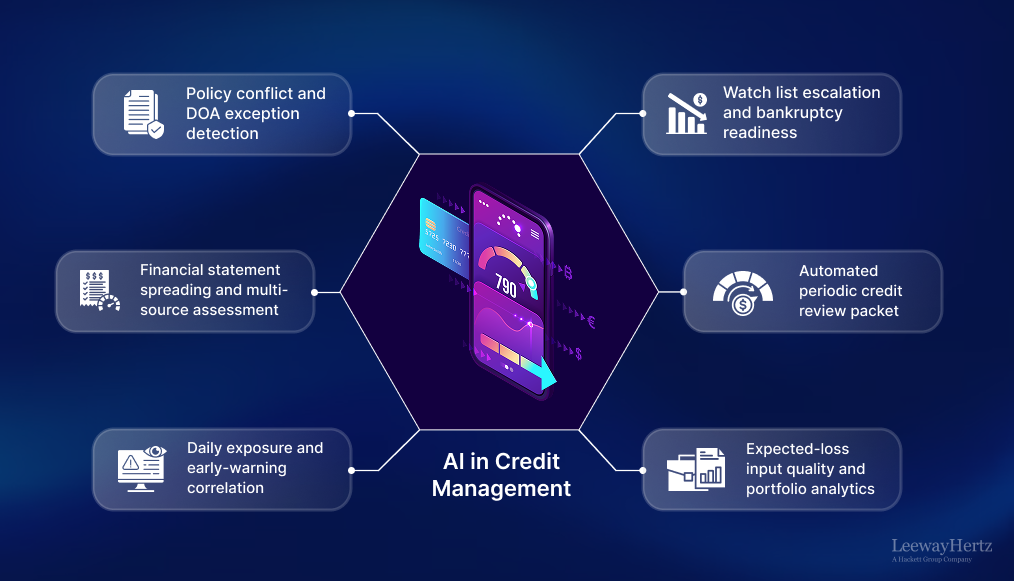
B2B trade credit management determines whether a customer can buy on credit and monitors the risk until payment is received. It spans credit policy, applications, customer investigation, credit scoring, limit setting, security, order holds, exposure monitoring, periodic review, watch list management, and portfolio reporting. It operates within order-to-cash, but it is distinct from invoicing, post-due collection activity, cash application, and detailed order fulfillment. Credit teams determine credit availability and exposure controls, while adjacent functions manage billing, payment processing, collection activity, and downstream order execution.
The function has a direct effect on revenue enablement, working capital, bad debt risk, customer experience, and financial control. Credit teams must make timely decisions while combining legal-entity information, bureau data, financial statements, payment behavior, open orders, in-transit shipments, guarantees, insurance, policy, and delegated authority. Existing ERP, credit, bureau, insurance, and analytics platforms remain systems of record.
The scale of trade credit exposure is substantial. The Federal Reserve data show approximately $5.8 trillion of trade receivables for U.S. nonfinancial corporate businesses at year-end 2025, rising to about $6.0 trillion in the first quarter of 2026 [1]. The Administrative Office of the U.S. Courts reported 25,960 business bankruptcy filings in the 12 months ending March 31, 2026, an increase of 11.4 percent from 2025 [2]. These figures do not measure the entire global trade-credit market, but they illustrate why timely assessment, exposure visibility, and distress readiness matter.
At this scale, credit teams must evaluate large volumes of information while responding quickly to customer applications, order holds, exposure changes, and signs of financial distress. Relevant data may be distributed across applications, financial statements, bureau reports, receivables, open orders, insurance records, policies, and approval systems. AI can help bring this information together, identify changes and exceptions, reconcile evidence across systems, and prepare recommendations for authorized professionals.
The relevant solution is not a generic chatbot. A credit analyst needs a signed application compared with policy and registry evidence. A credit manager needs an over-limit order packet that shows current receivables, open orders, shipments, security, insurance, and the governing release rule. A controller needs expected-loss inputs reconciled and segmented without allowing a model to select the accounting methodology or reserve. AI is useful when it performs a bounded capability against a named artifact and stops at a defined review boundary.
This article uses the B2B trade credit operating model to break work down into the function, process, and sub-process levels. It maps relevant AI capabilities to business artifacts, source systems, policy requirements, accountable roles, and human approval points. It does not cover consumer lending, bank underwriting, or the detailed operations of adjacent functions such as collections, cash application, receivables accounting, and order management, except where they directly interact with credit decisions.
- How AI is transforming credit management operations
- Why AI use cases in credit management must be mapped at the sub-process level
- Credit management operating model and AI opportunity mapping across trade credit processes
- High-value AI use cases in credit management
- How agentic AI works in credit management workflows
- How to prioritize AI use cases in credit management
- Governance, risk, and responsible AI in credit management
- How ZBrain operationalizes AI use cases in credit management
- Future of AI in credit management
How AI is transforming credit management operations
AI changes credit work by examining artifacts before an analyst opens them, connecting records across systems, and preparing the evidence needed for review. The opportunity is strongest where the activity recurs frequently but still requires professional judgment, delegated authority, legal interpretation, or accounting approval.
Consider a periodic review of an existing customer. The evidence may sit across ERP receivables, order management, shipment systems, a commercial bureau, an insurer portal, a financial-statement repository, the prior credit memo, the credit policy, and the DOA matrix. A governed AI workflow can collect and organize those sources, rerun approved analytics, identify changes, and draft a recommendation. It must still pause before a limit, terms, watch list, adverse-action, legal, or reserve decision.
Credit management work can be grouped into five recurring work types:
-
Document-heavy work: Signed credit applications, financial statements, bureau reports, guarantees, standby letters of credit, insurance endorsements, and UCC records can be extracted and checked for missing fields, inconsistent entities, unsupported values, or expired terms.
-
Narrative-heavy work: Credit review memos, limit-change recommendations, watch list summaries, adverse-action explanations, approval rationales, and management commentary can be drafted from approved sources while showing where evidence is missing or contradictory.
-
Exception-heavy work: Incomplete applications, unmatched legal entities, over-limit orders, past-due accounts, bureau deterioration, uninsured exposure gaps, expired reviews, and approval exceptions can be classified and prioritized for the appropriate specialist.
-
Knowledge-heavy work: Credit policy, DOA rules, scorecard methodology, terms standards, security requirements, accounting guidance, and bankruptcy procedures can be retrieved and compared with the customer or transaction under review.
-
Workflow-heavy work: Application assessment, limit approval, hold release, periodic review, watch list escalation, and credit-master updates can be coordinated so that evidence, approvals, and handoffs remain visible.
The practical design rule is to name the capability, the artifact, the change to the work, and the accountable reviewer. Deterministic calculations such as ratios, exposure totals, and authority thresholds should remain transparent rules or analytics. AI should be reserved for extraction, interpretation, prediction, classification, anomaly detection, evidence synthesis, recommendation preparation, and natural-language generation. This separation improves transparency and makes the workflow easier to validate, monitor, and govern. It also ensures that AI supports credit professionals without assuming responsibility for decisions that affect customer credit availability, legal obligations, order release, or financial reporting.
Build governed AI workflows for credit management
Connect customer, credit, exposure, and risk data with policies, approvals, and oversight while keeping consequential decisions with authorized professionals.
Why AI use cases in credit management must be mapped at the sub-process level
AI use cases in credit management must be defined at the sub-process level to make them implementable, measurable, and governable. “AI for credit assessment” is too broad to build or govern. It does not identify whether the workflow extracts an application, resolves a legal entity, interprets a bureau report, spreads financial statements, executes a scorecard, sizes a limit, compares security, or drafts an approval memo. Each activity has different systems, rules, error modes, and reviewers.
A better approach is to map AI use cases to the credit management operating model:
-
Function: A governed area of accountability, such as credit investigation, limit setting, order hold management, or periodic review. A function contains multiple processes and is too broad to implement as one workflow.
-
Process: A recurring workflow area within a function, such as application intake, external credit evidence, approval and structuring, exposure surveillance, or credit reassessment. A process groups related activities but may still contain multiple decision points and system interactions.
-
Sub-process: A specific work activity with a trigger, input artifact, source system, policy, exception taxonomy, accountable reviewer, output artifact, writeback target, and human decision boundary.
-
AI-enabled opportunity: A specific AI capability applied to a named artifact or activity to change how a sub-process is performed. For example, entity resolution can compare a credit application with registry and ERP records to identify the most likely legal entity for analyst confirmation.
This detail makes implementation requirements visible. Application completeness needs signed forms, reference fields, guarantee language, policy checklists, and an analyst queue. Exposure monitoring needs AR, orders, shipments, credit limits, security, insurance, currencies, family hierarchies, and a refresh schedule. Periodic review needs those sources plus the prior decision, current policy, scorecard version, DOA, and approval evidence.
It also clarifies the review boundary. Document intelligence may extract a personal guarantee, but legal professionals decide whether its wording is acceptable. Scenario analysis may compare credit limits, but the authorized approver selects the binding limit. Classification may prioritize an order hold, but only an authorized credit manager releases it. Data-quality analytics may prepare CECL or IFRS 9 inputs, but the controller owns the accounting judgment.
Sub-process mapping therefore turns a high-level AI use case into a build-ready specification: what starts the work, what evidence is authoritative, which deterministic rules apply, what AI capability is appropriate, which exceptions must be tested, who reviews the result, what the output is, and which system action remains locked behind approval.
Credit management operating model and AI opportunity mapping across trade credit processes
The following operating model maps AI opportunities across the B2B trade credit lifecycle, from policy administration and customer assessment to exposure monitoring, periodic review, risk response, and portfolio reporting.
The model focuses on the activities through which credit teams establish and manage customer credit availability. It also identifies the points where credit management interacts with adjacent order-to-cash and finance functions. Credit-hold adjudication is included because credit professionals determine whether a blocked order may proceed. Downstream fulfillment remains the responsibility of order management.
Accounts-receivable aging and payment history are treated as inputs to credit assessment and monitoring, while invoice accounting and cash application remain within accounts receivable. Watch list decisions may influence collection strategies, but detailed dunning and recovery activity remain within collections. Expected-credit-loss inputs are included where credit teams provide operational data, while accounting methodology, reserve judgments, journal entries, and financial-close activities remain with controllership.
The operating model comprises ten functions organized into four lifecycle bands. Each function includes its teams, AI capabilities, human decision boundary, complete process and sub-process table, artifacts, systems, applicable rules, accountable roles, highest-value opportunities, and a named bounded workflow.
Governance foundation
Function 1: Credit policy administration and governance
Turning risk appetite, commercial standards, and authority limits into controlled credit policy and decision rules.
Credit policy administration establishes the rules within which customer credit decisions are made. It translates enterprise risk appetite, commercial objectives, terms-of-sale standards, delegation of authority, and scorecard governance into approved guidance that analysts and approvers can apply consistently. Its outputs shape application review, limit approval, order release, periodic review, and portfolio oversight.
Teams involved: The function is led by the director of credit or global credit director with participation from credit managers, the treasury team, the corporate controller, the legal team, sales leadership, internal audit, and information technology control owners.
What AI helps with: Retrieval-grounded comparison can identify conflicts among the current credit policy, terms standards, DOA matrix, and prior approved versions. Natural-language generation can prepare redlined policy drafts and change summaries from approved source material. Anomaly detection can identify override patterns, scorecard drift, and authority exceptions that require governance review.
What humans continue to own: The director of credit owns policy content and recommends changes. The treasurer, controller, CFO, legal team, or another designated committee approves changes according to corporate governance. Authorized owners approve the scorecard methodology and override policy. AI compares, summarizes, and drafts but does not establish risk appetite, approve policy, or attest to control effectiveness.
| Process | Sub-process | Key AI-enabled opportunities |
| Credit policy lifecycle management | Credit policy authoring and annual refresh |
|
| Authority and model governance | Delegation of authority matrix maintenance for limit approval tiers |
|
| Credit scorecard model governance and override tracking |
|
Key artifacts
-
Approved credit policy and prior versions
-
Risk appetite statement and terms-of-sale standards
-
Delegation of authority matrix
-
Credit scorecard methodology and validation records
-
Override log and approval evidence
Systems involved
-
Policy and document repository
-
Governance, risk, and compliance platform
-
Credit decisioning or scorecard platform
-
ERP credit master and approval history
-
Business intelligence and audit analytics tools
Regulatory and standards considerations
-
SOX internal-control requirements may apply to public-company approval and change controls over financially relevant credit processes.
-
The COSO Internal Control framework can structure control objectives, approvals, monitoring, and evidence retention.
-
ISO 31000 provides risk-management principles that can inform policy design and review, but internal policy remains company–specific.
Accountable roles
-
Director of credit or global credit director – function owner
-
Credit manager – operational reviewer and policy contributor
-
Treasurer and corporate controller – finance and control oversight
-
CFO – top-tier policy and authority approval
-
General counsel – legal review of terms and security provisions
-
Internal audit or SOX control owner – independent assurance
Highest-value opportunities
-
Policy conflict detection: High leverage because inconsistent terms, authority rules, or scorecard provisions can propagate into every downstream credit decision.
-
Override-pattern analysis: High leverage because repeated overrides may reveal model drift, commercial pressure, unclear policy, or control failure.
-
DOA exception testing: Important because it provides evidence that approvals were made by authorized roles and that changes were governed.
Example agentic workflow: Annual credit policy refresh and approval
- The workflow begins with the annual policy-review calendar task and the current approved credit policy, DOA matrix, terms standards, scorecard methodology, override log, and recent audit findings.
- Retrieval-grounded comparison identifies changed regulations, internal standards, recurring exceptions, and conflicts among policy documents.
- Natural-language generation prepares a redlined policy draft, a change summary, and a list of decisions that require owner judgment.
- Human checkpoint: The director of credit, treasurer, controller, legal, and any required executive approver review the proposed changes, resolve risk-appetite questions, and approve or reject the revision.
- After approval, workflow coordination publishes the controlled version, archives the superseded version, updates effective dates, and records the approval trail under existing change-management controls.
Customer assessment and credit establishment
Function 2: New customer credit application and onboarding
Turning a commercial credit request and supporting records into a complete, verified, and review-ready customer file.
New customer onboarding captures the information required to evaluate a legal entity and establish appropriate commercial terms. It begins with a signed credit application and supporting references, resolves the applicant to the correct legal entity and corporate family, and prepares a terms recommendation for authorized review. The output feeds investigation, scoring, limit setting, customer master creation, and the first review date.
Teams involved: Credit analysts and senior credit analysts perform the work with support from sales, customer master data teams, legal, order management, tax or compliance teams, and the credit manager.
What AI helps with: Document intelligence can extract application fields, signatures, requested terms, guarantor information, references, and consent language. Entity resolution can match the applicant to business registries, DUNS identifiers, corporate-family records, and the existing customer master. Classification can identify missing or contradictory information and prepare a targeted information request.
What humans continue to own: Credit staff determine whether the file is sufficiently complete for assessment, resolve uncertain legal-entity matches, and decide whether additional documentation is required. Authorized credit personnel assign binding terms of sale and approve creation or changes to the credit master. AI extracts, matches, and prepares but does not approve the applicant, assign binding terms, or create available credit without authorization.
| Process | Sub-process | Key AI-enabled opportunities |
| Application intake | Credit application intake and completeness validation |
|
| Entity resolution and legal-entity verification |
|
|
| Credit terms assignment | Terms-of-sale assignment |
|
Key artifacts
-
Signed commercial credit application, including terms and guarantee language
-
Trade reference requests and responses
-
Bank reference or bank comfort letter
-
Entity registry evidence and DUNS match
-
Customer master request and approved terms record
Systems involved
-
CRM or customer-onboarding portal
-
Document repository and e-signature platform
-
Business-information bureau portals
-
Government business-entity registries
-
ERP customer and credit master data
Regulatory and standards considerations
-
Regulation B applies to business credit, but notification requirements vary by the type of business credit and applicant. For trade credit, action must be communicated within a reasonable time, and written reasons are required when requested under the applicable rule.
-
When personal data about principals or guarantors is collected, applicable privacy requirements such as GDPR or CCPA require purpose limitation, appropriate notices, access controls, and data governance.
-
A business application by itself should not be assumed to create a permissible purpose for obtaining a consumer report on a guarantor or principal; the FCRA basis should be confirmed before any pull.
Accountable roles
-
Credit analyst – operational owner
-
Senior or regional credit analyst – complex-file reviewer
-
Credit manager – terms and onboarding approver
-
VP of sales – commercial information and escalation counterpart
-
General counsel – guarantee and application-language review
-
Customer master data team – authorized system setup after approval
Highest-value opportunities
-
Application completeness review: High volume and artifact rich, with a clear analyst checkpoint before assessment begins.
-
Legal-entity resolution: High leverage because an incorrect entity match can contaminate bureau data, corporate-family exposure, guarantees, and customer-master records.
-
Policy-grounded terms recommendation: Valuable because it converts approved policy into a reviewable recommendation without allowing the system to bind terms autonomously.
Example agentic workflow: Commercial credit application readiness
- The workflow begins when a signed commercial credit application and supporting documents enter the onboarding queue.
- Document intelligence extracts application fields, and classification checks the package against the approved completeness checklist.
- Entity resolution compares the applicant with registry, bureau, corporate-family, and ERP customer-master records and presents candidate matches with supporting evidence.
- Human checkpoint: A credit analyst confirms the legal entity, resolves missing information, and determines whether the file is ready for investigation. A credit manager approves any binding terms or onboarding exception.
- After approval, the verified entity record, terms decision, source documents, and review evidence are retained and handed to credit investigation under existing customer master controls.
Function 3: Credit investigation and assessment
Turning external credit evidence, financial statements, and reference data into an evidence-based assessment of payment capacity and behavior.
Credit investigation assembles the external and internal evidence used to understand a prospective or existing customer. It combines commercial bureau information, financial statements, trade references, industry credit-group data, legal filings, and internal payment history. The function does not make the final credit decision; it produces a documented assessment that feeds scoring, limit setting, security requirements, and review frequency.
Teams involved: Credit analysts and senior credit analysts lead the assessment with input from treasury, the controller, legal, sales, financial planning teams, and authorized participants in industry credit groups.
What AI helps with: Document extraction can extract balance-sheet, income-statement, and cash-flow fields from audited, reviewed, or public filings. Bureau-event classification and payment-trend analysis can summarize D&B PAYDEX, Experian Intelliscore Plus, Creditsafe, suits, liens, judgments, and other reported events. Retrieval-grounded synthesis can assemble trade-reference evidence while keeping source and date visible.
What humans continue to own: Credit professionals determine the credibility and relevance of external reports, select adjustments to financial spreading, interpret unusual business conditions, and decide whether further investigation is required. Legal or compliance personnel determine whether information can be collected or exchanged. AI extracts and summarizes but does not certify financial statements, make legal conclusions, or approve credit.
| Process | Sub-process | Key AI-enabled opportunities |
| External credit data collection and review | Bureau report pulls and interpretation |
|
| Financial analysis | Financial statement spreading and ratio analysis |
|
| External credit evidence | Trade reference and industry credit group data exchange |
|
Key artifacts
-
D&B business information report
-
Experian Intelliscore Plus report
-
Creditsafe or other approved commercial bureau report
-
Audited or reviewed financial statements, 10-Ks, and 10-Qs
-
Trade reference responses and NACM or other authorized industry credit-group report
-
Internal payment history and AR aging
Systems involved
-
Commercial bureau portals and alert feeds
-
Financial spreading and credit-analysis platform
-
SEC filing or corporate disclosure sources
-
ERP accounts-receivable and payment-history data
-
Trade-reference workflow or approved NACM or other industry credit-group platform
-
Document repository
Regulatory and standards considerations
-
The FCRA must be evaluated when a consumer report on a guarantor, owner, or principal is contemplated; commercial bureau reports on the business entity are a different data category.
-
Information exchange through trade associations or credit groups should be limited and governed under U.S. antitrust law, including Sherman Act principles, to avoid sharing competitively sensitive current or forward-looking commercial information. Aggregation, historical context, and independent administration can reduce risk, but legal review remains important.
-
Applicable privacy law governs personal information about principals and guarantors, including collection purpose, retention, access, and security.
Accountable roles
-
Credit analyst – investigator and preparer
-
Senior or regional credit analyst – complex assessment reviewer
-
Credit manager – assessment sufficiency and escalation
-
Corporate controller or FP&A – financial statement context
-
General counsel – FCRA, privacy, and antitrust advice
-
Treasurer or chief risk officer – material risk consultation
Highest-value opportunities
-
Financial statement extraction and spreading: High leverage because it reduces manual transcription while retaining page-level evidence for analyst adjustment.
-
Multi-source payment trend analysis: Valuable because bureau data and internal payment behavior often diverge and require contextual review.
-
Trade-reference normalization: Useful because responses are unstructured and inconsistent, but the final interpretation remains with credit staff.
Example agentic workflow: Credit investigation evidence assembly
- The workflow begins with a verified applicant record and an approved investigation checklist.
- The workflow retrieves current bureau reports, internal payment history if available, financial statements, trade-reference responses, and relevant public filings.
- Document intelligence spreads financials, bureau-event classification structures external reports, and multi-source comparison identifies contradictions, stale evidence, and missing periods.
- Human checkpoint: A credit analyst validates extracted fields, adjusts the spreading where justified, evaluates source reliability, and records conclusions or requests further evidence.
- The approved assessment packet, source snapshots, assumptions, and reviewer disposition are retained and handed to credit scoring and limit setting.
Function 4: Credit scoring and limit setting
Turning verified customer evidence into a risk grade and proposed exposure limit for authorized approval.
Credit scoring and limit setting combines internal scorecard methodology, external risk evidence, financial capacity, requested exposure, payment history, security, and corporate-family structure. Deterministic rules and calculations produce score components and limit scenarios, while AI can interpret evidence, detect anomalies, and prepare recommendations. The result is a proposed risk grade and limit, not a binding decision until the appropriate authority approves it.
Teams involved: Credit analysts prepare the recommendation, credit managers and directors of credit review according to authority tier, and the treasurer, chief risk officer, controller, or CFO participates in material or top-tier decisions.
What AI helps with: AI-driven scorecard execution can combine validated inputs with approved scoring logic and show factor-level contributions. Scenario analysis can compare limit methodologies based on tangible net worth, high-credit history, requested exposure, insured capacity, and concentration constraints. Corporate-family matching can aggregate parent, subsidiary, and guarantee relationships before the recommendation is routed.
What humans continue to own: Authorized credit personnel select the applicable methodology, resolve conflicting evidence, determine whether an override is justified, and approve the binding risk grade and credit limit under the DOA matrix. Legal reviewers determine the enforceability and scope of guarantees. AI scores, aggregates, and drafts but does not set a binding limit, approve an override, or change customer availability.
| Process | Sub-process | Key AI-enabled opportunities |
| Risk grading | Internal scorecard execution and risk-grade assignment |
|
| Credit limit structuring | Credit limit sizing |
|
| Parent-subsidiary limit consolidation and guarantee treatment |
|
Key artifacts
-
Credit scorecard output and risk-grade record
-
Financial spread and bureau assessment data
-
Credit limit change request and approval memo
-
Corporate-family structure and exposure rollup
-
Personal or cross-corporate guarantee
-
Requested exposure and insured-limit evidence
Systems involved
-
Credit scorecard or decisioning platform
-
Financial spreading and analytics system
-
ERP credit master and credit segments
-
Corporate master-data or entity-resolution service data
-
Credit insurance portal
-
Approval workflow and document repository
Regulatory and standards considerations
-
The approved DOA matrix is the primary internal-control boundary for limit approval. SOX and COSO considerations may apply when the process affects financial reporting or key controls.
-
Personal data from guarantors must be handled under applicable privacy and FCRA requirements.
-
Scorecard governance should include version control, validation, monitoring, override tracking, and explainable factor-level evidence, aligned with the organization’s model-risk and AI-risk framework.
Accountable roles
-
Credit analyst – score and recommendation preparer
-
Credit manager – approval within delegated tier
-
Director of credit or global credit director – higher-tier approver
-
Treasurer or chief risk officer – portfolio and concentration oversight
-
CFO – top-tier limit approval
-
General counsel – guarantee interpretation
Highest-value opportunities
-
Explainable scorecard execution: High leverage because every recommendation can show the source, factor, calculation, and reviewer adjustment.
-
Limit scenario comparison: Valuable because it makes assumptions and policy tradeoffs visible before a binding decision.
-
Corporate-family exposure rollup: Critical where separate customer records could conceal aggregate exposure or duplicate reliance on a guarantee.
Example agentic workflow: Risk grade and credit limit recommendation
- The workflow begins with the approved investigation packet, scorecard methodology, requested exposure, existing family exposure, and security or insurance evidence.
- Scorecard execution applies the approved model, deterministic calculations produce limit scenarios, and corporate-family matching aggregates related exposure.
- The workflow prepares a recommendation memo with factor contributions, selected methodology, policy exceptions, sensitivity analysis, and the required DOA tier.
- Human checkpoint: The authorized credit manager, director of credit, treasurer, or CFO approves, modifies, rejects, or escalates the recommendation and records the rationale for any override.
- Only after approval does workflow coordination update the authorized limit and risk grade in the ERP credit master and retain the source snapshot, recommendation, approval, and writeback evidence.
Accelerate AI Solutions Development
Build fully functional solutions from your high-value use cases, based on specific operational needs and enterprise context.
Function 5: Credit decisioning and security management
Turning a credit recommendation into an authorized decision supported by appropriate guarantees, documentary credit, secured interests, or credit insurance.
Credit decisioning applies the DOA matrix to the proposed terms and exposure, then determines whether unsecured credit is acceptable or whether additional security or risk transfer is required. The function coordinates approvals, legal instruments, UCC filings, standby letters of credit, guarantees, and buyer-specific credit-insurance limits. These instruments remain legal and commercial commitments that require human negotiation, review, and authorization.
Teams involved: Credit managers and directors of credit coordinate with treasury, the CFO, general counsel, sales leadership, insurance brokers or carriers, and authorized corporate-signature or filing personnel.
What AI helps with: Policy and DOA retrieval can route the decision to the correct authority and show the governing limit tier. Document intelligence and clause comparison can extract amount, expiry, governing rules, obligor, beneficiary, draw conditions, and discrepancies from guarantees and standby letters of credit. Insurance-limit comparison can identify uninsured exposure and endorsement gaps.
What humans continue to own: Authorized approvers accept, reject, or condition the credit decision. Legal and treasury personnel negotiate and approve guarantees, letters of credit, UCC filings, and other security. Authorized representatives bind insurance coverage and accept endorsements. AI assembles, compares, and drafts but does not approve credit, accept legal security, authorize filing, or bind insurance.
| Process | Sub-process | Key AI-enabled opportunities |
| Credit approval and security structuring | Approval routing per delegation of authority |
|
| Security negotiation and instrument review |
|
|
| Credit risk transfer management | Credit insurance placement and buyer-limit endorsements |
|
Key artifacts
-
Credit limit change request and approval memo
-
Standby letter of credit subject to UCP 600 or ISP98 where incorporated
-
Personal guarantee and cross-corporate guarantee
-
UCC-1 financing statement and UCC-3 amendments
-
Credit insurance schedule and buyer-limit endorsement
-
DOA approval trail
Systems involved
-
Contract lifecycle and document-management system
-
Treasury or trade-finance platform
-
UCC filing service or official filing portal
-
Credit insurance carrier or broker portal, such as Allianz Trade, Coface, or Atradius, where contracted
-
Customer credit master in the ERP
Regulatory and standards considerations
-
UCC Article 9 provides the framework for secured transactions in U.S. jurisdictions, but filing office, debtor-name, collateral, perfection, and priority requirements depend on applicable state law and transaction facts.
-
UCP 600 and ISP98 govern documentary credits or standbys when the instrument incorporates those rules. Instrument wording and legal effect require specialist review.
-
SOX and COSO controls may apply to approval authority, instrument custody, system updates, and evidence retention.
Accountable roles
-
Credit manager – decision owner within authority
-
Director of credit – higher-tier decision approver
-
Treasurer – documentary credit and risk-transfer oversight
-
CFO – top-tier approval
-
General counsel – guarantee, UCC, and instrument review
-
VP of sales – commercial escalation counterpart
-
Insurance broker or carrier contact – external contributor
Highest-value opportunities
-
DOA-controlled routing: High leverage because it prevents self-approval and preserves a clear authority trail.
-
Security-instrument comparison: Important because amount, expiry, obligor, draw terms, and governing rules must match the approved credit condition.
-
Insured-exposure gap analysis: Valuable because open orders and receivables can exceed an insurer’s buyer limit even when the nominal credit limit appears covered.
Example agentic workflow: Security-backed credit approval and instrument validation
- The workflow begins with an approved risk-grade and limit recommendation that requires a guarantee, standby letter of credit, UCC security interest, or credit-insurance support.
- Policy retrieval identifies the required approver and approved security standard. Document intelligence extracts the received instrument and compares it with the approved condition and template.
- The workflow prepares a discrepancy schedule, uninsured-exposure analysis, and decision packet with unresolved legal or documentary issues.
- Human checkpoint: credit, treasury, legal, and the authorized DOA approver resolve discrepancies, negotiate terms, accept or reject the instrument, and approve the final credit structure.
- After approval, the instrument, filing evidence, insurance endorsement, decision, and credit-master update are retained under existing legal, treasury, and control procedures.
In-life credit control and monitoring
Function 6: Order hold management and credit release
Turning a credit block into a documented release, continued hold, or escalation decision before order processing continues.
Order hold management sits at the boundary between credit control and order management. It evaluates why an ERP credit check blocked an order, assembles current exposure and payment information, and routes the case to an authorized credit professional. Credit owns the adjudication logic and release decision; order management owns downstream fulfillment mechanics after the decision is recorded.
Teams involved: Credit analysts and credit managers work with order management, sales, collections, customer service, logistics, and, for material exceptions, the director of credit or CFO.
What AI helps with: Exposure aggregation can combine open receivables, open orders, in-transit shipments, deposits, disputed balances, guarantees, and insurance status into a dated decision packet. Classification can identify the block reason and prioritize cases by value, customer commitment, delinquency, available security, and deadline. Natural-language generation can draft a release rationale from approved evidence.
What humans continue to own: Authorized credit personnel decide whether to maintain or release the block, establish conditions, approve an override, and document the rationale. Sales and order-management personnel provide commercial and fulfillment context. AI prepares and ranks but does not release a blocked order or change a credit limit.
| Process | Sub-process | Key AI-enabled opportunities |
| Credit hold assessment | Credit block adjudication in the ERP |
|
| Past-due and over-limit release workflows with documented rationale |
|
|
| Credit exception escalation | Cross-functional credit exception escalation |
|
Key artifacts
-
AR aging report and open order exposure report
-
ERP credit block record
-
Payment commitment and recent payment evidence
-
Credit hold release log
-
Temporary-limit or exception approval
-
Customer communication and sales escalation record
Systems involved
-
ERP credit management and sales-order modules
-
ERP accounts-receivable module and collections management workbench
-
Order management system
-
CRM and customer communication records
-
Credit insurance portal
-
Approval workflow and audit repository
Regulatory and standards considerations
-
Approval and release controls should align with the organization’s DOA, SOX scoping, and COSO control design where applicable.
-
Customer and guarantor data used in the decision packet must be protected under applicable privacy and access-control requirements.
-
External communications about credit status or adverse action require approved content and, where applicable, Regulation B analysis.
Accountable roles
-
Credit analyst – packet preparation and first review
-
Credit manager – release or continued-hold decision within authority
-
Director of credit or CFO – material exception approval
-
VP of sales – commercial escalation counterpart
-
Order management supervisor – downstream execution after decision
-
Collections manager – payment status handoff counterpart, not credit owner
Highest-value opportunities
-
Exposure packet assembly: High leverage because the release decision depends on current data spread across ERP, AR, order, shipment, insurance, and communication systems.
-
Block-reason classification: Valuable because it routes routine data defects differently from genuine credit-risk exceptions.
-
Policy-grounded release rationale: Important because it preserves evidence and avoids undocumented commercial overrides.
Example agentic workflow: Blocked order review and controlled release
- The workflow begins when the ERP creates a credit block on a sales order and records the failed credit-check condition.
- The workflow classifies the block reason and assembles current AR aging, open orders, in-transit exposure, security, insurance, payment commitments, and prior exceptions.
- Policy retrieval shows the applicable release criteria and DOA tier, and natural-language generation prepares a proposed disposition with supporting evidence.
- Human checkpoint: The authorized credit manager or higher-tier approver maintains the hold, releases it, or approves a documented conditional exception.
- The ERP releases the order to normal order-management processing only after recording the approved disposition, with the decision and evidence logged in the credit hold release log.
Function 7: Credit exposure monitoring and early warning
Turning daily transaction data and external alerts into a current view of customer, family, and portfolio credit exposure.
Exposure monitoring follows risk after credit has been granted. It aggregates the amount already invoiced with open orders, in-transit shipments, and other committed exposure, then compares the total with approved limits, security, insurance, payment behavior, and concentration thresholds. Early-warning signals feed order control, periodic review, watch list, collections strategy, and portfolio reporting.
Teams involved: Credit analysts and regional credit analysts monitor accounts, credit managers own escalation, and the director of credit, treasurer, chief risk officer, sales, and collections participate in material portfolio responses.
What AI helps with: Exposure aggregation can create a customer and corporate-family view from ERP and order data. Payment behavior trend detection can identify deterioration before a formal default. Bureau event classification can distinguish meaningful alerts from duplicates or low-relevance events, while portfolio concentration analysis highlights correlated risk by industry, geography, and corporate family.
What humans continue to own: Credit professionals set thresholds, determine whether an alert is material, decide whether to restrict exposure, initiate a review, or escalate to the watch list, and approve any limit or terms change. Credit and risk leaders, with executive oversight, define the organization’s concentration risk appetite. AI monitors, prioritizes, and prepares but does not curtail credit or place a customer on the watch list.
| Process | Sub-process | Key AI-enabled opportunities |
| Credit exposure surveillance | Daily exposure aggregation |
|
| Bureau alert monitoring |
|
|
| Portfolio credit risk monitoring | Portfolio concentration analysis by industry, geography, and corporate family |
|
Key artifacts
-
AR aging and open order exposure report
-
In-transit shipment and unbilled commitment data
-
Bureau alerts and refreshed business reports
-
Credit insurance buyer-limit status
-
Corporate-family hierarchy
-
Portfolio concentration and stress report
Systems involved
-
ERP AR, sales-order, and logistics modules
-
Credit management or exposure platform
-
Commercial bureau alert feeds
-
Credit insurance portal
-
Master-data and corporate-family service data
-
Business intelligence and risk analytics platform
Regulatory and standards considerations
-
SOX and COSO controls may govern data completeness, reconciliations, thresholds, and evidence where exposure reporting supports financial or control decisions.
-
ISO 31000 can inform concentration-risk identification, analysis, treatment, and monitoring.
-
External and personal data must be used consistently with applicable privacy rights, contracts, and permitted purposes.
Accountable roles
-
Credit analyst or regional credit analyst – daily monitor
-
Credit manager – escalation owner
-
Director of credit – portfolio owner
-
Chief risk officer – concentration oversight
-
Treasurer – liquidity and risk-transfer context
-
VP of sales and collections manager – response counterparts
Highest-value opportunities
-
Daily corporate-family exposure aggregation: High leverage because customer-level records can understate total exposure to a common parent or guarantor.
-
Multi-source early-warning correlation: Valuable because a bureau alert becomes more decision useful when compared with internal payment and order behavior.
-
Concentration scenario analysis: Important because individually acceptable limits can create excessive correlated portfolio exposure.
Example agentic workflow: Daily exposure and early-warning triage
- The workflow begins with the daily exposure refresh and any new bureau, insurer, or internal payment alert.
- Exposure aggregation combines AR, orders, shipments, limits, security, and insurance by customer and corporate family.
- Alert classification and trend detection rank accounts using severity, recency, corroborating evidence, utilization, and concentration impact.
- Human checkpoint: A credit analyst validates the evidence and a credit manager decides whether to continue monitoring, request information, initiate an early review, adjust controls, or escalate to watch list under the DOA.
- The approved disposition, alert evidence, next action, owner, and review date are retained and handed to the relevant credit control workflow.
Function 8: Periodic credit review
Turning scheduled or event-driven evidence into a documented reaffirm, increase, curtailment, or monitoring recommendation.
Periodic review reassesses whether the approved terms, risk grade, and limit remain appropriate. Reviews may occur on a risk-based calendar or be accelerated by payment deterioration, bureau events, concentration changes, insurer action, or new financial information. The function creates a dated review packet and recommendation, then routes it to the correct authority.
Teams involved: Credit analysts prepare reviews, credit managers and directors approve within delegated authority, and treasury, sales, collections, the controller, legal, and the chief risk officer contribute when material issues arise.
What AI helps with: Review-priority classification identifies accounts requiring review based on approved risk grades, watch list status, and emerging risk signals. Policy-grounded generation then prepares the required evidence requests, while workflow rules schedule the review and assign follow-up tasks. Multi-source aggregation can assemble aging, exposure, bureau, insurer, financial, and prior-review data. Scorecard execution and trend analysis can re-evaluate the account, while natural-language generation drafts a review memo that separates evidence, assumptions, red flags, and recommendations.
What humans continue to own: Credit professionals validate the evidence, determine whether the score or limit methodology remains appropriate, approve reaffirmation, increase, curtailment, or watch list escalation, and decide whether updated financial statements are sufficient. AI assembles, re-scores, and drafts but does not approve a limit, curtail credit, or update the credit master without authorization.
| Process | Sub-process | Key AI-enabled opportunities |
| Credit review calendar management | Review calendar management by risk grade |
|
| Credit reassessment | Credit limit review and adjustment |
|
| Financial statement re-request cadence and covenant-style tracking |
|
Key artifacts
-
Periodic credit review memo
-
Watch list register and prior review history
-
AR aging and payment history
-
Open order and in-transit exposure report
-
Current bureau reports and alerts
-
Financial statements and re-request correspondence
-
Credit insurance buyer-limit status
Systems involved
-
Review calendar and workflow platform
-
ERP AR, order, and credit master data
-
Commercial bureau portals
-
Credit insurance portal
-
Financial spreading and scorecard platform
-
Document repository and audit log
Regulatory and standards considerations
-
Regulation B should be evaluated when review action constitutes adverse action on an existing account or changes customer credit availability; requirements depend on the facts and business-credit category.
-
SOX, COSO, and accounting-control requirements may affect review evidence, approval, and writeback when the process supports expected credit loss or financial reporting.
-
Source data about principals and guarantors remains subject to applicable privacy and permissible-purpose controls.
Accountable roles
-
Credit analyst – review preparer
-
Credit manager – decision approver within authority
-
Director of credit – higher-tier approver
-
CFO – top-tier limit decision
-
VP of sales – terms-change communication counterpart
-
Collections manager – payment-behavior contributor
-
Corporate controller – ECL and reporting counterpart
Highest-value opportunities
-
Automated review packet assembly: High leverage because review evidence is distributed across ERP, bureau, insurer, financial, and document systems.
-
Event-driven review prioritization: Valuable because risk changes do not wait for the annual review date.
-
Evidence-grounded review memo: Important because it separates facts, assumptions, score changes, and the human decision.
Example agentic workflow: Periodic credit review and limit decision
- The workflow begins when a scheduled review date arrives, or an approved early-review trigger is met.
- The workflow collects the current aging, payment history, open orders, in-transit exposure, bureau reports, insurer status, latest financials, prior review, policy, and DOA matrix.
- Scorecard execution and trend analysis update the evidence, and natural-language generation prepares a draft review memo with red flags and a proposed limit action.
- Human checkpoint: The credit manager or higher-tier approver validates the evidence, approves, changes, rejects, or escalates the recommendation, and records the rationale.
- After approval, the review memo, source snapshot, decision, and next review date are retained, and any authorized credit master change is executed under existing controls.
Function 9: Watch list and credit risk response management
Turning sustained deterioration or distress signals into enhanced monitoring, controlled terms changes, and documented action.
Watch list management applies a higher level of review to customers whose payment behavior, financial condition, legal status, insured capacity, or concentration risk has deteriorated. It coordinates entry criteria, enhanced monitoring, terms tightening, adverse-action communication, and bankruptcy preparedness. The function hands post-due collection strategy to collections while retaining ownership of credit availability and exposure controls.
Teams involved: Credit managers and directors of credit lead the process with credit analysts, treasury, the chief risk officer, sales, collections, legal, order management, and the controller.
What AI helps with: Classification can map alerts and deterioration to approved watch list criteria. Scenario analysis can compare limit reduction, cash-in-advance conversion, security, or insured-exposure options. Bankruptcy-event monitoring and evidence aggregation can identify filings, preference-period transactions, recent goods deliveries, and documents that may support counsel review.
What humans continue to own: Authorized credit leaders decide whether to place or remove an account from the watch list, tighten terms, reduce a limit, demand security, or stop additional unsecured exposure. Legal team reviews adverse-action communications, bankruptcy response, preference risk, and claim strategy. AI identifies, prepares, and drafts but does not take adverse action, curtail credit, make a legal determination, or file a claim.
| Process | Sub-process | Key AI-enabled opportunities |
| Credit watch list management | Credit watch list assessment and enhanced monitoring |
|
| Credit terms adjustment and risk mitigation |
|
|
| Customer financial distress and bankruptcy response | Preference-risk awareness, Chapter 11 monitoring, and 503(b)(9) claim readiness assesment |
|
Key artifacts
-
Watch list register and enhanced-monitoring plan
-
Terms-tightening or limit-curtailment memo
-
Adverse-action communication and approval record
-
AR aging, exposure, bureau, insurer, and financial evidence
-
Bankruptcy filing and legal correspondence
-
Invoices, proof of delivery, payment history, guarantees, and UCC evidence
Systems involved
-
Watch list and credit workflow platform
-
ERP AR, order, and credit master data
-
Commercial bureau and court-alert services system
-
Collections management system
-
Document repository and legal matter management system
-
Credit insurance portal
Regulatory and standards considerations
-
Regulation B adverse-action requirements depend on applicant and transaction facts; business trade credit has specific notification provisions, and reasons should reflect the actual factors used.
-
The U.S. Bankruptcy Code addresses avoidable preferences in section 547 and administrative expenses for qualifying goods received within 20 days before commencement in section 503(b)(9). Counsel should determine applicability and action.
-
Terms and late-payment practices for EU transactions may be affected by Directive 2011/7/EU and national implementation.
Accountable roles
-
Credit manager – watch list and terms decision owner
-
Director of credit – material curtailment approver
-
CFO or treasurer – major exposure decision
-
General counsel – adverse action, bankruptcy, preference, and claim review
-
Collections manager – post-due strategy handoff counterpart
-
VP of sales – commercial communication counterpart
-
Chief risk officer – concentration and enterprise-risk oversight
Highest-value opportunities
-
Watch list criteria classification: High leverage because it turns disparate signals into a consistent, reviewable escalation packet.
-
Terms-tightening scenario analysis: Valuable because it shows exposure and commercial effects before a human chooses a response.
-
Bankruptcy evidence assembly: Important because statutory windows and legal strategy require complete, dated transaction records and counsel review.
Example agentic workflow: Customer credit deterioration response and watch list escalation
- The workflow begins with a validated deterioration trigger, such as sustained aging, a material bureau event, insurer action, financial decline, or a bankruptcy filing.
- The workflow aggregates current exposure, recent payments, order commitments, security, insurance, legal events, and prior decisions and compares them with approved watch list criteria.
- Scenario analysis prepares alternative controls and a recommended monitoring plan, while natural-language generation drafts the internal memo and any proposed communication.
- Human checkpoint: The credit manager, director, CFO, or other authorized approver decides whether to enter the account on the watch list, tighten terms, curtail the limit, or take another action. Legal teams approve any regulated, contractual, or bankruptcy-related communication or filing.
- The approved status, monitoring plan, terms decision, communication, owners, and evidence are recorded and handed to order management, sales, collections, and legal teams under existing governance.
Portfolio oversight and financial reporting
Function 10: Reserving, reporting and portfolio analytics
Turning customer-level credit data into expected-loss inputs, performance reporting, and portfolio oversight for finance and risk leaders.
Credit reporting connects operational credit activity with financial planning, controllership, treasury, and enterprise risk. Credit teams prepare customer risk grades, aging, default indicators, recoveries, overrides, concentrations, and scenario inputs, while the controller’s team owns the accounting methodology, journal entries, disclosures, and final reserve judgment. The same data supports DSO, bad debt, CEI, blocked-order, cycle-time, and exposure reporting.
Teams involved: The corporate controller and finance team own accounting judgments, while the director of credit, credit managers, treasury, FP&A, the chief risk officer, collections, internal audit, and data teams contribute operational inputs and controls.
What AI helps with: Data-quality anomaly detection can identify missing risk grades, stale reviews, inconsistent defaults, unusual recoveries, and breaks between AR and credit data. Portfolio analytics can segment expected-loss inputs by risk, aging, geography, industry, and corporate family. Natural-language generation can prepare management commentary that is grounded in the approved reporting dataset and clearly separates observed results from assumptions.
What humans continue to own: The corporate controller and authorized finance personnel approve CECL or IFRS 9 methodology, scenarios, adjustments, reserve conclusions, journal entries, and disclosures. Credit leadership approves operational KPI definitions and commentary. AI analyzes and drafts but does not approve an expected-credit-loss judgment, book a reserve, attest to financial reporting, or change reported results.
| Process | Sub-process | Key AI-enabled opportunities |
| Expected credit loss input preparation | CECL and IFRS 9 expected credit loss input preparation |
|
| Credit performance reporting and analysis | Bad debt forecast, DSO, and collection effectiveness index reporting |
|
| Credit KPI reporting and analysis |
|
Key artifacts
-
CECL or IFRS 9 input dataset and control evidence
-
Bad debt forecast and reserve support schedules
-
AR aging and write-off or recovery history
-
DSO and collection effectiveness index report
-
Credit department KPI pack
-
Portfolio concentration and stress report
-
Management commentary and approval record
Systems involved
-
ERP general ledger and accounts receivable data
-
Credit management and review systems
-
Enterprise data warehouse or lakehouse
-
Financial planning and consolidation platform
-
Business intelligence and risk analytics tools
-
Governance, risk, and compliance repository
Regulatory and standards considerations
-
ASC 326 governs expected credit loss accounting for entities reporting under U.S. GAAP, and FASB issued ASU 2025-05 for certain Topic 606 receivables and contract assets. Applicability and method remain accounting judgments.
-
IFRS 9 governs expected credit loss accounting for entities reporting under IFRS, including the simplified lifetime expected credit loss approach for specified trade receivables and contract assets.
-
SOX and COSO requirements may govern data lineage, reconciliations, management review, change control, and evidence where reporting affects financial statements.
Accountable roles
-
Corporate controller – accounting methodology and reserve owner
-
Director of credit – operational input and KPI owner
-
Treasurer – liquidity and portfolio context
-
Chief risk officer – concentration and scenario oversight
-
CFO – executive review and approval
-
Collections manager – recovery and collection-effectiveness contributor
-
Internal audit or SOX owner – control assurance
Highest-value opportunities
-
Expected-loss input quality review: High leverage because missing or inconsistent credit data can distort accounting analysis before finance applies judgment.
-
Portfolio segmentation and scenario preparation: Valuable because it creates repeatable, auditable datasets while leaving methodology and reserve conclusions with the controller.
-
KPI anomaly detection: Useful because apparent performance changes may reflect data timing, duplicate events, or mix rather than operational improvement or deterioration.
Example agentic workflow: Credit portfolio reporting and expected credit loss input preparation
- The workflow begins with the monthly reporting calendar and governed extracts from AR, credit, collections, insurance, write-off, recovery, and customer-master systems.
- Data-quality checks reconcile populations and identify missing risk grades, stale reviews, inconsistent defaults, duplicate events, and breaks between reporting sources.
- Portfolio analytics prepare approved segments, trends, scenarios, and draft commentary without selecting the accounting methodology or reserve amount.
- Human checkpoint: Credit leadership validates operational data and the corporate controller approves methodology, assumptions, adjustments, expected-loss conclusions, and reporting treatment.
- The approved dataset, reconciliations, assumptions, reviewer decisions, and final reporting outputs are retained under financial-reporting and audit controls.
Accelerate AI Solutions Development
Build fully functional solutions from your high-value use cases, based on specific operational needs and enterprise context.
High-value AI use cases in credit management
A high-value AI use case is not defined by model sophistication alone. It combines a recurring business problem, usable artifacts, a bounded capability, a measurable operational or risk outcome, and a clearly named reviewer. The opportunities below cover every function in the operating model.
| Use case | Function | How AI creates high-value impact |
| Policy conflict and DOA exception detection | Credit policy administration and governance | Retrieval-grounded comparison links policy clauses, authority tiers, approvals, and override records, helping control owners identify inconsistencies before they affect credit decisions. |
| Commercial application completeness and entity resolution | New customer credit application and onboarding | Document intelligence and entity resolution convert signed applications and registry evidence into a verified, review-ready file, reducing downstream rework and wrong entity risk. |
| Financial statement spreading and multi-source assessment | Credit investigation and assessment | Document extraction, deterministic ratio calculation, and anomaly detection reduce transcription effort while surfacing trends and source conflicts for analyst judgment. |
| Explainable risk-grade and limit recommendation | Credit scoring and limit setting | Entity resolution and corporate-family matching consolidate related-customer exposure. An approved scorecard and scenario analysis then produce a factor-based credit limit recommendation for authorized review, without allowing the scorecard or AI system to set or approve the credit limit |
| Security-instrument and insured-exposure review | Credit decisioning and security instruments | Document intelligence and terms comparison identify amount, expiry, obligor, governing rules, filing, and coverage gaps before legal, treasury, or credit teams accept the structure. |
| Blocked-order review packet | Order hold management and credit release | Exposure aggregation and policy-grounded analysis assemble a current release packet while preserving the authorized credit manager as the only release decision maker. |
| Daily exposure and early-warning correlation | Exposure monitoring and early warning | Multi-source aggregation and trend detection connect AR, orders, shipments, bureau events, insurance, and corporate-family exposure to prioritize material changes. |
| Automated periodic credit review packet | Periodic credit review | Workflow coordination, evidence aggregation, scorecard execution, and memo generation reduce review preparation time while maintaining DOA approval for any limit action. |
| Watch list escalation and bankruptcy readiness | Watch list and adverse action management | Classification, scenario analysis, and legal evidence assembly prepare enhanced monitoring and distress-response packets without automating adverse action or legal filings. |
| Expected-loss input quality and portfolio analytics | Reserving, reporting and portfolio analytics | Data-quality anomaly detection and portfolio segmentation create auditable CECL or IFRS 9 inputs while leaving methodology, reserve, and reporting judgments with the controller. |
The strongest first projects typically have high volume, stable artifacts, clear source ownership, explicit exception categories, and a limited blast radius. Application completeness, entity resolution, financial extraction, alert classification, exposure packet assembly, and review packet preparation fit this profile because AI can improve preparation and triage without independently changing a customer’s credit position.
Organizations should evaluate these opportunities using both operational and control measures. Relevant indicators may include preparation time, review cycle time, incomplete-file rate, entity-match accuracy, exception rate, analyst rework, overdue reviews, alert-resolution time, blocked-order aging, data-quality defects, override frequency, and reviewer acceptance. The most suitable starting point is therefore not necessarily the use case with the most advanced AI capability. It is the use case with a clearly defined problem, reliable evidence, transparent rules, a measurable outcome, an accountable reviewer, and a controlled path from recommendation to authorized action.
How agentic AI works in credit management workflows
Agentic AI can coordinate multiple software activities around a bounded credit goal. It may retrieve records, invoke approved APIs, apply deterministic rules, run analytics, classify exceptions, draft documents, monitor deadlines, and route work. The workflow should pause before any decision or system update that changes credit availability, releases an order, accepts legal security, communicates adverse action, or affects accounting.
Here are some examples:
Workflow 1: New customer credit application and assessment
-
Agent role: Prepare a complete, verified, and evidence-indexed credit application packet for analyst assessment.
-
Starting artifacts: Signed commercial credit application, trade and bank references, registry evidence, business bureau reports, financial statements, requested terms, and credit policy.
-
Workflow: Document intelligence extracts application data and financial statement fields; entity resolution matches the legal entity and corporate family; completeness classification identifies missing information; bureau-event classification and financial trend analysis prepare the investigation summary.
-
Human checkpoint: A credit analyst confirms the legal entity, validates extracted evidence, resolves missing information, and determines whether the applicant is ready for scoring. A credit manager approves any terms exception.
-
Output: A verified application and assessment packet with source citations, unresolved issues, reviewer disposition, and handoff to credit scoring and limit setting.
Workflow 2: Credit scoring, limit recommendation and approval routing
-
Agent role: Prepare an explainable risk grade and credit-limit recommendation and route it to the correct authority tier.
-
Starting artifacts: Approved assessment packet, scorecard methodology, financial spread, bureau data, requested exposure, existing family exposure, guarantee or insurance evidence, and DOA matrix.
-
Workflow: Scorecard execution applies approved factors; deterministic calculations produce limit scenarios; corporate-family matching aggregates exposure; scenario analysis compares limit methodologies; natural-language generation drafts the recommendation and identifies the required approver.
-
Human checkpoint: The authorized credit manager, director of credit, treasurer, or CFO approves, modifies, rejects, or escalates the recommendation and records the rationale for any override.
-
Output: An approved risk grade, limit, terms, and review cadence, followed by a controlled ERP credit-master update and retained approval evidence.
Workflow 3: Order hold adjudication and controlled release
-
Agent role: Assemble and prioritize a blocked-order decision packet without releasing the order.
-
Starting artifacts: ERP block record, AR aging, open orders, in-transit shipments, payment commitments, limit, risk grade, security, insurance status, and prior exceptions.
-
Workflow: Block classification identifies the failed condition; exposure aggregation calculates current gross, secured, and insured exposure; policy retrieval presents release criteria and DOA; natural-language generation drafts a release, continued-hold, or conditional-release rationale.
-
Human checkpoint: An authorized credit manager or higher-tier approver decides the disposition. Sales and order management teams provide context but cannot override credit authority.
-
Output: An approved ERP disposition, release log entry, rationale, evidence snapshot, and handoff to normal order processing only after authorization.
Workflow 4: Automated periodic credit review and watch list escalation
-
Agent role: Coordinate an event-driven periodic review from evidence collection through approved credit-master and monitoring updates.
-
Starting artifacts: A scheduled review task or approved trigger such as a material PAYDEX decline, new lien, insurer action, payment deterioration, or concentration event; AR aging; payment history; orders; shipments; bureau reports; insurer status; financials; policy; DOA; and watch list criteria.
-
Workflow: The workflow uses deterministic analytics to aggregate current exposure and execute the approved credit scorecard. Policy retrieval identifies the applicable review criteria, while payment-behavior trend detection, financial trend analysis, and anomaly detection highlight material changes. Evidence-grounded natural-language generation then drafts a review memo with a proposed action, such as limit reaffirmation, increase, curtailment, or watch list escalation. A vendor score threshold, such as a PAYDEX trigger, remains an organization-configured rule rather than a universal standard.
-
Human checkpoint: The credit manager approves within authority, denies with rationale, or escalates to the director of credit, treasurer, or CFO. Legal team reviews any adverse-action or bankruptcy-related communication.
-
Output: After approval, the workflow updates the authorized credit master and next review date, records watch list status if approved, notifies the sales counterpart of any terms change, and retains the source snapshot, memo, approval trail, and system writeback for SOX and expected-loss support.
The review boundary is the safety property of each workflow. The agent may hold context across many steps, but authority remains with the role that already owns the credit, legal, treasury, order-release, risk, or accounting judgment.
Accelerate AI Solutions Development
Build fully functional solutions from your high-value use cases, based on specific operational needs and enterprise context.
How to prioritize AI use cases in credit management
Credit leaders should prioritize AI investments according to operational value, implementation readiness, and governance, not according to the apparent novelty of the model. A strong use case connects a measurable outcome with a specific sub-process and a reviewer who can validate the output before it becomes consequential.
| Criterion | What to ask |
| Volume and frequency | How often do applications, hold reviews, alerts, limit changes, or periodic reviews occur? |
| Artifact availability | Are the required source data and artifacts, including bureau reports, AR aging, exposure records, financial statements, approval records, and policy versions, available, current, sufficiently complete, and, where applicable, properly licensed? |
| Review boundary | Can a named credit analyst, credit manager, director of credit, controller, treasurer, general counsel, or CFO validate the result before action? |
| Blast radius | Could an error change available credit, release an order, affect a customer relationship, create legal exposure, disclose sensitive data, or influence a reserve? |
| Business impact | Can the workflow affect approval cycle time, blocked-order value, bad debt risk, uninsured exposure, review completion, working capital, or control effort? |
A useful prioritization process begins with one sub-process, its current population, cycle time, exception rate, rework, reviewer effort, decision quality, and downstream effects. The team should then evaluate data rights, integration effort, model or rule validation, change management, user adoption, monitoring, and operating ownership.
Four failure patterns should be avoided. The first is misaligned scope, such as treating “automated credit decisions” as one workflow. The second is missing, stale, or inconsistently matched data. The third is bypassed governance, especially when a workflow can update the credit master, release an order, or communicate externally. The fourth is premature savings or bad-debt claims before baseline volume, reviewer effort, exception behavior, decision outcomes, and control costs have been measured.
The strongest first projects are high-volume, artifact-rich, cleanly reviewed sub-processes with limited direct authority. Organizations can expand only after the workflow has demonstrated accuracy, robustness to exceptions, data security, traceability, reviewer acceptance, and controlled failure behavior.
Governance, risk, and responsible AI in credit management
AI in credit management operates across customer financial information, guarantor data, legal instruments, approval authority, order availability, expected-loss inputs, and customer communications. Governance must therefore be designed into the workflow, not added after deployment.
Human-in-the-loop oversight: Every use case should state what AI may extract, classify, calculate, rank, compare, draft, or recommend and which role must confirm the result. Decisions must map to the DOA matrix, prevent self-approval, and prevent AI approval. Credit, legal, treasury, risk, and finance teams retain the actions assigned to them.
Regulatory and standards alignment: Use a recognized AI risk framework, such as the NIST AI Risk Management Framework, to structure governance, mapping, measurement, and risk management. Then map the resulting controls to applicable credit, privacy, accounting, secured-transaction, documentary-credit, bankruptcy, internal-control, and company-policy requirements. NIST’s AI RMF remains voluntary and is being maintained and revised, so the organization should control the version it adopts.
Bias mitigation and evidence retention: Test whether small-business applicants, geography, industry, company size, ownership structure, or historical overrides create unjustified disparities or proxies. Limit guarantor information to a lawful and necessary purpose, evaluate stale or incomplete bureau data, explain the factors behind scorecard recommendations, and retain the source artifacts that support each recommendation.
Key governance requirements: Maintain an inventory of credit AI use cases, deterministic rules, scorecards, predictive models, and agent permissions. Define risk tiers, model and scorecard versioning, performance monitoring, override tracking, approval separation, escalation thresholds, third-party data lineage, review-calendar controls, validation evidence, incident response, and retirement criteria.
Design principles: Ground outputs in approved sources; separate authoritative evidence from context; apply least privilege and role-based access; separate read permissions from write permissions; and restrict tools for the ERP credit master, order blocks, bureau portals, insurer portals, watch list, review calendar, policy repository, communications, and legal filing systems. No risk-bearing action should be available without an authorized confirmation.
Traceability and data security: Retain source artifact versions, bureau-pull timestamps, financial-statement periods, policy and DOA versions, scorecard or model version, prompts or workflow version, generated recommendation, override rationale, reviewer identity, approval tier, exceptions, system writeback, and customer or sales notification. Protect personal, commercial, legal, and financial data with access, authentication, encryption, monitoring, retention, and incident controls appropriate to the applicable legal and enterprise framework.
How ZBrain operationalizes AI use cases in credit management
Identifying an AI opportunity in credit management is only the first step. Organizations need a controlled way to analyze the current workflow, define requirements, design integrations and review boundaries, build and validate the solution, deploy it, and govern it in operation.
ZBrain supports this lifecycle through four connected stages: ZBrain Analyzer, ZBrain Design, ZBrain Solution Builder, and ZBrain Governance. The platform provides a governed path from use-case analysis to deployed agentic workflows while maintaining policies, permissions, approval points, monitoring, and runtime evidence.
ZBrain Analyzer
ZBrain Analyzer helps teams examine selected credit management processes, identify AI opportunities, and document the business context, systems, data, roles, controls, and review requirements needed to evaluate each use case.
ZBrain Design
ZBrain Design creates a build-ready technical design for the selected use case. It generates the BRD, functional requirements, user journeys, architecture, workflow logic, data details, integration context and governance considerations needed before development begins.
ZBrain Solution Builder
ZBrain Solution Builder enables teams to create, configure, and validate governed AI workflows for credit management on the technical design provided by the ZBrain Design module. It supports testing across normal, exception, and control scenarios before deployment.
ZBrain Governance
ZBrain Governance applies policies, access controls, human approval requirements, monitoring, and traceability throughout workflow execution. It provides guardrails, approval gates, escalation controls, kill switches, and audit trails to help organizations maintain oversight of AI outputs, user actions, exceptions, and authorized system updates.
Future of AI in credit management
The next stage of AI in credit management will move from isolated task automations toward federated platforms that share identity, orchestration, policy, evidence, and observability across customer onboarding, credit, order management, accounts receivable, collections, treasury, insurance, legal, and controllership teams. This can address a persistent handoff problem: an entity error or outdated limit created during onboarding may not become visible until a large order is blocked or exposure deteriorates.
Longer-horizon agentic workflows will hold a credit goal across multiple stages. A workflow may monitor whether an applicant is complete, the legal entity is verified, the assessment is current, the limit is approved, security is valid, exposure remains within policy, reviews are current, alerts are resolved, and reporting inputs reconcile. It can prepare the next software action, but a qualified reviewer must confirm every credit, legal, commercial, order-release, or accounting judgment.
The advantage will not come only from selecting one frontier model. It will come from designing the workflow around the decision: choosing authoritative artifacts, separating deterministic calculations from model interpretation, defining permissions, mapping approval authority, testing missing and conflicting data, monitoring drift and overrides, and retaining evidence of every consequential step.
The future of AI in credit management therefore depends on connected enterprise context, precise sub-process design, and enforceable governance, not only on better models.
Endnote
Credit management is not one approval step. It is a connected operating model spanning policy, onboarding, investigation, scoring, limits, security, order control, exposure monitoring, periodic review, watch list management, and portfolio reporting.
AI can support this model where work involves repeated document checking, entity matching, financial extraction, bureau interpretation, anomaly detection, policy retrieval, evidence aggregation, recommendation preparation, and workflow coordination. These capabilities can reduce preparation and help specialists focus on cases that require judgment.
The implementation challenge is precision. Broad ambitions such as “automate credit decisions” do not define the source records, systems, policy, legal conditions, scorecard version, authority tier, exception categories, reviewer, or writeback controls required for a safe implementation.
The strongest operating model keeps responsibility with the role that already owns the decision. Credit leaders own credit availability. Treasury and legal teams own documentary and legal instrument judgments. Order management teams act after an authorized credit disposition. The controller owns expected-loss and financial-reporting judgments.
Organizations should begin with a bounded sub-process, establish a measurable baseline, validate normal and exception paths, test attempted unauthorized actions, and expand only after accuracy, reviewer effort, security, traceability, and governance have been demonstrated.
To explore how ZBrain can help analyze, design, build, and govern AI workflows across B2B trade credit management, contact the ZBrain team today.
Author’s Bio


Akash's ability to build enterprise-grade technology solutions has garnered the trust of over 30 Fortune 500 companies, including Siemens, 3M, P&G, and Hershey's. Akash is an early adopter of new technology, a passionate technology enthusiast, and an investor in AI and IoT startups.

Transform Enterprise Processes with AI
Whether you have a defined use case or a process you want to improve, we design and build AI solutions that address operational gaps, enhance existing capabilities, and integrate with your enterprise data, systems, and workflows.
Start a conversation by filling the form
Once you let us know your requirement, our technical expert will schedule a call and discuss your idea in detail post sign of an NDA.
All information will be kept confidential.
FAQs
What is AI in credit management?
AI in credit management is the use of AI to support how organizations assess customers, establish and maintain credit terms and limits, monitor exposure, manage exceptions, review changing risk, and oversee portfolio performance. It combines capabilities such as document intelligence, entity resolution, classification, anomaly detection, predictive analysis, retrieval-grounded reasoning, natural-language generation, and workflow orchestration with existing credit policies, data, systems, and approval structures.
AI can help collect and interpret evidence, identify risks and exceptions, prepare recommendations, coordinate reviews, and maintain traceable workflows across customer onboarding, credit assessment, decision support, order holds, exposure monitoring, periodic reviews, watch list management, and portfolio reporting. Consequential decisions remain with authorized credit, legal, treasury, risk, and finance professionals.
Which AI use cases are most vital in credit management?
The most vital AI use cases span the credit management lifecycle, from governance and customer assessment to decision support, ongoing monitoring, and portfolio oversight.
-
Governance foundation: Policy conflict detection, DOA exception testing, scorecard monitoring, and override analysis.
-
Customer assessment: Application completeness, legal-entity resolution, bureau interpretation, financial statement extraction, and trade-reference normalization.
-
Decisioning and control: Explainable scoring, limit scenarios, corporate-family exposure, security-instrument review, insured-exposure gaps, and blocked-order packets.
-
Monitoring and review: Daily exposure aggregation, early-warning correlation, concentration analysis, periodic-review packets, watch list classification, and bankruptcy evidence assembly.
-
Portfolio oversight: Expected-loss input quality, portfolio segmentation, bad-debt and DSO analysis, KPI anomaly detection, and evidence-grounded management commentary.
Where should an organization begin with AI in credit management?
An organization should begin with a focused credit management sub-process that has high transaction volume, consistent source records, measurable performance, a clearly identified reviewer, and a contained operational impact. Suitable starting points include application completeness checks, legal-entity resolution, financial statement extraction, bureau-alert classification, exposure packet preparation, and periodic-review packet preparation.
Before deployment, the organization should establish the current performance baseline, define the human decision boundary, confirm data and policy ownership, and test the workflow across normal, exception, missing-data, conflicting-data, stale-data, system-failure, and unauthorized-action scenarios. Once the workflow demonstrates reliable performance, effective human oversight, and traceable outputs, the organization can extend AI to more complex credit decisions and cross-functional processes.
Can AI approve credit limits or release blocked orders?
No. AI can support these decisions by analyzing customer data, calculating exposure, comparing policy requirements, identifying exceptions, and preparing recommendations. However, it should not independently approve credit, set or override a binding limit, release a blocked order, change payment terms, accept security, or update a customer’s available credit.
These actions must remain with an authorized professional operating within the organization’s delegated authority framework. The workflow should clearly show what AI recommended, what evidence it used, who reviewed the recommendation, what decision was approved, and which system update followed. This defined human approval boundary is essential for maintaining accountability, control, and auditability.
How does AI support periodic credit review?
AI can streamline periodic credit reviews by bringing together current receivables, open orders, payment behavior, bureau updates, insurance status, financial statements, prior review decisions, and applicable credit policy. It can extract and compare evidence, identify material changes, apply an approved scorecard, flag missing or inconsistent information, and prepare a draft review memo with supporting rationale.
An authorized credit manager or higher-level approver must validate the evidence and decide whether to reaffirm, increase, reduce, or withdraw the credit limit, change the review frequency, or place the customer on a watch list. Any approved change to the credit master or review calendar should occur only after the decision is recorded, with the source evidence, recommendation, approval, and system update retained for audit and oversight.
How should regulatory and legal requirements be addressed when using AI in credit management?
Regulatory and legal requirements should be assessed in the context of the relevant jurisdiction, customer or guarantor, transaction type, data source, security instrument, and accounting framework. Each requirement should be mapped to the specific credit management sub-process where it applies, with the authoritative source, applicable version, conditions, and responsible reviewer documented.
AI can retrieve relevant requirements, compare evidence with approved policies, identify potential exceptions, and prepare information for review. It should not independently issue regulated communications, authorize filings, accept guarantees or other security instruments, or make legal or accounting determinations. These actions must remain subject to review and approval by appropriately authorized legal, credit, finance, or treasury professionals.
How does ZBrain support AI in credit management?
ZBrain supports the development and operation of governed AI workflows across the credit management lifecycle. ZBrain Analyzer helps organizations examine existing processes, identify suitable AI opportunities, and document the relevant data, systems, roles, exceptions, controls, and human decision boundaries.
ZBrain Design translates the selected use case into structured requirements for integrations, workflow logic, permissions, approvals, validation, monitoring, and system interactions. ZBrain Solution Builder enables teams to configure, build and test the workflow across expected and exception scenarios before deployment. ZBrain Governance applies runtime policies, access controls, human approval requirements, monitoring, traceability, and audit evidence so that AI supports credit operations without replacing authorized decision-makers.
Insights
AI in High-Tech Manufacturing: Use Cases & Agentic Workflows
High-tech manufacturing is well-suited to AI because its core workflows already depend on structured production data, controlled engineering and quality documents, and repeatable decisions across design, fabrication, assembly, testing, and supply chain operations.
AI in Territory & Quota Management: Processes and Use Cases Across the Operating Model
AI in territory and quota management helps planning teams connect fragmented data, reconcile planning assumptions, compare scenarios, and prepare review-ready decisions across the territory and quota lifecycle while preserving human accountability.
AI in Account Management: RevOps Use Cases, Workflows, and Operating Model
AI creates the most value in account management when it is applied to workflows that require repeated analysis, information consolidation, structured decision preparation, and coordination across revenue teams.