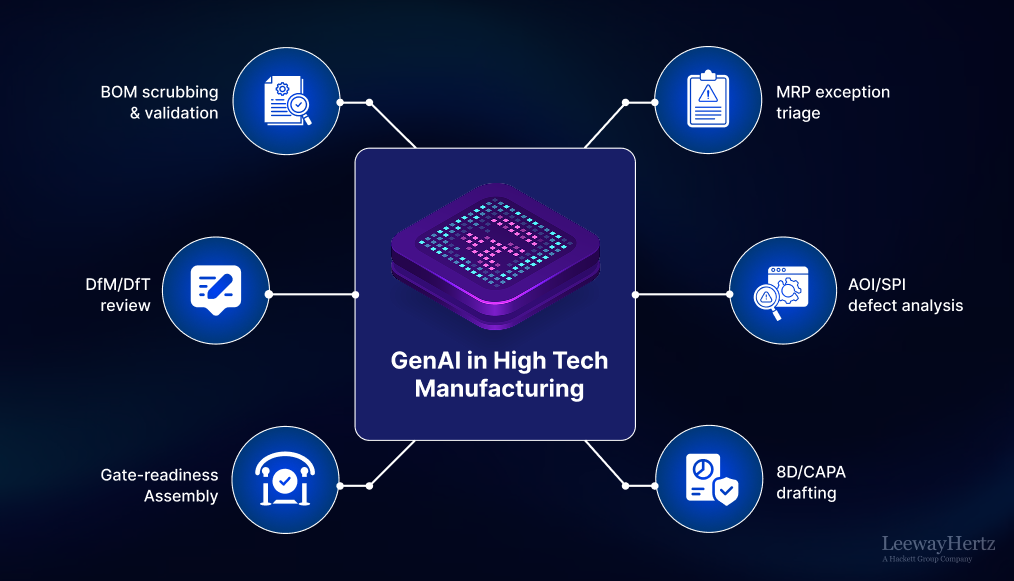
High-tech manufacturing operates on a paradox. While the products themselves rank among the most sophisticated objects humans build, the work of bringing them to volume remains heavily document-driven: datasheets, errata, bills of materials, approved manufacturer lists, gate checklists, control plans, test programs, nonconformance reports, and corrective-action records. Engineers and quality teams spend a substantial portion of their time reading these artifacts, reconciling information, and drafting the next document in the workflow. This is precisely the type of work where generative and agentic AI now delivers tangible value.
The investment trends reflect this opportunity. The broader AI in manufacturing market is projected to grow from $34.18 billion in 2025 to $155.04 billion by 2030, representing a compound annual growth rate of approximately 35% [1]. The agentic AI segment alone reached $5.5 billion in 2025 [2], while McKinsey estimates the generative AI opportunity in manufacturing and supply chains at up to $500 billion [3].
This analysis is targeted at the professionals who run these functions: NPI and component engineers, BOM and configuration owners, SMT and test engineers, supplier-quality and sourcing teams, planners, and quality and field-service groups responsible for closing the operational loop. In the United States, the NIST AI Risk Management Framework serves as the governing reference for trustworthy AI, establishing expectations for human-in-the-loop oversight and accountability for every workflow discussed here.
That is why this insight follows the manufacturing operating model rather than a generic use-case list. It maps each function to its underlying processes and sub-processes, then identifies where a specific AI capability interacts with a specific manufacturing artifact. The appropriate level of granularity is not abstract, such as “AI-driven quality”, but task-focused, for example: “classify AOI and AXI defect images into IPC categories” or “draft the MRB disposition rationale from the control plan.” This is where the work truly resides.
By mapping the operating model in this way, this insight highlights how generative and agentic AI create actionable value at each layer of high-tech manufacturing operations, providing a practical blueprint for adoption across functions, processes, and sub-processes.
- How generative AI is transforming high-tech manufacturing operations
- Why high-tech manufacturing GenAI use cases must be mapped at the sub-process level
- High-tech manufacturing operating model and AI enablement opportunities
- High-value GenAI use cases in high-tech manufacturing
- How agentic AI works in high-tech manufacturing workflows
- How to prioritize GenAI use cases in high-tech manufacturing
- Governance, risk, and responsible AI in high-tech manufacturing
- How ZBrain operationalizes generative AI use cases in high-tech manufacturing
- Future of generative AI in high‑tech manufacturing
How generative AI is transforming high-tech manufacturing operations
Manufacturers have long relied on established digital and statistical systems such as statistical process control (SPC), rule-based automation engines, manufacturing execution systems (MES), enterprise resource planning (ERP) platforms, machine vision systems, and traditional machine learning models. These technologies continue to play a critical role in ensuring operational stability, quality control, and process optimization.
However, generative AI introduces a fundamentally different capability layer. Unlike deterministic systems, generative AI is designed to work with both structured and unstructured information, enabling it to interpret context, generate new content, and support reasoning across complex operational workflows.
Traditional automation systems are rule-driven and execute predefined logic. Machine learning models, by contrast, are primarily designed to predict outcomes, classify data, or detect patterns based on historical datasets. Generative AI expands this landscape by enabling systems to read and interpret technical and operational content, summarize large volumes of information, draft structured documentation, compare specifications, extract insights, and translate complex data into actionable outputs.
When extended with agentic capabilities, generative AI can go beyond content generation to orchestrate multi-step workflows. These agents can retrieve relevant evidence, correlate information across systems, classify operational events such as excursions or nonconformances, generate structured reports, route items for review or approval, and update downstream enterprise systems once decisions are made.
In high-tech manufacturing environments, generative and agentic AI can interpret, synthesize, and generate structured outputs from technical and operational information. This capability is particularly impactful because a significant portion of operational effort is information-intensive and distributed across engineering, quality, supply chain, and compliance functions. Key categories of such work include:
-
Document-intensive processes, including Gerber and ODB++ design files, BOMs, datasheets, routings, PPAP packages, first article inspection (FAI) reports, control plans, and audit documentation, all of which require precise interpretation and traceability
-
Narrative-intensive processes, such as 8D corrective action reports, CAPA documentation, MRB disposition justifications, gate review minutes, yield analysis summaries, and qualification reports that require structured technical storytelling
-
Exception-driven processes, including SPC excursions, AOI and inspection defects, MRP action messages, supply shortages, nonconformance reports, and warranty escalation trends that require rapid triage and prioritization
-
Knowledge-intensive processes, such as the interpretation of industry standards (IPC, J-STD, JEDEC), internal manufacturing specifications, work instructions, and maintenance procedures that require contextual reasoning across domains
-
Workflow-intensive processes, including NPI phase-gate reviews, supplier qualification and corrective actions, engineering change management, and returns and repair workflows that span multiple systems and stakeholders
The most effective uses of generative AI in high-tech manufacturing do not replace human decision-making. Instead, they augment engineering and operational teams by preparing structured inputs, retrieving relevant evidence, generating initial drafts of technical documents, highlighting anomalies or risks, and routing work to appropriate reviewers within governance frameworks. This human-in-the-loop model enables AI to speed up analysis and documentation while qualified personnel retain accountability for final decisions, preserving compliance, traceability, and operational control.
Why high-tech manufacturing GenAI use cases must be mapped at the sub-process level
The phrase “GenAI in manufacturing” is often too broad to guide action. For leaders designing, deploying, and governing AI-enabled operations, the relevant unit of analysis is not the function but the work step. Broad labels such as “GenAI in quality,” “GenAI in supply chain,” or “GenAI in semiconductor fabs” can help plan the strategy, but they rarely provide the precision needed to define data requirements, integration points, control mechanisms, approval workflows, or success metrics.
A more effective approach is to align GenAI use cases with the manufacturing operating model. This ensures that GenAI initiatives are directly traceable to real operational workflows and embedded within existing enterprise structures.
At a practical level, this operating model can be structured into four layers:
-
Function: The highest-level operational or governance domain, such as new product introduction (NPI), semiconductor fabrication, quality management, supply chain operations, or regulatory compliance.
-
Process: A defined workflow within a function that delivers a specific operational outcome, such as design-for-excellence review, yield management, PPAP review, or export classification.
-
Sub-process: A granular, task-level activity that forms part of the broader workflow, such as a DfM analysis, defect classification during inspection review, MRB disposition preparation, or ECCN determination.
-
GenAI-enabled opportunity: The precise intervention point where GenAI adds value, such as extracting structured data from documents, generating technical narratives, classifying exceptions, retrieving relevant standards, or assembling supporting evidence for decision-making.
This hierarchical breakdown is critical because manufacturing environments are inherently governed, standardized, and interdependent. Each workflow is connected to specific regulatory requirements, engineering standards, controlled documents, enterprise systems, and defined decision ownership. As a result, even within the same function, GenAI applications can differ significantly based on the sub-process context.
For example, a GenAI system designed to support 8D excursion report drafting must operate with different inputs, validation rules, and approval flows than one used for PPAP review. Similarly, defect classification in AOI inspection requires a different data structure and decision logic compared to shortage triage in supply chain operations. Maintenance knowledge retrieval, export classification, and MRB disposition support each involve distinct risk levels, stakeholders, and compliance constraints.
Mapping GenAI opportunities at the sub-process level enables organizations to transition from conceptual AI initiatives to execution-ready workflows. It provides the clarity needed to define system integrations, training data requirements, governance controls, and human-in-the-loop checkpoints. Most importantly, it ensures that GenAI solutions are not abstract productivity tools, but operational components embedded within governed manufacturing processes that deliver measurable business value.
Transform high-tech manufacturing workflows
Apply generative and agentic AI across engineering, NPI, quality, supply chain, and compliance to improve productivity, traceability, and speed to decision.
High-tech manufacturing operating model and AI enablement opportunities
The operating model below presents each industry-native function in turn. Each function begins with a short overview, followed by a table mapping its processes and sub-processes to relevant AI enablement opportunities. Each opportunity specifies a capability, the artifact it acts on, and the methodology it employs.
Function 1. Product engineering and R&D
Product engineering and R&D define product requirements and develop the hardware, firmware, and mechanical designs that NPI later industrializes. The work spans requirements management, architecture and trade studies, schematic and PCB design, firmware development, and the design records that anchor every later stage.
Generative AI can support product engineering by extracting and tracing requirements, drafting review comments and design documentation, and synthesizing prior designs and standards into engineer-ready inputs, while design decisions stay with the team.
| Process | Sub-process | Key AI enablement opportunities |
|---|---|---|
| Requirements and architecture | Requirements capture and traceability |
|
| Architecture and design trade studies |
|
|
| Hardware and PCB design | Schematic and design review |
|
| Design documentation |
|
|
| Firmware and embedded software | Firmware requirements and test mapping |
|
| Code review support |
|
The highest-value opportunities in product engineering are requirements traceability, schematic review support, design documentation, and firmware release-note drafting. These workflows are document-heavy and well-suited to AI drafting with engineer review.
An example agentic workflow is requirements traceability. An AI agent can read the customer specification and applicable standards, extract and classify each requirement, map it to a verification method, draft the requirements-traceability matrix, and flag conflicting requirements for engineer review.
Function 2. New product introduction (NPI)
New product introduction owns the gated journey from concept through EVT, DVT, and PVT to mass production, balancing schedule, cost, and manufacturability through the APQP discipline. It manages gate reviews, design-for-excellence checks, prototype builds, and the pilot-to-ramp transition.
Generative AI can accelerate NPI by drafting gate-readiness summaries, tracking APQP deliverables, surfacing manufacturability and cost risks, and drafting FMEA and pilot-run documentation, while gate decisions remain with the review board.
| Process | Sub-process | Key AI enablement opportunities |
|---|---|---|
| NPI gate and APQP management | Gate readiness review and exit criteria tracking |
|
| APQP deliverable tracking |
|
|
| Design for excellence review | Design for manufacturability (DfM) and design for test (DfT) review |
|
| Design for cost and supply (DfC) review |
|
|
| Prototype build and validation | Build documentation and red-line capture |
|
| Design FMEA (DFMEA) development |
|
|
| Pilot run and production ramp | Pilot-run readiness and PFMEA |
|
| Ramp and yield-learning tracking |
|
The highest-value NPI opportunities are gate-readiness drafting, APQP deliverable tracking, DfM and DfT review, DFMEA development, and pilot-run documentation. These workflows are repetitive and document-heavy while keeping gate and RPN decisions with engineers.
An example agentic workflow is gate readiness. An AI agent can read the gate checklist, prior build reports, and open actions, run anomaly detection across yield and supplier-readiness data, draft a gate-readiness summary that flags unmet exit criteria, and route the gate decision memo to the review board.
Function 3. Component and hardware engineering
Component and hardware engineering selects, qualifies, and characterizes the electronic components and reference designs that go into each product, and manages part risk across the lifecycle, including obsolescence, alternates, and supplier change notices.
Generative AI can support component engineering by extracting datasheet parameters, drafting qualification plans and candidate-part rationale, and aggregating lifecycle and change data into risk registers and triage notes for engineer review.
| Process | Sub-process | Key AI enablement opportunities |
|---|---|---|
| Component selection and qualification | Datasheet and parametric evaluation |
|
| Component qualification testing |
|
|
| Alternate and cross-reference qualification |
|
|
| Component change and errata management | PCN and errata triage |
|
The highest-value component-engineering opportunities are datasheet parameter extraction, obsolescence risk registers, alternate qualification, and PCN and errata triage. These workflows are document-heavy and lifecycle-driven.
An example agentic workflow is PCN and errata triage. An AI agent can read an incoming product-change notification, identify the affected parts and products, retrieve the affected designs and qualification records, draft the impact assessment, and route it to the responsible design owner.
Function 4. BOM, configuration, and document management
BOM, configuration, and document management maintain the multi-level bill of materials, approved-manufacturer lists, engineering change records, and controlled documents that keep what is designed, sourced, and built in agreement.
Generative AI can support this function by validating BOMs against approved lists, rolling up compliance declarations, drafting engineering change orders and notices, and managing controlled-document records, with stewardship decisions retained by the owners.
| Process | Sub-process | Key AI enablement opportunities |
|---|---|---|
| BOM creation and maintenance | BOM scrub and AVL / AML reconciliation |
|
| Compliance and declarations roll-up |
|
|
| Engineering change management (ECO / ECN) | Change-request drafting and impact analysis |
|
| Change implementation and cut-in tracking |
|
|
| Document and configuration control (PLM) | Controlled-document management |
|
The highest-value opportunities here are BOM scrub and AML reconciliation, compliance roll-up, ECO drafting and impact analysis, and controlled-document management. These workflows are rules-driven and document-heavy.
An example agentic workflow is drafting engineering change orders. An AI agent can read the change request, identify the affected BOM lines, drawings, and work instructions, build the where-used impact list, flag at-risk work in process, and draft the ECO and ECN for the review board.
Function 5. Process and industrial engineering
Process and industrial engineering designs how the product is built: the work instructions, standardized work, line balance, and process controls that turn a validated design into a repeatable line, without owning the physical equipment itself.
Generative AI can support process engineering by generating work instructions and standardized work, drafting control plans and SPC setup, and supporting kaizen and value stream analysis, while physical line installation stays a hardware activity.
| Process | Sub-process | Key AI enablement opportunities |
|---|---|---|
| Work instruction and standardized work | Work instruction authoring |
|
| Standardized work and poka-yoke design |
|
|
| Line design and balancing | Time study and line balancing |
|
| Layout and material-flow planning |
|
|
| Process control and improvement | Control plan and SPC setup |
|
| Kaizen and value-stream-mapping support |
|
The highest-value process-engineering opportunities are work-instruction authoring, standardized-work drafting, control-plan and SPC setup, and VSM and kaizen support. These workflows convert engineering knowledge into repeatable line documentation.
An example agentic workflow is work-instruction authoring. An AI agent can read the BOM, drawings, and process notes, generate the assembly and inspection work instruction, reference the IPC-A-610 and J-STD-001 workmanship standards, and route the draft to the process engineer for review.
Accelerate AI Solutions Development
Build fully functional solutions from your high-value use cases, based on specific operational needs and enterprise context.
Function 6. SMT and assembly operations
SMT and assembly operations run surface-mount and final-assembly lines, owning the process programs, defect response, traceability, and line performance that turn boards and parts into products.
Generative AI can support these operations by generating process documentation, classifying inspection-image defects, assembling traceability genealogy, and drafting OEE and downtime commentary, while the machines themselves run deterministically.
| Process | Sub-process | Key AI enablement opportunities |
|---|---|---|
| Process engineering and setup | SMT process documentation |
|
| Defect classification and Andon response |
|
|
| Physical assembly execution | Solder paste printing, placement, and reflow execution |
|
| Traceability and genealogy | As-built record and genealogy |
|
| Line performance and continuous improvement | OEE and yield analysis |
|
| Downtime and Andon event review |
|
The highest-value SMT opportunities are process documentation, AOI and AXI defect classification, traceability genealogy, and OEE and downtime commentary. These workflows are high-volume and well-suited to controlled AI.
An example agentic workflow is AOI defect triage. An AI agent can read the captured AOI and AXI inspection images, classify them into IPC defect categories, distinguish false calls from true defects, identify the root cause of a defect spike, and draft an Andon escalation note for operator review.
Function 7. Test engineering
Test engineering designs and sustains the in-circuit, functional, and system-level tests that screen each unit, and turns test data into yield, coverage, and repair decisions.
Generative AI can support test engineering by drafting test plans and coverage matrices, analyzing yield and failure patterns, supporting test-limit and measurement-system analysis, and drafting repair guidance, with limit and disposition decisions retained by engineers.
| Process | Sub-process | Key AI enablement opportunities |
|---|---|---|
| Test development and coverage | Test program and coverage review |
|
| Test fixture and ATE documentation |
|
|
| Test data and yield analysis | Yield and failure-pattern analysis |
|
| Test-limit and Gauge R&R support |
|
|
| Repair and rework loop | Repair diagnosis support |
|
The highest-value test-engineering opportunities are coverage review, yield and failure-pattern analysis, MSA support, and repair diagnosis. These workflows turn test data into engineer-ready decisions.
An example agentic workflow is yield-excursion analysis. An AI agent can read the ATE logs, detect the failing test step and parametric drift, surface the suspect process or lot, draft the yield-excursion summary, and route it to the test engineer for review.
Function 8. Reliability and qualification engineering
Reliability and qualification engineering demonstrate that the product will survive its intended life and environment and meet the certifications required by its markets, through reliability modeling, qualification testing, and certification evidence.
Generative AI can support this function by drafting reliability predictions and test plans, extracting qualification results, analyzing failure mechanisms, and assembling certification evidence, while retaining engineering judgment on every call.
| Process | Sub-process | Key AI enablement opportunities |
|---|---|---|
| Reliability planning and prediction | Reliability prediction and modeling |
|
| Reliability test planning (HALT / HASS / ORT) |
|
|
| Qualification testing and reporting | Qualification test execution support |
|
| Failure mechanism analysis |
|
|
| Product certification and compliance readiness | Certification evidence preparation |
|
The highest-value reliability opportunities are reliability prediction, HALT and HASS planning, qualification reporting, and certification evidence preparation. These workflows are standards-grounded and document-intensive.
An example agentic workflow is certification evidence preparation. An AI agent can read the lab test reports and the applicable standards, assemble the evidence pack against the named clauses, identify open gaps, and draft the certification-readiness status for review.
Function 9. Quality, compliance, and CAPA
Quality, compliance, and CAPA supports the quality system, nonconformance handling, corrective and preventive action, statistical process control, and calibration that keep the product within specification and the organization audit-ready.
Generative AI can support quality by classifying and routing non-conformances, drafting CAPA and MRB documentation, flagging SPC signals, managing calibration records, and assembling audit evidence, while dispositions and closures stay with the board or owner.
| Process | Sub-process | Key AI enablement opportunities |
|---|---|---|
| Nonconformance and CAPA | NCR and MRB disposition |
|
| CAPA investigation and closure |
|
|
| Statistical process control | SPC monitoring and capability |
|
| Metrology and calibration | Calibration scheduling and records management |
|
| Audit and compliance | Audit preparation and evidence retrieval |
|
| Internal audit and finding management |
|
The highest-value quality opportunities are NCR and MRB disposition drafting, CAPA documentation, SPC commentary, calibration management, and audit evidence assembly. These workflows are evidence-heavy and governance-critical.
An example agentic workflow is MRB disposition support. An AI agent can read the nonconformance report, retrieve the specification, control plan, and prior dispositions, draft the use as-is, rework, or scrap rationale, and route the case to the material review board for the disposition decision.
Function 10. Supplier quality and sourcing
Supplier quality and sourcing qualify and monitor the suppliers and contract manufacturers behind every part and board, and own approvals, scorecards, audits, and supplier corrective actions.
Generative AI can support supplier quality by reviewing PPAP and FAI submissions, drafting audit and scorecard documentation, and assembling supplier corrective-action packages, while retaining approval and escalation decisions with the team.
| Process | Sub-process | Key AI enablement opportunities |
|---|---|---|
| Supplier qualification and approval | PPAP and FAI review |
|
| Supplier audit support |
|
|
| Supplier performance and corrective action | Supplier scorecard and risk monitoring |
|
| Supplier 8D and corrective action |
|
The highest-value supplier-quality opportunities are PPAP and FAI review, supplier audit support, scorecard commentary, and supplier 8D drafting. These workflows are document-heavy and recurring.
An example agentic workflow is 8D support for suppliers. An AI agent can read the nonconformance report and prior 8D records, draft the SCAR and 8D problem statement, propose Five-Whys root-cause candidates, and draft the containment-and-corrective-action summary for quality review.
Function 11. Production planning and scheduling
Production planning and scheduling convert demand and material availability into executable build plans and line schedules, from S&OP down to the daily line, balancing capacity, changeovers, and shortages.
Generative AI can support planning by drafting demand and S&OP scenarios, prioritizing MRP exceptions, analyzing clear-to-build shortages, and sequencing build plans, while retaining planner decisions throughout.
| Process | Sub-process | Key AI enablement opportunities |
|---|---|---|
| Sales and operations planning (S&OP) | Demand plan and consensus support |
|
| Supply and capacity balancing |
|
|
| Master scheduling and MRP | Master production schedule and MRP review |
|
| Detailed scheduling and execution | Material shortage and clear-to-build analysis |
|
| Build-plan and changeover sequencing |
|
The highest-value planning opportunities are demand and S&OP scenario drafting, MRP exception prioritization, clear-to-build analysis, and changeover sequencing. These workflows balance large data sets against planner judgment.
An example agentic workflow is clear-to-build analysis. An AI agent can read open orders, on-hand inventory, and supplier commitments, draft a clear-to-build shortage report for each work order, predict lead-time variance for at-risk purchase orders, and draft mitigation options for the planner.
Function 12. Supply chain, logistics, and trade compliance
Supply chain, logistics, and trade compliance plans procurement, manages inventory and incoming materials, moves finished goods, and keeps the flow of parts and products compliant across a multi-tier, multi-country electronics supply base.
Generative AI can support this function by validating purchase-order acknowledgments, analyzing quotes, managing excess and incoming material, and drafting trade-compliance classifications and shipping documents, with compliance decisions retained by the responsible owner.
| Process | Sub-process | Key AI enablement opportunities |
|---|---|---|
| Procurement and order management | Purchase-order and acknowledgment handling |
|
| Supplier negotiation and quote analysis |
|
|
| Inventory and incoming material | Excess, obsolete, and discrepancy handling |
|
| Incoming inspection support |
|
|
| Logistics and trade compliance | Export classification and screening |
|
| Shipping documentation |
|
The highest-value supply chain opportunities are purchase order validation, quote analysis, excess and incoming material handling, export classification, and shipping documentation. These workflows are high-volume and rules-driven.
An example agentic workflow is export classification and screening. An AI agent can read the product and supplier documents, propose the ECCN based on the export-control schedule, run denied-party screening, draft the country-of-origin and HTS classification, and route the package to trade compliance for a decision.
Function 13. Field service, RMA, and sustaining engineering
Field service, RMA, and sustaining engineering handle returns, field failures, warranty, and post-launch design fixes, closing the loop from customer-reported issues back to engineering and the line.
Generative AI can support this function by triaging RMAs and drafting failure-analysis narratives, supporting repair and knowledge work, handling warranty claims, and drafting sustaining engineering changes, with engineering review retained.
| Process | Sub-process | Key AI enablement opportunities |
|---|---|---|
| Returns and field failure analysis | RMA triage and failure analysis |
|
| Knowledge and repair support |
|
|
| Warranty and service operations | Warranty claim handling |
|
| Sustaining engineering | Field issue ECO management |
|
The highest-value field-service opportunities are RMA triage and failure analysis, knowledge and repair support, warranty claim handling, and the field-issue-to-ECO loop. These workflows close the quality loop back to engineering.
An example agentic workflow is RMA triage. An AI agent can read the return record and customer-reported symptoms, classify the failure category, retrieve failure-analysis reports and field history, draft the failure-analysis narrative and likely root cause, and route it for engineer review.
Function 14. Technology, data, cybersecurity, and AI governance
Technology, data, cybersecurity, and AI governance run the manufacturing IT and data backbone, secure the IT and OT environment, and govern the adoption of AI across the plant, ensuring the systems on which other functions rely remain available, compliant, and trustworthy.
Generative AI can support this function by managing master data and integrations, triaging incidents and vulnerabilities, drafting security and incident documentation, and running AI governance intake and monitoring, while retaining security and governance decisions with the owners.
| Process | Sub-process | Key AI enablement opportunities |
|---|---|---|
| Enterprise systems and data management | Master data management (MDM) |
|
| Integration and data-pipeline support |
|
|
| Reporting and analytics enablement |
|
|
| Cybersecurity and IT / OT risk | Vulnerability and patch management |
|
| Security monitoring and incident response |
|
|
| Access review and policy compliance |
|
|
| AI governance and model risk | AI use-case intake and risk classification |
|
| Model and workflow monitoring |
|
The highest-value opportunities here are master-data validation, incident and vulnerability triage, security documentation, and AI governance intake and monitoring. These workflows let the plant scale AI safely.
An example agentic workflow is AI governance intake. An AI agent can collect the proposed use-case details and data sources, classify the risk tier against the governance policy and the NIST AI Risk Management Framework, draft the risk-and-impact assessment and the human-in-the-loop plan, and route the use case through the required reviews.
Accelerate AI Solutions Development
Build fully functional solutions from your high-value use cases, based on specific operational needs and enterprise context.
High-value GenAI use cases in high-tech manufacturing
The GenAI use-case landscape in high-tech manufacturing is broad; however, not all workflows should be prioritized for early adoption. The most suitable initial candidates are typically high-volume, document-intensive, exception-driven, or narrative-heavy processes where GenAI can reliably generate structured drafts, summaries, or recommendations for human validation.
These use cases are particularly valuable because they sit at the intersection of engineering judgment and information processing, where significant time is spent consolidating data, interpreting standards, and preparing structured outputs for review and approval.
| High-value use case | Why it matters |
|---|---|
| BOM scrubbing and validation | Reduces manual reconciliation against the AVL/AML and helps identify compliance gaps, obsolescence risks, and duplicate or non-approved parts early in the lifecycle. |
| DfM and DfT design review | Detects manufacturability and test coverage issues during the design phase, reducing downstream costs and avoiding late-stage engineering changes. |
| Gate-readiness assembly | Aggregates EVT, DVT, and PVT evidence, validates completeness against exit criteria, and prepares structured gate-review summaries and minutes. |
| MRP exception triage | Converts high-volume MRP action messages into prioritized, actionable summaries based on impact, urgency, and supply risk. |
| AOI and SPI defect analysis | Reduces false positives and identifies recurring defect patterns using inspection images and process data already generated on the line. |
| Wafer-map and final-test yield analysis | Accelerates identification of yield excursions by correlating test data, spatial defect patterns, and process signals. |
| PPAP completeness review | Validates supplier submissions against AIAG requirements and flags missing or inconsistent documentation for quality review. |
| MRB disposition support | Compiles nonconformance evidence, retrieves historical precedent, and drafts structured disposition recommendations for board review. |
| 8D and CAPA drafting | Structures failure data into standardized 8D/CAPA formats while engineers focus on root-cause validation and corrective action decisions. |
| ECO impact analysis | Identifies affected BOMs, routings, and work instructions to preserve configuration integrity and traceability across engineering changes. |
| Shipping and receiving document handling | Validates ASNs, invoices, and packing lists against purchase orders to detect discrepancies and prevent logistics errors. |
| Warranty claim adjudication | Verifies claims against entitlement rules and surfaces emerging defect trends based on serial number and date-code analysis. |
| Export classification support | Suggests ECCN classification candidates with supporting rationale for review by licensed compliance personnel. |
| Substance-declaration validation | Checks RoHS, REACH, and conflict-minerals submissions against BOM data to ensure regulatory compliance. |
| Maintenance knowledge support | Enables rapid retrieval of maintenance manuals and procedures while assisting in CMMS work order triage and prioritization. |
GenAI primarily supports the preparation, synthesis, and structuring of information, while engineers and domain experts retain responsibility for validation, interpretation, and final decision-making.
These workflows can reduce cycle time, improve engineering productivity, and raise documentation quality. They also strengthen operational visibility, compliance, traceability, and process discipline across manufacturing operations.
How agentic AI works in high-tech manufacturing workflows
Generative AI is highly effective at performing individual cognitive tasks such as drafting documentation, summarizing engineering records, classifying defects, or retrieving relevant standards and historical data. However, high-tech manufacturing environments, particularly in semiconductor fabrication, electronics assembly, and precision manufacturing, rarely operate as single-step workflows.
Instead, they are composed of tightly coupled, multi-system processes that span PLM, MES, ERP, QMS, and equipment-level data systems. These workflows require coordination across engineering, production, quality, and compliance teams, often under strict traceability and audit requirements.
Agentic AI extends generative AI from task execution to workflow orchestration. It enables a system of coordinated agents that can plan, sequence, and execute multiple steps across enterprise systems while operating within predefined governance and approval boundaries. In manufacturing terms, this shifts AI from being a “document assistant” to becoming a process-aware execution layer embedded within industrial operations.
This distinction is particularly important in high-tech manufacturing, where decisions are data-rich, time-sensitive, and governed by quality and regulatory standards such as ISO 9001, IATF 16949, AS9100, JEDEC, IPC, and internal control plans.
From isolated tasks to orchestrated manufacturing workflows
In traditional systems, each step in a manufacturing workflow is handled independently, and data is extracted, analyzed, and passed manually between teams or systems. Agentic AI compresses this lifecycle by enabling continuous orchestration across the full workflow chain.
For example, in an 8D excursion management workflow within a semiconductor fab or electronics assembly line, the process is not limited to report generation. It typically includes:
-
Detecting SPC violations, yield excursions, or process drift from MES and equipment telemetry
-
Pulling lot genealogy, tool history, and process parameters from fab execution systems
-
Correlating inspection outputs such as wafer maps, AOI images, or test failure logs
-
Identifying likely process steps or toolsets contributing to the deviation
-
Structuring containment actions aligned with quality system requirements
-
Drafting a complete 8D report with evidence-backed reasoning
-
Routing the case through engineering review, MRB, or quality approval workflows
An agentic AI system orchestrates these steps by interacting with multiple systems, standardizing outputs, and maintaining traceability across the workflow. Importantly, it does not replace engineering judgment; instead, it ensures engineers receive a complete, structured, and evidence-backed decision package.
Agentic AI workflows in high-tech manufacturing domains
In industrial environments, agentic AI is best understood as a set of domain-specific orchestration agents, each designed around a controlled manufacturing workflow:
1. NPI and gate-readiness orchestration (EVT / DVT / PVT)
Agentic systems aggregate validation data across design, engineering, and manufacturing systems, including build reports, test yields, reliability data, and open action logs. They then:
-
Map evidence to gate exit criteria
-
Identify missing deliverables or incomplete validation steps
-
Generate structured gate readiness summaries and review packs
-
Prepare decision-ready materials for program and engineering leadership
2. Yield excursion and fab analysis agents
In semiconductor environments, agents operate across high-frequency process data streams:
-
Detect SPC violations and process drift in near real time
-
Retrieve lot history, tool logs, and recipe parameters from MES and equipment systems
-
Correlate defect patterns from wafer maps, metrology, and inspection systems
-
Generate structured excursion summaries for process engineering teams
This enables faster root-cause narrowing in high-complexity fab environments where thousands of variables must be correlated.
3. Defect triage and quality inspection agents
In SMT, PCBA, and semiconductor assembly:
-
Classify AOI, SPI, and X-ray inspection results using historical defect taxonomies
-
Suppress false positives and normalize defect categorization
-
Identify recurring failure modes linked to stencil, placement, reflow, or bonding processes
-
Generate yield-impact summaries for manufacturing and quality engineering
4. MRB (Material Review Board) decision support agents
MRB workflows are highly structured and require strong traceability:
-
Consolidate nonconformance records, inspection data, and engineering inputs
-
Retrieve historical disposition decisions for similar failure modes
-
Prepare structured disposition options (rework, repair, use-as-is, scrap)
-
Generate MRB case summaries with supporting evidence for review boards
5. CAPA and 8D automation agents
These agents operate across production and field failure data:
-
Aggregate failure signals from FRACAS, MES, and warranty systems
-
Structure 8D reports with containment, root cause, and corrective actions
-
Link corrective actions back to PFMEA and control plans for system consistency
-
Ensure alignment with quality system documentation standards
6. MRP and supply chain exception agents
Within ERP-driven planning environments:
-
Classify MRP action messages (expedite, defer, cancel)
-
Consolidate inventory, demand, and capacity constraints
-
Highlight production risk exposure by work order or line
-
Generate planner-ready exception summaries for decision-making
7. Regulatory and compliance orchestration agents
In regulated manufacturing environments:
-
Validate RoHS, REACH, and conflict mineral declarations against BOM data
-
Aggregate supplier compliance submissions
-
Identify missing or inconsistent documentation
-
Prepare structured compliance reports for audit and certification processes
Agentic AI needs strict governance in high-tech manufacturing. Autonomy must be controlled. Human approval is required for MRB decisions, CAPA closure, export classification, and root-cause confirmation. Every workflow should leave a clear audit trail. The record must show data sources, intermediate steps, AI outputs, user reviews, and approvals. Access must also be tightly managed across PLM, MES, ERP, and QMS environments. Decision logic should be traceable and aligned with quality, regulatory, and compliance frameworks. When outputs are low-confidence, incomplete, or conflicting, the system should escalate the case for expert review. These controls allow agents to support complex workflows while accountability remains with qualified engineers, quality owners, and compliance authorities.
Accelerate AI Solutions Development
Build fully functional solutions from your high-value use cases, based on specific operational needs and enterprise context.
How to prioritize GenAI use cases in high-tech manufacturing
Selecting GenAI use cases in high-tech manufacturing should not be driven by novelty or technological appeal. Many organizations make the mistake of prioritizing “interesting” use cases rather than “operationally viable” ones. In practice, successful scaling depends on selecting workflows where GenAI can deliver measurable business impact while operating within the constraints of manufacturing systems, quality standards, and regulatory controls.
High-tech manufacturing relies on tightly controlled processes across PLM, MES, ERP, and QMS systems. This is especially true in semiconductor, electronics, and precision engineering environments. As a result, GenAI use case prioritization must evaluate not only potential value, but also execution feasibility, governance readiness, and integration complexity.
A structured prioritization approach typically evaluates use cases across the following dimensions:
| Prioritization criterion | What manufacturers should evaluate |
|---|---|
| Business value | Evaluate potential impact on core operational KPIs such as productivity gains, cost reduction (e.g., scrap, rework, rework loops), cycle‑time compression, first‑pass yield improvement, and quality outcomes tied to factory performance and product reliability. |
| Workflow fit | Assess whether the work is primarily document‑heavy (e.g., engineering records), knowledge‑intensive (standards and specs interpretation), exception‑driven (SPC excursions, nonconformances), narrative‑centric (8D, CAPA), or highly repeatable, because GenAI excels where structured information needs synthesis across systems. |
| Data readiness | Ensure the necessary data sources, including design files, process logs, inspection images, production records, and tool telemetry, are accessible, consistent, and connected across PLM, MES, ERP, and QMS. Confirm data quality, entity relationships, and permissions early, as poor data readiness is one of the most common barriers to realizing value. |
| Human review model | Determine whether qualified engineers, quality owners, planners, or compliance reviewers exist to validate, approve, correct, or reject GenAI outputs. High‑value GenAI work should augment human expertise, not replace accountability. |
| Control impact | Evaluate how the use case strengthens documentation quality, traceability, adherence to internal and industry standards (IPC, JEDEC, ISO/IATF, etc.), audit readiness, and exception tracking. Workflows that improve control outcomes are better GenAI candidates. |
| Regulatory sensitivity | Identify whether the workflow touches regulated domains such as export control (ECCN/ITAR/EAR), product safety, substance compliance (RoHS/REACH/conflict minerals), or quality‑system records. These require tighter governance layers and clear human checkpoints. |
| Integration complexity | Consider how many systems need to be integrated (PLM, MES, ERP, QMS, SCM) and how many distinct approval paths are involved. Lower integration complexity generally reduces implementation risk and shortens time‑to‑value. |
| Scalability | Assess whether the use case pattern is reusable across product lines, manufacturing sites, plants, or business units. Prioritizing scalable opportunities accelerates broader GenAI adoption and maximizes ROI. |
Practical guidelines for prioritization
-
Balance value and feasibility: Prioritize workflows that combine strong measured business impact with feasible execution given current data, systems, and governance readiness. Scoring frameworks that weigh business value and feasibility are a common best practice in AI adoption programs.
-
Start with bounded, human-centered workflows: Early focus should be on clear, repeatable GenAI augmentation patterns with well-defined scope and easy human oversight.
-
Build organizational momentum: Initial wins build confidence, surface data gaps early, and lay foundations for more complex automation later.
A practical first wave of GenAI use cases in high-tech manufacturing often includes examples such as BOM scrubbing and validation, PPAP completeness review, AOI and SPI defect classification, and MRP exception triage. These workflows share clear boundaries, repeatable steps, and natural human review points. The GenAI assists with drafting, evidence assembly, and recommendation generation, while qualified engineers or planners retain decision authority.
More sensitive or governance‑intensive use cases
Certain high‑impact GenAI applications should be staged for later adoption, accompanied by stronger governance controls:
-
Final disposition of nonconforming material (MRB closure decisions)
-
Export classification determinations and ECCN decisions
-
Product safety certification and market compliance sign‑offs
-
Engineering root‑cause decisioning in cross‑domain failure analysis
These workflows are strategically important but require clear accountability boundaries, stronger audit trails, and more rigorous model explainability before being delegated to production.
Accelerate AI Solutions Development
Build fully functional solutions from your high-value use cases, based on specific operational needs and enterprise context.
Governance, risk, and responsible AI in high-tech manufacturing
Generative AI in high-tech manufacturing must operate within the organization’s established governance, quality management, and control frameworks. In regulated and precision-driven environments such as semiconductor fabrication, electronics assembly, and advanced manufacturing, AI systems cannot function as standalone tools; they must be embedded within existing operational and compliance structures.
A foundational principle is clear accountability. GenAI can support decision-making by preparing, analyzing, and structuring information, but the responsibility for final decisions must remain with qualified engineers, quality owners, or compliance authorities. This is especially critical for decisions that directly impact product quality, yield, safety, regulatory compliance, or customer reliability.
Modern AI governance approaches, including frameworks such as the NIST AI Risk Management Framework (AI RMF), emphasize structured risk management across the AI lifecycle, encompassing governance, mapping, measurement, and continuous risk management. In manufacturing contexts, this aligns naturally with existing quality systems such as ISO 9001, IATF 16949, AS9100, and industry-specific controls in semiconductor and electronics manufacturing.
Key governance requirements in high-tech manufacturing GenAI systems
To ensure safe, compliant, and scalable deployment, GenAI systems in manufacturing environments must incorporate the following governance controls:
-
Human review for disposition decisions, root-cause confirmations, export classifications, product-safety sign-off, and regulatory filings, ensuring that all high-impact engineering and compliance decisions remain under qualified human authority.
-
Source-grounded outputs that cite or link back to approved specifications, standards, drawings, and controlled records across PLM, MES, ERP, and QMS systems, ensuring technical correctness and audit readiness.
-
Audit trails that capture inputs, outputs, prompts, model versions, reviewer actions, approvals, rejections, and downstream system updates, enabling full traceability across manufacturing and quality workflows.
-
Role-based access control so GenAI only retrieves information that the user and workflow are authorized to access, including controlled engineering data, supplier records, and export-restricted technical information.
-
Data protection controls for design files, process recipes, test data, customer information, and export-controlled technical assets, ensuring confidentiality and IP protection across the AI lifecycle.
-
Model and agent monitoring for accuracy, completeness, drift, bias, latency, adoption, and exception rates to ensure consistent performance in production-scale manufacturing environments.
-
Escalation procedures for low-confidence outputs, conflicting interpretations of standards, missing evidence, or safety- and compliance-sensitive scenarios requiring expert review and intervention.
-
Third-party and vendor risk review for AI platforms, models, infrastructure, and integrations, ensuring security, compliance, and IP protection across the external AI ecosystem.
-
Alignment with the quality management system (ISO 9001, IATF 16949, AS9100), export-control requirements (EAR, ITAR), substance compliance (RoHS, REACH), and the NIST AI Risk Management Framework, ensuring regulatory alignment and operational consistency.
Governance should not be treated as a blocker. It is the foundation that enables GenAI to be safely operationalized in high-tech manufacturing environments. A well-governed GenAI workflow enhances transparency, strengthens documentation discipline, and improves cross-functional consistency across plants and processes. It also reinforces clear accountability in engineering and quality decisions, delivering significantly more control and reliability than unmanaged, manual processes.
How ZBrain operationalizes generative AI use cases in high-tech manufacturing
Identifying use cases is only the first step. High-tech manufacturing organizations need a controlled way to design, build, validate, deploy, govern, and scale generative AI workflows across product design, engineering change management, component sourcing, supplier quality, manufacturing, test and inspection, demand planning, supply chain, warranty and returns, field service, compliance management, commercial operations, and enterprise reporting.
This is where ZBrain helps.
ZBrain is an end-to-end AI enablement platform that supports this lifecycle through four connected stages: ZBrain Analyzer, ZBrain Design, ZBrain Solution Builder, and ZBrain Governance. The platform provides a governed path from use-case analysis to deployed agentic workflows while maintaining policies, permissions, approval points, monitoring, and runtime evidence.
ZBrain Analyzer
ZBrain Analyzer helps teams examine selected high-tech manufacturing processes, identify generative AI opportunities, and document the business context, systems, data, artifacts, roles, controls, and review requirements needed to evaluate each use case.
ZBrain Design
ZBrain Design creates a build-ready technical design for the selected use case. It generates the business requirements document, functional requirements, user journeys, architecture, workflow logic, data specifications, integration context, and governance considerations needed before development begins.
ZBrain Solution Builder
ZBrain Solution Builder enables teams to create, configure, and validate governed generative AI workflows for high-tech manufacturing processes based on the technical design developed in ZBrain Design. It supports testing across routine, exception, engineering, quality, and control scenarios before deployment.
ZBrain Governance
ZBrain Governance applies policies, access controls, human approval requirements, monitoring, and traceability throughout workflow execution. It provides guardrails, approval gates, escalation controls, kill switches, and audit trails to help organizations maintain oversight of AI outputs, reviewer actions, exceptions, and authorized system updates.
Accelerate AI Solutions Development
Build fully functional solutions from your high-value use cases, based on specific operational needs and enterprise context.
Future of generative AI in high‑tech manufacturing
The future of generative AI in high-tech manufacturing will be defined by integration, not isolated experimentation. As AI becomes part of product development, operations, supply chains, and enterprise planning, it will move from tactical support to a core layer of the industrial operating model.
In the near term, most initiatives will continue to begin with focused pilots such as engineering content generation, defect analysis, knowledge retrieval, and exception triage. Over time, these pilots will mature into connected workflows across MES, PLM, ERP, QMS, and supply chain systems.
This shift will change how manufacturers use AI. Instead of relying on standalone chat tools, teams will increasingly use industrial copilots and agentic workflows to synthesize cross-system data, guide operators in real time, coordinate multi-step processes, and prepare decision-ready outputs for engineers, planners, and quality teams.
Several application areas will shape this next phase. In engineering, GenAI will support generative design, manufacturability analysis, and design optimization against cost, performance, and compliance constraints. In operations, it will move beyond prediction to recommend corrective actions, draft work plans, and connect maintenance decisions with scheduling and inventory systems.
Quality teams will also benefit from more integrated intelligence. Multimodal AI will combine sensor data, inspection outputs, test logs, and process records to explain anomalies and narrow root-cause hypotheses. Supply chain teams will use GenAI to synthesize internal production signals with external market data, helping them model disruption scenarios and prepare mitigation options earlier.
Documentation will become more dynamic as well. SOPs, work instructions, compliance records, and audit evidence can be updated from actual execution data, creating living knowledge systems that remain aligned with plant operations.
Smart factories and human-AI collaboration
-
As factories become more connected, GenAI will increasingly appear in operator-assist tools and frontline decision-support systems. Natural-language interfaces can help teams diagnose production issues, retrieve procedures, and respond to exceptions without searching across disconnected systems.
The human role will remain central. Engineers, planners, operators, and quality professionals will use AI to reduce repetitive analysis and documentation effort, while focusing more time on judgment, innovation, escalation, and accountable decisions.
Strategic implications for manufacturers
-
For manufacturers, the strategic question is no longer whether GenAI can improve isolated tasks. The larger opportunity is to embed it into the operating model so that engineering, quality, planning, and supply chain teams work from faster, more complete, and better-structured information.
Organizations that treat GenAI as a governed capability rather than a point solution will be better positioned to improve resilience, shorten response times, and adapt to changing market and production conditions. Competitive advantage will come from disciplined integration, clear accountability, and consistent reuse across functions.
In high-tech manufacturing, GenAI will become most valuable when it is woven into daily operations rather than added as a separate tool. It will support engineers, operators, planners, and quality teams by interpreting complex data, coordinating workflow steps, and surfacing actionable insights.
This future still depends on human authority. AI can accelerate analysis and prepare recommendations, but governance, accountability, and final decisions must remain with qualified professionals.
By advancing from reactive analytics to real‑time prescriptive intelligence, GenAI will help manufacturers navigate uncertainty, scale operational excellence, and unlock new levels of agility and innovation.
End note
High-tech manufacturing has long been defined by precision, discipline, and control. With GenAI, the next step is not to automate judgment, but to reduce the documentary burden that surrounds it. Critical processes such as design release, production readiness, quality review, supplier control, and audit preparation depend on dense, complex technical records. GenAI can help interpret, reconcile, and structure this information, allowing engineers and quality teams to focus on decisions rather than the effort required to document them.
In this context, GenAI must remain focused and well-bounded. Its role is to prepare evidence, organize information, and support governed workflows, while engineers, quality leaders, review boards, and compliance owners retain authority over final decisions. The real advantage will come from disciplined application across the operating model. Manufacturers that embed GenAI into transparent, reviewable workflows will be best positioned to scale adoption without compromising control, accountability, or trust.
From use case to governed, scalable AI. Move beyond isolated pilots and embed AI into your manufacturing operating model with clear human review, audit trails, and measurable ROI across functions. Explore ZBrain Builder!
Author’s Bio


Akash's ability to build enterprise-grade technology solutions has garnered the trust of over 30 Fortune 500 companies, including Siemens, 3M, P&G, and Hershey's. Akash is an early adopter of new technology, a passionate technology enthusiast, and an investor in AI and IoT startups.

Transform Enterprise Processes with AI
Whether you have a defined use case or a process you want to improve, we design and build AI solutions that address operational gaps, enhance existing capabilities, and integrate with your enterprise data, systems, and workflows.
Start a conversation by filling the form
Once you let us know your requirement, our technical expert will schedule a call and discuss your idea in detail post sign of an NDA.
All information will be kept confidential.
FAQs
What is the difference between generative AI and agentic AI in a high-tech manufacturing domain?
Generative AI handles single cognitive tasks: drafting an 8D narrative, summarizing a batch of AOI results, or assembling a gate-readiness pack from build reports. Agentic AI coordinates the multi-step, multi-system workflows that dominate fabrication facilities and electronics assembly environments, for example, detecting an SPC excursion in the MES, pulling lot genealogy and tool history, correlating wafer map or AOI signatures, drafting the excursion summary, and routing it for engineering review. Predictive and pattern-detection models remain distinct, flagging yield drift, parametric trends, and recurring defect modes before an engineer or quality owner makes a decision.
Why does GenAI in high-tech manufacturing have to be mapped at the sub-process level?
Because “GenAI in quality” or “GenAI in the fab” is too coarse to design, integrate, or govern. Each workflow is wired to specific standards (IPC, J-STD, JEDEC), controlled documents, enterprise systems, and a named decision owner, so the data, validation rules, and approval path for 8D excursion drafting differ from those for PPAP review or ECCN determination. Mapping to the sub-process is what defines the data dependencies, system integrations, human-in-the-loop checkpoints, and measurable success criteria that turn a concept into an execution-ready workflow.
Where can high-tech manufacturers realize early value from AI?
The earliest wins appear where large, repetitive review queues meet mature engineering data. Product engineering and NPI use AI for requirements traceability and EVT/DVT/PVT gate-readiness assembly. SMT, test, and quality use it to classify AOI, SPI, and AXI defects, analyze wafer map and final test yield, and draft CAPA and MRB documentation. Supplier quality, planning, and supply chain apply it to PPAP review, MRP exception triage, and export classification. In each case, the AI prepares evidence and drafts, while engineers and quality owners make the decision.
Which AI use cases matter most in high-tech manufacturing?
The most valuable use cases sit at the intersection of engineering judgment and information processing, where time goes into interpreting standards and assembling structured outputs for review.
- NPI and gate readiness: Aggregate EVT, DVT, and PVT evidence, validate completeness against exit criteria, and draft gate-review summaries, while the review board holds the pass or hold decision.
- Inspection and yield analysis: Classify AOI, SPI, and AXI defect images, suppress false calls, and correlate yield excursions across wafer maps, metrology, and test logs to narrow root cause faster.
- Quality, compliance, and CAPA: Draft 8D and CAPA records, compile MRB disposition evidence with historical precedent, and assemble audit packs against ISO 9001 or IATF 16949 clauses.
- Supplier quality: Review PPAP and FAI submissions against AIAG requirements, draft supplier scorecards, and structure SCAR and 8D packages.
- Planning and supply chain: Triage MRP action messages by impact and supply risk, draft clear-to-build shortage reports, and validate ASNs, invoices, and packing lists against purchase orders.
- Trade and substance compliance: Propose ECCN candidates with rationale, run denied-party screening, and validate RoHS, REACH, and conflict-minerals declarations against the BOM.
How do manufacturers keep AI safe with human review?
High-impact decisions stay with qualified authorities. AI can compile nonconformance evidence and draft an MRB disposition, but the material review board makes the call on whether to use it as is, rework it, or scrap it. A quality unit approver signs off on CAPA closure and batch disposition before any release change. The NPI review board owns the gate decision after AI drafts the readiness summary. Export classification and ECCN determinations are confirmed by licensed compliance personnel, and engineering root cause confirmation remains with the responsible engineer. Source-grounded outputs and full audit trails keep every draft traceable.
How should manufacturing teams prioritize AI use cases?
Manufacturing teams should begin with a clearly defined workflow bottleneck rather than a model-first initiative. The strongest early candidates are high-volume, document-intensive, or exception-driven tasks with accessible source data and an established human review owner. BOM scrubbing, PPAP completeness review, AOI and SPI defect classification, MRP exception triage, and 8D drafting are practical starting points because they support existing decisions without shifting accountability. More sensitive workflows, including MRB closure, export determinations, and product-safety sign-off, should follow later once stronger audit trails, validation controls, and explainability are in place.
How does ZBrain support high-tech manufacturing AI programs?
ZBrain provides an end-to-end AI enablement platform for high-tech manufacturing organizations to identify, design, validate, deploy, govern, and scale generative AI workflows across product design, engineering change management, component sourcing, supplier quality, manufacturing, test and inspection, demand planning, supply chain, warranty and returns, field service, compliance management, commercial operations, and enterprise reporting.
- ZBrain Analyzer: Helps teams examine selected high-tech manufacturing processes, identify generative AI opportunities, and document the business context, systems, data, artifacts, roles, controls, KPIs, and review requirements needed to evaluate each use case.
- ZBrain Design: Converts selected use cases into build-ready technical designs, including business requirements, functional requirements, user journeys, architecture, workflow logic, data specifications, integration context, approval points, and governance considerations.
- ZBrain Solution Builder: Enables teams to create, configure, and validate governed generative AI workflows based on the design developed in ZBrain Design. It supports testing across routine, exception, engineering, quality, and control scenarios before deployment.
- ZBrain Governance: Applies policies, access controls, human approval requirements, monitoring, traceability, escalation controls, kill switches, and audit trails throughout workflow execution.
ZBrain’s role is enablement rather than autonomous decision-making. It helps define where generative AI assists, augments, or acts within high-tech manufacturing workflows, while final approvals and risk-bearing decisions remain with accountable roles across product engineering, quality, compliance, manufacturing, supply chain, sourcing, field service, warranty, commercial, and enterprise operations.
How can a high-tech manufacturer start with AI without over-investing?
Select one constrained workflow with a defined backlog and an established review owner. A suitable initial pilot could involve classifying AOI defects or drafting 8D documentation using existing systems and documented procedures, executed in shadow mode against live records so that outputs can be compared with the team’s current deliverables. Track cycle time and review rework before expanding the scope; scale only after data lineage is documented and the quality unit accepts the validation evidence. Early, well-bounded successes help expose data gaps and build the confidence required for more complex orchestration over time.
How should manufacturers measure ROI from GenAI in high-tech manufacturing?
ROI should be measured against the workflow baseline, not the model output alone. Useful measures include:
- Cycle-time reduction in reviews, reports, and exception handling
- Lower rework in documentation, quality records, and supplier submissions
- Improved first-pass completeness of audit, gate, CAPA, and PPAP packages
- Reduced manual effort in evidence gathering, summarization, and routing
- Better visibility into risks, bottlenecks, and recurring issues
The business case is strongest when these gains can be tied to named KPIs, approved data sources, and human-reviewed outcomes.
Insights
AI in Account Management: RevOps Use Cases, Workflows, and Operating Model
AI creates the most value in account management when it is applied to workflows that require repeated analysis, information consolidation, structured decision preparation, and coordination across revenue teams.
AI in Payroll Operations: Use Cases Across Operating Model
AI in payroll operations is about improving payroll accuracy, accelerating exception handling and strengthening compliance through governed, evidence-based workflows with human oversight.

AI for contract management: Use cases, solution and implementation
AI-based contract management involves utilizing Artificial Intelligence (AI) technologies to optimize and streamline the processes involved in drafting, organizing, and overseeing contracts.