
Generative AI: Use cases, applications, solutions and implementation
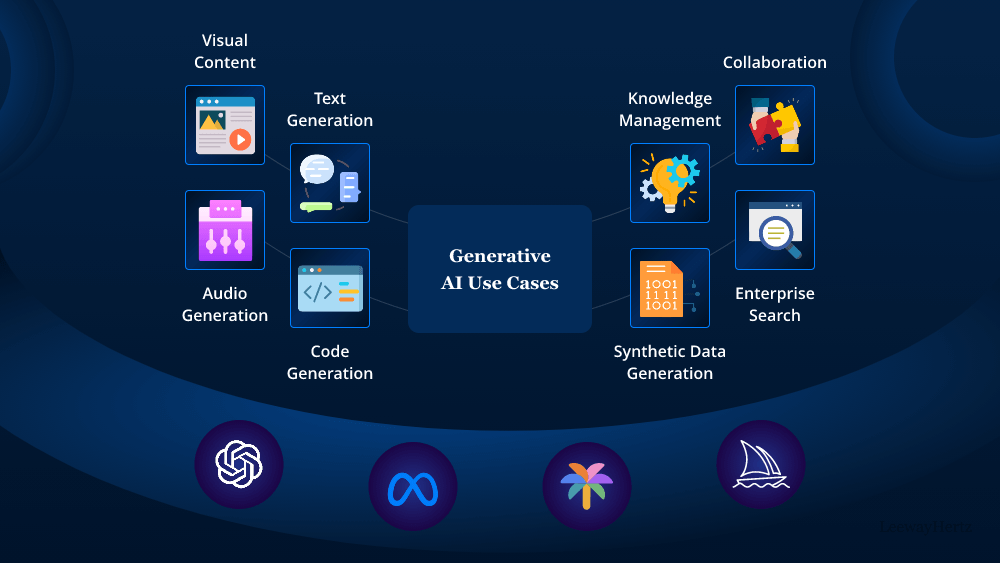
Generative AI demonstrates versatile applications across diverse industries, leveraging its capacity to create novel content, simulate human behavior, and generate innovative outputs based on learned patterns.


Generative AI for recruitment and talent acquisition: Approaches, use cases, benefits and future outlook
Integrating generative AI into recruitment and talent acquisition can take different forms, each offering unique benefits based on a company’s resources, needs, and goals.

GenAI in Customer Success: Integration, Use Cases, Challenges, ROI, and Future Trends
Generative AI is shaping customer success by enabling personalized, proactive engagement, improving team productivity, and scaling global support, all of which drive customer satisfaction and business growth.

Generative AI in healthcare: Integration, use cases, challenges, ROI, and future outlook
The integration of generative AI in healthcare is more than just a technological upgrade—it’s a pivotal transformation in how care is delivered and managed.

Generative AI in internal audit: Importance, use cases, implementation strategies and future trends
Generative AI significantly impacts internal audit practices by enhancing risk evaluation, monitoring compliance, and boosting operational efficiency.

Generative AI in hospitality: Enhancing guest experience and operational efficiency
Hospitality is one of the industries best suited to generative and agentic AI because hospitality work sits at the intersection of guests, documents, data, service standards, exceptions, and around-the-clock operational execution.

Decision intelligence: Benefits, applications, implementation, and future trends
Decision Intelligence (DI) is a data-driven approach to decision-making that leverages advanced analytics, machine learning, and artificial intelligence (AI) to empower organizations with actionable insights.

How AutoML is transforming AI: The Concept of ‘AI Creating AI’
AI creating AI” through AutoML is transforming the field, expanding beyond human-led processes to make AI development more accessible and efficient.

Structured outputs in LLMs: Definition, techniques, applications, benefits
Structured outputs in large language models (LLMs) refer to the ability of these models to generate responses in specific, predefined formats rather than just free-form text.

Causal AI: Importance, use cases, benefits, challenges and implementation strategies
Causal AI is a branch of artificial intelligence focused on understanding and determining cause-and-effect relationships rather than merely identifying patterns or correlations.

ReAct Agents vs Function Calling Agents
ReACT and function calling agents represent two distinct but powerful approaches to extending the capabilities of LLMs, each with its own strengths and weaknesses.

Composite AI: Benefits, applications, implementation strategies, best practices, and future prospects
Composite AI refers to an advanced AI approach that integrates multiple artificial intelligence (AI) technologies to create a more sophisticated, flexible, and intelligent system.

Advanced RAG: Architecture, techniques, applications and use cases and development
Advanced RAG builds upon the basic principles of naive RAG by incorporating more sophisticated techniques to enhance retrieval accuracy and contextual relevance.


Follow Us


